Spice Comparisons · Comparison
Chives vs. Green Onions: Species, Flavor, Nutrition and Swaps
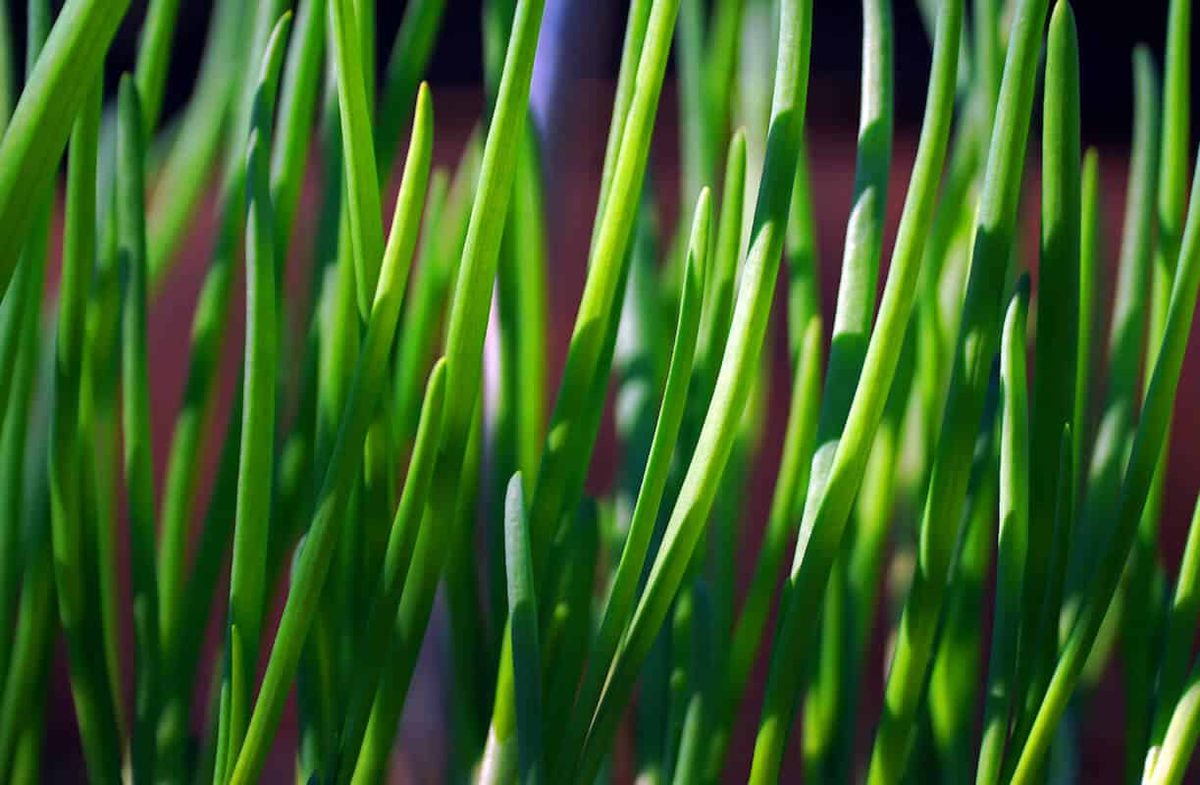
Chives and green onions are both alliums with hollow green leaves, and they share a job on the plate: a fresh onion note without raw onion’s bulk. They are different plants. Chives are Allium schoenoprasum, a perennial herb,12 and their thin leaves are almost always added raw, at the end.3 Green onions, also sold as scallions or spring onions, are most often Allium fistulosum, though some are young bulb onions, Allium cepa.4 Their thicker leaves and white bases can be cooked or eaten raw.5 For a garnish they swap easily; in a cooked dish they don’t.
Side by side
| Chives | Green onions (scallions) | |
|---|---|---|
| Species | Allium schoenoprasum1 | Most often Allium fistulosum; some Allium cepa, the bulb onion, harvested young4 |
| Family | Amaryllidaceae1 | Amaryllidaceae (Kew);6 PROSEA, using an older system, puts it in Liliaceae5 |
| Native range | Temperate northern hemisphere (Kew)1 | A. fistulosum: known only in cultivation, from China (Kew);6 probably northwestern China (PROSEA)5 |
| Plant | Perennial; thin, tubular leaves in clumps72 | Leaves hollow and round in cross-section, 1.0–2.5 cm wide;5 usually no true bulb52 |
| Part used | Leaves; the flowers are edible too3 | Green tops and the white bases (pseudostems); in Java, whole plants5 |
| Flavor | Mild onion (UW-Madison Extension; Iowa State)32 | “Not very strong” odor, chemically related to bulb onion’s (PROSEA)5 |
| How it’s used | Chopped and sprinkled on just before serving3 | Raw in salads, as an herb in soups, and as a cooked vegetable5 |
| Weight of 1 tablespoon, chopped | 3 g8 | 6 g (tops and bulb)9 |
| Vitamin K, per 100 g | 213 µg8 | 207 µg9 |
| Vitamin A (RAE), per 100 g | 218 µg8 | 50 µg9 |
| Vitamin C, per 100 g | 58.1 mg8 | 18.8 mg9 |
| Grown as | A perennial that comes back every year2 | Mostly grown for green tops, since Welsh onions don’t usually form a bulb2 |
The nutrient figures are USDA’s for raw chives and for raw scallions including the bulb, so the scallion row is not tops alone.
Names: what “green onion” means
Green onion, scallion and spring onion are regional names for the same thing. Oregon State University’s vegetable guide says green bunching onions go by all three names, and that today they are most often A. fistulosum, though a considerable amount of A. cepa, the regular bulb onion, is still grown for green onions.4 Iowa State adds that almost any onion grown for its green tops can be called a bunching onion or scallion.2 PROSEA’s English names for A. fistulosum are Welsh onion, Japanese bunching onion and spring onion.5
A widely repeated claim says green onions are “mature scallions.” The sources above treat the names as interchangeable, not as stages of growth.
Chives are a separate species. Iowa State notes that chives are usually treated as an herb, while other onions are treated as vegetables.2 Garlic chives are another plant again; see garlic chives vs. chives.
How they differ in the plant
Size and shape. Britannica describes chives as growing in clumps of thin, tubular leaves.7 PROSEA gives A. fistulosum leaves as hollow, circular in cross-section and 1.0 to 2.5 cm across.5 We found no published diameter for chive leaves.
The base. Both are bulb-forming plants in Kew’s terms (bulbous geophytes),16 but neither makes the large bulb of an onion. PROSEA calls the A. fistulosum bulb indistinct, passing gradually into the stem, and notes that A. cepa has a much better-developed bulb.5 Iowa State says Welsh onions don’t typically produce a bulb, which is why they are grown for their tops.2 Oregon State notes that some A. fistulosum types develop a slight swelling at the base.4
Harvest. Chives are perennials that come back every year, and Iowa State says the young leaves can be cut any time during the growing season.2 Green onions are usually pulled and sold whole, in bunches, while chives are snipped and left to regrow; that contrast is our observation.
Flavor
UW-Madison Extension describes chives as having a mild onion flavor, more pungent in hotter weather.3 PROSEA says the odor of Welsh onion is not very strong and is chemically related to the odor of bulb onion, deriving from volatile allyl sulfides.5 No study we found measures the two side by side, so neither source settles which is stronger. A widely repeated claim says chives are far more potent than green onions; the extension guides that publish a swap treat them as equal by volume (see below).1011
In the kitchen, chives read as gentle and grassy-oniony, and green onion tops similar but a little sharper, with the white base closer to a mild onion. That is our description.
Cooking
Chives belong at the end. UW-Madison Extension says chive leaves are usually chopped and sprinkled on food just before serving.3 LSU AgCenter lists chives among the delicate herbs to add in the last minute or two, since prolonged heat costs flavor and aroma,12 and America’s Test Kitchen counts chives among the delicate herbs whose flavor compounds are more volatile.13 Britannica lists eggs, soups, salads and vegetables as their common uses,7 and they are one of the French fines herbes, with parsley, tarragon and chervil.14
Green onions can take heat. PROSEA describes the thick, blanched pseudostems eaten as a pot herb (cooked) in East Asia, the green leaves used in salads or to flavor soups, and in Java whole plants steamed or briefly grilled.5 By common practice they go into stir-fries, fried rice, braises and pancakes, with the greens often held back as a garnish.
Nutrition and warfarin
Per 100 g, USDA data show chives with more vitamin A and C than scallions, and about the same vitamin K (213 µg against 207 µg).89 Nobody eats 100 g of chives, though. A tablespoon of chopped chives weighs 3 g and a tablespoon of chopped scallions 6 g,89 so by our arithmetic a tablespoon gives about 6 µg of vitamin K from chives and 12 µg from scallions, about 5% and 10% of the 120 µg Daily Value.15
That matters only to people on the blood thinner warfarin. MedlinePlus lists scallions (green onions) among the foods that can change how warfarin works, and advises not avoiding them but keeping the amount small and steady.16 The NIH Office of Dietary Supplements likewise says to get about the same amount of vitamin K each day.17 A garnish is not the concern; a big scallion-heavy dish on some days and not others might be. Ask the prescriber.
Can one stand in for the other?
| Swap | Starting amount | Treatment | Notes |
|---|---|---|---|
| Green onion tops for chives (raw garnish, dips) | 1 to 1 by volume, finely chopped | Attributed | NDSU and NMSU Extension both give 2 teaspoons finely chopped green onion tops for 2 teaspoons chives;1011 A Couple Cooks gives 1 tablespoon for 1 tablespoon18 |
| Chives for green onions (raw garnish) | Same volume | Method | No published ratio found |
| Chives for green onions (cooked) | Not recommended | Method | Chives lose flavor with long heat;1213 add them at the end instead |
Green onions for chives. The three sources agree on a straight swap by volume.101118 Use the green tops, sliced as thin as you can; see chives substitutes for more.
Chives for green onions. No source gives a ratio. For a raw garnish, start with the same volume and taste. If the green onions are meant to cook in a stir-fry or braise, chives won’t hold up: stir them in at the end, or use another allium. That is our judgment, based on the heat guidance above.
A widely repeated rule says you need six times as many chives to replace green onions, and a sixth as much green onion to replace chives. We found no source for it, and the extension guides’ 1:1 swap contradicts the second half.
What isn’t known
- No study compares the flavor compounds or pungency of chives and green onions directly. We found no published analysis of chive flavor chemistry.
- No source publishes a ratio for using chives in place of green onions.
- No published leaf diameter for chives was found.
- USDA’s scallion figures include the bulb, so they don’t describe green tops alone.
Related
- Chives, the full profile, and chives substitutes
- Garlic chives vs. chives and garlic chives
- How to dry chives
- Fines herbes and fines herbes substitutes
Footnotes
-
Allium schoenoprasum L., Plants of the World Online, Royal Botanic Gardens, Kew. powo.science.kew.org · Reference work ↩ ↩2 ↩3 ↩4 ↩5
-
Cynthia Haynes, “The Other Onions”, Iowa State University Extension and Outreach, 2024. yardandgarden.extension.iastate.edu · Reference work ↩ ↩2 ↩3 ↩4 ↩5 ↩6 ↩7 ↩8 ↩9 ↩10
-
Susan Mahr, “Chives, Allium schoenoprasum”, University of Wisconsin-Madison Division of Extension, 2026. hort.extension.wisc.edu · Reference work ↩ ↩2 ↩3 ↩4 ↩5 ↩6
-
“Onions, Green Bunching”, Oregon Vegetables, Oregon State University, 2010. agsci.oregonstate.edu · Reference work ↩ ↩2 ↩3 ↩4
-
L.P.A. Oyen and Soenoeadji, Allium fistulosum, Plant Resources of South-East Asia (PROSEA). uses.plantnet-project.org · Reference work ↩ ↩2 ↩3 ↩4 ↩5 ↩6 ↩7 ↩8 ↩9 ↩10 ↩11 ↩12 ↩13
-
Allium fistulosum L., Plants of the World Online, Royal Botanic Gardens, Kew. powo.science.kew.org · Reference work ↩ ↩2 ↩3
-
“Chive”, Encyclopaedia Britannica, 2026. britannica.com · Reference work ↩ ↩2 ↩3
-
Chives, raw (FDC ID 169994), USDA FoodData Central. fdc.nal.usda.gov · Regulator ↩ ↩2 ↩3 ↩4 ↩5 ↩6
-
Onions, spring or scallions (includes tops and bulb), raw (FDC ID 170005), USDA FoodData Central. fdc.nal.usda.gov · Regulator ↩ ↩2 ↩3 ↩4 ↩5 ↩6
-
Julie Garden-Robinson, Ingredient Substitutions (FN198), NDSU Extension, 2018. ksre.ksu.edu · Reference work ↩ ↩2 ↩3
-
In a Pinch Ingredient Substitution (E-131), NMSU Cooperative Extension, 2016. pubs.nmsu.edu · Reference work ↩ ↩2 ↩3
-
“Flavorful Herbs”, LSU AgCenter. lsuagcenter.com · Reference work ↩ ↩2
-
“Science: Substituting Dried Herbs for Fresh”, America’s Test Kitchen. americastestkitchen.com · Publication ↩ ↩2
-
“Fines herbes”, Encyclopaedia Britannica. britannica.com · Reference work ↩
-
Daily Value on the Nutrition and Supplement Facts Labels, U.S. Food and Drug Administration. fda.gov · Regulator ↩
-
“Taking warfarin”, MedlinePlus, U.S. National Library of Medicine. medlineplus.gov · Regulator ↩
-
Vitamin K: Fact Sheet for Consumers, NIH Office of Dietary Supplements. ods.od.nih.gov · Regulator ↩
-
Sonja Overhiser, “Best Substitute for Chives”, A Couple Cooks, 2026. acouplecooks.com · Publication ↩ ↩2