Spice Comparisons · Comparison
Garlic Chives vs. Chives: Two Alliums, Flat Leaves vs. Hollow, Garlic vs. Onion
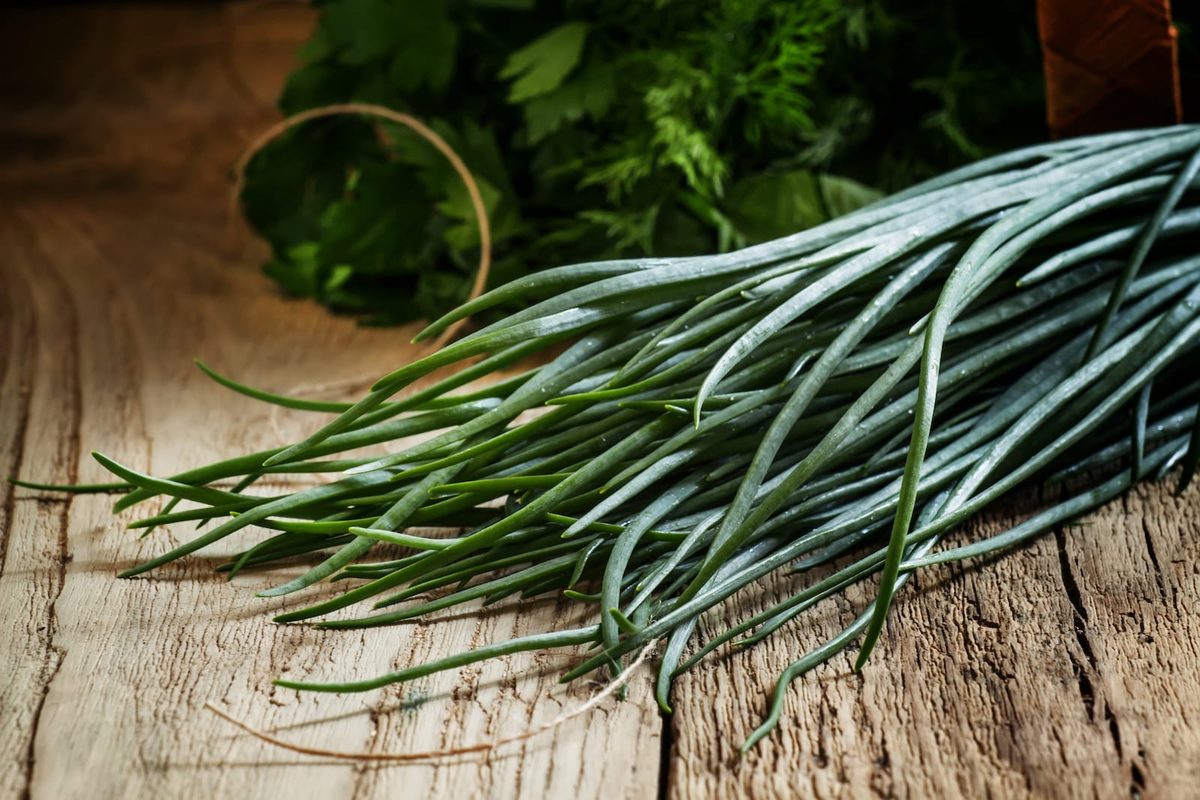
Garlic chives and chives are two different species in the onion genus. Chives are Allium schoenoprasum, with thin, tubular leaves and a mild onion flavor.12 Garlic chives, also called Chinese chives, are Allium tuberosum, with flat leaves and a mild garlic taste and smell.3 The difference that matters most in the kitchen is how each is used: chives are mostly a raw herb snipped over food at the end, while in Chinese cooking garlic chives are treated more as a vegetable, cooked into stir-fries and dumpling fillings.24
Side by side
| Garlic chives | Chives | |
|---|---|---|
| Species | Allium tuberosum Rottler ex Spreng.5 | Allium schoenoprasum L.6 |
| Family | Amaryllidaceae5 | Amaryllidaceae6 |
| Native range | Himalaya to China (southwest Shanxi)5 | The temperate northern hemisphere6 |
| Leaves | Flat above, slightly keeled below3; flatter and wider than chives4 | Thin and tubular1 |
| Flowers | White, widely opened and star-like, slightly fragrant3 | Dense round heads of bluish or lilac flowers1 |
| Below ground | Indistinct bulbs on a prominently spreading rhizome3 | Small white elongated bulbs1 |
| Parts eaten | Leaves and young flower stalks3 | Leaves; the flowers are edible too2 |
| Flavor | Mild garlic taste and smell (PROSEA)3 | Mild onion (UW-Madison Extension)2 |
| Aroma chemistry | One study: dimethyl trisulfide most abundant of 59 volatiles (headspace method)7 | One study: methyl propyl trisulfide the largest component of the essential oil (distilled oil)8 |
| Forms sold | Green leaves, flowering stems with buds, and yellow (blanched) chives4 | Fresh bunches and potted plants; also dried and freeze-dried (common retail forms) |
| Typical uses | Stir-fries and dumpling fillings; the yellow form in Cantonese noodle and seafood dishes4 | Raw over eggs, soups, salads and vegetables; sauces and dips14 |
| Keeps | 2 to 3 days at 0 to 2 °C (PROSEA)3 | Up to a week refrigerated (UW-Madison Extension)2 |
| Price | No dated, sourced retail comparison found | No dated, sourced retail comparison found |
The two storage figures come from different sources describing different conditions, so they show a direction, not a measured comparison. For each plant on its own, see garlic chives and chives.
Leaf shape is the quickest tell
Look at a cut end. A chive leaf is a thin tube.1 A garlic chive leaf is flat on top and slightly keeled underneath, not folded lengthwise,3 and The Woks of Life describes garlic chives as flatter and wider than regular chives.4 In flower they part ways again: chives carry round heads of bluish or lilac flowers,1 garlic chives open white, star-shaped flowers.3
Underground, chives grow from small white elongated bulbs.1 Garlic chives have bulbs that PROSEA calls indistinct, sitting on a prominently spreading rhizome.3 PROSEA names only the leaves and young flower stalks as food,3 so in practice the green parts are what you cook. We found no source saying either plant’s bulbs are inedible, or that they are eaten.
Flavor: garlic vs. onion, and what the chemistry shows
PROSEA describes garlic chives as having a mild garlic taste and smell,3 and UW-Madison Extension describes chives as having a mild onion flavor, more pungent in hot weather.2 In our judgment garlic chives taste the stronger of the two when raw, and both soften with heat. No source measures that difference.
Two studies have looked at what makes each smell the way it does, but they used different methods, so their numbers can’t be set against each other:
| Study | Plant and sample | Method | Main finding |
|---|---|---|---|
| Xie et al. 20227 | Garlic chives (A. tuberosum), samples in the study | Headspace sampling of volatiles | 59 volatile compounds; dimethyl trisulfide the most abundant at 10,623.30 µg/kg; a “garlic and onion” odor category dominated the aroma profile |
| Miltojević et al. 20188 | Chives (A. schoenoprasum), above-ground parts collected on the Šar Mountains | Essential oil by distillation | Organosulfur compounds about 60% of the oil; methyl propyl trisulfide the major component at 8.3%; dipropyl disulfide 3.8% |
What the table supports: both plants’ aroma is built largely from sulfur compounds, and the most abundant compound differs between the two studies. What it doesn’t support is any claim about which plant is stronger, because one study measured volatiles in µg/kg of plant and the other measured percentages of a distilled oil, from different samples in different places. We found no study that analyzes both plants with the same method.
How each is used
Chives are a finishing herb. UW-Madison Extension says the leaves are usually sprinkled on food just before serving,2 and Britannica lists them as a common seasoning for eggs, soups, salads and vegetables.1 The Woks of Life notes that regular chives are often eaten raw, sprinkled over a dish, or added to sauces and dips.4 For chives in French cooking, see fines herbes.
Garlic chives are closer to a green vegetable. PROSEA records that the leaves and young flower stalks are used to season food, eaten blanched or green,3 and that the crop is of considerable importance in China, Japan and Taiwan.3 The Woks of Life calls them more vegetal than herbal and uses them more as a vegetable than an herb,4 in stir-fries and dumpling fillings.4 It also describes two other forms sold in Chinese markets: flowering stems with buds, which are more seasonal than the leaves, and yellow chives, a blanched form (PROSEA notes that in China the plant is grown in trenches to blanch it3), which have the same basic flavor as the green leaves but milder.4 In Mandarin the green leaves are jiǔ cài; in Cantonese, “gow choy.”4
In our kitchen judgment, the practical rule follows from that: chives go on at the end and rarely see heat; garlic chives can take a short stir-fry and are usually added near the end of cooking so they stay green.
Can one stand in for the other?
Yes, with a flavor shift either way. No source measures either swap; the ratios below are labeled by where they come from. See garlic chives substitutes and chives substitutes for the full ranked lists.
| Swap | Starting amount | Treatment |
|---|---|---|
| Garlic chives in place of chives | 1:1 (A Couple Cooks) | Attributed |
| Chives in place of garlic chives | Same volume of chives plus a small amount of fresh garlic | Method |
- Garlic chives for chives (Attributed). Sonja Overhiser of A Couple Cooks says to use garlic chives as a 1:1 substitute for chives.9 Expect a garlic note that chives don’t have. In a raw garnish that note shows most; cooked into eggs or a stir-fry it matters less. That last point is our judgment.
- Chives for garlic chives (Method). The Spice House suggests blending regular chives with a small amount of fresh garlic to mimic garlic chives,10 but gives no amount. As a starting point, use the same volume of chives and a pinch of finely grated garlic per tablespoon, more if the garlic chives were a main ingredient. Because chives are thinner and more delicate, add them at the very end. That amount is ours, not a measurement.
- Neither on hand. For chives, NDSU and NMSU Extension both give finely chopped green onion tops as a straight swap, 2 teaspoons for 2 teaspoons.1112 The Spice House also calls green onions the best substitute for chives.10 See chives vs. green onions. For garlic chives in a cooked dish, scallion greens with a little garlic, or garlic scapes, are the usual stand-ins (Method; see the substitutes page).
Buying and storage
Chives keep up to a week refrigerated, according to UW-Madison Extension, and lose much of their flavor when dried.2 PROSEA gives fresh garlic chives only 2 to 3 days at 0 to 2 °C.3 Either way, buy them close to when you need them. Look for firm, evenly colored leaves with no slimy tips; yellow garlic chives are pale by design. Those buying points are kitchen judgment. For drying, see how to dry chives.
What isn’t known
- No study analyzes the aroma compounds of chives and garlic chives side by side with one method, so their relative strength is a cook’s judgment, not a measurement. Both studies cited here were read as abstracts.
- No source measures a swap ratio between them. The 1:1 figure is one writer’s guidance.
- We found no source on whether either plant’s bulbs are eaten.
- No dated, sourced price comparison was found, and nothing measured on how widely each is stocked in US or European groceries.
Related
- Garlic chives and garlic chives substitutes
- Chives, chives substitutes and chives vs. green onions
- Garlic scapes, wild garlic and garlic
- Fines herbes and how to dry chives
Footnotes
-
“Chive”, Encyclopaedia Britannica, 2026. britannica.com · Reference work ↩ ↩2 ↩3 ↩4 ↩5 ↩6 ↩7 ↩8 ↩9
-
Susan Mahr, “Chives, Allium schoenoprasum”, University of Wisconsin-Madison Division of Extension, 2026. hort.extension.wisc.edu · Reference work ↩ ↩2 ↩3 ↩4 ↩5 ↩6 ↩7 ↩8
-
Q.P. van der Meer et al., Allium tuberosum, Plant Resources of South-East Asia (PROSEA). uses.plantnet-project.org · Reference work ↩ ↩2 ↩3 ↩4 ↩5 ↩6 ↩7 ↩8 ↩9 ↩10 ↩11 ↩12 ↩13 ↩14 ↩15 ↩16
-
“Fresh Herbs & Aromatics Used in Chinese Cooking”, The Woks of Life, 2025. thewoksoflife.com · Publication ↩ ↩2 ↩3 ↩4 ↩5 ↩6 ↩7 ↩8 ↩9 ↩10 ↩11
-
Allium tuberosum Rottler ex Spreng., Plants of the World Online, Royal Botanic Gardens, Kew. powo.science.kew.org · Reference work ↩ ↩2 ↩3
-
Allium schoenoprasum L., Plants of the World Online, Royal Botanic Gardens, Kew. powo.science.kew.org · Reference work ↩ ↩2 ↩3
-
Xie et al., “Identification of Major Volatile Aroma-Active Compounds in Chinese Chive (Allium tuberosum Rottler)”, Molecules, 2022 (abstract). doaj.org · Peer-reviewed ↩ ↩2
-
Miltojević, Radulović and Golubović, “The chemical composition of chives (Allium schoenoprasum L.) essential oil”, Facta Universitatis, 2018 (abstract). casopisi.junis.ni.ac.rs · Peer-reviewed ↩ ↩2
-
Sonja Overhiser, “Best Substitute for Chives”, A Couple Cooks, 2026. acouplecooks.com · Publication ↩
-
“The 5 Best Substitutes for Chives”, The Spice House, 2018. thespicehouse.com · Merchant ↩ ↩2
-
Julie Garden-Robinson, Ingredient Substitutions (FN198), NDSU Extension, 2018. ksre.ksu.edu · Reference work ↩
-
In a Pinch Ingredient Substitution (E-131), NMSU Cooperative Extension, 2016. pubs.nmsu.edu · Reference work ↩