Spice Substitutes · Substitutes
Chives Substitutes, Ranked by the Job Chives Are Doing
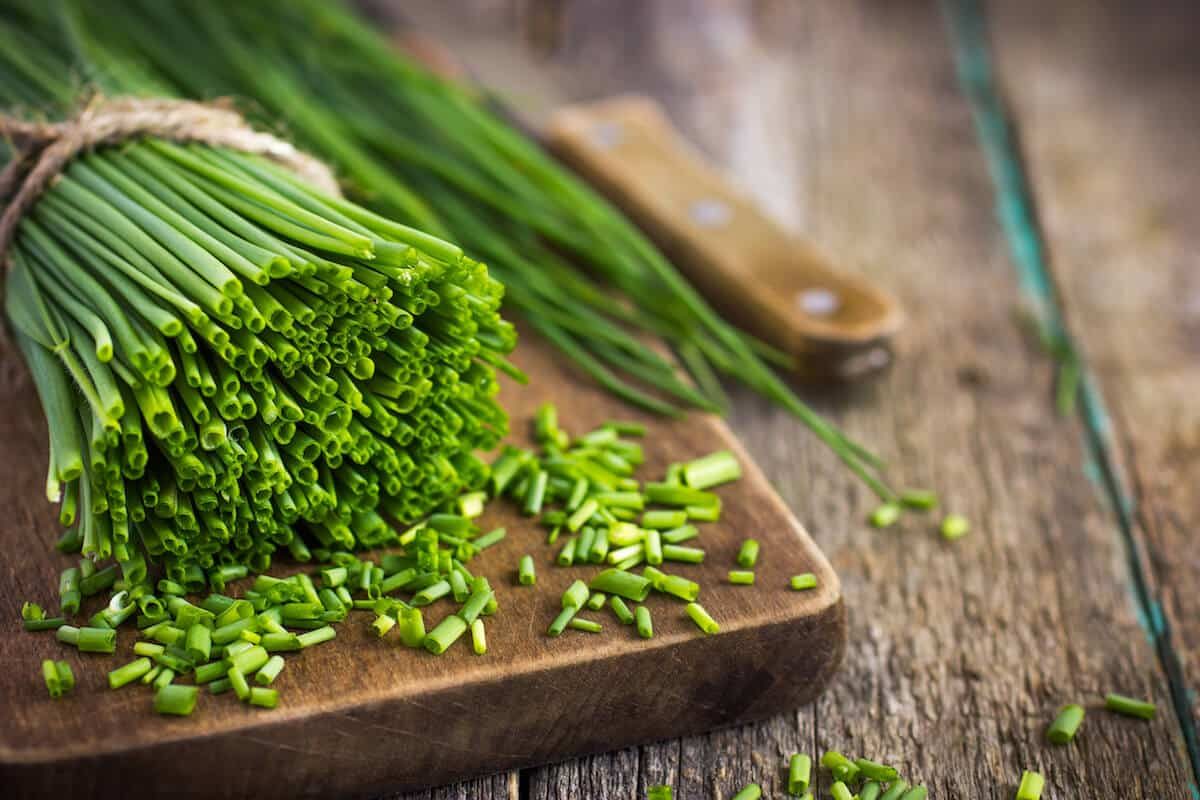
Chives are the thin, hollow leaves of Allium schoenoprasum, a small perennial of the amaryllis family in the onion’s genus, Allium.1 UW-Madison Extension describes their flavor as mild onion, and notes that the leaves are usually chopped and sprinkled on food just before serving.2 They are among the easier herbs to replace, because a mild green onion flavor is easy to find. What matters is whether the chives are raw or cooked, and whether you need their look as well as their taste.
Quick answer
| What chives are doing | Best substitute | Starting amount, per 1 part chopped chives | Treatment |
|---|---|---|---|
| Raw garnish (potatoes, eggs, soups, salads) | Green onion (scallion) tops, finely chopped | 1 part | Attributed |
| Stirred into dips, sour cream or cream cheese | Green onion tops, or minced shallot | 1 part (shallot is sharper) | Attributed |
| Cooked into eggs, stir-fries or dumplings | Garlic chives | 1 part | Attributed |
| Same job, more garlic | Garlic scapes, finely chopped | About 1/2 part, then taste | Method |
| No fresh chives at all | Dried chives | 1 teaspoon dried per 1 tablespoon fresh | Computed, with a caveat |
The rest of the page explains each choice.
How the ratios on this page are labeled
Every ratio carries one of four labels.
- Computed: based on a measurable physical relationship, such as converting fresh herbs to dried, with the source named.
- Attributed: a named source publishes this ratio. We quote it as theirs.
- Disputed: named sources give different answers to the same swap. We show each one and do not average them.
- Method: we found no published ratio. We give a direction and a cautious starting point, and say so.
The attributed figures below are cooks’ and extension services’ rules of thumb. None says how it was arrived at.
If chives are a raw garnish
This is the main job: snipped over baked potatoes, eggs, soups and salads at the last moment. Britannica lists eggs, soups, salads and vegetables as chives’ common uses.1 Here you want a mild onion flavor and fine green pieces.
1. Green onion (scallion) tops
Ratio (Attributed): Three sources agree on a straight swap. NDSU Extension and NMSU Extension both give 2 teaspoons of finely chopped green onion tops for 2 teaspoons of chives.34 Sonja Overhiser of A Couple Cooks says scallion greens can be substituted one for one, so 1 tablespoon finely chopped scallion greens equals 1 tablespoon chopped chives.5
Use the green tops, not the white bulbs, and slice them as thin as you can. Cutting the leaves in half lengthwise before slicing across gives finer pieces that look more like chives; that is kitchen practice, not a sourced finding. Like chives, they are best added at the end: LSU AgCenter groups chives with the delicate herbs to add in the last minute or two of cooking.6
2. A little parsley, for color only
If the chives are there mostly to make a plate look green, Overhiser suggests parsley for the color, with a pinch of onion powder if you want some of the onion flavor back.5
Ratio (Method): No amount is given. Use the same volume of finely chopped parsley as chives, and add onion powder only in small pinches.
If chives are stirred into a dip or spread
In sour cream, cream cheese, yogurt dips and potato salad, chives give onion flavor and green flecks without bite. Green onion tops work the same way here as above, at the same 1:1 ratio.345
Minced shallot
Ratio (Attributed): Overhiser says minced shallot can be used as an approximately 1:1 substitute, though the flavor is sharper.5 In a raw dip that sharpness shows, so we would start at about half and add more after the dip has rested; that adjustment is our judgment.
Dried chives
Overhiser notes that dried chives are best rehydrated in creamy dips or cooked recipes, and that they don’t have a lot of flavor on their own.5 A dip that sits for a while is the one place they do reasonably well. See the dried chives section below for the conversion.
If chives are cooked into a dish
Chives’ flavor fades with heat. America’s Test Kitchen lists chives among the delicate herbs whose flavor compounds tend to be more volatile,7 and LSU AgCenter says prolonged heat costs delicate herbs their flavor and aroma.6 When the recipe cooks the chives, as in scrambled eggs, a stir-fry or a dumpling filling, a sturdier allium does the job better.
1. Garlic chives
Garlic chives, Allium tuberosum, are a different species with flat leaves. PROSEA describes their taste and smell as mild garlic,8 and The Woks of Life describes a strong garlicky fragrance and says they are used more as a vegetable than an herb, in stir-fries and dumpling fillings.9
Ratio (Attributed): Overhiser says to use garlic chives as a 1:1 substitute.5 Expect a garlic note that chives lack.
2. Garlic scapes
Garlic scapes are the flower stalks of hardneck garlic, not a kind of chive.10 University of Maine Extension says young chopped scapes give a mild garlic flavor,10 and Nebraska Extension calls them milder than garlic cloves and suggests using them in place of green onions or scallions.11 They are crunchy and much thicker than chives, so chop them fine.
Ratio (Method): No published ratio for scapes in place of chives was found. Start with about half the chive amount and taste, since the garlic flavor builds.
3. Leeks
Ratio (Method): No published ratio was found. Leeks are coarser and, raw, sharper than chives; that is kitchen judgment. If you use them, take the pale green part, slice it very thin, cook it briefly, and start with about a third of the chive amount.
4. Onion
Ratio (Method): No published ratio was found. Very finely minced onion gives the flavor but not the look. Start with about a third of the chive amount and taste. Shallot, above, is the milder choice.
If chives are one of the fines herbes
Britannica describes fines herbes as a mix commonly made of parsley, chives, tarragon and chervil, though the herbs vary.12 Chives supply the onion note. Finely chopped green onion tops, at the same 1:1 ratio as above, fill that role best. See fines herbes substitutes.
Dried chives: the conversion, and why it may not hold
The extension services give the same general rule for swapping fresh herbs and dried, and A Couple Cooks applies it to chives:
| Source | Fresh | Dried |
|---|---|---|
| NDSU Extension | 1 tablespoon, finely cut | 1 teaspoon3 |
| NMSU Extension | 1 tablespoon, finely cut | 1 teaspoon4 |
| Penn State Extension | 1 tablespoon | 1 teaspoon13 |
| LSU AgCenter | 1 tablespoon | 1 teaspoon6 |
| A Couple Cooks, for chives specifically | 1 tablespoon | 1 teaspoon5 |
| America’s Test Kitchen, tasting test | 3 parts | 1 part7 |
Ratio (Computed, with a caveat): On the number itself the sources agree: one part dried to three parts fresh. In ATK’s testing that proportion came closest to producing flavors of equal strength.7 The caveat is whether it applies to chives at all. ATK’s testers preferred fresh herbs in all but one application, and the dried herbs that fared reasonably well in its tests were hardy ones, oregano, rosemary, sage and thyme, in long-cooked dishes with plenty of liquid.7 ATK’s Danielle Lapierre lists chives among the herbs that are better fresh, saying they are much weaker in flavor when dried.14 UW-Madison Extension says the leaves lose a lot of their flavor when dried.2 Even A Couple Cooks, which gives the 1:3 figure, says dried chives don’t have a lot of flavor.5
So the 3:1 rule is a starting point, not an equivalence. Dried chives may need more than a third, and in a raw garnish no amount will replace fresh ones. For keeping a surplus, see the chives profile.
What isn’t known
- No source we found publishes a ratio for leeks, onion or garlic scapes in place of chives. Those are Method starting points.
- No source measures how much flavor chives lose when dried, so the 3:1 rule has not been tested for chives specifically.
- We found no published analysis of the aroma compounds in common chives. Chives taste milder than onion, but the chemistry behind that difference is not documented in the sources we opened.
- Freeze-dried chives are sold, but we found no source comparing them with air-dried chives or giving a conversion.
Related
- Chives, chives vs. green onions and how to dry chives
- Garlic chives, garlic chives vs. chives and garlic chives substitutes
- Garlic scapes and garlic scapes substitutes
- Onion powder and parsley
- Fines herbes, dried vs. fresh herbs and how to rehydrate herbs
Footnotes
-
“Chive”, Encyclopaedia Britannica, 2026. britannica.com · Reference work ↩ ↩2
-
Susan Mahr, “Chives, Allium schoenoprasum”, University of Wisconsin-Madison Division of Extension, 2026. hort.extension.wisc.edu · Reference work ↩ ↩2
-
Julie Garden-Robinson, Ingredient Substitutions (FN198), NDSU Extension, 2018. ksre.ksu.edu · Reference work ↩ ↩2 ↩3
-
In a Pinch Ingredient Substitution (E-131), NMSU Cooperative Extension, 2016. pubs.nmsu.edu · Reference work ↩ ↩2 ↩3
-
Sonja Overhiser, “Best Substitute for Chives”, A Couple Cooks, 2026. acouplecooks.com · Publication ↩ ↩2 ↩3 ↩4 ↩5 ↩6 ↩7 ↩8
-
“Flavorful Herbs”, LSU AgCenter. lsuagcenter.com · Reference work ↩ ↩2 ↩3
-
“Science: Substituting Dried Herbs for Fresh”, America’s Test Kitchen. americastestkitchen.com · Publication ↩ ↩2 ↩3 ↩4
-
van der Meer et al., Allium tuberosum, Plant Resources of South-East Asia (PROSEA). uses.plantnet-project.org · Reference work ↩
-
“Fresh Herbs & Aromatics Used in Chinese Cooking”, The Woks of Life, 2025. thewoksoflife.com · Publication ↩
-
David Fuller and Steven B. Johnson, Growing Hardneck Garlic in Your Maine Garden (Bulletin #2063), University of Maine Cooperative Extension, 2013. projects.sare.org · Reference work ↩ ↩2
-
“Garlic Scapes”, Nebraska Extension. food.unl.edu · Reference work ↩
-
“Fines herbes”, Encyclopaedia Britannica. britannica.com · Reference work ↩
-
Stacy Reed, “Preserving Herbs by Drying”, Penn State Extension, 2024. extension.psu.edu · Reference work ↩
-
Danielle Lapierre, “When You Should Actually Use Dried Herbs (and Which Ones to Avoid)”, America’s Test Kitchen, 2022. americastestkitchen.com · Publication ↩