Cooking · Cooking with
Cooking With Mace: Blades vs. Ground, Toasting, Amounts and Storage
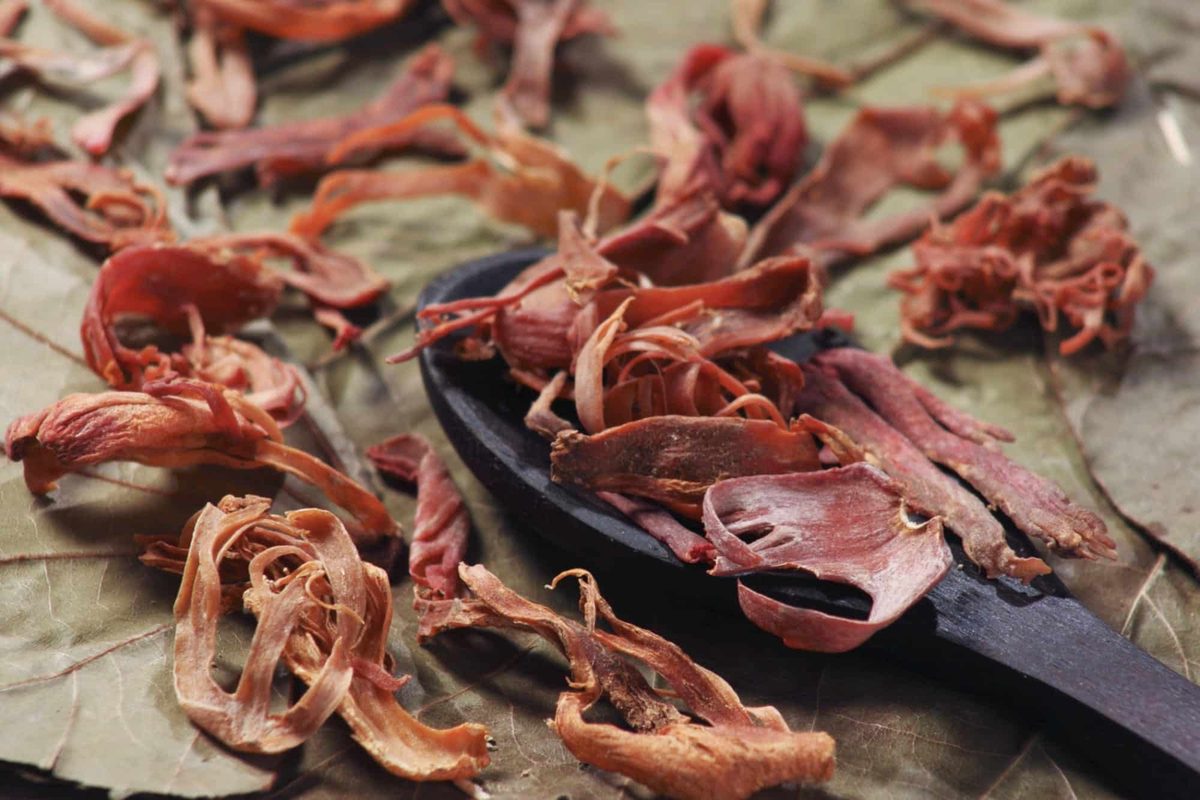
Mace is the dried aril of the nutmeg fruit, the lacy covering around the seed that becomes nutmeg. It is red when fresh and is cured in the dark until it turns orange-yellow.1 America’s Test Kitchen (ATK) notes that whole mace is sold as “blades,” though the ground form is more common.2 The two forms are used differently: blades go into a liquid to infuse and come out again, while ground mace is measured into batters, sauces and spiced butters.
At a glance
| Question | Short answer |
|---|---|
| Whole or ground? | Blades for long-cooked liquids, used like a bay leaf;3 ground for baking and sauces. |
| How strong? | Sources disagree. ATK found mace much stronger than nutmeg; McCormick says nutmeg is slightly more intense.45 |
| How much? | Start small. In ATK’s cake test, 1/2 teaspoon mace did the work of 1 teaspoon nutmeg.4 |
| Toast it? | One Indian method toasts the blades with other whole spices before grinding.3 |
| Grind when? | Just before using, if you buy it whole.6 |
| Store | Tightly closed, dark, away from heat and steam.7 |
| Safety | Keep it, like nutmeg, out of children’s reach.8 |
How strong is mace?
This matters more than anything else on the page, and the sources do not agree:
| Source | What it says |
|---|---|
| ATK, substitution test4 | Mace is much stronger than nutmeg. In a Bundt cake, 1/2 teaspoon of mace replaced 1 teaspoon of nutmeg. |
| ATK, baking spices guide2 | Use half as much of the more potent mace as you would nutmeg. |
| McCormick5 | Nutmeg has a slightly more intense flavor and fragrance than mace. |
| The Spice House3 | Mace is a touch sharper; start with a bit less. |
ATK’s figure is the only one we found that comes from a side-by-side kitchen test.4 We have not averaged these. The safe working rule that follows from all four is to start with less mace than you would nutmeg and add more after tasting. On the chemistry, FAO reports a study of Grenadian oils in which the share of aromatic ethers was always higher in mace oil than in nutmeg oil from the same trees.9 That explains a difference in character; it does not settle which spice tastes stronger in a dish.
Whole blades: infuse, then remove
The Spice House compares whole blades to a bay leaf: they suit recipes with long cooking times, where their flavor infuses gradually.3 Its suggestions include simmering chicken stock, homemade pickles, and a piece of blade added to a pot of basmati rice as it steams.3 Britannica lists sauces and pickles among mace’s uses,10 and PROSEA describes it as used mainly in savory dishes, pickles and ketchups.1
As with a bay leaf, common practice is to lift the blades out before serving, and keeping them whole makes them easier to find (kitchen practice). A common claim says the longer mace cooks, the more flavor it gives. The Spice House’s description of gradual infusion over long cooking points the same way,3 but we found no measurement of it.
Ground mace: baking, sauces and spiced butter
ATK’s two tests show where ground mace earns its place. Its 1/2-teaspoon-for-1-teaspoon ratio worked in a Bundt cake and held in a plain béchamel seasoned at the last minute.4 FAO lists sweet foods, cakes, doughnuts and fruit pies among mace’s food uses, and says it is used particularly for seasoning seafood.11 McCormick recommends it for recipes that want a subtle hint of sweetness, such as cakes, pies and custards.5
| Dish | How mace is used | Amount |
|---|---|---|
| Proper potted shrimps, from Sea Salt by the Lea-Wilson family (Food and Travel)12 | Ground mace simmered for 1 minute in clarified butter with bay leaves, cayenne, salt and pepper, then poured over brown shrimps | 1/2 teaspoon ground mace, 250 g butter, 200 g shrimps; serves 4 |
| Bundt cake (ATK substitution test)4 | Ground mace in place of nutmeg in the batter | 1/2 teaspoon mace for 1 teaspoon nutmeg |
| Béchamel (ATK substitution test)4 | Stirred in at the end | Same ratio as the cake |
The potted shrimps show a technique worth knowing: warming ground mace in butter before it meets the main ingredient. That is how the recipe is written,12 not a tested claim about flavor extraction.
The Spice House’s own suggestion for ground mace is a pinch to 1/4 teaspoon in a single recipe, adjusted from there.3 That is a merchant’s guidance, and a reasonable starting point.
Cuisines and pairings
Merchants describe a wide range of uses. These are their claims, attributed:
- Indian cooking. McCormick says mace often goes into biryanis, curries and meat dishes.5 The Spice House describes a common Indian method in which whole blades are toasted with cardamom, cloves and black pepper, then ground with fresh ginger, garlic and turmeric into a paste.3
- Northern European cooking. The Spice House names English pork pies, Swedish meatballs, mashed potatoes, and rhubarb cakes and crumbles.3
- Middle Eastern cooking. McCormick names savory lamb and beef stews.5
- Fruit and spice partners. McCormick pairs mace with apples, pears and berries, and with cinnamon, cloves and allspice.5
Toasting and grinding
A widely repeated tip says to toast mace lightly before using it, because heat brings out its oils and makes leathery blades brittle enough to grind. The Spice House’s Indian method does toast the blades with other whole spices before grinding,3 but we found no source that explains what toasting does to mace or that tests whether it helps. Treat it as a technique some cooks use, not a rule.
On grinding, ATK’s general advice is to buy spices whole where possible and grind them just before using.6 The Spice House says freshly ground mace gives a fresher, more intense flavor.3 The common explanation, that grinding exposes more surface for aroma to escape, is plausible but we found no source stating it for mace.
Storing mace
The University of California Cooperative Extension’s guidance for all spices applies here: a tightly covered container, a dark place, and away from the stove, dishwasher, microwave, sink and the top of the refrigerator. It also says not to sprinkle spice straight from the jar into a steaming pot, which lets steam into the container.7
| Source | Scope | Whole | Ground |
|---|---|---|---|
| UC Cooperative Extension7 | Spices in general | 2 years | 1 year |
| The Spice House3 | Its advice on ground mace | not given | Best within 6 to 8 months |
FAO adds a point specific to mace: ground mace keeps better than ground nutmeg, because it contains almost no fixed oil.119 A common tip says to keep whole mace in the refrigerator or freezer. We found no source recommending that for mace; the extension release recommends refrigeration only for paprika, chili powder and red pepper.7 For how to tell a spice has faded, ATK’s test is to crush a little and replace it if the aroma and color have faded.6 More on how to store nutmeg, which shares mace’s tree and most of its storage questions.
Safety
Mace contains the same aromatic ethers as nutmeg, and in a higher share of its oil.9 The National Capital Poison Center advises keeping nutmeg and its relative, mace, out of children’s reach.8 Cooking amounts like those above are not the concern; we found no poison-center dose figure for mace itself. See too much nutmeg for the nutmeg figures.
Not yet measured
- Whether mace is stronger or weaker than nutmeg in a dish, beyond ATK’s single kitchen test.
- What toasting does to mace’s flavor.
- How much flavor whole blades give up over a long simmer.
- A shelf-life figure for whole mace blades.
Related
- Mace, mace vs. nutmeg and mace vs. allspice
- Mace substitutes and nutmeg substitutes
- Cooking with nutmeg and garam masala
Footnotes
-
M. Flach and M. Tjeenk Willink, Myristica fragrans, Plant Resources of South-East Asia (PROSEA). uses.plantnet-project.org · Reference work ↩ ↩2
-
“Getting to Know: Baking Spices”, America’s Test Kitchen. americastestkitchen.com · Publication ↩ ↩2
-
“Mace Spice Explained: Flavor, Culinary Uses, and Origin Story”, The Spice House, 2024. thespicehouse.com · Merchant ↩ ↩2 ↩3 ↩4 ↩5 ↩6 ↩7 ↩8 ↩9 ↩10 ↩11 ↩12
-
“Substutions for Mace”, America’s Test Kitchen. americastestkitchen.com · Publication ↩ ↩2 ↩3 ↩4 ↩5 ↩6 ↩7
-
“What is Mace: Uses, Substitutes and Recipes”, McCormick, 2025. mccormick.com · Merchant ↩ ↩2 ↩3 ↩4 ↩5 ↩6
-
“Keeping Spices and Dried Herbs Fresher Longer”, America’s Test Kitchen. americastestkitchen.com · Publication ↩ ↩2 ↩3
-
Anna Martin, “Add a Little Spice to Your Life! Part II”, University of California Cooperative Extension, 2002. ucanr.edu · Reference work ↩ ↩2 ↩3 ↩4
-
Rose Ann Gould Soloway, “Kitchen surprises and cautions”, National Capital Poison Center. poison.org · Reference work ↩ ↩2
-
Production, handling and processing of nutmeg and mace, Section VI: Composition and constituents, FAO. fao.org · Reference work ↩ ↩2 ↩3
-
“Mace”, Encyclopaedia Britannica. britannica.com · Reference work ↩
-
Production, handling and processing of nutmeg and mace, Section VII: Utilization of products, FAO. fao.org · Reference work ↩ ↩2
-
“Proper potted shrimps”, from Sea Salt by the Lea-Wilson family with Anna Shepherd, Food and Travel. foodandtravel.com · Publication ↩ ↩2