Spice Substitutes · Substitutes
Nutmeg Substitutes, Ranked by the Job Nutmeg Is Doing
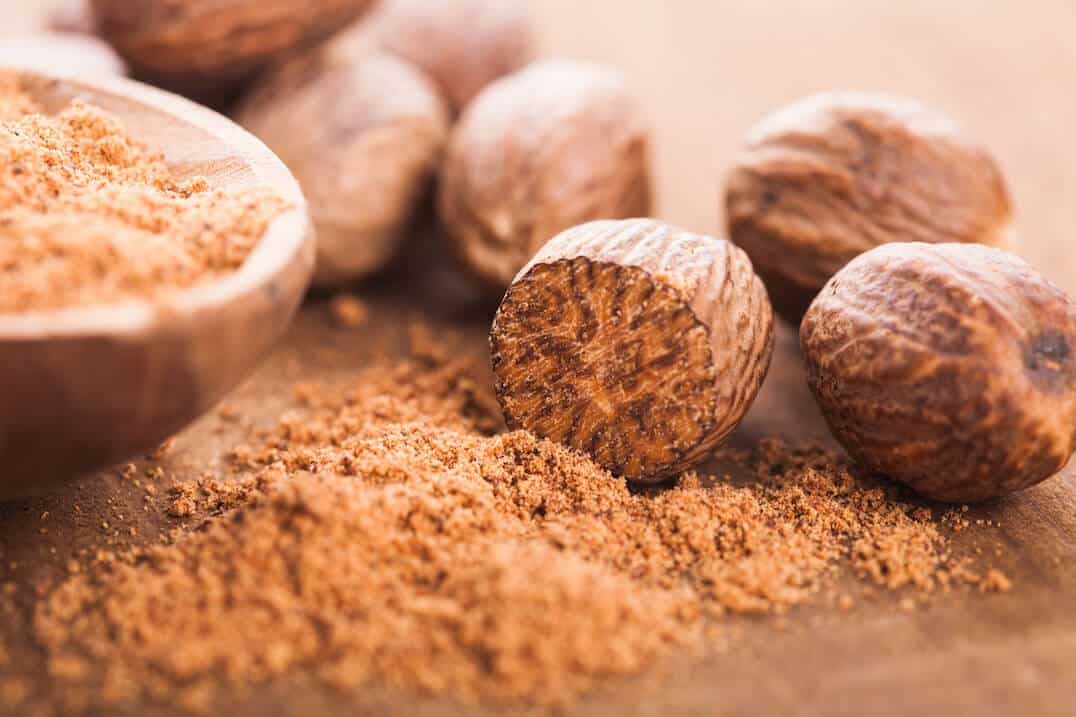
Nutmeg is the dried seed kernel of Myristica fragrans.1 Britannica describes it as having a distinctive pungent fragrance and a warm, slightly sweet taste.2 Most of its aroma comes from a volatile oil that makes up 5 to 15 percent of the kernel, led by pinenes and sabinene.3 The same fruit gives a second spice, mace, which is why mace tops every substitute list we found. How you replace nutmeg still depends on what it is doing in the dish.
Quick answer
| What nutmeg is doing | Best substitute | Starting amount, per 1 part nutmeg | Treatment |
|---|---|---|---|
| Warm, sweet spice in baking, custards and eggnog | Mace | 1/2 part, then add to taste | Disputed |
| A pinch in a cream sauce, béchamel or creamed vegetables | Mace | 1/2 part, then add to taste | Disputed |
| Background warmth in pies and spice cakes, when you have no mace | Cinnamon | 1/2 part | Attributed |
| One spice among many in a curry or spiced dish | Garam masala | 1 part | Attributed |
| You have whole nutmeg but the recipe says ground | Freshly grated nutmeg | 1/2 whole nutmeg per 1 teaspoon ground | Computed |
How the ratios on this page are labeled
- Computed: based on a measurable physical relationship, with the source named.
- Attributed: a named source publishes this ratio. We quote it as theirs.
- Disputed: named sources give different answers to the same swap. We show each one, do not average them, and give a cautious starting point.
- Method: we found no published ratio. We give a direction and a starting point, and say so.
Only one of the ratios we found comes from a kitchen test: America’s Test Kitchen’s mace trials. The rest are merchants’ and writers’ rules of thumb that do not say how they were arrived at.
If nutmeg is the warm, sweet spice in baking or a custard
1. Mace
Mace is the dried aril, the lacy red covering around the nutmeg seed, so the two come from the same fruit.41 Their oils overlap but are not the same. In a Grenadian study summarized by FAO, mace oil always carried a higher share of aromatic ethers than nutmeg oil from the same tree, and taste panels could tell the two apart.3 The Spice House describes mace as more piquant and somewhat less sweet than nutmeg.5
Sources disagree about which spice is stronger. America’s Test Kitchen says mace is much stronger than nutmeg.6 McCormick says the reverse: nutmeg has a slightly more intense flavor and fragrance than mace.7 The Spice House calls mace “a touch sharper.”5
Ratio (Disputed):
| Source | Mace for 1 teaspoon nutmeg | Basis |
|---|---|---|
| America’s Test Kitchen6 | 1/2 teaspoon | Tested in a Bundt cake (1 tsp too strong, 3/4 tsp still too sharp, 1/4 tsp too mild) and confirmed in a béchamel |
| The Spice House5 | 1 teaspoon, but “start with a bit less” | Guidance, no test described |
| McCormick7 | 1/4 teaspoon mace for 1/4 teaspoon nutmeg | Guidance, no test described |
| Healthline8 | 1 teaspoon (1:1) | Guidance, no test described |
America’s Test Kitchen also reports that the substitution amounts recommended by the brands it checked ranged from 1/4 teaspoon to nearly 7/8 teaspoon of mace per teaspoon of nutmeg.6 It does not name the brands.
Starting point (Method): Use half as much mace as the nutmeg called for, which is the tested figure, then taste and add more up to an equal amount if the dish needs it.
2. Pumpkin pie spice or apple pie spice
Both are blends that already contain nutmeg. McCormick’s pumpkin pie spice lists cinnamon, ginger, nutmeg and allspice; its apple pie spice lists cinnamon, nutmeg and allspice.910 Cinnamon comes first on both labels, so expect a cinnamon-led result. The Spice House names both blends as nutmeg substitutes without giving an amount.11
Pumpkin pie spice ratio (Attributed): Healthline says to use it in equal quantities in most recipes.8
Apple pie spice ratio (Attributed): Healthline says to use half the amount, to avoid an overpowering cinnamon taste.8
3. Cinnamon
Cinnamon is a bark spice whose oil is dominated by cinnamaldehyde,12 a different chemistry from nutmeg’s pinene-led oil,3 so it brings warmth and sweetness but not nutmeg’s own aroma. Use it where nutmeg is one of several baking spices rather than the main one.
Ratio (Attributed): The Spice House says to start with half the amount of cinnamon as the nutmeg called for, then taste and add more.11 Healthline also says to use half.8
4. Allspice
Britannica says allspice is so named because its flavor resembles a combination of cloves, cinnamon and nutmeg.13 Its oil is mostly eugenol, at 50 to 80 percent in PROSEA’s figures,14 which gives it a clove note nutmeg does not have.
Ratio (Attributed): Healthline says to use an equal amount.8 The Spice House lists allspice as a substitute without an amount.11
If nutmeg is a pinch in a cream sauce or savory dish
McCormick suggests nutmeg for scalloped potatoes, glazed carrots and creamed spinach,15 and FAO lists cabbage and other sulfur-rich vegetables among its uses.16 In these dishes nutmeg is a background note, and a pale spice keeps a white sauce looking clean.
1. Mace
America’s Test Kitchen found that its half-as-much-mace ratio held in a béchamel seasoned at the last minute; a few tasters found the nutmeg version slightly more peppery.6 Use the same Disputed figures and starting point as above.
2. Black pepper, or leave it out
For lasagna, The Spice House lists black pepper, pumpkin pie spice and mace as options.11 Pie spice is a poor fit for most savory food in our judgment, because of the cinnamon.
Ratio (Method): No published ratio was found for black pepper in place of nutmeg. Add a pinch of white or black pepper to taste, or simply leave the nutmeg out; in a cheese or cream sauce it is a supporting note, and the dish will still work.
If nutmeg is one spice among many
1. Garam masala
Garam masala recipes vary widely by region and by cook.17 Saveur’s version grinds a whole nutmeg in with cardamom, black cumin, pepper, cloves and cinnamon,18 but many blends contain no nutmeg at all, so check the label. The Spice House lists masala among its substitutes.11
Ratio (Attributed): Healthline says to use equal parts garam masala.8 It brings cumin, pepper and cardamom with it, so use it only where those suit the dish.
2. Ginger
Ground ginger’s bite comes from gingerols, which PROSEA identifies as the constituents responsible for its pungent taste.19 It shares warmth with nutmeg but little else.
Ratio (Attributed): Healthline says to use an equal amount of ginger.8
3. Cloves
Britannica describes cloves as strong in aroma and hot and pungent in taste,20 and eugenol makes up about 85 to 92 percent of clove oil in one review.21 Use them sparingly.
Ratio (Attributed): Healthline says to use half the amount.8
If you have whole nutmeg but the recipe says ground
This is not a substitute so much as a conversion, and it is the best option if a whole nutmeg is in the cupboard.
Ratio (Computed): McCormick’s conversion is 1/2 whole nutmeg = 1 teaspoon ground nutmeg.22 That is a volume figure for grating, not a measure of flavor strength; freshly grated nutmeg may taste stronger than an older jar of ground. Grate a little at a time and taste.
A note on safety
Recipe amounts of nutmeg are safe. The National Capital Poison Center says nutmeg is not dangerous when used as recommended, but that too much can cause hallucinations, and it advises keeping both nutmeg and mace out of children’s reach.23 Poison-center figures for what “too much” means differ:
| Source | Amount of ground nutmeg | What the figure describes |
|---|---|---|
| Tennessee Poison Center24 | 15 to 20 g (“two to three tablespoons”) | Dose at which psychogenic effects have been reported |
| Missouri Poison Center25 | 5 to 30 g | Range of doses taken by people using nutmeg to get high |
Missouri puts one whole nutmeg at 6 to 7 g.25 The Tennessee Poison Center names myristicin and elemicin as the main compounds of concern.24 If you are avoiding nutmeg for this reason, note that mace is not a way around it: its oil carries a higher share of the same aromatic ethers.3 More on too much nutmeg.
What isn’t known
- No study measures the flavor strength of nutmeg against mace or any other substitute. The only tested ratio is America’s Test Kitchen’s, in one cake and one sauce.
- Sources disagree on whether mace or nutmeg is the stronger spice, so the direction of the adjustment is itself unsettled.
- No source we found publishes how much nutmeg a commercial pie spice or garam masala contains.
Related
- Nutmeg, mace and mace vs. nutmeg
- Mace substitutes, allspice substitutes, cinnamon substitutes
- Cinnamon vs. nutmeg, allspice vs. nutmeg, nutmeg vs. cloves
- Pumpkin pie spice, apple pie spice, garam masala, ginger, cloves, allspice, cinnamon
- Fresh vs. ground nutmeg, cooking with nutmeg, nutmeg uses, how to store nutmeg
Footnotes
-
Production, handling and processing of nutmeg and mace, Section III: Post harvest handling, FAO. fao.org · Reference work ↩ ↩2
-
“Nutmeg”, Encyclopaedia Britannica. britannica.com · Reference work ↩
-
Production, handling and processing of nutmeg and mace, Section VI: Composition and constituents, FAO. fao.org · Reference work ↩ ↩2 ↩3 ↩4
-
Production, handling and processing of nutmeg and mace, Introduction, FAO. fao.org · Reference work ↩
-
“Mace Spice Explained”, The Spice House, 2024. thespicehouse.com · Merchant ↩ ↩2 ↩3
-
“Substutions for Mace”, America’s Test Kitchen. americastestkitchen.com · Publication ↩ ↩2 ↩3 ↩4
-
McCormick Kitchens, “What is Mace: Uses, Substitutes and Recipes”, McCormick, 2025. mccormick.com · Merchant ↩ ↩2
-
Katey Davidson, “8 Great Substitutes for Nutmeg”, Healthline, 2019. healthline.com · Publication ↩ ↩2 ↩3 ↩4 ↩5 ↩6 ↩7 ↩8
-
McCormick Pumpkin Pie Spice product page, McCormick & Company. mccormick.com · Merchant ↩
-
McCormick Apple Pie Spice product page, McCormick & Company. mccormick.com · Merchant ↩
-
“Nutmeg Substitute”, The Spice House, 2018. thespicehouse.com · Merchant ↩ ↩2 ↩3 ↩4 ↩5
-
Cinnamomum, Plant Resources of South-East Asia (PROSEA). uses.plantnet-project.org · Reference work ↩
-
“Allspice”, Encyclopaedia Britannica. britannica.com · Reference work ↩
-
D. Sulistiarini, Pimenta dioica, Plant Resources of South-East Asia (PROSEA). uses.plantnet-project.org · Reference work ↩
-
McCormick Ground Nutmeg product page, McCormick. mccormick.com · Merchant ↩
-
Production, handling and processing of nutmeg and mace, Section VII: Utilization of products, FAO. fao.org · Reference work ↩
-
“How to make garam masala”, Great British Chefs. greatbritishchefs.com · Publication ↩
-
“Garam Masala”, Saveur, 2014. saveur.com · Publication ↩
-
Sutarno, Hadad and Brink, Zingiber officinale, Plant Resources of South-East Asia (PROSEA). uses.plantnet-project.org · Reference work ↩
-
“Clove”, Encyclopaedia Britannica. britannica.com · Reference work ↩
-
Batiha et al., Syzygium aromaticum L. (Myrtaceae), Biomolecules, 2020. mdpi.com · Peer-reviewed ↩
-
McCormick Kitchens, “How to Grind Your Own Spices”, McCormick, 2025. mccormick.com · Merchant ↩
-
Rose Ann Gould Soloway, “Kitchen surprises and cautions”, National Capital Poison Center. poison.org · Reference work ↩
-
Nena Bowman, “Nutmeg, a Potentially Uninvited Holiday Guest?”, Tennessee Poison Center, 2020. vumc.org · Reference work ↩ ↩2
-
“Nutmeg Abuse”, Missouri Poison Center, 2022 (updated 2026). missouripoisoncenter.org · Reference work ↩ ↩2