Spices · Profile
Nutmeg: Flavor, Chemistry, the Banda Islands and Safe Use
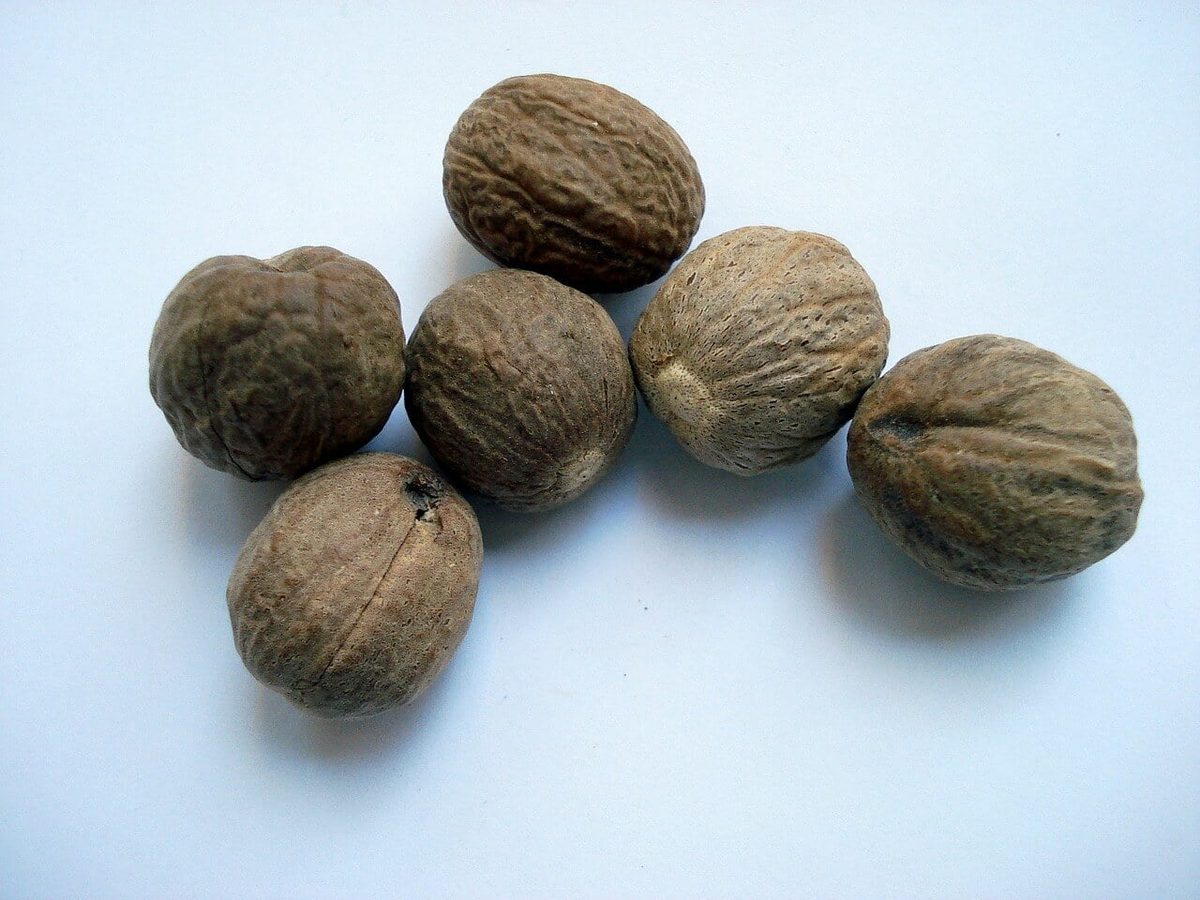
Nutmeg is the dried seed kernel of Myristica fragrans, an evergreen tree whose native range Kew gives as the Banda Islands in Indonesia’s Maluku province.12 One fruit yields two spices: the red, lacy aril wrapped around the seed is dried separately and sold as mace.34 This page covers what nutmeg is, where its aroma comes from, its history, how it is used and graded, and the two safety issues that are real: aflatoxin in the supply chain and intoxication at doses far beyond any recipe.
At a glance
| Botanical name | Myristica fragrans Houtt.1 |
| Plant family | Myristicaceae (nutmeg family)1 |
| Part used | The dried seed kernel; the aril around the seed is mace2 |
| Native range | Maluku (Banda Islands) per Kew; PROSEA says it is known only from cultivation15 |
| Main producers | Indonesia and Grenada, roughly 60% and 30% of world-market supply per PROSEA (no year given)5 |
| Essential oil in the kernel | 5–15% (FAO)6 |
| Key aroma compounds | α- and β-pinene and sabinene; myristicin and elemicin among the aromatic ethers6 |
| Forms sold | Whole (in or out of the shell), ground, essential oil78 |
| US status | Listed as a generally recognized as safe spice9 |
| EU aflatoxin limits | 5.0 µg/kg aflatoxin B1; 10.0 µg/kg total10 |
Measured values
9 figures, sourced| Measure | Value | Scope | Source |
|---|---|---|---|
| Essential (volatile) oil | 5–15 % of the kernel | FAOSources differ; do not merge with the PROSEA figure | fao.org |
| Essential oil | 5 g per 100 g edible portion (about) | PROSEASources differ; do not merge with the FAO range | uses.plantnet-project.org |
| Essential oil: monoterpene hydrocarbons | 61–88 % of the oil | FAO | fao.org |
| Essential oil: aromatic ethers (myristicin, elemicin, safrole) | 2–18 % of the oil | PROSEA | uses.plantnet-project.org |
| Fixed oil | 25–40 % of sound nutmegs | FAO | fao.org |
| Volatile oil, minimum (whole or ground nutmeg) Limit | 6.5 mL per 100 g | Canada Food and Drug Regulations, section B.07, in force 2006 until December 2024Historical legal minimum, no longer in force | laws-lois.justice.gc.ca |
| Moisture, maximum (whole or ground nutmeg) Limit | 8 % | Canada Food and Drug Regulations, section B.07, in force 2006 until December 2024Historical legal maximum, no longer in force | laws-lois.justice.gc.ca |
| Aflatoxin B1, maximum Limit | 5.0 µg/kg | EU Regulation 2023/915, nutmeg | eur-lex.europa.eu |
| Total aflatoxins (B1, B2, G1, G2), maximum Limit | 10.0 µg/kg | EU Regulation 2023/915, nutmeg | eur-lex.europa.eu |
Each figure is quoted as its source states it, with the samples or standard it applies to. Where sources differ, both are shown; nothing is averaged. All measured values
What nutmeg is
The nutmeg tree is usually dioecious, meaning male and female flowers grow on separate trees.11 Its fruit is a fleshy drupe. When it splits open it shows a bright red, net-like aril partly wrapped around a dark brown to black, shiny seed coat.11 Inside that hard coat, the “shell,” is the kernel. FAO is explicit that the spice traded as nutmeg is only the dried kernel.2 In Grenadian processing, nutmegs are dried and stored in the shell and only cracked, sorted and shelled when an order comes in.2
The aril becomes mace. For how the two spices compare in the kitchen, see mace vs. nutmeg.
Flavor and aroma
Britannica describes nutmeg as having a distinctive pungent fragrance and a warm, slightly sweet taste.4 In cooking it reads as warm, woody and faintly sweet, and it turns harsh when overdone; that description is ours.
The compounds
Nutmeg’s aroma lives in its volatile oil. The kernel also carries a large amount of fixed oil (fat), which is a separate thing:
| What | Figure | Source |
|---|---|---|
| Essential (volatile) oil, share of the kernel | 5–15% | FAO6 |
| Essential oil, per 100 g edible portion | about 5 g | PROSEA5 |
| Monoterpene hydrocarbons, share of the oil | 61–88% | FAO6 |
| Aromatic ethers (myristicin, elemicin, safrole), share of the oil | 2–18% | PROSEA5 |
| Fixed oil, share of sound nutmegs | 25–40% | FAO6 |
These are ranges compiled from different samples and methods; they should not be merged. FAO names α-pinene, β-pinene and sabinene as the major monoterpenes and myristicin as the main aromatic ether in the general literature, but in one study of Grenadian oils elemicin was the main aromatic ether in both nutmeg and mace oil.6 The main component of the fixed oil, sold as nutmeg butter, is trimyristin.6
Origin changes the oil. Work summarized by FAO found West Indian oils weaker in odor and less spicy than East Indian oils, with less α-pinene, safrole and myristicin and more sabinene.6
A widely repeated claim says myristicin is what gives nutmeg its flavor. The sources above do not support that: myristicin is one minor part of an oil dominated by monoterpenes. Its importance is toxicological, covered under Safety.
Origin and history
Where it comes from
Kew gives nutmeg’s native range as Maluku, specifically the Banda Islands, and lists it as introduced in places including Mauritius, Réunion, Java, Thailand and the Philippines.1 PROSEA notes that nutmeg is known only from cultivation and most probably originated in the southern Moluccas, especially Ambon and Banda.5 FAO adds that it is seldom found truly wild.11 Britannica describes the Banda group as nine islands in the Banda Sea, southeast of Ambon, with volcanic soils well suited to nutmeg.12
The Banda monopoly
The history of nutmeg is one of the most violent episodes of the spice trade, and it circulates with errors. What the sources support:
- 1512. The Portuguese reached Banda and, per PROSEA, obtained a monopoly on nutmeg; Britannica says the islands were annexed by the Portuguese that year.512
- Early 1600s. The Dutch expelled the Portuguese early in the 17th century and took over the monopoly.125
- 1616. Run, one of the five Bandanese nutmeg islands, became an English colony.13
- 1621. The Dutch East India Company’s Governor-General, Jan Pieterszoon Coen, ordered the capture of the whole archipelago. A chapter in The Cambridge World History of Genocide describes the result as a genocide that destroyed Bandanese civilization: many elites were killed or enslaved, and much of a population of about 15,000 people died or fled.14 A 2025 study of the conquest estimates that 90 percent of the indigenous population died, and that the Company then brought in enslaved people to work the plantations.15 The Company took Run the same year without English permission.13
- After 1621. With the Banda lands in its hands, the Company held a world monopoly on nutmeg and mace production.14
- 1667. In the Peace of Breda, England ceded Run to the Dutch in a settlement under which the Dutch gave up New Amsterdam, today’s New York.13 This is the basis of the often-told “nutmeg for Manhattan” story; the treaty was a wider settlement than a straight swap.
- 1772 and 1802. PROSEA says the French broke the monopoly in 1772 and the British ended it in 1802, during their rule of Indonesia.5 England and the Netherlands traded control of the islands several times before they were returned to the Dutch by the Treaty of Paris in 1814.12
Into the Caribbean
Nutmeg was being planted on St. Vincent as early as 1802, and the first nutmeg planted in Grenada came from seeds brought from Banda in 1843.11 Grenada grows only the Banda type and became the largest nutmeg grower in the West Indies, second only to Indonesia internationally (FAO, 1995).11 The tree is the reason Grenada is called the Isle of Spice.3
A claim that the Roman writer Pliny described nutmeg as a nut with two flavors circulates widely. We could not trace it to Pliny’s text or to any scholarly source, so it is not repeated here.
Production
There is no recent official world figure for nutmeg alone that we could open. PROSEA estimates annual world production at about 17,000 tonnes of nutmeg and 3,000 tonnes of mace, with about 60% of the nutmeg and mace on the world market coming from Indonesia and 30% from Grenada; the entry gives no year for these shares, and the most recent dated figures in it are from 1994, so the estimate is old.5
India publishes its own figures. The Spices Board’s latest table gives nutmeg at 19,325 tonnes from 26,604 hectares in 2024-25 (final) and an advance estimate of 19,329 tonnes from 26,520 hectares for 2025-26.16 The table does not say whether the figure is shelled kernel, in-shell nut or includes mace, so it should not be compared directly with PROSEA’s world estimate.
How nutmeg is used
PROSEA notes that in most countries grated nutmeg flavors confectionery in small amounts, and that in western Europe it also goes into meat dishes and soups.5 FAO’s utilization tables list cakes and cookies, cabbage and other sulfur-rich foods, eggnog, ice cream and milk pudding, and, in industry, sausages, soups, prepared sauces and ketchup.17 In Grenadian rum punch, FAO says, nutmeg is obligatory.17
- Sweet. Custards, cakes, cookies, spice cakes and eggnog. McCormick suggests its ground nutmeg for pumpkin pie and gingerbread.8
- Savory and dairy. McCormick also suggests scalloped potatoes, glazed carrots and creamed spinach.8 By common kitchen practice, a pinch also goes into white sauces and cheese sauces.
- Blends and spiced dishes. Saveur’s Cincinnati chili uses nutmeg alongside cinnamon, allspice and cloves,18 and Saveur’s garam masala grinds in a whole nutmeg with cardamom, black cumin, pepper, cloves and cinnamon.19 See also pumpkin pie spice and quatre épices.
Technique
Common practice is to buy whole nutmeg and grate it straight into the dish, since a few strokes on a fine grater give more control than a shaker. Nutmeg is strong: add a little, let it cook in, taste, and add more. For whole versus ground, see fresh vs. ground nutmeg. For more ideas, see nutmeg uses and cooking with nutmeg. If a dish has gone over, see too much nutmeg.
Buying and quality
Grenada’s export grades, as FAO recorded them in 1995, give a sense of how the trade sorts nutmeg:7
| Grade | Name |
|---|---|
| 1 | Sound unassorted (SUNs) |
| 2 | Sound selected, sized 60/65s, 80s and 110s |
| 3 | Defectives, including “grinders” (distillation grade) |
| 4 | Dry in shells |
| 5 | Shiny black seeds |
From 2006 until December 2024, Canada’s Food and Drug Regulations required nutmeg, whole or ground, to contain at least 6.5 mL of volatile oil per 100 g and no more than 8% moisture.20 That was a legal minimum, not an average of what is on shelves.
Adulteration: PROSEA notes that seeds of several other Myristica species turn up as adulterants of or substitutes for true nutmeg, among them M. malabarica, the “Bombay nutmeg” of India’s west coast.5 At home, whole nutmegs should be heavy and intact; that is kitchen judgment rather than a standard.
Storage
Keep nutmeg tightly covered, in a dark place away from heat and steam.21 Whole nutmeg keeps longer than ground, but the shelf-life figures that circulate are mostly untraceable and the named ones disagree; the full comparison, and what fades nutmeg, are in how to store nutmeg. The practical test is to grate a little and smell it.21
Safety
Aflatoxin
Nutmeg is one of only a few spices named in the EU’s aflatoxin limits: 5.0 µg/kg for aflatoxin B1 and 10.0 µg/kg for the sum of aflatoxins B1, B2, G1 and G2, under Regulation (EU) 2023/915.10 The problem is mold in the supply chain. A 2015 survey of stored nutmeg kernels in North Sulawesi, Indonesia, found aflatoxin B1 and total aflatoxin relatively high in several samples from farmers and exporters.22
The EU has put Indonesian nutmeg under increased border checks for aflatoxin since July 2012, citing a continuous high frequency of non-compliance.23 Checks rose to 50% of consignments in June 2024 and were cut to 30% in June 2026.2425 The full timeline is on how to store nutmeg.
Myristicin and nutmeg intoxication
Eaten by the spoonful, nutmeg is a poison. The Tennessee Poison Center names myristicin and elemicin as the primary ingredients of concern in ground nutmeg and says the body converts myristicin into MMDA, a compound with hallucinogenic properties.26 PROSEA attributes nutmeg’s hallucinogenic properties to the aromatic ethers safrole, myristicin and elemicin.5 Symptoms typically appear 3 to 8 hours after eating it,26 and the Missouri Poison Center says the episode usually resolves within 24 to 36 hours.27 The National Capital Poison Center lists nausea, vomiting, agitation, prolonged drowsiness and coma as possible, and also says nutmeg is not dangerous when used as recommended.28
How much it takes depends on whom you ask, so the figures are shown side by side:
| Source | Amount of ground nutmeg | What the figure describes |
|---|---|---|
| Tennessee Poison Center26 | 15 to 20 g (“two to three tablespoons”) | Dose at which psychogenic effects have been reported |
| Missouri Poison Center27 | 5 to 30 g | Range of doses taken by people using nutmeg to get high |
The Missouri Poison Center puts one whole nutmeg at 6 to 7 g.27 PROSEA repeats that two ground nutmegs, which it puts at about 8 g, “is said to” cause death; the entry hedges the claim, and its weight per nutmeg does not match Missouri’s.5 Keep nutmeg and mace out of children’s reach.28
Safrole
Nutmeg oil contains safrole.5 EU law bans adding safrole to food as such and caps it in some compound foods, but those caps do not apply where the only flavoring ingredients added are fresh, dried or frozen herbs and spices.29 In other words, the EU regulates added safrole, not the safrole that comes with a grating of nutmeg.
Health claims
Nutmeg is often credited with easing flatulence, nausea and poor digestion. We found no regulator summary or systematic review supporting those claims, and this page makes no claim that nutmeg treats or prevents any condition.
Substitutes and comparisons
Mace is the closest substitute, since it comes from the same fruit. In our judgment it tastes lighter; chemically, its oil carries a higher share of aromatic ethers than nutmeg oil from the same tree.6 No source we found gives a tested swap ratio. See nutmeg substitutes for the ranked list, and:
Footnotes
-
Myristica fragrans Houtt., Plants of the World Online, Royal Botanic Gardens, Kew. powo.science.kew.org · Reference work ↩ ↩2 ↩3 ↩4 ↩5
-
Production, handling and processing of nutmeg and mace, Section III: Post harvest handling, FAO. fao.org · Reference work ↩ ↩2 ↩3 ↩4
-
Production, handling and processing of nutmeg and mace, Introduction, FAO. fao.org · Reference work ↩ ↩2
-
“Nutmeg”, Encyclopaedia Britannica. britannica.com · Reference work ↩ ↩2
-
M. Flach and M. Tjeenk Willink, Myristica fragrans, Plant Resources of South-East Asia (PROSEA). uses.plantnet-project.org · Reference work ↩ ↩2 ↩3 ↩4 ↩5 ↩6 ↩7 ↩8 ↩9 ↩10 ↩11 ↩12 ↩13 ↩14
-
Production, handling and processing of nutmeg and mace, Section VI: Composition and constituents, FAO. fao.org · Reference work ↩ ↩2 ↩3 ↩4 ↩5 ↩6 ↩7 ↩8 ↩9
-
Production, handling and processing of nutmeg and mace, Section IV: Classes of obtainable products, FAO. fao.org · Reference work ↩ ↩2
-
McCormick Ground Nutmeg product page, McCormick. mccormick.com · Merchant ↩ ↩2 ↩3
-
21 CFR 182.10, Spices and other natural seasonings and flavorings, FDA. ecfr.gov · Regulator ↩
-
Commission Regulation (EU) 2023/915, European Commission. eur-lex.europa.eu · Regulator ↩ ↩2
-
G.B. Marcelle, Production, handling and processing of nutmeg and mace, Section I, FAO, 1995. fao.org · Reference work ↩ ↩2 ↩3 ↩4 ↩5
-
“Banda Islands”, Encyclopaedia Britannica. britannica.com · Reference work ↩ ↩2 ↩3 ↩4
-
“Run”, Atlas of Mutual Heritage. atlasofmutualheritage.nl · Reference work ↩ ↩2 ↩3
-
Frank Dhont, “Genocide in the Spice Islands”, The Cambridge World History of Genocide, Cambridge University Press, 2023. cambridge.org · Peer-reviewed ↩ ↩2
-
Yuwono and ter Braake, “Conquest of the Banda Islands by the Vereenigde Oostindische Compagnie (1609–1621)”, Journal of Indonesian History, 2025. journal.unnes.ac.id · Peer-reviewed ↩
-
Spice wise area and production in India, 2021-22 to 2025-26, Spices Board India. indianspices.com · Regulator ↩
-
Production, handling and processing of nutmeg and mace, Section VII: Utilization of products, FAO. fao.org · Reference work ↩ ↩2
-
“Cincinnati Chili”, Saveur. saveur.com · Publication ↩
-
“Garam Masala”, Saveur, 2014. saveur.com · Publication ↩
-
Food and Drug Regulations, section B.07.026, Government of Canada. laws-lois.justice.gc.ca · Regulator ↩
-
Anna Martin, “Add a Little Spice to Your Life! Part II”, University of California Cooperative Extension, 2002. ucanr.edu · Reference work ↩ ↩2
-
Dharmaputra et al., BIOTROPIA, 2015. journal.biotrop.org · Peer-reviewed ↩
-
Commission Implementing Regulation (EU) 2016/24, European Commission. legislation.gov.uk · Regulator ↩
-
Commission Implementing Regulation (EU) 2024/1662, European Commission. eur-lex.europa.eu · Regulator ↩
-
Commission Implementing Regulation (EU) 2026/1206, European Commission. eur-lex.europa.eu · Regulator ↩
-
Nena Bowman, “Nutmeg, a Potentially Uninvited Holiday Guest?”, Tennessee Poison Center, 2020. vumc.org · Reference work ↩ ↩2 ↩3
-
“Nutmeg Abuse”, Missouri Poison Center, 2022 (updated 2026). missouripoisoncenter.org · Reference work ↩ ↩2 ↩3
-
Rose Ann Gould Soloway, “Kitchen surprises and cautions”, National Capital Poison Center. poison.org · Reference work ↩ ↩2
-
Regulation (EC) No 1334/2008, Annex III, European Union. eur-lex.europa.eu · Regulator ↩