Cooking · Storage
How to Store Nutmeg: Whole vs Ground, Shelf Life and Mold
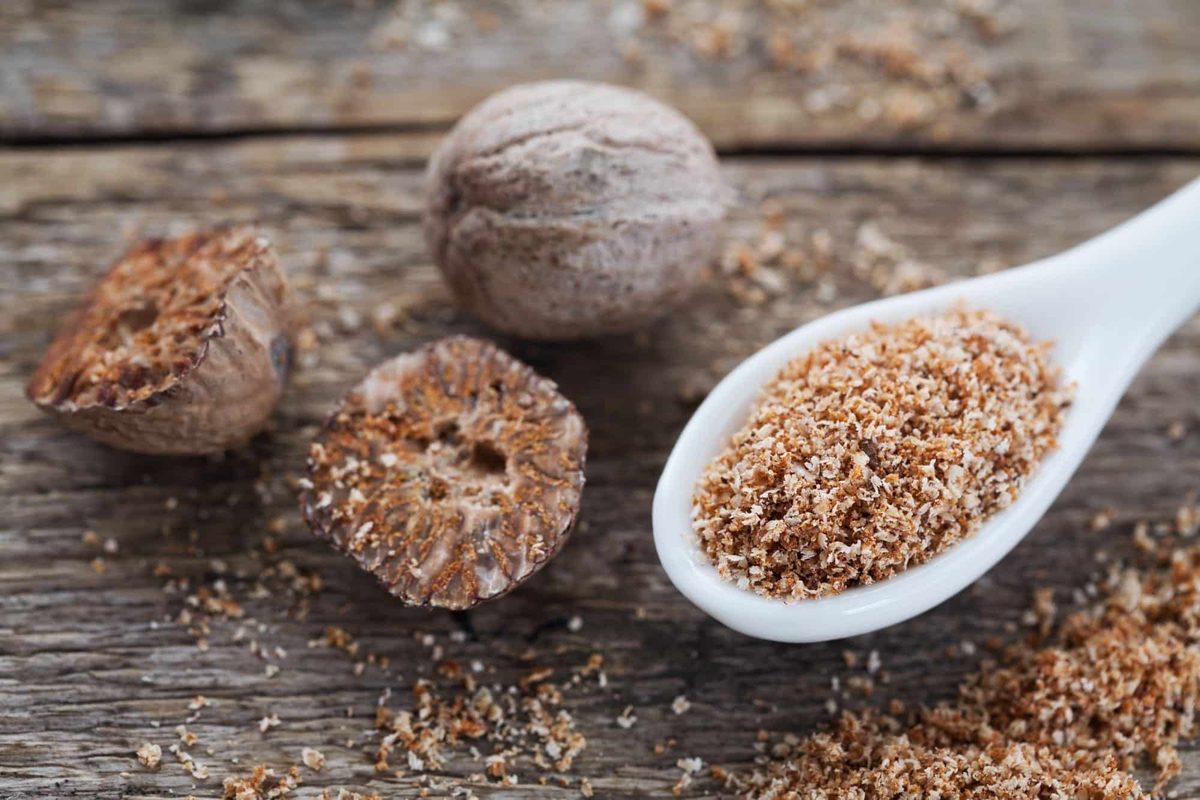
Nutmeg’s flavor lives in its volatile oil, and everything about storing it comes down to slowing the loss of that oil and keeping the kernel dry enough that mold cannot grow. Whole nutmeg keeps longer than ground.12 Beyond that, the shelf-life numbers you see repeated online are mostly untraceable, and the ones that can be traced are general spice guidance, not nutmeg measurements.
At a glance
| Question | Short answer |
|---|---|
| Whole or ground? | Buy whole and grate as needed. Every source below gives ground spices the same or a shorter life than whole. |
| Container | Tightly closed, kept in a dark cupboard or drawer.1 |
| Where | Away from the stove, dishwasher, sink and heating vents.1 |
| Temperature | Cool. A cargo handbook warns oil may be lost above 25°C.3 |
| Humidity | Dry. The same handbook says mold sets in above 75% relative humidity.3 |
| How long | No nutmeg-specific home figure has been published that we could find. See the table below for what named sources say. |
| Faded? | Grate a little and smell it. Weak aroma means weak flavor.1 |
What nutmeg actually is
Nutmeg is the dried kernel of the seed of Myristica fragrans. The red, lacy aril wrapped around the seed is dried separately and sold as mace.4 Between the aril and the kernel is a hard seed coat, the “shell.” In FAO’s account of Grenadian processing, nutmegs are dried in the shell, stored in bags in the shell until an order comes in, and only then cracked by machine, sorted and shelled.4
That trade practice is consistent with the idea that the shell protects the kernel, but we found no measurement of how much longer in-shell nutmeg keeps at home. If you have nutmeg in the shell, keeping it in the shell until use costs nothing.
How long nutmeg lasts: what named sources say
Figures like “whole nutmeg lasts four years, ground lasts six months” circulate widely without any source. We could not trace them. That does not make them wrong; it means nobody can show where they came from. Here is everything we found that carries a name, with its scope.
| Source | What it covers | Whole | Ground |
|---|---|---|---|
| UC Cooperative Extension, 20021 | Spices in general, home storage | 2 years | 1 year |
| America’s Test Kitchen2 | Spices in general, home storage | 2 years | 1 year |
| McCormick5 | Spices in general; a spice company’s own guidance | 3–4 years | 2–4 years |
| TIS cargo handbook3 | Nutmegs in commercial transport and storage, under its recommended conditions | more than 12 months | not given |
| Spices Inc.6 | That merchant’s own ground nutmeg | not applicable | minimum 12 months |
These sources disagree, and we have not averaged them. The extension service and America’s Test Kitchen give ground spices half the life of whole; McCormick’s ranges overlap. None of the home-storage figures was measured on nutmeg. The only nutmeg-specific figures are a cargo handbook’s trade guidance and one merchant’s specification for its own product. McCormick defines shelf life as how long spices stay most aromatic,5 which is the useful way to read all of these numbers: they are quality windows, not safety dates.
What degrades nutmeg
Volatile oil loss. Nutmeg’s seasoning power comes from essential oils that are “readily volatilized,” and as they leave, the spice weakens.3 McCormick describes air and humidity as degrading essential oils over time.5
Heat. The TIS handbook gives a favorable range of 5–25°C for nutmegs in transit and says essential oils may be lost above 25°C.3 In a 1989 laboratory study, nutmeg kernels aged at 37°C for six months showed a general decrease in their low-boiling volatile compounds. The picture was not simple loss, though: the total volatile concentrate rose for the first four months and then fell, and the shares of myristicin and myristic acid climbed, to 24.50% and 18.69% by six months.7 So warm storage changes the aroma profile, not only its strength. That study tested one storage temperature; it does not give a rate for a kitchen cupboard.
Light. The extension service lists light alongside air, moisture and heat as speeding flavor and color loss in herbs and spices, and recommends a dark place away from sunlight.1 We found no study measuring light damage to nutmeg specifically.
Moisture and air. Moisture and air are on the same extension list.1 For nutmeg, damp is also the route to mold, covered below.
Oxidation. It is often said that contact with air makes nutmeg oxidize. That may be true, but we found no source that states it for nutmeg, so we have left it out.
Whole vs ground
Every named source above gives ground spices a life the same as or shorter than whole ones, and McCormick advises choosing whole nutmeg over ground.5 Common practice is to grate only what the recipe needs, so the aroma goes into the dish rather than fading in a jar. For more on the difference in the cup, see fresh vs ground nutmeg.
How nutmeg is ground matters too. A 1993 study compared grinding at room temperature, chilled, and frozen with liquid nitrogen, measured volatile oil and oleoresin, and found the best results with liquid nitrogen.8 The abstract gives no figures, so we cannot say how large the difference was.
Mold and aflatoxin
Mold is the one storage problem with a safety side. The TIS handbook says nutmegs should be kept below 75% relative humidity or mold growth sets in, and that molds on moldy goods may include Aspergillus flavus, which produces aflatoxin.3 The evidence on contamination comes from the supply chain, before nutmeg reaches a shop. A 2015 survey of stored nutmeg kernels in North Sulawesi, Indonesia, found moisture within the Indonesian national limit of 10%, yet aflatoxin B1 and total aflatoxin were “relatively high” in several samples from farmers and exporters. The authors called for better postharvest handling along the chain.9 That is one province’s supply chain, not a measure of nutmeg on the market as a whole.
The European Union has regulated nutmeg aflatoxin for over a decade:
| Date | EU measure | What it did for nutmeg |
|---|---|---|
| July 2012 | Increased official controls | Nutmeg from Indonesia placed under increased official controls for aflatoxins.10 |
| 8 January 2016 | Implementing Regulation (EU) 2016/24 | Nutmeg from India and Indonesia to travel with a health certificate stating it was sampled and tested for aflatoxins, results attached.10 |
| 22 October 2019 | Implementing Regulation (EU) 2019/1793 | Nutmeg from Indonesia and from India listed for aflatoxins, with identity and physical checks on 20% of consignments.11 |
| 30 May 2022 | Implementing Regulation (EU) 2022/913 | Checks on Indonesian nutmeg raised to 30% of consignments after a high frequency of aflatoxin non-compliance.12 |
| 11 June 2024 | Implementing Regulation (EU) 2024/1662 | Checks on Indonesian nutmeg raised to 50% of consignments after a high rate of aflatoxin non-compliance.13 |
| 9 June 2026 | Implementing Regulation (EU) 2026/1206 | Checks on Indonesian nutmeg for aflatoxins cut from 50% to 30% of consignments; the Indian nutmeg entry now lists pesticide residues instead.14 |
The 2016 regulation explained that these commodities showed “a continuous high frequency of non-compliance” with aflatoxin limits.10 The current EU maximum levels for nutmeg, set in Regulation (EU) 2023/915, are 5.0 µg/kg for aflatoxin B1 and 10.0 µg/kg for the sum of aflatoxins B1, B2, G1 and G2. Nutmeg also falls under the general dried-spices limit for ochratoxin A, 15 µg/kg.15
At home, the practical points are the ones that keep flavor in: keep nutmeg dry and closed, and don’t store it near a sink or kettle steam. Discard nutmeg that shows visible mold. That is a cautious judgment on our part rather than a sourced rule: we found nothing showing that home storage can undo contamination, and it is not worth the risk.
How to tell nutmeg has faded
Smell it. The extension guidance is that if a spice smells strong and flavorful it is probably still potent, and that whole spices should be crushed or broken first to release their aroma.1 For whole nutmeg, grate a little. America’s Test Kitchen gives the same test: crush a little, and replace it if aroma and color have faded.2 Treat fading as a loss of quality: faded nutmeg just does less. If you still use it, you will need more of it, and you may want to read how to fix too much nutmeg before you adjust.
What good nutmeg contains
For a sense of what you are trying to preserve: from 2006 until December 2024, Canada’s Food and Drug Regulations required nutmeg, whole or ground, to contain at least 6.5 mL of volatile oil per 100 g and not more than 8% moisture.16 That was a legal minimum for sale in Canada, not an average of what is on shelves.
Not yet measured
- How long nutmeg keeps at home, whole or ground, measured on nutmeg rather than spices in general.
- How much longer nutmeg keeps in its shell.
- Whether refrigerating or freezing whole nutmeg helps. The extension release recommends refrigeration only for paprika, chili powder and red pepper.1
- Light damage to nutmeg specifically.
Related
- Nutmeg
- Mace vs nutmeg
- Cooking with nutmeg
- Nutmeg substitutes
- Allspice vs nutmeg
- How to store saffron
- How to store coriander
Footnotes
-
Add a Little Spice to Your Life! Part II, University of California Cooperative Extension. ucanr.edu · Reference work ↩ ↩2 ↩3 ↩4 ↩5 ↩6 ↩7 ↩8 ↩9
-
Keeping Spices and Dried Herbs Fresher Longer, America’s Test Kitchen. americastestkitchen.com · Publication ↩ ↩2 ↩3
-
Nutmegs, Transport Information Service (GDV). tis-gdv.de · Reference work ↩ ↩2 ↩3 ↩4 ↩5 ↩6
-
Post harvest handling of nutmeg and mace, FAO. fao.org · Reference work ↩ ↩2
-
How Long Do Spices Last?, McCormick. mccormick.com · Merchant ↩ ↩2 ↩3 ↩4
-
Ground Nutmeg product specification, Spices Inc. spicesinc.com · Merchant ↩
-
Kim, Huh and Choi, Korean Journal of Food Science and Technology, 1989. koreascience.kr · Peer-reviewed ↩
-
McKee, Thompson and Harden, Lebensmittel-Wissenschaft und -Technologie, 1993. iifiir.org · Peer-reviewed ↩
-
Dharmaputra et al., BIOTROPIA, 2015. journal.biotrop.org · Peer-reviewed ↩
-
Commission Implementing Regulation (EU) 2016/24, European Commission. legislation.gov.uk · Regulator ↩ ↩2 ↩3
-
Commission Implementing Regulation (EU) 2019/1793, European Commission. eur-lex.europa.eu · Regulator ↩
-
Commission Implementing Regulation (EU) 2022/913, European Commission. eur-lex.europa.eu · Regulator ↩
-
Commission Implementing Regulation (EU) 2024/1662, European Commission. eur-lex.europa.eu · Regulator ↩
-
Commission Implementing Regulation (EU) 2026/1206, European Commission. eur-lex.europa.eu · Regulator ↩
-
Commission Regulation (EU) 2023/915, European Commission. eur-lex.europa.eu · Regulator ↩
-
Food and Drug Regulations, section B.07.026, Government of Canada. laws-lois.justice.gc.ca · Regulator ↩