Spice Fixes · Fix
Too Much Nutmeg? How to Fix the Dish, and When It Becomes a Safety Issue
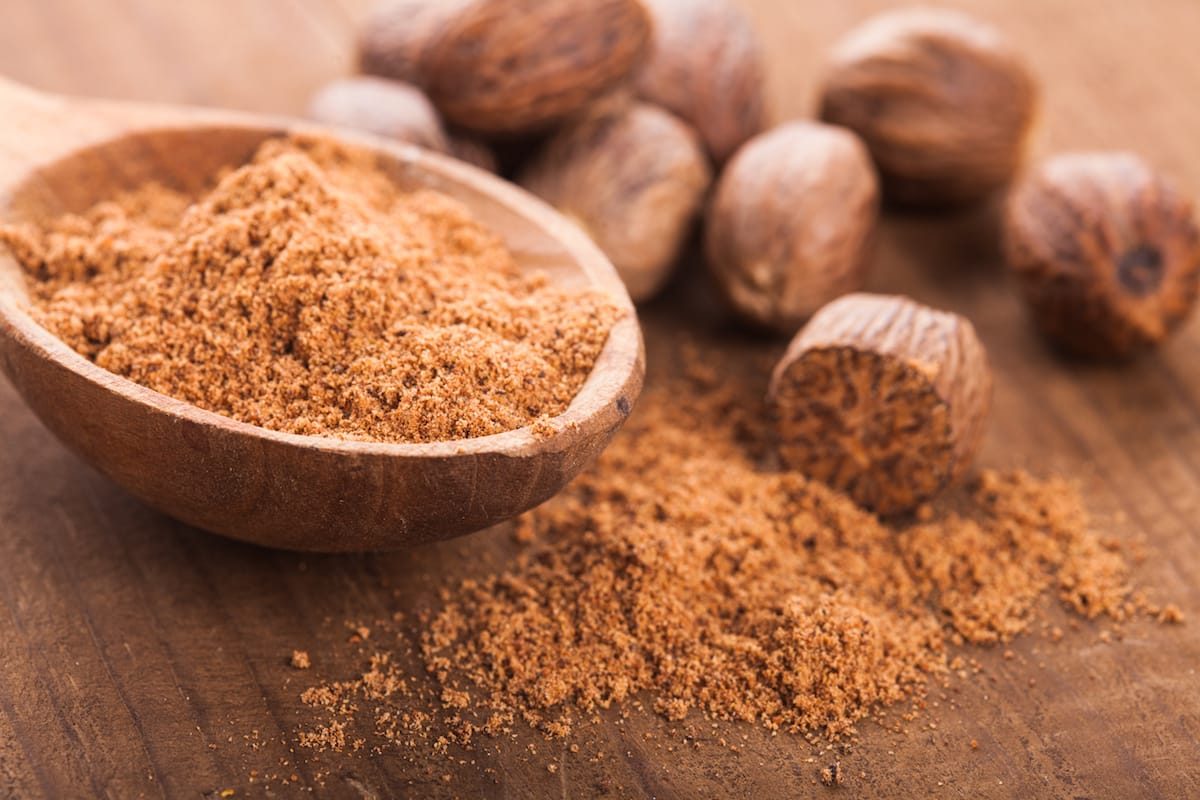
Too much nutmeg in a recipe is almost always a flavor problem: the dish tastes of nutmeg and little else, sometimes with a harsh or bitter edge. It is worth separating that from the other kind of “too much.” Poison centers do see nutmeg poisoning, but at amounts far beyond what any recipe uses (see the safety section below). Within each section the fastest fix comes first.
Quick answer
| What’s wrong | Fastest fix | If that’s not enough |
|---|---|---|
| Too much nutmeg, overall (soup, sauce, filling) | Add more of everything else, or make a nutmeg-free second batch and combine | Add more of the cream, milk or cheese the dish already uses |
| Freshly grated nutmeg sitting on top, not yet stirred in | Skim or spoon it off | Re-season lightly |
| Harsh or bitter edge | Dilute | A little sugar or salt, if the dish can take it |
| Caked on the outside of meat or vegetables | Scrape or wipe off the excess | Don’t rinse raw meat or poultry under the tap |
| Someone ate a large amount on purpose or by accident | Call a poison center | See the safety section |
Why a little nutmeg goes a long way
Nutmeg is the dried kernel of the seed of Myristica fragrans; mace is the lacy red covering around the seed, dried separately.1 Its flavor is concentrated enough that recipes use it by the pinch or the grating, and it turns up in both sweet and savory food. McCormick suggests it for pumpkin pie and gingerbread but also for scalloped potatoes, glazed carrots and creamed spinach.2 In our judgment the savory dishes are where an overdose is most obvious, because nothing sweet is there to round it off.
Sheer volume: too much nutmeg for the dish
Dilute. This is the one fix that actually lowers the amount of nutmeg in each bite. Add more of every other ingredient except nutmeg. If you put in twice as much as the recipe called for, doubling everything else brings it back to the intended level; if you’re not sure how much went in, add the other ingredients in small batches and taste after each. If you can’t add to the pot without changing the dish, Tasting Table’s method for an over-garlicked dish works the same way: cook a second batch without the spice and combine the two.3 Freeze the extra, or set half the original aside first so you don’t end up with a double batch.
Add more of the dairy that’s already there. Nutmeg often lives in creamy dishes: white sauces, pumpkin soup, custards, eggnog. Adding more of the cream, milk or cheese the recipe already uses is dilution with ingredients that suit the dish. It adds a mild, rich flavor that, in our judgment, softens the overall impression. We could not find a source showing that dairy chemically binds nutmeg’s flavor compounds, so treat this as dilution plus balance, not a neutralizer.
Serve it with something plain. For a baked dessert that can’t be changed, a scoop of vanilla ice cream or unsweetened whipped cream with each slice is dilution at the plate.
Nutmeg sitting on the surface
If freshly grated nutmeg has just landed on top of eggnog, custard or a thick soup and hasn’t been stirred in, spoon off as much as you can. This only works before mixing.
When a rub or spice blend heavy in nutmeg is on the outside of a roast or vegetables, scrape or wipe off the excess with a knife or paper towel, then re-season lightly. Don’t rinse raw meat or poultry to get it off: the USDA advises against washing raw poultry, beef, pork, lamb or veal before cooking, because its research found that rinsing raises the risk of cross-contamination.4
A harsh or bitter edge
Overdone nutmeg can taste harsh, even bitter or soapy to some palates; that is a flavor description, not a measured effect. Dilution is the main fix. For any bitterness that remains, controlled taste tests found that sugar and sodium salts both suppressed bitterness, while citric acid was the weakest suppressor.5 Those were pure taste solutions, not food, but they point toward a pinch of sugar or a little salt rather than lemon juice.
Fixes that don’t hold up
Covering it with cinnamon or garlic. Adding cinnamon to a dessert or garlic to a savory dish to “balance” nutmeg is often suggested. In our judgment it mostly adds a second strong flavor on top of the first, and cinnamon is easy to overdo too (see too much cinnamon). It can help a dish that is only slightly heavy on nutmeg; for a real overdose, dilute.
When too much nutmeg is a safety issue
This is about eating nutmeg by the spoonful, not about an over-seasoned dish. The National Capital Poison Center says nutmeg tastes great in cookies and eggnog but that too much can cause hallucinations, and that nausea, vomiting, agitation, prolonged drowsiness and coma are all possible.6 It also says that none of the kitchen items it discusses, nutmeg included, is dangerous when used as recommended.6
What causes it. Discussing nutmeg poisoning, the Tennessee Poison Center lists myristicin and elemicin as the primary ingredients in ground nutmeg and says the body converts myristicin into MMDA, a compound with hallucinogenic properties.7 It describes the effects of a large dose as resembling anticholinergic poisoning, starting 3 to 8 hours after eating it and lasting from hours to days.7 The Missouri Poison Center gives the same 3 to 8 hour onset for nervous-system symptoms and says the whole episode usually resolves within 24 to 36 hours, though patients with nervous-system symptoms are normally admitted for observation.8
How much. Poison-center figures differ, and we report them side by side rather than pick one:
| Source | Amount of ground nutmeg | What the figure describes |
|---|---|---|
| Tennessee Poison Center7 | 15 to 20 g (“two to three tablespoons”) | The dose at which psychogenic effects have been reported |
| Missouri Poison Center8 | 5 to 30 g | The range of doses taken by people using nutmeg to get high |
For scale, the Missouri Poison Center says one whole nutmeg weighs 6 to 7 g,8 so the low end of its range is less than a single whole nutmeg. A figure of “two to three teaspoons” also circulates widely; we found no source for it.
Who is at risk. The cases poison centers describe are people deliberately swallowing large amounts to get high, and children who get into the jar.6 The National Capital Poison Center advises keeping nutmeg and mace out of children’s reach.6 If someone has eaten a large amount, call a poison center. Symptoms can take 3 to 8 hours to appear.7
Preventing it next time
Start low and taste. We found no published guideline for how much nutmeg a dish should take; recipes vary. The method that works: add about half of what you think you need, let it simmer or mix in, taste, and add more in stages.
Grate as you go. Freshly grated whole nutmeg lets you add a few strokes at a time and stop. How strong a jar of ground nutmeg is depends on its age: extension guidance is that a spice that still smells strong is probably still potent.9 A fresh jar can be noticeably stronger than the old one you’re used to, so taste before adding the full amount. More in how to store nutmeg and fresh vs. ground nutmeg.
Shake into your hand, not over the pot. Common kitchen practice: a loose lid or a clogged shaker hole that suddenly clears spills onto the counter, not into dinner.
Related
Footnotes
-
Post harvest handling of nutmeg and mace, FAO. fao.org · Reference work ↩
-
McCormick Ground Nutmeg product page, McCormick. mccormick.com · Merchant ↩
-
Simple Ways To Tone Down The Pungency Of Garlic, Harmony Colangelo, Tasting Table, 2023. tastingtable.com · Publication ↩
-
Washing Food: Does it Promote Food Safety?, USDA Food Safety and Inspection Service. fsis.usda.gov · Regulator ↩
-
Green BG et al., Taste Mixture Interactions: Suppression, Additivity, and the Predominance of Sweetness, Physiology & Behavior, 2010. pmc.ncbi.nlm.nih.gov · Peer-reviewed ↩
-
Kitchen surprises and cautions, Rose Ann Gould Soloway, National Capital Poison Center. poison.org · Reference work ↩ ↩2 ↩3 ↩4
-
Nutmeg, a Potentially Uninvited Holiday Guest?, Nena Bowman, Tennessee Poison Center, Vanderbilt University Medical Center, 2020. vumc.org · Reference work ↩ ↩2 ↩3 ↩4
-
Nutmeg Abuse, Missouri Poison Center, 2022 (updated 2026). missouripoisoncenter.org · Reference work ↩ ↩2 ↩3
-
Add a Little Spice to Your Life! Part II, Anna Martin, University of California Cooperative Extension, 2002. ucanr.edu · Reference work ↩