Cooking · Cooking with
Cooking With Summer Savory: Beans, Stuffing and When to Add It
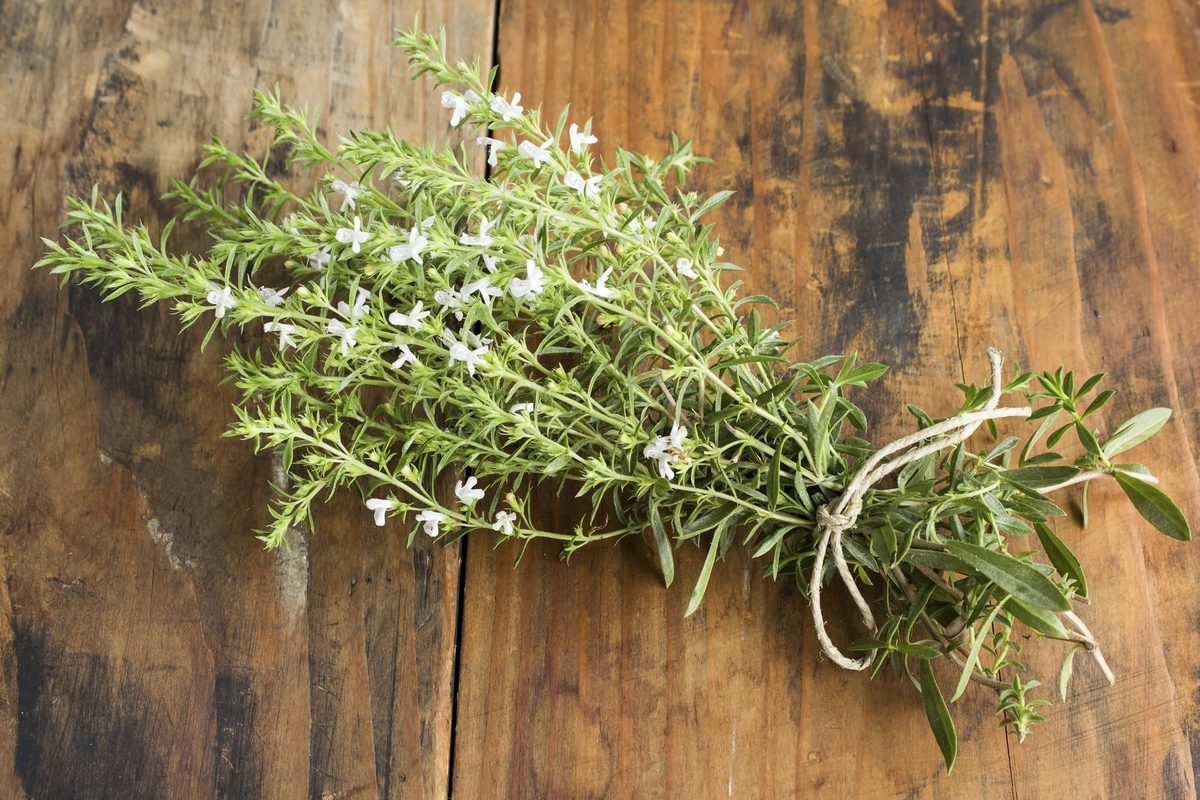
Summer savory (Satureja hortensis) is an annual herb of the mint family.1 Britannica describes its flavor as delicate, sweet and spicy, and says it seasons poultry and stuffings in particular.2 When America’s Test Kitchen tasted it, most tasters found it closer to thyme and sage than to mint.3 Despite its English name, the word “savory” does not describe the taste: it comes from Latin satureia, which the Online Etymology Dictionary calls a foreign word of unknown origin.4 This page covers the dishes it suits, how much to use, when to add it, and how to keep it.
Where summer savory belongs
Beans and lentils. In German, savory is Bohnenkraut, which Duden defines as a seasoning used especially for bean dishes.5 Katzer says savory is very often used for legumes, especially dishes of dried lentils or beans.6 A widely repeated claim that savory prevents gas from beans has no source we could find.
Poultry and stuffing. Britannica names poultry and stuffings as its main uses.2 Barry C. Parsons of Rock Recipes calls summer savory the herb that gives Newfoundland dressing, a bread stuffing for poultry, its aroma and flavor. His recipe uses 2 to 4 tablespoons of dried savory to 4 cups of coarse breadcrumbs, with onion softened in butter and a little chicken stock.7 Parsons notes the herb is far less common elsewhere in Canada and North America.7
Herbes de Provence. France’s Label Rouge specification for herbes de Provence sets savory (sarriette) at 26 to 27 percent of the blend, alongside rosemary at the same share and thyme at 19 percent.8 The specification text we read does not name the savory species. See herbes de Provence and cooking with herbes de Provence.
Bulgarian table blends. Katzer calls savory the most frequently used culinary herb in Bulgaria, and says Bulgarian blends may combine salt, paprika and dried herbs including savory, thyme, basil and lovage.6 He does not say which savory species Bulgarian cooks use.
Bouquet garni. A common claim puts savory in most bouquets garnis. Britannica’s classic bouquet garni is parsley, thyme and a bay leaf, with no savory.9 Adding a sprig of savory to a bundle for a bean pot is reasonable, but it is a variation, not the classic. See bouquet garni.
How much to use
The University of Delaware puts savory in its medium-strength herb group with oregano, thyme and mint, and suggests moderate amounts for that group: 1 to 2 teaspoons for 6 servings (Attributed; the fact sheet does not say fresh or dried).10 Parsons’s Newfoundland dressing uses far more, 2 to 4 tablespoons of dried savory for 8 servings, because savory is the point of that dish.7
Our starting point (Method): for a pot of beans or soup serving four to six, start with 1 teaspoon dried or 1 tablespoon chopped fresh, and adjust at the end.
When to add it
Two sources point the same way. Katzer says boiling drastically reduces savory’s pungency,6 and the University of Delaware advises adding herbs during the last 45 minutes when a recipe calls for long simmering.10 In practice: for a strong savory note in a long-cooked bean pot, add some near the end, not only at the start. A sprig or two at the start, fished out later, and a pinch of chopped leaves toward the end is our suggestion, not a tested method.
Whole sprigs have woody stems, so remove them before serving or strip the leaves first. Running your fingers or the tines of a fork down the stem from the top works; that is common practice.
Pairing
ATK’s tasters linked savory to thyme and sage,3 and savory shares the Label Rouge herbes de Provence blend with rosemary and thyme.8 Those are the herbs it naturally sits with. If you are out of it, ATK replaced summer savory with 2 parts fresh thyme to 1 part fresh sage in sausage stuffing and chicken soup (Attributed).3 More on summer savory substitutes.
Summer vs. winter savory
Winter savory (Satureja montana) is the perennial relative. Britannica says it can be used much like summer savory but has a harsher, more bitter flavor,2 and ATK calls summer savory the more delicate of the two.3 In a quick dish, use less winter savory; in a long-boiled bean pot, Katzer’s point about boiling suggests the gap narrows.6 Full comparison: summer savory vs. winter savory. A common claim that summer savory is preferred for sausages and salads could not be traced.
Keeping it
These are general extension guidelines for herbs; none is specific to savory.
- Refrigerator. Ohio State Extension says fresh herbs last only a few days in the refrigerator.11 We found no source for the “few weeks” often quoted for savory.
- Freezer. Ohio State suggests chopping herbs into ice cube trays covered with water, broth or oil, and using frozen herbs within 3 to 6 months.11 Freeze oil cubes right away: Oregon State Extension says herbs in oil must be refrigerated and used within 4 days, or frozen.12
- Drying. The National Center for Home Food Preservation gives a dehydrator setting of 95°F to 115°F and says to store dried herbs airtight in a cool, dry, dark place.13 Penn State Extension says most dried herbs keep well for one year.14 Details and air-drying methods are on our how to store thyme page, which uses the same extension guidance.
Related
- Summer savory
- Summer savory uses
- Summer savory substitutes
- Winter savory
- Summer savory vs. winter savory
Footnotes
-
Satureja hortensis L., Plants of the World Online, Royal Botanic Gardens, Kew. powo.science.kew.org · Reference work ↩
-
“Savory”, Encyclopaedia Britannica. britannica.com · Reference work ↩ ↩2 ↩3
-
“Cooking with Savory”, America’s Test Kitchen. americastestkitchen.com · Publication ↩ ↩2 ↩3 ↩4
-
“savory (n.)”, Online Etymology Dictionary. etymonline.com · Reference work ↩
-
Gernot Katzer, “Savory”, Gernot Katzer’s Spice Pages. gernot-katzers-spice-pages.com · Reference work ↩ ↩2 ↩3 ↩4
-
Barry C. Parsons, “Newfoundland Dressing a.k.a. Summer Savoury Stuffing”, Rock Recipes. rockrecipes.com · Publication ↩ ↩2 ↩3
-
Cahier des charges du Label Rouge « Herbes de Provence », INAO, 2014. extranet.inao.gouv.fr · Regulator ↩ ↩2
-
“Bouquet garni”, Encyclopaedia Britannica. britannica.com · Reference work ↩
-
Diane Oliver (rev.), “Using Herbs and Spices”, University of Delaware Cooperative Extension, 2025. udel.edu · Reference work ↩ ↩2
-
Shari Gallup, “Preserving Herbs: Freezing and Drying” (HYG-5360), Ohio State University Extension, 2026. ohioline.osu.edu · Reference work ↩ ↩2
-
Carolyn Raab and Margy Woodburn, “Herbs and vegetables in oil” (SP 50-701), Oregon State University Extension Service, 2025. extension.oregonstate.edu · Reference work ↩
-
“Herbs (drying)”, So Easy to Preserve, National Center for Home Food Preservation. nchfp.uga.edu · Reference work ↩
-
Stacy Reed, “Preserving Herbs by Drying”, Penn State Extension, 2024. extension.psu.edu · Reference work ↩