Spice Comparisons · Comparison
Summer Savory vs. Winter Savory: Annual and Perennial, Mild and Harsh
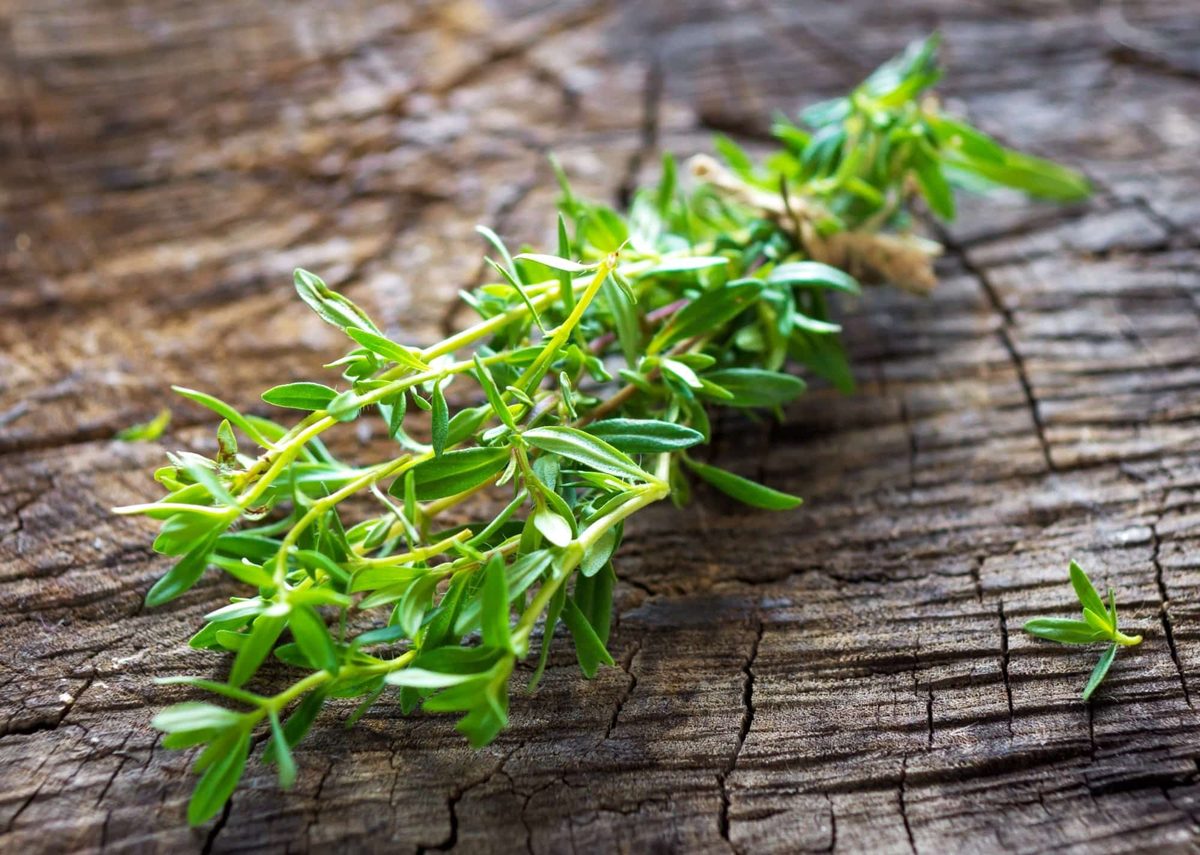
Summer savory is an annual and winter savory a woody perennial, two species of the same genus that do the same jobs in the kitchen.123 Britannica describes winter savory as harsher and more bitter,3 and America’s Test Kitchen calls summer savory slightly more delicate and winter savory coarser in texture.4 Their oils share carvacrol as a main compound, though the published analyses vary widely.56 In a long-cooked pot of beans the gap between them narrows; in a quick dish, winter savory needs a lighter hand.
Side by side
| Summer savory | Winter savory | |
|---|---|---|
| Botanical name | Satureja hortensis1 | Satureja montana2 |
| Family | Lamiaceae (mint family)3 | Lamiaceae (mint family)3 |
| Life cycle | Annual13 | Perennial subshrub23 |
| Native range | Southeastern Europe to Kazakhstan and northwestern Iran (Kew); Eurasia and North Africa (Britannica)13 | South-central and southern Europe to Lebanon2 |
| The leaf | Linear, gray-green, in opposite pairs3 | No description found in the sources reviewed |
| Flavor | Fragrant, slightly sharp and warm3 | Harsher and more bitter than summer savory3 |
| Texture | Slightly more delicate4 | Coarser4 |
| Main oil compounds | Carvacrol and γ-terpinene, with thymol and p-cymene; proportions vary widely5 | Carvacrol, p-cymene and γ-terpinene in one Croatian sample6 |
| Typical uses | Poultry and stuffings;3 beans78 | Bean dishes, organ meats and wild game9 |
| US food status | GRAS spice10 | GRAS spice10 |
How strong is the difference?
Sources agree on the direction but not on how much it matters.
| Source | What it says |
|---|---|
| Britannica | Winter savory can be used much as summer savory is, but is considered harsher and more bitter.3 |
| America’s Test Kitchen | The two are quite similar; summer savory’s flavor is slightly more delicate and winter savory has a coarser texture.4 |
| Gernot Katzer’s Spice Pages | Says in one passage that winter savory is more pungent than summer savory, and in another that the two flavors are almost indistinguishable, with summer savory slightly more pungent.7 It also says boiling drastically reduces savory’s pungency, so that after cooking the two become equivalent.7 |
Katzer’s page is not consistent on which savory is the more pungent, so we rely on Britannica and ATK for the direction. The practical point from all three: in a quick sauté or a raw herb rub, winter savory will taste stronger; in a long-simmered bean pot, much of the difference cooks away.
What’s in the oils
Few analyses of winter savory were found, and they cannot be lined up against summer savory sample for sample. The table keeps each figure with its scope.
| Scope | Carvacrol | γ-Terpinene | p-Cymene | Thymol | Source |
|---|---|---|---|---|---|
| Summer savory: range across studies in a 2018 review | 11–67% | 15.30–39% | 3.5–19.6% | 0.3–28.2% | Fierascu et al.5 |
| Winter savory: one sample of flowering aerial parts, Croatia | 13.7% | 10.6% | 11.8% | not given here | Bezić et al.6 |
The summer savory row is a spread across many studies, which the review attributes to season, climate, growing practice and geography.5 The winter savory row is one sample from one place, which also contained 9.5 percent limonene and 4.6 percent linalool.6 Carvacrol leads or nearly leads in both, and Katzer gives carvacrol as savory’s main component, with only minor amounts of thymol.7 Nothing here supports a claim that one savory has more carvacrol than the other.
Summer savory’s volatile oil runs up to 5 percent of the dry plant, according to the review;5 Katzer says good-quality savory should contain 1 to 2 percent.7 Those are different measures from different sources, and neither is specific to winter savory.
How each is used
Beans. The German name for savory, Bohnenkraut, means “bean herb,” and Duden defines it as a seasoning used especially for bean dishes.8 Katzer says savory is very often used for legumes, especially dishes of dried lentils or beans.7 Monticello’s notes suggest winter savory for bean dishes, organ meats and wild game.9 The often-repeated reason, that savory prevents gas, has no source behind it that we could find.
Poultry and stuffing. Britannica says summer savory’s leaves season food, particularly poultry and stuffings, and that winter savory can be used similarly.3
Herbes de Provence. Savory (sarriette) is one of the five herbs in the French Label Rouge specification, at 26 to 27 percent of the blend, alongside rosemary, oregano, thyme and basil.11 The specification text we reviewed names savory, not a particular species. See herbes de Provence.
Bulgaria. Katzer calls savory the most frequently used culinary herb in Bulgaria.7 Bulgarian table blends known as sharena sol, “colored salt,” may contain salt, paprika and dried herbs including savory, thyme, basil and lovage.7 Katzer does not say which savory species Bulgarian cooks use.
Strength in the pot. The University of Delaware puts savory in its medium-strength herb group, with thyme, oregano and mint.12 As cooking judgment: add either savory early to beans and braises, and use winter savory more sparingly in anything cooked briefly.
Can one stand in for the other?
Yes. They are the closest substitutes for each other, and no published ratio exists in either direction, so our substitute pages treat both swaps as Method:
| Swap | Starting amount | Treatment |
|---|---|---|
| Winter savory in place of summer savory | About two thirds as much, then taste | Method (summer savory substitutes) |
| Summer savory in place of winter savory | The same amount, up to half again more | Method (winter savory substitutes) |
The reasoning is Britannica’s and ATK’s: winter savory is the harsher herb,34 so it goes in at a lower amount. Long cooking narrows the gap, per Katzer,7 so in a bean pot you can lean toward equal amounts. If you have neither, ATK’s tasters found summer savory closer to thyme and sage than to mint, and ATK’s rule is 2 parts fresh thyme to 1 part fresh sage in place of summer savory (Attributed).4
Safety
The FDA lists both summer savory and winter savory among spices generally recognized as safe.10 This page makes no claim that either savory treats or prevents gas or any other condition.
What isn’t known
- No study we found analyzes the two savories side by side; the oil figures come from different studies with very different scopes.
- No reliable description of winter savory’s leaf was found in the sources reviewed.
- No published swap ratio exists between the two savories.
- Claims that there are about 30 kinds of savory, that a jar labeled simply “savory” is almost always summer savory, and that winter savory flavors liqueurs could not be traced.
Related
- Profiles: summer savory and winter savory
- Substitutes: summer savory substitutes and winter savory substitutes
- Uses: summer savory uses, winter savory uses and cooking with summer savory
- Related herbs: thyme, oregano, marjoram and herbes de Provence
Footnotes
-
Satureja hortensis L., Plants of the World Online, Royal Botanic Gardens, Kew. powo.science.kew.org · Reference work ↩ ↩2 ↩3 ↩4
-
Satureja montana L., Plants of the World Online, Royal Botanic Gardens, Kew. powo.science.kew.org · Reference work ↩ ↩2 ↩3 ↩4
-
“Savory”, Encyclopaedia Britannica, 2026. britannica.com · Reference work ↩ ↩2 ↩3 ↩4 ↩5 ↩6 ↩7 ↩8 ↩9 ↩10 ↩11 ↩12 ↩13 ↩14
-
“Cooking with Savory”, America’s Test Kitchen. americastestkitchen.com · Publication ↩ ↩2 ↩3 ↩4 ↩5 ↩6
-
Fierascu et al., “Phytochemical Profile and Biological Activities of Satureja hortensis L.: A Review of the Last Decade”, Molecules, 2018. mdpi.com · Peer-reviewed ↩ ↩2 ↩3 ↩4 ↩5
-
Bezić et al., “Essential Oil Composition and ITS Sequence Variability of Four South-Croatian Satureja Species”, Molecules, 2009. mdpi.com · Peer-reviewed ↩ ↩2 ↩3 ↩4
-
Gernot Katzer, “Savory (Satureja hortensis, S. montana)”, Gernot Katzer’s Spice Pages. gernot-katzers-spice-pages.com · Reference work ↩ ↩2 ↩3 ↩4 ↩5 ↩6 ↩7 ↩8 ↩9
-
“Winter Savory”, Thomas Jefferson Foundation, Monticello. monticello.org · Reference work ↩ ↩2
-
21 CFR 182.10, US Food and Drug Administration. ecfr.gov · Regulator ↩ ↩2 ↩3
-
Label Rouge LA 02/03 “Herbes de Provence” specification, INAO, 2014. extranet.inao.gouv.fr · Regulator ↩
-
“Using Herbs and Spices”, University of Delaware Cooperative Extension, 2025. udel.edu · Reference work ↩