Herbs · Profile
Summer Savory: Flavor, Carvacrol Chemistry, History and How to Use It
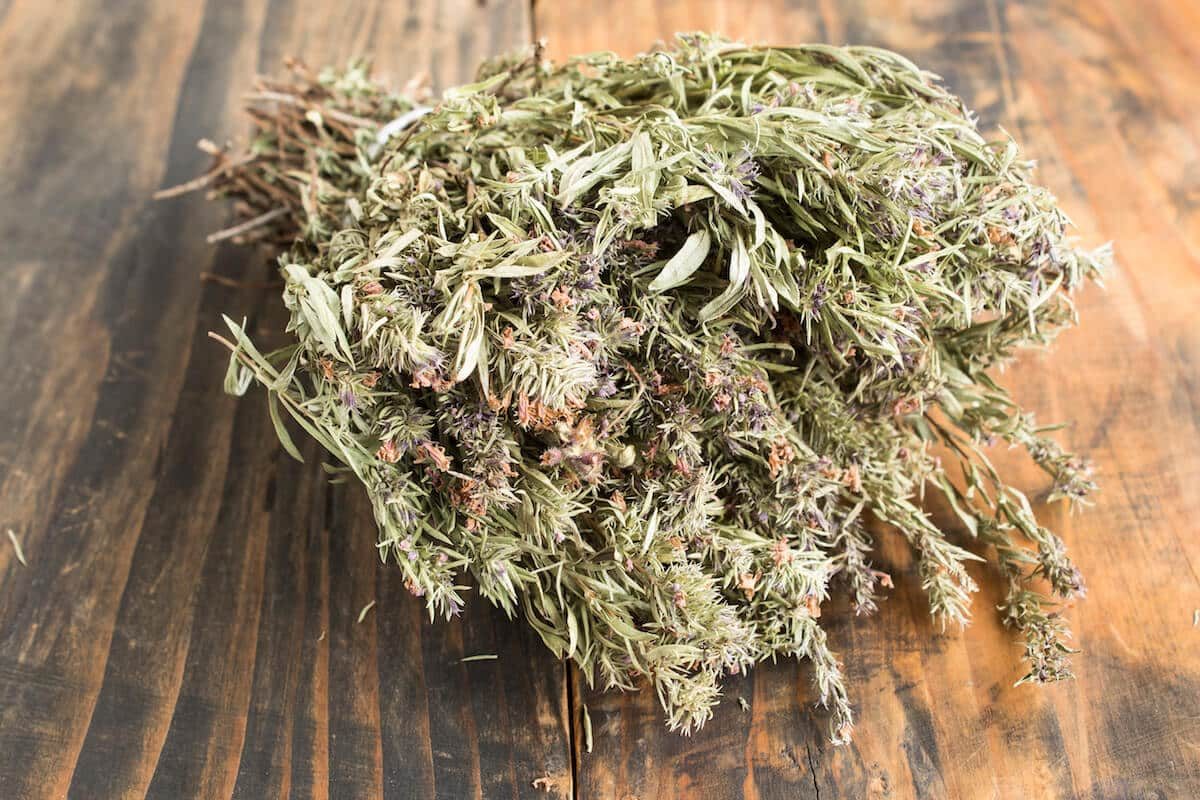
Summer savory is the leaf of Satureja hortensis, an annual herb in the mint family. It tastes sharp and warm, a little like thyme with a peppery edge, and its aroma comes mostly from carvacrol and γ-terpinene, two compounds it shares with oregano and thyme. This page covers what it is, where it grows, the chemistry behind its flavor, how cooks use it, and how it differs from winter savory.
At a glance
| Botanical name | Satureja hortensis L.1 |
| Plant family | Lamiaceae (mint family)1 |
| Life cycle | Annual12 |
| Part used | Leaves, fresh or dried2 |
| Native range | Southeastern Europe to Kazakhstan and northwestern Iran (Kew); Eurasia and North Africa (Britannica)12 |
| Main aroma compounds | Carvacrol and γ-terpinene, with thymol and p-cymene; proportions vary widely3 |
| Volatile oil | Up to 5% of dry weight3 |
| Forms sold | Fresh sprigs, dried leaf, ground |
| US status | Listed by the FDA as a spice generally recognized as safe4 |
Measured values
16 figures, sourced| Measure | Value | Scope | Source |
|---|---|---|---|
| Volatile oil | up to 5 % of dry weight | S. hortensis, 2018 review | mdpi.com |
| Carvacrol | 11–67 % of essential oil | Range across studies summarized in a 2018 review of S. hortensis (Fierascu et al.) | mdpi.com |
| γ-Terpinene | 15.30–39 % of essential oil | Range across studies summarized in a 2018 review of S. hortensis (Fierascu et al.) | mdpi.com |
| Thymol | 0.3–28.2 % of essential oil | Range across studies summarized in a 2018 review of S. hortensis (Fierascu et al.) | mdpi.com |
| p-Cymene | 3.5–19.6 % of essential oil | Range across studies summarized in a 2018 review of S. hortensis (Fierascu et al.) | mdpi.com |
| Carvacrol | 54.7 % of essential oil | Wild-growing Turkish plants (Dikbas et al., as tabulated in the 2018 review) | mdpi.com |
| γ-Terpinene | 20.9 % of essential oil | Wild-growing Turkish plants (Dikbas et al., as tabulated in the 2018 review) | mdpi.com |
| Thymol | 2.0 % of essential oil | Wild-growing Turkish plants (Dikbas et al., as tabulated in the 2018 review) | mdpi.com |
| p-Cymene | 12.3 % of essential oil | Wild-growing Turkish plants (Dikbas et al., as tabulated in the 2018 review) | mdpi.com |
| Carvacrol | 46.4 % of essential oil | Study following the oil through the growing season, ripened-fruit stage (reported in the 2018 review)γ-Terpinene was the main component at most other stages. | mdpi.com |
| Iron Nutrient | 37.9 mg per 100 g | USDA FoodData Central, savory, ground (FDC ID 170936, SR Legacy); entry does not say which species | fdc.nal.usda.gov |
| Potassium Nutrient | 1,050 mg per 100 g | USDA FoodData Central, savory, ground (FDC ID 170936, SR Legacy); entry does not say which species | fdc.nal.usda.gov |
| Calcium Nutrient | 2,130 mg per 100 g | USDA FoodData Central, savory, ground (FDC ID 170936, SR Legacy); entry does not say which species | fdc.nal.usda.gov |
| Magnesium Nutrient | 377 mg per 100 g | USDA FoodData Central, savory, ground (FDC ID 170936, SR Legacy); entry does not say which species | fdc.nal.usda.gov |
| Vitamin A (RAE) Nutrient | 257 µg per 100 g | USDA FoodData Central, savory, ground (FDC ID 170936, SR Legacy); entry does not say which species | fdc.nal.usda.gov |
| Vitamin C Nutrient | 50 mg per 100 g | USDA FoodData Central, savory, ground (FDC ID 170936, SR Legacy); entry does not say which species | fdc.nal.usda.gov |
Each figure is quoted as its source states it, with the samples or standard it applies to. Where sources differ, both are shown; nothing is averaged. All measured values
What summer savory is
Summer savory is an aromatic annual with square stems covered in fine hairs, sometimes tinged purple, and narrow gray-green leaves about 2.5 cm (1 inch) long, arranged in opposite pairs.2 The German dictionary Duden describes the plant (as Bohnenkraut) as having narrow, elongated leaves and small white or lilac flowers.5
Its close relative, winter savory (Satureja montana), is a perennial subshrub rather than an annual.62 The two can be used the same way in cooking, though Britannica describes winter savory as harsher and more bitter.2 See winter savory and summer savory vs. winter savory.
Native range
Kew’s Plants of the World Online gives summer savory’s native range as southeastern Europe to Kazakhstan and northwestern Iran, listing it as native to Albania, Iran, Italy, Kazakhstan, Crimea and the northwestern Balkans, and doubtfully present in Türkiye.1 Kew lists it as introduced in France, Germany, Spain, Portugal, Greece and several US states, among other places.1 Britannica gives a broader native range of Eurasia and North Africa.2 We treat Kew as the botanical authority and note the difference. The widely repeated statement that summer savory is “native to the Mediterranean” is too loose for either source.
Flavor and aroma
Britannica describes summer savory’s flavor as delicate, sweet and spicy, with a fragrant aroma and a slightly sharp, warm taste.2 In a pot of beans or a stuffing it reads as peppery and thyme-like, with less of oregano’s bite. That comparison is ours.
The compounds
The flavor sits in the volatile oil, which a 2018 review puts at up to 5% of the plant on a dry-weight basis.3 Four compounds dominate most analyses, but how much of each depends on the plant, where it grew and when it was cut. The review attributes the spread to season, climate, growing practice and geography.3
| Scope | Carvacrol | γ-Terpinene | Thymol | p-Cymene | Source |
|---|---|---|---|---|---|
| Range across studies summarized in a 2018 review of S. hortensis | 11–67% | 15.30–39% | 0.3–28.2% | 3.5–19.6% | 3 |
| Wild-growing Turkish plants (Dikbas et al., as tabulated in the same review) | 54.7% | 20.9% | 2.0% | 12.3% | 3 |
The same review reports a study that followed the oil through the growing season: γ-terpinene was the main component at most stages, and carvacrol took the lead (46.4%) only at the ripened-fruit stage.3 These figures come from different samples and methods, so they should not be averaged into one number. The practical point is that two jars of summer savory can smell noticeably different. For comparison, one Croatian sample of winter savory, distilled from flowering plants in August 2007, had 13.7% carvacrol, 11.8% p-cymene and 10.6% γ-terpinene, with only 1.9% thymol.7
Carvacrol and thymol are the same phenols that characterize oregano and thyme. A review of oregano chemistry notes that the name “oregano” is sometimes applied to plants from other genera, Satureja among them.8
Origin and history
The English word savory goes back to Latin satureia, which the Online Etymology Dictionary calls “a foreign word of unknown origin”; the herb’s name appears in English from the late 14th century.9 A widely repeated story says the name comes from “satyr”, the goat-legged figure of Greek myth, because Pliny thought the herb an aphrodisiac. The etymology dictionary does not support the satyr link, and we could not trace the Pliny reference to an edition we could open, so this page does not repeat it.
Several other claims about savory’s history circulate widely and could not be traced to any source: that Romans used it as a salt substitute, that Roman armies carried it to England, that it was one of Europe’s only strong seasonings before black pepper arrived from Asia, and that Romans made a savory vinegar. Virgil is often said to have recommended planting savory near beehives; we could not open a text and translation to check that reading, so it is left out here.
How summer savory is used
Britannica notes that savory is grown for its leaves, which season food, particularly poultry and stuffings.2
- Beans. The German name is Bohnenkraut, built on the word for beans, and Duden defines it as a plant used as a seasoning especially for bean dishes.5 The often-repeated reason, that savory prevents gas, has no source behind it that meets our standard.
- Herbes de Provence. Savory (sarriette) is one of the four main herbs in the French Label Rouge specification for herbes de Provence, at 26–27% of the blend alongside rosemary and oregano, with thyme at 19%.10 See herbes de Provence.
- Stuffing and poultry. This is the use Britannica singles out.2 See also poultry seasoning.
In the kitchen it behaves much like thyme and marjoram, its mint-family relatives: add the dried leaf early to braises and bean pots, and the fresh leaf later. That is kitchen judgment rather than a measured fact. For more ideas, see summer savory uses and cooking with summer savory.
Buying and quality
No international or national quality standard for savory was found. When buying dried summer savory, look for gray-green leaf with a sharp smell when rubbed; that is kitchen judgment, not a standard.
Nutrition
USDA FoodData Central lists ground savory (the entry does not say which species) at 37.9 mg iron, 1,050 mg potassium, 2,130 mg calcium, 377 mg magnesium, 257 µg vitamin A (RAE) and 50 mg vitamin C per 100 g.11 Those figures are per 100 g of dried herb; a recipe typically uses a teaspoon or less, so savory is not a meaningful source of these nutrients in normal cooking.
Storage
We found no published shelf-life figure for dried savory from a regulator or standards body. Because the flavor lives in a volatile oil, the practical test is smell: if a pinch rubbed between your fingers smells faint, the savory has faded.
Safety and health claims
The FDA lists summer savory (as Satureia hortensis) among spices generally recognized as safe.4 Britannica notes that savory’s essential oils have potential antioxidant, antimicrobial and anti-inflammatory properties and that it has been used traditionally for various ailments.2 The NIH’s National Center for Complementary and Integrative Health has no fact sheet on savory.12 This page makes no claim that summer savory treats or prevents any condition, including the digestive and anti-gas uses often attributed to it.
Substitutes and comparisons
Winter savory is the closest stand-in; it is stronger and more bitter, so start with less. Thyme is the usual second choice. No source we found gives a tested swap ratio. See summer savory substitutes, winter savory substitutes and summer savory vs. winter savory.
Related pages
Footnotes
-
Satureja hortensis L., Plants of the World Online, Royal Botanic Gardens, Kew. powo.science.kew.org · Reference work ↩ ↩2 ↩3 ↩4 ↩5 ↩6
-
“Savory”, Encyclopaedia Britannica, 2026. britannica.com · Reference work ↩ ↩2 ↩3 ↩4 ↩5 ↩6 ↩7 ↩8 ↩9 ↩10 ↩11
-
Fierascu et al., “Phytochemical Profile and Biological Activities of Satureja hortensis L.: A Review of the Last Decade”, Molecules, 2018. mdpi.com · Peer-reviewed ↩ ↩2 ↩3 ↩4 ↩5 ↩6 ↩7
-
21 CFR 182.10, Spices and other natural seasonings and flavorings, US Food and Drug Administration. ecfr.gov · Regulator ↩ ↩2
-
Satureja montana L., Plants of the World Online, Royal Botanic Gardens, Kew. powo.science.kew.org · Reference work ↩
-
Bezić et al., “Essential Oil Composition and ITS Sequence Variability of Four South-Croatian Satureja Species”, Molecules, 2009. mdpi.com · Peer-reviewed ↩
-
Lombrea et al., “A Recent Insight Regarding the Phytochemistry and Bioactivity of Origanum vulgare L. Essential Oil”, International Journal of Molecular Sciences, 2020. mdpi.com · Peer-reviewed ↩
-
“savory (n.)”, Online Etymology Dictionary. etymonline.com · Reference work ↩
-
Label Rouge LA 02/03 “Herbes de Provence” specification, INAO, 2014. extranet.inao.gouv.fr · Regulator ↩
-
Spices, savory, ground (FDC ID 170936), USDA FoodData Central. fdc.nal.usda.gov · Regulator ↩
-
Herbs at a Glance, National Center for Complementary and Integrative Health. nccih.nih.gov · Regulator ↩