Herbs · Profile
Bouquet Garni: What Goes in the Classic French Herb Bundle
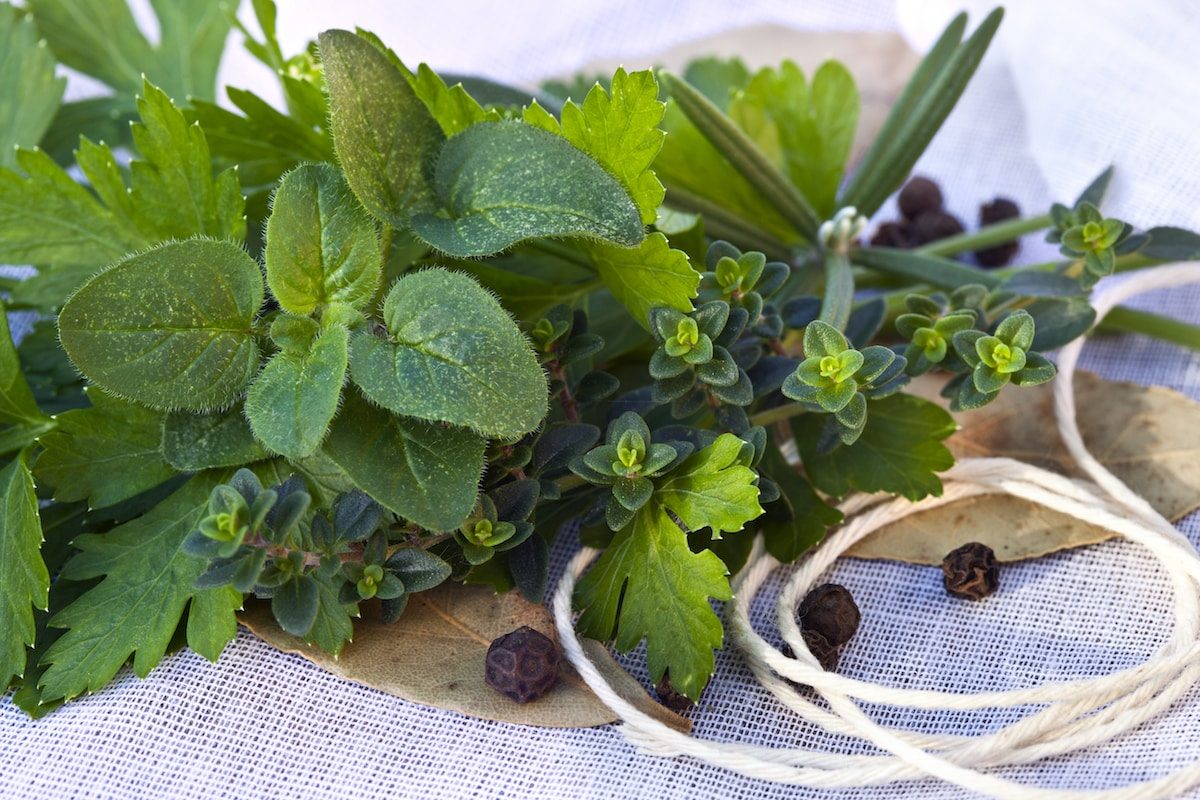
A bouquet garni is a small bundle of herbs that cooks in a soup, stew, sauce or poaching liquid and comes out before the dish is served. The classic French version is parsley, thyme and a bay leaf. This page covers what goes in it, where the idea comes from, how to make and use one, and how it differs from the other French herb mixes.
At a glance
| What it is | A bundle of herbs cooked with a dish and removed before serving12 |
| Classic contents | Parsley, thyme and a bay leaf1 |
| Common additions | Celery, garlic, fennel, orange peel, marjoram1 |
| Form | Tied together if fresh; wrapped in cheesecloth if dried1 |
| Typical uses | Soups, stews, sauces, poaching liquids, stocks13 |
| First appears | In French cookery in the 17th century; in English in the mid-19th century2 |
What goes in it
Britannica gives the classic bouquet garni as sprigs of parsley and thyme and a bay leaf, and lists celery, garlic, fennel, orange peel and marjoram as common additions.1 There has never been one fixed recipe, and the historical versions show how much it has varied:
| Version | Contents | Source |
|---|---|---|
| Classic, per Britannica | Parsley, thyme, bay leaf | 1 |
| Pierre de Lune, Le Cuisinier (1656), as given in The Oxford Companion to Food | A strip of bacon, chives, thyme, cloves, chervil, parsley | 2 |
| Pierre de Lune, per food historian Christianne Muusers | Thyme, chervil, parsley, cloves, with lard or bacon on meat days | 4 |
| Escoffier, brown stock (English edition) | A little parsley, a stick of celery, a small sprig of thyme, a bay leaf | 3 |
| Escoffier, white veal stock | 1 oz of parsley, 1 bay leaf, a small sprig of thyme | 3 |
Two things stand out. Bay is absent from de Lune’s 17th-century bundle and central to the later classic version.21 And in Escoffier’s veal stock, parsley dominates: an ounce of it against one bay leaf and a small sprig of thyme.3
What each herb brings
The flavor of a bouquet garni is the sum of its herbs, so it varies with the recipe. For the chemistry and flavor of each, see the profiles for parsley, thyme, bay leaves, chervil and marjoram, and for spices sometimes tucked in, cloves and black pepper. Peppercorns and tarragon are sometimes suggested as additions, but we found no source among those above that includes them.
History
The Oxford Companion to Food says the bundle began to appear in French cookery in the 17th century, as cooks moved away from highly spiced medieval dishes toward subtler flavors, and that even in 1656 Pierre de Lune thought he needed to explain what it was.2 The term came into English in the mid-19th century.2
De Lune’s Le Cuisinier (1656) is the best-documented early source. Christianne Muusers of Coquinaria, which publishes historical recipes, notes that he called the bundle a paquet, counts it among the book’s important innovations, and records that little is known about his life.4 Two details differ from the modern idea: it included cloves, and on meat days a piece of lard or bacon went in with the herbs.4 Both accounts list the bacon or lard as one of the bundle’s components; neither describes the herbs as wrapped in it.24
A widely repeated claim says the bouquet garni was used in the Middle Ages to mask the flavor of food. We found no source for that; the Oxford Companion frames its arrival as part of the move away from heavily spiced medieval cooking.2
The bouquet garni belongs to French cooking in general, not to any one region. The sources above tie it to French cookery and to classic stocks, not specifically to Provence.123
How to make and use one
Britannica’s method: tie fresh herbs together, or wrap dried herbs in cheesecloth, add the bundle to the liquid, and remove it before the dish is served.1 Escoffier puts one into each of his fundamental stocks.3
A few practical points, which are kitchen judgment rather than sourced findings:
- Leave a long tail on the string and tie it to the pot handle so the bundle is easy to fish out.
- Dried-herb bundles in cheesecloth suit long braises where loose leaves would scatter.
- Add the bundle with the liquid and let it cook as long as the dish does, then taste before removing it.
Removing the bundle also takes out the whole bay leaf. That matters: case reports describe whole bay leaves lodging in the esophagus, and one leaf penetrating the bowel wall.56
Bouquet garni, fines herbes and herbes de Provence
These three French herb terms are often confused:
- Bouquet garni is a bundle that is cooked in a dish and removed.1
- Fines herbes is a mix of herbs, commonly parsley, chives, tarragon and chervil, used as a seasoning or garnish.7
- Herbes de Provence is a blend of dried herbs; the French Label Rouge specification requires drying.8 It stays in the food.
Health
A bouquet garni is removed before the dish is served,1 so it is a flavoring rather than a meaningful source of nutrients, and this page makes no health claims for it. Nutrition figures for individual herbs are on their own profile pages.
Substitutes and related pages
If you have no fresh herbs, a pinch of dried thyme and a bay leaf added loose, or a dried blend, will do some of the same work; this is cooking judgment, and no source we found gives a tested ratio. See bouquet garni substitutes.
Footnotes
-
“Bouquet garni”, Encyclopaedia Britannica. britannica.com · Reference work ↩ ↩2 ↩3 ↩4 ↩5 ↩6 ↩7 ↩8 ↩9 ↩10 ↩11 ↩12
-
“Bouquet garni”, in Alan Davidson, The Oxford Companion to Food, Oxford University Press, via ckbk. app.ckbk.com · Reference work ↩ ↩2 ↩3 ↩4 ↩5 ↩6 ↩7 ↩8 ↩9
-
A. Escoffier, A Guide to Modern Cookery, Project Gutenberg. gutenberg.org · Reference work ↩ ↩2 ↩3 ↩4 ↩5 ↩6
-
Christianne Muusers, “Salmon in red wine sauce”, Coquinaria. coquinaria.nl · Publication ↩ ↩2 ↩3 ↩4
-
Ahmed and McCormick, “Bay-leaf: an unusual oesophageal foreign body”, Journal of Laryngology & Otology, 1993. cambridge.org · Peer-reviewed ↩
-
Bell and Mustard, “Bay leaf perforation of Meckel’s diverticulum”, Canadian Journal of Surgery, 1997. canjsurg.ca · Peer-reviewed ↩
-
“Fines herbes”, Encyclopaedia Britannica. britannica.com · Reference work ↩
-
Cahier des charges du Label Rouge LA 02/03 “Herbes de Provence”, INAO. extranet.inao.gouv.fr · Regulator ↩