Seasonings · Profile
Herbes de Provence: What’s in the Blend, the Label Rouge Recipe, and How to Use It
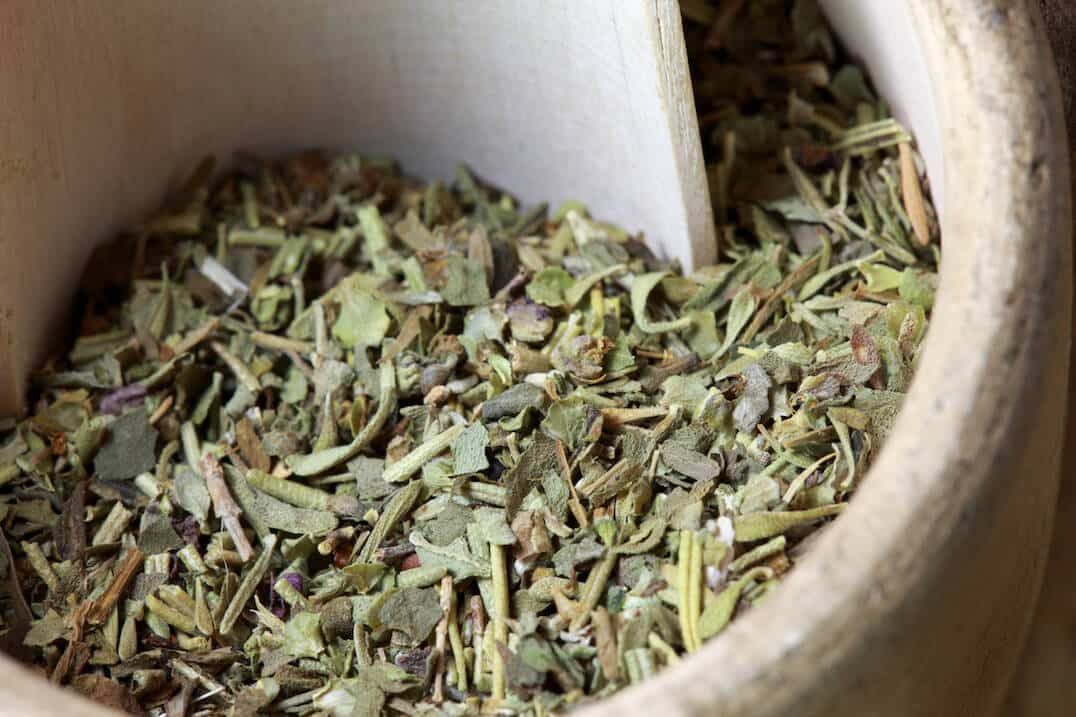
Herbes de Provence is a blend of dried Mediterranean herbs named for Provence in southeastern France, built around thyme, rosemary, savory and oregano. In France one version is protected by a Label Rouge specification with fixed proportions; everywhere else, the name covers whatever a maker puts in the jar, sometimes including lavender. This page covers what goes into it, the certified recipe, the compounds behind its smell, how it is used, and what to know when buying it.
At a glance
| What it is | A blend of dried, cut herb leaves1 |
| Typical components | Thyme, rosemary, savory and oregano (Label Rouge)12; marjoram, basil, fennel seed, mint, tarragon and others in commercial blends (The Takeout)3 |
| Lavender? | Not in the Label Rouge blend;1 added to some commercial blends3 |
| Origin | Named for Provence; a packaged blend sold by Ducros by the 1970s (The Takeout)3 |
| Forms sold | Dried leaf blend |
| Certification | French Label Rouge LA 02/03, held by the Association Interprofessionnelle des Herbes de Provence1 |
| Where commercial herbs come from | Generally not from Provence, according to Label Rouge producers (2008)4 |
Measured values
18 figures, sourced| Measure | Value | Scope | Source |
|---|---|---|---|
| Composition: thyme Limit | 19 % of the blend | Label Rouge blend as described by Reussir, 2008 (2003 label)Composition specification | reussir.fr |
| Composition: rosemary, savory and oregano, each Limit | 26 % of the blend | Label Rouge blend as described by Reussir, 2008 (2003 label)Composition specification | reussir.fr |
| Composition: basil Limit | 3 % of the blend | Label Rouge blend as described by Reussir, 2008 (2003 label)Composition specification | reussir.fr |
| Composition: thyme Limit | 19 % of the blend | Label Rouge LA 02/03, INAO 2014 modification request | extranet.inao.gouv.fr |
| Composition: rosemary, savory and oregano, each Limit | 26 / 27 % of the blend | Label Rouge LA 02/03, INAO 2014 modification requestDocument shows both 26% and 27%, read as a proposed change; sources differ | extranet.inao.gouv.fr |
| Composition: basil Limit | 3 % of the blend | Label Rouge LA 02/03, INAO 2014 modification request | extranet.inao.gouv.fr |
| Composition: thyme | 19 % of the blend | Ducros Label Rouge product specification, 2025company's own figures | mccormickforchefs.com |
| Composition: rosemary, savory and oregano, each | 27 % of the blend | Ducros Label Rouge product specification, 2025No basil in this specification; company's own figures | mccormickforchefs.com |
| Essential oil, minimum per herb: thyme Limit | 3 % | Label Rouge LA 02/03 (2014 text) | extranet.inao.gouv.fr |
| Essential oil, minimum per herb: oregano Limit | 3.5 % | Label Rouge LA 02/03 (2014 text) | extranet.inao.gouv.fr |
| Essential oil, minimum per herb: rosemary Limit | 1.8 % | Label Rouge LA 02/03 (2014 text) | extranet.inao.gouv.fr |
| Essential oil, minimum per herb: savory Limit | 1.4 % | Label Rouge LA 02/03 (2014 text) | extranet.inao.gouv.fr |
| Essential oil, minimum per herb: basil Limit | 0.4 % | Label Rouge LA 02/03 (2014 text) | extranet.inao.gouv.fr |
| Essential oil, finished blend, minimum Limit | 2 % | Label Rouge LA 02/03 (2014 text) | extranet.inao.gouv.fr |
| Moisture, maximum Limit | 14 % | Label Rouge LA 02/03 (2014 text) | extranet.inao.gouv.fr |
| Stems, maximum Limit | 2.2 % | Label Rouge LA 02/03 (2014 text) | extranet.inao.gouv.fr |
| Foreign matter, maximum Limit | 1 % | Label Rouge LA 02/03 (2014 text) | extranet.inao.gouv.fr |
| Acid-insoluble ash, maximum Limit | 0.8 % | Label Rouge LA 02/03 (2014 text) | extranet.inao.gouv.fr |
Each figure is quoted as its source states it, with the samples or standard it applies to. Where sources differ, both are shown; nothing is averaged. All measured values
What is in it
The Label Rouge recipe
One version of the blend carries the French Label Rouge quality mark. Its specification, LA 02/03, published by France’s INAO, is held by the Association Interprofessionnelle des Herbes de Provence (AIHP) and fixes both the herbs and their proportions: thyme, rosemary, savory and oregano, with basil in the original version.1 Lavender is not part of it.1 The trade paper Réussir reported in 2008 that the label was obtained in 2003 for a precisely defined blend.4
The proportions have changed, and the sources do not all show the same figures:
| Source | Thyme | Rosemary | Savory | Oregano | Basil |
|---|---|---|---|---|---|
| Réussir, 2008, describing the 2003 label | 19% | 26% | 26% | 26% | 3% |
| INAO, 2014 modification request | 19% | 26% / 27% | 26% / 27% | 26% / 27% | 3% |
| Ducros Label Rouge product specification, 2025 | 19% | 27% | 27% | 27% | none |
The 2014 document on INAO’s site shows both 26% and 27% for the three main herbs, which reads as a proposed change, and still lists 3% basil.1 Ducros’s 2025 sheet for its “red label” (Label Rouge) blend lists rosemary, savory and oregano at 27% each and thyme at 19%, with no basil.2 We could not open the final approved text of the current specification, so the table shows each source as it stands.142
The 2014 specification also sets out how the herbs are handled and what the finished blend must meet:1
| Requirement | Label Rouge LA 02/03 (2014 text) |
|---|---|
| Drying | In ventilated dryers; sun-drying alone is not allowed |
| Plant parts | Leaves only, sorted and cut plant by plant |
| Essential oil, minimum per herb | Thyme 3%, oregano 3.5%, rosemary 1.8%, savory 1.4%, basil 0.4% |
| Essential oil, finished blend | 2% minimum |
| Moisture, maximum | 14% |
| Stems, maximum | 2.2% |
| Foreign matter, maximum | 1% |
| Acid-insoluble ash, maximum | 0.8% |
| Treatment | Steam treatment after blending; irradiation prohibited |
| Color | A clean, uniform green |
Commercial blends
Outside the label, there is no fixed recipe. The Takeout’s Leah Kaplan gives the most common blend as rosemary, fennel seeds, thyme, marjoram and savory, along with basil, mint, oregano and tarragon, with some blends adding bay leaves, chervil or culinary lavender.3 She also writes that Julia Child’s version called for only thyme or savory, basil and ground fennel seed.3
Origin and history
The Takeout credits Julia Child with bringing the blend into American kitchens by the 1960s, and says the French brand Ducros was selling a packaged herbes de Provence by the 1970s.3 We could not find an older documentary source for the name.
The herbs in most jars are not from Provence. Label Rouge producers told Réussir in 2008 that herbs sold as “de Provence” generally do not come from the region, and estimated that genuine Provençal herbs held about 5% of the French market.4 We found no statistical source for which countries supply the rest; widely repeated lists naming North Africa, China and eastern Europe could not be traced.
On lavender, Kaplan writes that it was added to the blend to appeal to tourists.3 That is her account rather than a documented history, but the Label Rouge recipe’s exclusion of lavender is a matter of record.1
Flavor and the compounds behind it
The blend smells resinous and savory, with a peppery, thyme-like warmth. That description is ours. The aroma comes from the essential oils of the individual herbs, which have been measured separately:
| Herb | Main compounds | What has been measured | Source |
|---|---|---|---|
| Thyme | Thymol | 42.44% of the oil in one 2023 sample of common thyme | 5 |
| Rosemary | α-pinene, 1,8-cineole, camphor | α-pinene 13.5–37.7%, 1,8-cineole 16.1–29.3%, camphor 0.7–7.0% across samples | 6 |
| Oregano | Carvacrol and thymol | Together about 78–85% of the oil (review) | 7 |
| Basil (sweet) | Estragole | 20–43% of the oil | 8 |
No source was opened for savory or lavender chemistry, and no study of the blend’s aroma as a whole was found. Because the Label Rouge recipe sets minimum oil contents for each herb, it is the one version of the blend where aroma strength is specified.1
How it is used
The Takeout recommends it for grilling fish, marinating meat and roasting vegetables, and in stews and ratatouille, which is usually cooked in olive oil with a generous amount of the blend; a pinch also goes into vinaigrettes and marinades.3 Kaplan suggests leaning on fennel for bouillabaisse and on thyme for roast chicken.3 Dried woody herbs like these are usually added early, so they have time to soften and release their flavor. That is common practice rather than a measured finding.
For more ideas, see herbes de Provence uses and cooking with herbes de Provence.
Making your own
The Takeout suggests grinding the rosemary and fennel first, then mixing in the other dried herbs, and says the proportions need not be exact.3 The Label Rouge table above gives one documented set of proportions to start from.
Buying and quality
In France, the red Label Rouge mark identifies the certified blend, made to the recipe and quality limits above.1 Elsewhere, check the ingredient list: it tells you whether the jar includes lavender, which changes the flavor noticeably, and whether it leans on thyme and savory or on marjoram and basil. A good blend is green rather than gray-brown and smells strongly when rubbed. The Label Rouge specification requires a clean, uniform green and limits stems to 2.2%.1
Storage
The Takeout says the blend can last up to a year in an airtight container in a cool, dry place, and should be replaced when its color or aroma fades.3 Ducros gives its Label Rouge blend a best-before period of 24 months, stored in a dry, cool place away from light.2 These are a writer’s guidance and a manufacturer’s date for its own product, not measured shelf lives.
Safety
At food amounts the herbs in the blend raise no specific regulatory concern that we found. On lavender, NCCIH says it is likely safe in food amounts.9 Basil contains estragole, which the European Commission’s Scientific Committee on Food found to be genotoxic and carcinogenic in studies mainly of mice given it orally.8 Basil is a small part of the blend where it appears at all, at 3% in the original Label Rouge recipe and absent from the 2025 Ducros sheet.42
Health claims
Lavender is often credited with calming effects. NCCIH says it is unclear whether lavender aromatherapy helps with sleep or stress, and that the evidence that an oral lavender oil product might help anxiety is limited by small studies.9 None of that research concerns lavender eaten in an herb blend. This page makes no health claim for herbes de Provence, and claims that the blend boosts immunity or strengthens bones could not be traced to any source.
Substitutes and comparisons
The closest everyday stand-in is Italian seasoning. The USDA’s purchase specification describes Italian seasoning as a blend of thyme, rosemary, sage, oregano and basil,10 which overlaps heavily with herbes de Provence but adds sage and lacks savory. The Takeout says the two can typically be swapped one for one in everyday cooking, while noting they are not a direct match.3 See herbes de Provence vs. Italian seasoning, herbes de Provence substitutes and Italian seasoning.
Other French blends: fines herbes, which The Takeout describes as lighter and better as a finishing herb,3 and bouquet garni.
The herbs themselves: thyme, rosemary, summer savory, winter savory, oregano, marjoram, basil, lavender, tarragon, fennel seed and bay leaves. See also rosemary vs. lavender and summer savory vs. winter savory.
Footnotes
-
Cahier des charges du Label Rouge LA 02/03 « Herbes de Provence », modification request, INAO, 2014. extranet.inao.gouv.fr · Regulator ↩ ↩2 ↩3 ↩4 ↩5 ↩6 ↩7 ↩8 ↩9 ↩10 ↩11 ↩12 ↩13
-
“Provencal herbs red label 78g”, product specification, McCormick for Chefs (Ducros), 2025. mccormickforchefs.com · Merchant ↩ ↩2 ↩3 ↩4 ↩5
-
Leah Kaplan, “What Is Herbs De Provence, Really?”, The Takeout, 2025. thetakeout.com · Publication ↩ ↩2 ↩3 ↩4 ↩5 ↩6 ↩7 ↩8 ↩9 ↩10 ↩11 ↩12 ↩13
-
Sylvie Carriat, “Les vraies herbes de Provence raniment la flamme”, Réussir Les Marchés, 2008. reussir.fr · Publication ↩ ↩2 ↩3 ↩4 ↩5
-
Dong et al., “Chemical Compositions of Essential Oil Extracted from Eight Thyme Species”, Plants, 2023. mdpi.com · Peer-reviewed ↩
-
Satyal et al., “Chemotypic Characterization and Biological Activity of Rosmarinus officinalis”, Foods, 2017. mdpi.com · Peer-reviewed ↩
-
Lombrea et al., “A Recent Insight Regarding the Phytochemistry and Bioactivity of Origanum vulgare L. Essential Oil”, International Journal of Molecular Sciences, 2020. pmc.ncbi.nlm.nih.gov · Peer-reviewed ↩
-
Opinion of the Scientific Committee on Food on Estragole, European Commission, 2001. food.ec.europa.eu · Regulator ↩ ↩2
-
“Lavender”, National Center for Complementary and Integrative Health, 2025. nccih.nih.gov · Regulator ↩ ↩2
-
Commercial Item Description A-A-20001C, Spices and Spice Blends, USDA Agricultural Marketing Service, 2023. ams.usda.gov · Regulator ↩