Cooking · Cooking with
Cooking With Turmeric: Blooming, Fresh vs. Ground, and How Much to Use
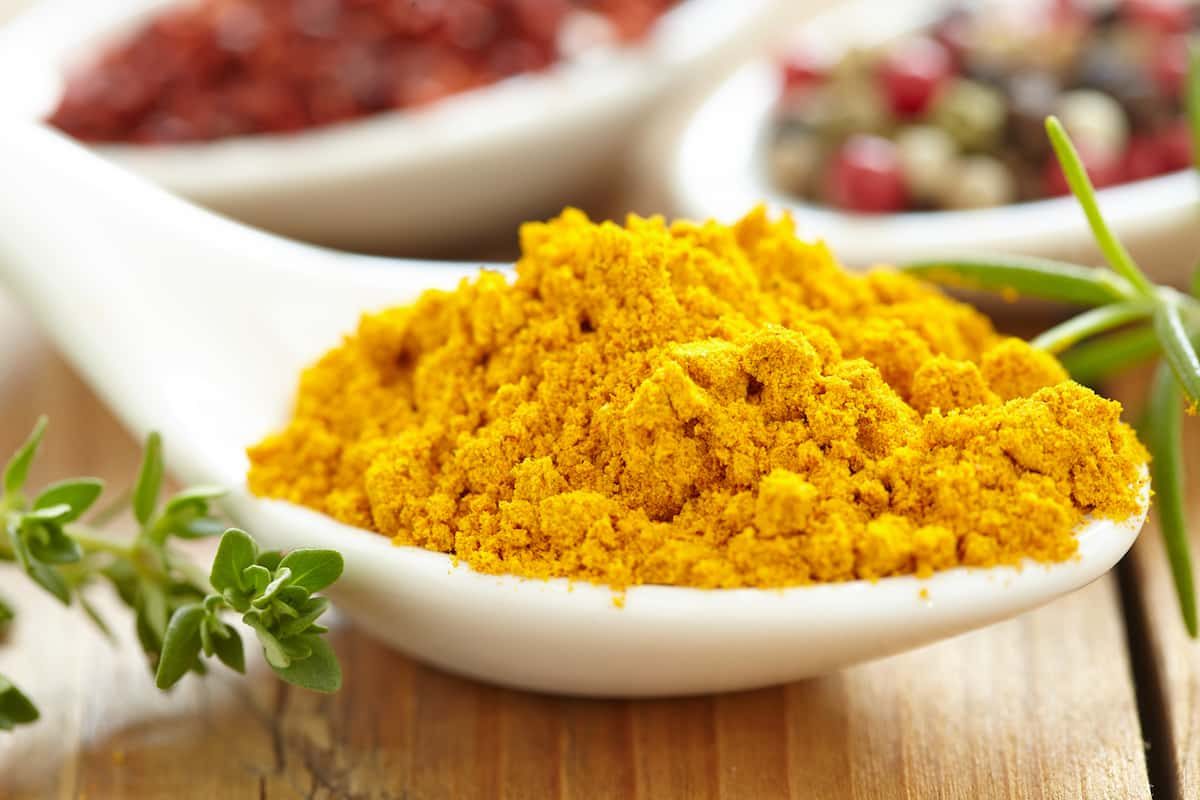
Turmeric is the rhizome of Curcuma longa, a plant of the ginger family known from cultivation in southwestern India.12 Curcumin gives it its yellow color.2 Its taste is not neutral: a reference chapter on the spice describes it as bitter, slightly acrid, yet sweet.3 Most of cooking with turmeric comes down to three things: cook ground turmeric briefly in fat, use it in modest amounts, and expect it to stain.
Bloom ground turmeric in oil
Gernot Katzer describes the typical procedure as frying turmeric in a little oil at the beginning of cooking, which releases its aroma and gives a deep yellow color.4 America’s Test Kitchen explains the general case for ground spices: added straight to a pot, they can taste bland and musty, and blooming them in fat helps.5 ATK also warns that ground spices burn fairly quickly and turn scorched, so blooming takes anywhere from 30 seconds to several minutes.5
Our approach (Method) for curries and stews: add turmeric to the hot oil with or just after the onions, stir for under a minute, then add liquid. Many dals do it differently: Saveur’s Hyderabadi khatti dal stirs 1/4 teaspoon of ground turmeric into 1 cup of simmering toor dal and cooks it about 45 minutes, then adds a separate tempering of cumin and mustard seeds popped in hot oil.6 Katzer notes that he found the largest quantities of turmeric in boiled lentils.4
How much to use
No reference gives a standard amount. Saveur’s khatti dal uses 1/4 teaspoon of ground turmeric for 1 cup of dry dal (Attributed).6 A widely repeated claim that 1/8 teaspoon is enough to color a dish has no source we could find.
Our starting point (Method): 1/4 to 1/2 teaspoon ground turmeric for a dish serving four, raised only if you want more color. Because turmeric itself tastes bitter and acrid,3 heavy-handed use shows up as bitterness as well as a darker, duller yellow. If that has happened, see too much turmeric.
Turmeric is a supporting spice. Katzer says it is part of all curry powders,4 and the reference chapter says it gives curry its distinctive yellow color and flavor.3 On its own it gives color and an earthy bitterness rather than a full flavor, so it is usually paired with cumin, coriander, ginger, chiles and onion; that pairing is common practice.
Fresh turmeric
Turmeric is in the ginger family,2 and the fresh rhizome is handled much like ginger: peeled, then grated, sliced or pounded. Katzer says fresh turmeric is much preferred to dried in Southeast Asia, and that in Thailand the fresh rhizome is grated into curries.4 Mark Wiens calls fresh turmeric an absolute necessity for southern Thai gaeng som, a sour fish curry.7
Converting fresh to ground. McCormick gives a 1-inch piece of fresh root as equal to 1 teaspoon ground (Attributed).8 A common rule of three times as much fresh as ground has no source we could find. Whether fresh is “better for you” than ground is not established; NCCIH says there is not enough evidence to conclude that turmeric or curcumin is beneficial for health.2 See fresh turmeric vs. powder.
Color for rice
The reference chapter notes that turmeric is traditionally used to color boiled white rice golden.3 Katzer adds that turmeric-colored rice is not very common in India itself, though yellow rice (nasi kuning) takes its color from fresh or dried turmeric.4 He is blunt about saffron: turmeric lacks saffron’s aroma, so he does not consider it an acceptable substitute.4 It can match the color, not the flavor. More in saffron vs. turmeric.
Staining
Katzer notes turmeric’s staining power, especially fresh,4 and Wiens warns that it stains everything yellow-orange, plastic in particular.7 Use a glass, metal or dedicated board and wear gloves when grating fresh rhizome; that is our suggestion.
Black pepper and curcumin
A common tip says to add black pepper to turmeric so the body absorbs it. Black pepper’s characteristic flavor comes mainly from piperine,9 and NCCIH says combining curcumin with piperine is one way to improve curcumin’s bioavailability.2 That finding comes from supplement research, and NCCIH also notes that liver damage has been reported in some people taking turmeric supplements.2 It does not show that a pinch of pepper in a curry makes the dish healthier. Pepper belongs in many turmeric dishes for flavor, which is reason enough.
Storage
| Guidance | Ground spices | Source |
|---|---|---|
| University of California Cooperative Extension | 1 year | UCCE10 |
| McCormick (its own products) | 2 to 4 years | McCormick11 |
Neither figure is specific to turmeric. Light matters for this spice in particular: in a 2025 lab study of turmeric oleoresin in solution, curcumin’s half-life was 9.9 hours under white LED light and 15.1 hours under fluorescent light, with no color loss in the dark.12 That is an extract under lamps, not a jar in a cupboard, but it supports keeping turmeric in an opaque, sealed container.
Buy from a reputable source
Lead chromate has been found added to turmeric to brighten its color. A 2026 study of 503 samples from 34 cities in eastern India found 30 percent above India’s lead limit of 10 micrograms per gram.13 In the United States, a 2017 study of 32 ground turmeric samples in the Boston area found 16 above FDA’s lead level for candy.14 Those findings are specific to the samples studied. Our turmeric profile covers recalls and regulatory limits.
Related
- Turmeric
- Turmeric substitutes
- Fresh turmeric vs. powder
- Turmeric vs. ginger
- Turmeric vs. curry powder
- Galangal vs. turmeric
Footnotes
-
Curcuma longa L., Plants of the World Online, Royal Botanic Gardens, Kew. powo.science.kew.org · Reference work ↩
-
“Turmeric: Usefulness and Safety”, National Center for Complementary and Integrative Health, 2025. nccih.nih.gov · Regulator ↩ ↩2 ↩3 ↩4 ↩5 ↩6
-
Prasad S, Aggarwal BB, “Turmeric, the Golden Spice”, in Herbal Medicine: Biomolecular and Clinical Aspects, 2011. ncbi.nlm.nih.gov · Reference work ↩ ↩2 ↩3 ↩4
-
Gernot Katzer, “Turmeric”, Gernot Katzer’s Spice Pages. gernot-katzers-spice-pages.com · Reference work ↩ ↩2 ↩3 ↩4 ↩5 ↩6 ↩7
-
“How to Bloom Spices”, America’s Test Kitchen, 2023. americastestkitchen.com · Publication ↩ ↩2
-
“Hyderabadi-Style Lentil Stew (Khatti Dal)”, Saveur, 2014. saveur.com · Publication ↩ ↩2
-
Mark Wiens, “Southern Thai Gaeng Som Recipe”, Eating Thai Food. eatingthaifood.com · Publication ↩ ↩2
-
“How to Grind Your Own Spices”, McCormick, 2025. mccormick.com · Merchant ↩
-
“Black pepper”, Encyclopaedia Britannica. britannica.com · Reference work ↩
-
Anna Martin, “Add a Little Spice to Your Life! Part II”, University of California Cooperative Extension, 2002. ucanr.edu · Reference work ↩
-
“How Long Do Spices Last?”, McCormick, 2025. mccormick.com · Merchant ↩
-
Kim, Oh and Hong, “Photodegradation of Turmeric Oleoresin Under Fluorescent Light and White LED”, Molecules, 2025. mdpi.com · Peer-reviewed ↩
-
Forsyth et al., “Systemic drivers of toxic food adulteration: lead chromate in turmeric across eastern India”, npj Science of Food, 2026. nature.com · Peer-reviewed ↩
-
Cowell et al., “Ground Turmeric as a Source of Lead Exposure in the United States”, Public Health Reports, 2017. journals.sagepub.com · Peer-reviewed ↩