Spice Comparisons · Comparison
Fresh Turmeric vs. Turmeric Powder: Processing, Flavor and Conversion
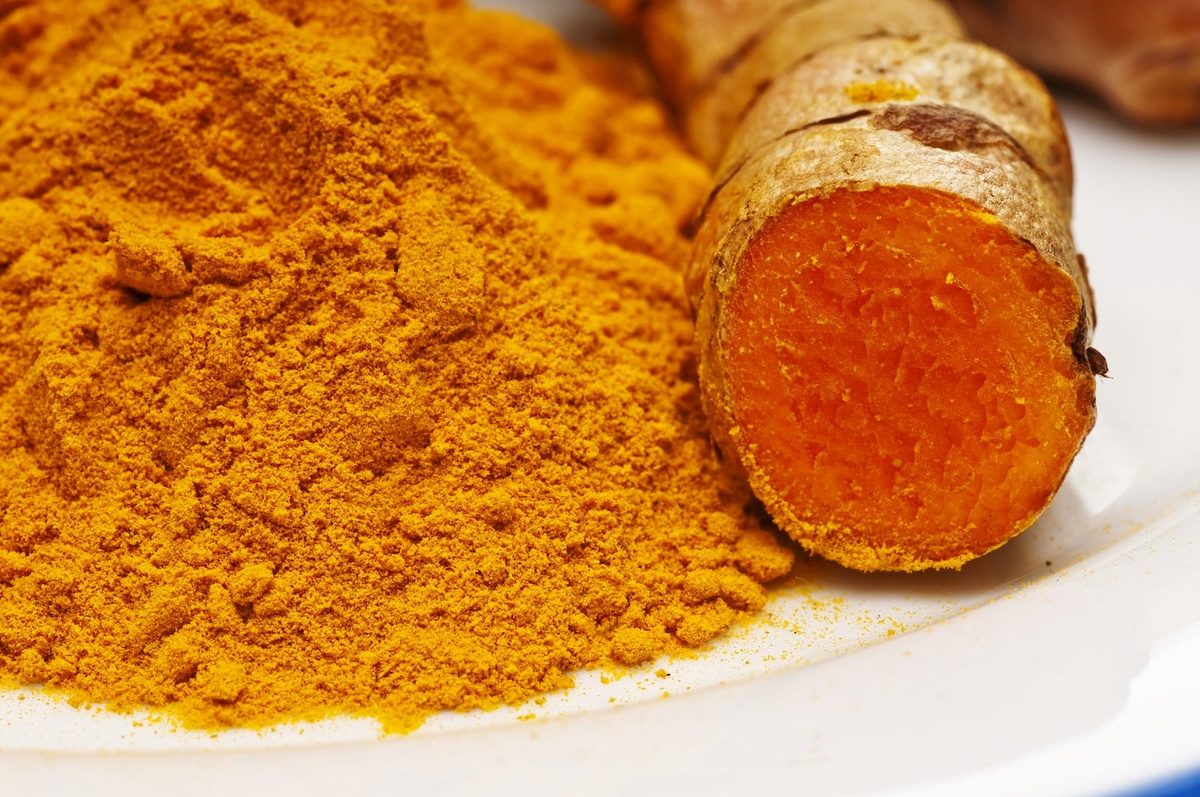
Fresh turmeric is the rhizome of Curcuma longa, a member of the ginger family.12 Turmeric powder is that rhizome after a cure: the rhizomes are boiled or steamed, sun-dried and polished before grinding.3 So the difference is not only texture. Curing changes the rhizome’s chemistry,4 polishing is where the spice’s worst safety problem enters,5 and fresh turmeric brings moisture and a sharper, more gingery taste that powder doesn’t.
Side by side
| Fresh turmeric | Turmeric powder | |
|---|---|---|
| Plant and part | Rhizome of Curcuma longa, family Zingiberaceae, known as a cultigen from southwestern India1 | Same rhizome, cured and ground3 |
| Processing | None; peeled or not, grated or sliced | Boiled or steamed to remove the raw odor, then sun-dried and polished3 |
| Color | Curcumin gives turmeric its yellow color2 | Same pigment; curcumin breaks down under light (see below)6 |
| Aroma compounds | Turmerone, ar-turmerone and zingiberene3 | Same; longer curing reduced essential oil in one study4 |
| Water | Not in USDA’s database | 12.8 g per 100 g7 |
| Flavor (editorial) | Bright, earthy and gingery, with a little bite | Earthy and bitter with a faint sweetness; a reference text describes turmeric as bitter, slightly acrid, yet sweet3 |
| Lead risk | Raw farm rhizomes tested low in one Indian survey8 | Where lead chromate is found, it is added mainly during polishing5 |
| Shelf life | No sourced figure found | 1 year for ground spices (UC extension);9 2–4 years (McCormick’s own guidance)10 |
What curing does
Boiling and drying. A reference chapter on turmeric describes the standard process: the rhizomes are boiled or steamed to remove the raw odor, then sun-dried and polished.3 A 2016 study of curing methods in India found that the longer the rhizomes were boiled or steamed, the more curcumin, starch, essential oil and oleoresin they lost.4 The best of the water-boiling treatments, 40 minutes, retained 5.91% curcumin and 3.6% essential oil.4 The study’s abstract does not give a figure for uncured rhizome, so it does not tell us how fresh turmeric compares.
Cooking with fresh turmeric. A 2023 study heated fresh turmeric rhizomes bought in Poland by boiling, frying and microwaving. The kind of heating and its length both changed the curcuminoid content; in microwaved samples, longer heating meant fewer curcuminoids, and a traditional 10-minute boil came out best.11 It is one lab study on one batch, and it does not compare fresh with dried powder.
Light. Curcumin breaks down under light. In a 2025 lab study of turmeric oleoresin in solution, curcumin’s half-life was 9.9 hours under white LED light, a little longer under fluorescent light.6 That was an extract in solution, not powder in a jar, but it is a good reason to store turmeric powder in the dark.
The safety difference: lead chromate
The serious difference between the two forms is adulteration. In a survey of 503 turmeric samples from 34 cities in eastern India, 30% exceeded India’s lead limit of 10 µg/g.5 The authors found that lead chromate, a yellow pigment, was principally added to turmeric roots during polishing, and that double-polished roots and loose powder had higher odds of exceeding the limit than single-polished roots.5 By contrast, a 2026 survey by the Indian nonprofit Toxics Link of 13 raw rhizomes from farms found lead from below the limit of quantification up to 1.87 mg/kg.8 Those two studies cover different samples and regions, so they show where the risk enters rather than measuring fresh against powdered turmeric directly. More on testing, recalls and limits is on the turmeric profile.
Can you swap them?
Yes for color and broad flavor; with care for texture.
Fresh to powder (Computed, McCormick’s figure): McCormick’s conversion is a 1-inch piece of fresh root for 1 teaspoon of ground turmeric.12 That is the same figure used on our turmeric substitutes page. It does not account for the thickness of the rhizome or how fresh it is. A widely repeated rule says to use three times as much fresh turmeric as powder; we found no source for it.
Moisture. Grated fresh turmeric is wet. In a dry rub or a spice blend it will clump; there, use powder (our judgment). You can dry fresh turmeric at home, but we found no tested home method, and commercial turmeric is boiled or steamed before drying.3
When to use which
- Fresh where turmeric’s own flavor is the point and a paste or broth carries it. Thai food writer Mark Wiens calls fresh turmeric an absolute necessity for southern Thai gaeng som, the sour fish curry.13 It is also the form to use raw, in dressings, smoothies or pickles (our judgment).
- Powder for color and background earthiness in curries, rice and dals, and in dry blends. A reference chapter notes that turmeric gives curry its distinctive yellow color and flavor.3 Bloom it briefly in oil before adding liquid (common practice).
Is fresh turmeric healthier?
A widely repeated claim says the curcumin in fresh turmeric is absorbed better than in powder. We found no study that compares the two. The NIH’s summary is that there isn’t enough evidence to conclude that turmeric or curcumin is beneficial for any health purpose.2
What isn’t known
- No published conversion besides McCormick’s, and none by weight.
- USDA has no entry for fresh turmeric, so no water-content comparison is possible.
- No study compares curcumin or aroma in fresh turmeric with retail powder made from the same batch.
- How long fresh turmeric keeps in the refrigerator.
Related
- Turmeric, turmeric substitutes, too much turmeric and cooking with turmeric
- Fresh ginger vs. ground ginger and dried galangal vs. fresh
- Turmeric vs. ginger, galangal vs. turmeric, turmeric vs. curry powder and saffron vs. turmeric
Footnotes
-
Curcuma longa L., Plants of the World Online, Royal Botanic Gardens, Kew. powo.science.kew.org · Reference work ↩ ↩2
-
“Turmeric: Usefulness and Safety”, National Center for Complementary and Integrative Health, 2025. nccih.nih.gov · Regulator ↩ ↩2 ↩3
-
Prasad and Aggarwal, “Turmeric, the Golden Spice”, in Herbal Medicine: Biomolecular and Clinical Aspects, 2011. ncbi.nlm.nih.gov · Reference work ↩ ↩2 ↩3 ↩4 ↩5 ↩6 ↩7 ↩8
-
Jayashree and Zachariah, “Processing of turmeric (Curcuma longa) by different curing methods and its effect on quality”, Indian Journal of Agricultural Sciences, 2016. epubs.icar.org.in · Peer-reviewed ↩ ↩2 ↩3 ↩4
-
Forsyth et al., “Systemic drivers of toxic food adulteration: lead chromate in turmeric across eastern India”, npj Science of Food, 2026. nature.com · Peer-reviewed ↩ ↩2 ↩3 ↩4
-
Kim, Oh and Hong, “Photodegradation of Turmeric Oleoresin Under Fluorescent Light and White LED”, Molecules, 2025. mdpi.com · Peer-reviewed ↩ ↩2
-
Spices, turmeric, ground, FDC ID 172231, USDA FoodData Central. fdc.nal.usda.gov · Regulator ↩
-
“Toxics Link Study Finds Raw Turmeric from Farms Within Safe Lead Limits”, Toxics Link, 2026. toxicslink.org · Publication ↩ ↩2
-
Anna Martin, “Add a Little Spice to Your Life! Part II”, University of California Cooperative Extension, 2002. ucanr.edu · Reference work ↩
-
McCormick Kitchens, “How Long Do Spices Last?”, McCormick, 2025. mccormick.com · Merchant ↩
-
Zagórska et al., “Impact of Thermal Processing on the Composition of Curcuma longa Rhizome”, Foods, 2023. mdpi.com · Peer-reviewed ↩
-
McCormick Kitchens, “How to Grind Your Own Spices, Plus Spice Conversions”, McCormick, 2025. mccormick.com · Merchant ↩
-
Mark Wiens, “Southern Thai Gaeng Som Recipe”, Eating Thai Food. eatingthaifood.com · Publication ↩