Spice Comparisons · Comparison
Galangal vs. Turmeric: Two Ginger-Family Rhizomes That Do Different Jobs
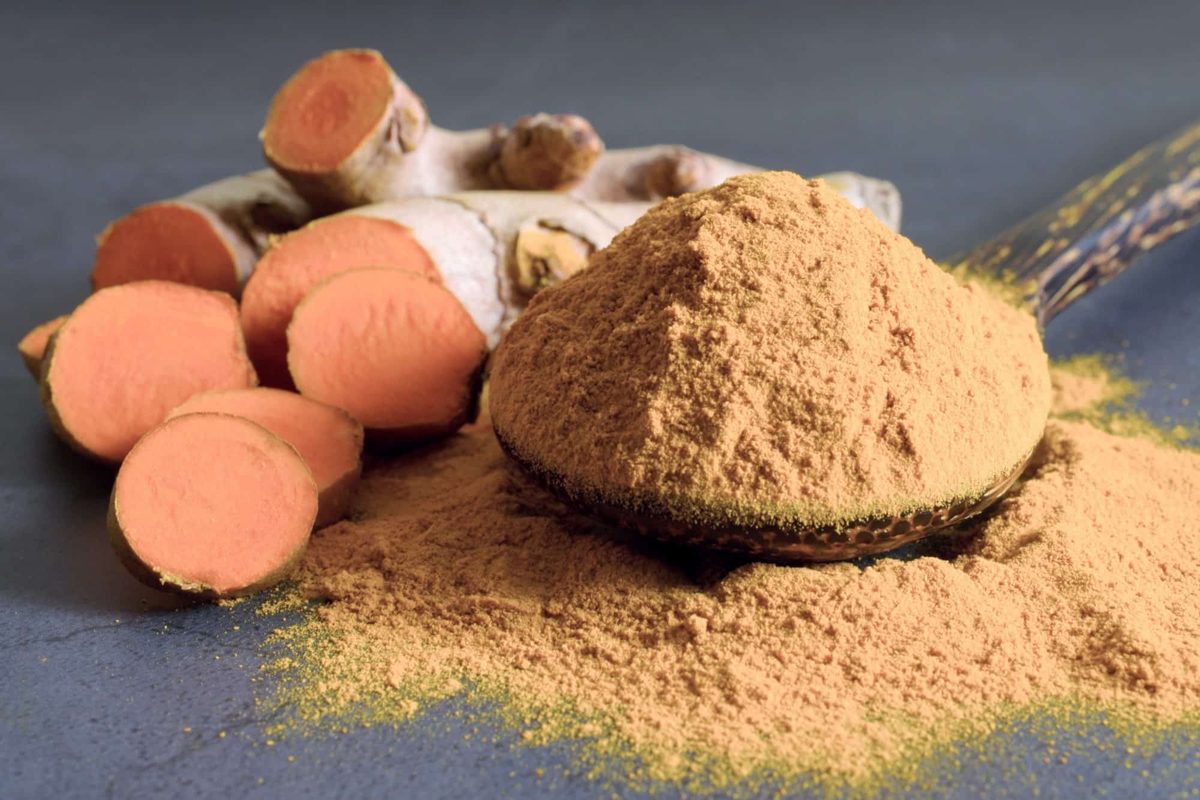
Galangal and turmeric are both rhizomes from the ginger family, Zingiberaceae, but they belong to different genera and do different jobs in a pot.12 Galangal (Alpinia galanga) is about aroma and bite: PROSEA describes a strong, pungent taste like a mix of pepper and ginger.3 Turmeric (Curcuma longa) is about color first. Curcumin gives it its yellow,2 and its taste is bitter and slightly acrid with a hint of sweetness.4 Swap one for the other and you change both the flavor and the color of the dish.
Side by side
| Galangal | Turmeric | |
|---|---|---|
| Species | Alpinia galanga (greater galangal)1 | Curcuma longa5 |
| Family | Zingiberaceae1 | Ginger family (Zingiberaceae)2 |
| Native range (Kew) | Southern China to western and central Malesia1 | Known only as a cultigen, from southwest India5 |
| Part used | Rhizome; flowers and young shoots are also eaten3 | Rhizome, usually boiled or steamed, dried and ground4 |
| The rhizome | Hard, fibrous and shiny, light red or pale yellow (PROSEA); Katzer describes a pale reddish surface ringed with reddish-brown bands36 | Fresh turmeric’s color stains: Mark Wiens warns it “stains everything yellow orange”7 |
| Key compounds | Essential oil 0.2 to 1.5% of dry weight, with 1,8-cineole confirmed as the main component in 1980s studies3 | Color from curcumin;2 aroma from turmerone, ar-turmerone and zingiberene4 |
| Flavor | Strong and pungent, like pepper and ginger (PROSEA); fresh, it smells close to fir or pine needles (Katzer)36 | Bitter, slightly acrid, yet sweet (Prasad and Aggarwal); fresh turmeric gives gaeng som a “mustardy flavor” (Wiens)47 |
| Forms | Fresh or dried; dried is usually ground before use3 | Dried and ground; also used fresh in some dishes47 |
| Typical uses | Thai soups and curry pastes; cooking across South and Southeast Asia689 | South Asian and Middle Eastern cooking, curry powder, yellow rice; fresh in southern Thai gaeng som47 |
| Safety | Covered by a 2024 Codex lead limit for dried rhizomes and roots10 | Documented lead chromate adulteration in South Asian supply chains11 |
| Price | No dated, sourced comparison found | No dated, sourced comparison found |
The oil figures come from separate studies of different samples. In one Brazilian study, dried turmeric rhizomes from three growers gave 3.0 to 5.16% oil, about 40% of it ar-turmerone;12 that sits higher than PROSEA’s galangal range, but the two were measured by different researchers on different material, so treat the comparison as rough. For each rhizome on its own, see galangal and turmeric.
The differences that change a dish
Color
This is the clearest split. Turmeric’s curcumin is a pigment,2 which is why it gives curry its yellow color and is used to color boiled white rice.4 In southern Thai gaeng som, Wiens credits fresh turmeric with the soup’s orange color.7 Galangal adds no such color. PROSEA does note that one of its compounds, galangin, can dye wool yellow,3 but nothing in the sources reviewed here suggests galangal tints food the way turmeric does.
Flavor and aroma
Galangal is the more aggressive of the two. PROSEA calls its taste strong and pungent,3 Britannica notes citrus, pepper and pine notes,9 and Katzer compares fresh galangal’s smell to fir or pine needles and says dried, powdered galangal tastes somewhere between ginger and cinnamon.6 Turmeric’s aroma compounds are different ones (turmerones and zingiberene)4 and its taste is bitter rather than sharp.4 In our judgment, turmeric works as a background note in most dishes, while galangal is often one of the flavors you can name.
Texture and prep
PROSEA describes the galangal rhizome as hard and fibrous, and Katzer calls its interior hard and woody.36 Recipes slice it rather than grate it: the Northern Illinois University tom kha kai calls for six thin slices of young galangal, and Hot Thai Kitchen’s tom yum for eight slices.138 Ground turmeric goes through more processing: the rhizomes are boiled or steamed to remove their raw smell, sun-dried and polished before grinding.4 Fresh turmeric is pounded or blended into pastes, as in Wiens’s gaeng som paste, which is heavy on chiles and turmeric.7
Where each belongs
Britannica says galangal is widely used in cooking in the Indian subcontinent and Southeast Asia,9 and Katzer calls ground fresh galangal an essential ingredient in most Thai curry pastes.6 Chongchitnant names lemongrass, galangal and makrut lime leaves as the three herbs behind tom yum’s iconic flavor.8 Turmeric is widely used in South Asian and Middle Eastern cooking and gives curry powders their yellow.4 The two meet in Southeast Asia, where fresh turmeric is, in Wiens’s words, an absolute necessity for gaeng som.7
Can one stand in for the other?
Not well, and no source we found recommends it. Neither our galangal substitutes nor our turmeric substitutes page lists the other rhizome as a replacement.
- Turmeric in place of galangal. You get yellow color and a bitter note, and lose galangal’s sharp, piney bite. Method: don’t swap them straight. For galangal, the usual stand-in is ginger. Chowhound suggests reinforcing ginger with lemon juice for galangal’s citrus notes, or turmeric and black pepper “for an earthy bite.”14 So turmeric can play a small supporting part in a galangal substitute; a pinch is plenty. No source gives an amount.
- Galangal in place of turmeric. The dish loses its color, and galangal’s flavor is stronger and quite different. Method: not recommended. If color is the point, see the saffron and annatto options on our turmeric substitutes page; if flavor is, its ginger option is closer.
- Fresh vs. dried. Each rhizome changes when dried. See dried vs. fresh galangal and fresh turmeric vs. powder for those conversions.
Safety
Both are covered by contaminant rules, but the documented problem is turmeric’s. A 2026 study of 503 turmeric samples from 34 cities in eastern India found 30% above India’s lead limit of 10 µg/g, and traced the lead chromate mainly to the polishing step.11 The Codex contaminants committee agreed a lead maximum of 2.0 mg/kg in 2024 for “spices, dried rhizomes and roots, including galangal”; its report notes that the proposed limits were based on data for one spice only, ginger.10 Turmeric is not named in that decision. More detail is on our turmeric page. On health claims, the NIH finds there isn’t enough evidence to say turmeric or curcumin is beneficial for any health purpose.2
What isn’t known
- No study measures galangal and turmeric side by side, for oil content, pungency or anything else; every figure above comes from a separate study.
- No source we opened names the compounds behind galangal’s bite.
- No dated price or availability comparison was found. Claims that turmeric is cheap because of its popularity as a supplement could not be traced.
- A widely repeated claim says drying and grinding turmeric removes its bitterness. We found no source for it; the sources say only that boiling removes the raw smell.4
Related
- Galangal vs. ginger and turmeric vs. ginger
- Saffron vs. turmeric, turmeric vs. curry powder and turmeric vs. cumin
- How to store galangal, can you freeze galangal? and cooking with turmeric
- Too much turmeric?
Footnotes
-
Alpinia galanga (L.) Willd., Plants of the World Online, Royal Botanic Gardens, Kew. powo.science.kew.org · Reference work ↩ ↩2 ↩3 ↩4
-
“Turmeric: Usefulness and Safety”, NCCIH, NIH, 2025. nccih.nih.gov · Regulator ↩ ↩2 ↩3 ↩4 ↩5 ↩6
-
J.J.C. Scheffer and P.C.M. Jansen, Alpinia galanga, Plant Resources of South-East Asia (PROSEA). uses.plantnet-project.org · Reference work ↩ ↩2 ↩3 ↩4 ↩5 ↩6 ↩7 ↩8 ↩9
-
Prasad and Aggarwal, “Turmeric, the Golden Spice”, in Herbal Medicine: Biomolecular and Clinical Aspects, CRC Press, 2011. ncbi.nlm.nih.gov · Reference work ↩ ↩2 ↩3 ↩4 ↩5 ↩6 ↩7 ↩8 ↩9 ↩10 ↩11 ↩12
-
Curcuma longa L., Plants of the World Online, Royal Botanic Gardens, Kew. powo.science.kew.org · Reference work ↩ ↩2
-
Gernot Katzer, “Greater Galangale”, Gernot Katzer’s Spice Pages. gernot-katzers-spice-pages.com · Reference work ↩ ↩2 ↩3 ↩4 ↩5 ↩6
-
Mark Wiens, “Southern Thai Gaeng Som Recipe”, Eating Thai Food. eatingthaifood.com · Publication ↩ ↩2 ↩3 ↩4 ↩5 ↩6 ↩7
-
Pailin Chongchitnant, “Tom Yum Soup (Tom Yum Goong)”, Hot Thai Kitchen. hot-thai-kitchen.com · Publication ↩ ↩2 ↩3
-
Jennifer Murtoff, “Galangal”, Encyclopaedia Britannica. britannica.com · Reference work ↩ ↩2 ↩3
-
Report of the 17th Session of the Codex Committee on Contaminants in Foods (REP24/CF17), Codex Alimentarius, 2024. fao.org · Regulator ↩ ↩2
-
Forsyth et al., “Systemic drivers of toxic food adulteration: lead chromate in turmeric across eastern India”, npj Science of Food, 2026. nature.com · Peer-reviewed ↩ ↩2
-
“Essential oil of Curcuma longa L. rhizomes: chemical composition, yield variation and stability”, Química Nova, 2020. scielo.br · Peer-reviewed ↩
-
“Tomkha Kai”, SEAsite, Northern Illinois University. seasite.niu.edu · Reference work ↩
-
Shriya Swaminathan, “Galangal Vs Ginger: Can You Substitute One For The Other?”, Chowhound, 2025. chowhound.com · Publication ↩