Spices · Profile
Fennel Pollen: What It Is, How It Tastes and How to Use It
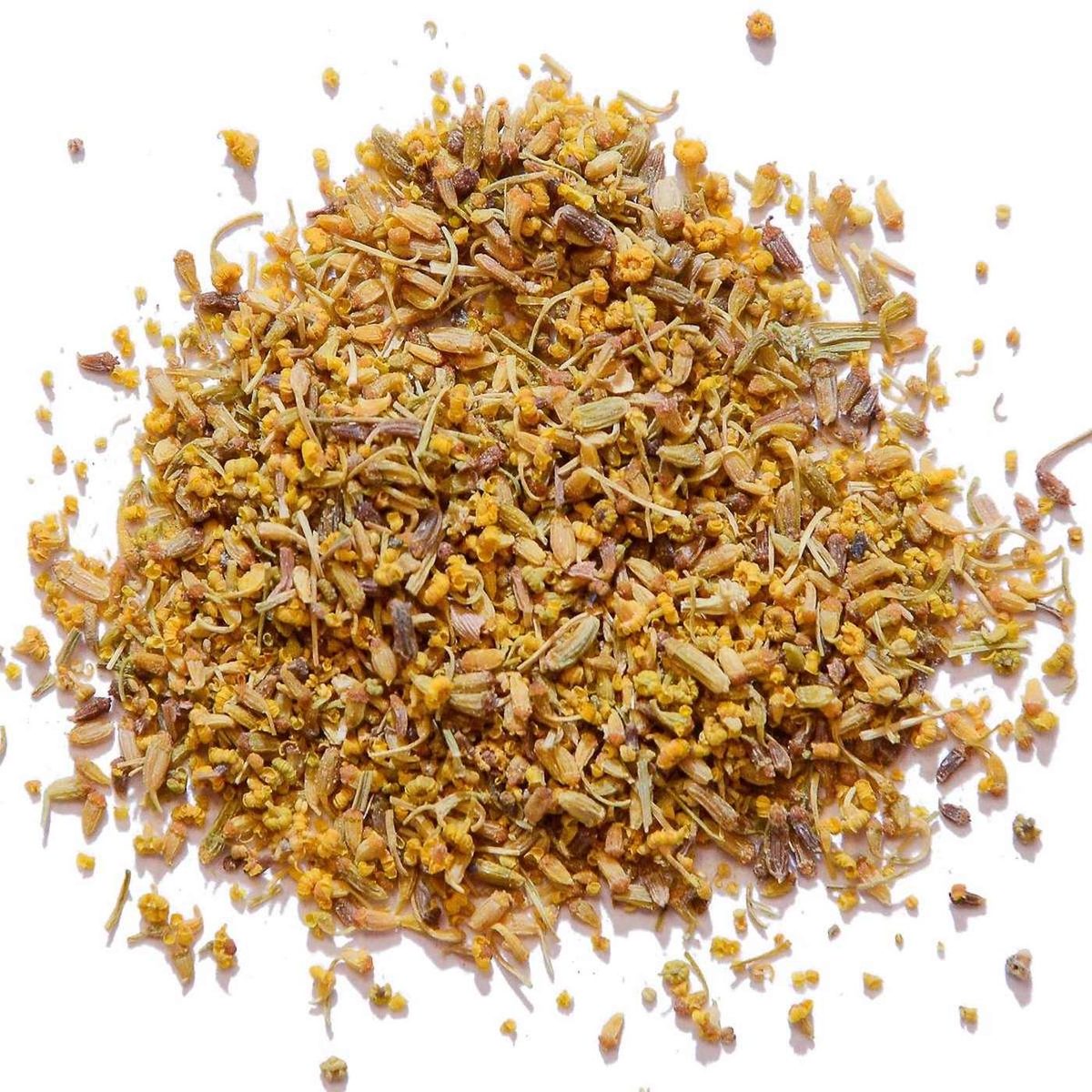
Fennel pollen is the yellow dust shaken from the flowers of wild fennel, Foeniculum vulgare.12 It is gathered by hand in Italy and California, sold in small jars at high prices, and used by the pinch as a finishing spice.3 Cooks describe it as tasting of fennel and licorice, with citrus and a honeyed sweetness the seeds lack.13 This page covers what it is, how it is gathered, how it reached American kitchens, and how to use it.
At a glance
| Plant | Fennel, Foeniculum vulgare Mill., Apiaceae2 |
| Part used | Pollen from the flowers |
| Source | Mostly wild fennel, collected by hand34 |
| Where gathered | Italy, notably Tuscany, and California35 |
| Flavor | Fennel and licorice with citrus and honeyed sweetness13 |
| Typical use | A pinch to finish a dish3 |
| Composition | No published analysis of its flavor compounds found |
What fennel pollen is
The flowers of blossoming wild fennel are coated in yellow pollen; shaken loose, it becomes a powdery seasoning with a sweet fennel flavor and a flowery scent.1 America’s Test Kitchen describes it as long harvested by hand from wild fennel by cooks in northern Italy, and more recently in California, where fennel also grows wild in abundance.3 Tasting Table reports that it is usually harvested only from wild fennel, and that the work is slow with low yields, which is why it is treated as a luxury.4
Fennel is native from the Mediterranean to Ethiopia and western Nepal, and Kew records it as introduced in California.2 Britannica notes that it is considered invasive in parts of the United States.6 Writing in Saveur in 2000, Peggy Knickerbocker said fennel grows all over California and that Italian immigrants brought it there in the 1800s.5
How it is gathered
Knickerbocker described her own method: gather the blossoms, plunge them head first into paper bags, hang the bags in a cellar for a few weeks, and shake them to release the pollen.5 Tasting Table describes the same shake-into-a-bag approach and puts a large yield at about a quarter teaspoon per flower head.4
How it reached American kitchens
According to the James Beard Foundation, fennel pollen was once a little-known spice used by Tuscans on meat and in soups and stews, and was introduced to an American audience by the food writer Faith Willinger, an American who had lived in Italy for nearly a quarter of a century.1 In the 1990s she took American chefs, Mario Batali among them, to a butcher shop in Panzano in Chianti owned by Dario Cecchini, who sold fennel pollen among the area’s specialties, and Batali quickly took it up.1 Knickerbocker first met it in the same village, and reported that Cecchini used it to flavor the pork and poultry he sold.5
“The spice of angels.” Tasting Table reports that fennel pollen has been nicknamed the spice of the angels, citing a spice seller.4 Knickerbocker’s line in Saveur was that if angels sprinkled a spice from their wings, this would be it.5 We found no source showing that the name is used in Tuscany itself.
Flavor
Sources agree on fennel and licorice, and add brighter notes on top. The James Beard Foundation describes a sweet fennel flavor and a flowery scent.1 America’s Test Kitchen, comparing it with fennel seed on ratatouille and in cookies, found hints of licorice and citrus and a honeyed, marshmallow-like sweetness, against the one-note licorice of the seeds.3 Knickerbocker called its aroma heady, honey-like and herbaceous.5 Tasting Table warns that too much gives an overly perfumed taste.4
We found no published analysis of the aroma compounds in fennel pollen. Claims that its citrus note comes from limonene and its licorice note from anethole have not, as far as we could find, been measured in the pollen itself. For the chemistry of fennel seed, see fennel seed.
Price
Fennel pollen is expensive, but how expensive depends on when and where it was priced:
| Source | Price quoted | Scope |
|---|---|---|
| America’s Test Kitchen | As much as $20 per ounce from boutique vendors, against about $5 per ounce for fennel seed3 | Undated page |
| Tasting Table | $15 for 0.5 oz ($30 per ounce) from one seller; $18 for 0.5 oz ($37 per ounce) from another4 | December 2022 retail listings |
These are retail prices for particular products, not a market price. The common claim that fennel pollen is the third most expensive spice in the world, behind only saffron and vanilla, could not be traced to a source; see saffron and vanilla for those spices.
How to use fennel pollen
America’s Test Kitchen recommends saving it as a finishing touch because of its cost: a pinch over vegetables, pork, fish and grilled meats, stirred into oil for dipping bread, or over pasta and creamy soups.3 Batali’s description of the effect was a tiny dusting on something hot giving a heady fennel perfume.1 Tasting Table adds dry rubs for chicken, grain dishes such as couscous and bulgur, and baked goods including muffins, breads and fruit pies.4 In Panzano, Cecchini used it on pork and poultry.5
These are cooking judgments, not measured facts. Add it at the end or just before serving; start with a pinch, taste, and add more only if needed. For more ideas see fennel pollen uses.
Buying and storage
Good fennel pollen is bright yellow-green and smells strongly of fennel when the jar is opened; that is kitchen judgment. We found no grading standard or shelf-life figure for it. Keep it sealed, cool and dark, and buy small amounts.
Health claims
Fennel pollen is used in pinches, and we found no nutrient data for it in USDA FoodData Central and no study of its health effects. Claims that it suppresses appetite, burns fat or fights cancer because of anethole or limonene could not be traced to any review or regulator, and are not made here. For what regulators say about fennel more broadly, including estragole, see fennel seed.
Substitutes and comparisons
Crushed fennel seed, preferably toasted, is the nearest stand-in, though America’s Test Kitchen found the seeds more one-note.3 No source we found gives a tested swap ratio. See fennel pollen substitutes and fennel pollen vs. fennel seed. Related: bronze fennel and fennel vs. dill.
Footnotes
-
“Eat This Word: Fennel Pollen”, James Beard Foundation, 2011. jamesbeard.org · Publication ↩ ↩2 ↩3 ↩4 ↩5 ↩6 ↩7 ↩8
-
Foeniculum vulgare Mill., Plants of the World Online, Royal Botanic Gardens, Kew. powo.science.kew.org · Reference work ↩ ↩2 ↩3
-
“Fennel Pollen: What It Is & How to Use It”, America’s Test Kitchen. americastestkitchen.com · Publication ↩ ↩2 ↩3 ↩4 ↩5 ↩6 ↩7 ↩8 ↩9 ↩10 ↩11
-
Lucy Clark, “What Is Fennel Pollen And How Can It Be Used?”, Tasting Table, 2022. tastingtable.com · Publication ↩ ↩2 ↩3 ↩4 ↩5 ↩6 ↩7
-
Peggy Knickerbocker, “Pollen Pleasure”, Saveur, 2000. saveur.com · Publication ↩ ↩2 ↩3 ↩4 ↩5 ↩6 ↩7
-
“Fennel”, Encyclopaedia Britannica. britannica.com · Reference work ↩