Herbs · Profile
Bronze Fennel: The Purple-Leaved Herb Fennel and How to Cook With It
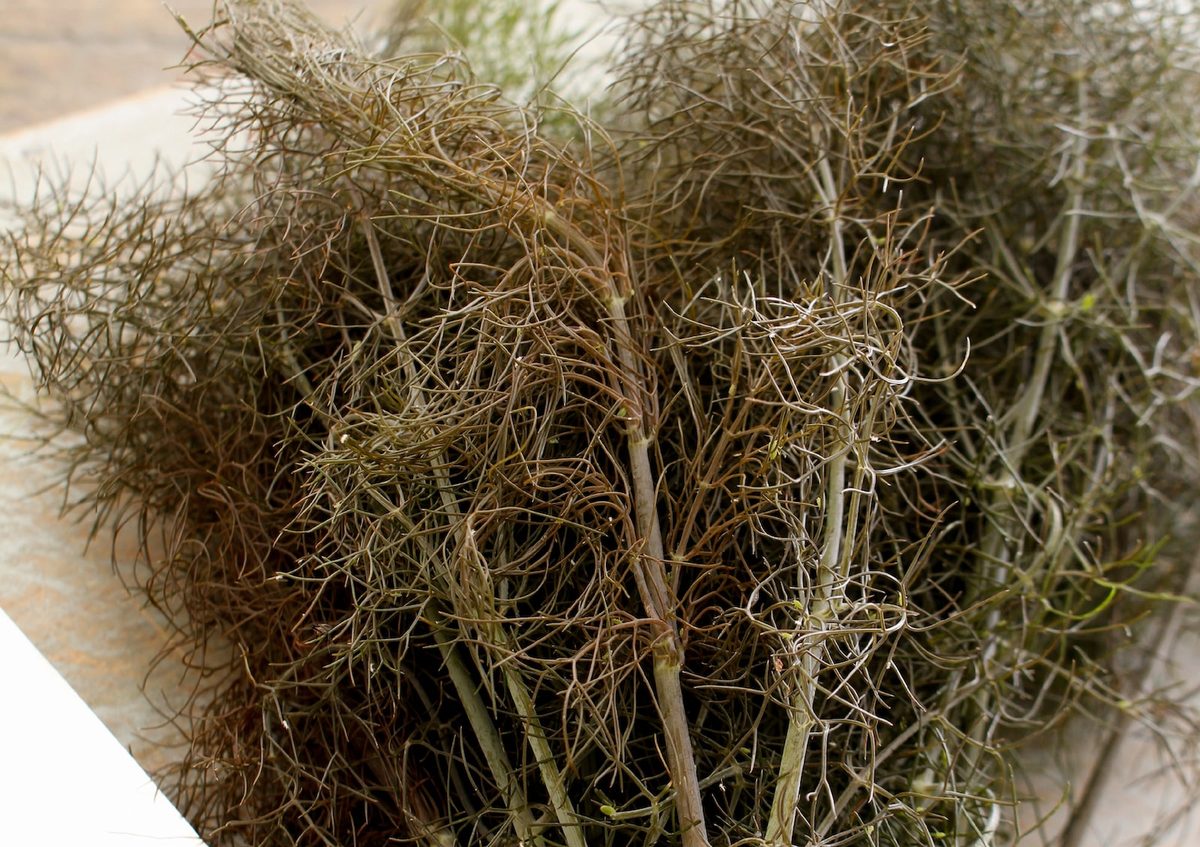
Bronze fennel is a purple-bronze form of common fennel, grown mainly as an ornamental but edible from flower to seed. It tastes of anise like other fennel, but it does not make the swollen white bulb sold as Florence fennel. Cooks use its feathery fronds, its seeds, and its pollen and flowers. This page covers what it is, how it differs from bulb fennel, how to cook with it, and why gardeners in warm climates treat it with caution.
At a glance
| Botanical name | Foeniculum vulgare ‘Purpureum’, a cultivar of fennel12 |
| Plant family | Apiaceae (carrot/parsley family)3 |
| Native range of the species | Mediterranean to Ethiopia and western Nepal (Kew)1 |
| Parts used | Fronds, stems, flowers, pollen, ripe and unripe seeds2 |
| Bulb | None; bronze and common fennel do not form bulbs4 |
| Key aroma compound | Anethole, as in other sweet fennel53 |
| Grown as | Mostly an ornamental; a heavy self-seeder in warm climates26 |
Measured values
1 figure, sourced| Measure | Value | Scope | Source |
|---|---|---|---|
| Share of plant oil in the fruit | about 95 % of the oil | mature fennel generally (PROSEA); no analysis specific to the bronze cultivar | uses.plantnet-project.org |
Each figure is quoted as its source states it, with the samples or standard it applies to. Where sources differ, both are shown; nothing is averaged. All measured values
What bronze fennel is
All culinary fennel belongs to one species, Foeniculum vulgare, a perennial herb in the Apiaceae.13 Kew’s Plants of the World Online accepts no subspecies or varieties within it.1 Bronze fennel is a garden cultivar of that species. Chef and forager Alan Bergo gives its name as Foeniculum vulgare purpureum and describes it as an herbaceous perennial and a cultivar of bulb fennel, usually grown as an ornamental.2 University of Illinois Extension lists a bronze-leaved type used as an ornamental alongside herb fennel and Florence fennel.6
Bronze fennel and bulb fennel
The swollen “bulb” sold in grocery stores is the stem base of Florence fennel, variety azoricum.3 Bronze fennel does not form one. The University of Washington’s Miller Library puts it plainly: common or bronze fennel, 3 to 5 feet tall with a tough stalk, does not form bulbs.4 Bergo says the same.2
So bronze fennel cannot replace bulb fennel in a recipe that needs the bulb’s crisp, juicy flesh. Its fronds can stand in for the fronds of bulb fennel, and its seeds for fennel seed. That is cooking judgment.
Flavor and the compounds behind it
Illinois Extension says both herb fennel and Florence fennel have an anise or licorice flavor.6 Bergo finds the anise strongest in the young purple fronds; as the plant flowers and turns green, the fronds take on a more vegetal taste.2
The chemistry is that of fennel generally. Britannica and PROSEA name anethole as the main component of sweet fennel oil, responsible for its anise fragrance and sweet taste.53 PROSEA says about 95% of the oil in mature fennel is in the fruit, the “seed”.5 No analysis specific to the bronze cultivar was found, so whether its oil differs from green fennel’s is not yet measured.
For the seed in detail, see fennel seed.
Origin and history
Kew gives fennel’s native range as the Mediterranean to Ethiopia and western Nepal.1 The bronze cultivar’s own origin is not documented in any source we found.
- Hippocrates. PROSEA says fennel was mentioned by Hippocrates and Dioscorides as a diuretic and emmenagogue.5
- Marathon. The Greek word for fennel was marathon, and the place Marathon was probably named “fennel field” because the plant grew there.7 The story that Pheidippides carried a fennel stalk on his run to Athens has no source we could find.
- California. Kew lists fennel as introduced in California.1 Saveur, writing in 2000, said fennel grows all over California and that Italian immigrants brought it in the 1800s.8 We found no source for the claim that Spanish explorers introduced it in the 17th century.
Claims that fennel use dates to ancient Egypt, that Pliny listed it for 22 conditions, that seeds were nibbled on medieval fast days, and that Culpeper recommended it as a poison antidote could not be traced to sources we could open.
A weed in warm places
Bergo calls bronze fennel a heavy self-seeder that is invasive in warmer climates, though not a problem where winters are cold, as in Minnesota.2 Common fennel is listed as a non-regulated noxious weed in King County, Washington,4 and the California Invasive Plant Council rates Foeniculum vulgare as a moderate invasive with dense populations in places such as Santa Cruz Island, the San Francisco Bay region and Camp Pendleton.9 Cal-IPC notes it is still unclear whether culinary varieties are invasive.9 In a mild climate, common gardening practice is to cut the flower heads before the seed drops.
How bronze fennel is used
- Fronds. Bergo uses them in salads and as a garnish.2 Illinois Extension says herb fennel is used in fish dishes, soups and stews, and its foliage can be cut as needed or air-dried.6
- Seeds. Illinois Extension notes fennel seed’s use in sausage, and Bergo uses bronze fennel seed in Italian fennel sausage and in rubs and seasonings for fish.62 Fennel seed is one of the five spices in Chinese five-spice powder.10
- Pollen and flowers. Bergo lists the flowers and pollen among the edible parts.2 See fennel pollen.
- Whole fish. Stuffing fronds and stalks into the cavity of a fish before roasting is common practice.
For more ideas, see bronze fennel uses and fennel pollen uses.
Buying and storage
Because bronze fennel is usually grown as an ornamental,2 a garden is often the easiest source. Illinois Extension says fennel foliage can be air-dried and stored for later use.6 We found no published storage-life figure for fresh fronds. Treat them like other tender herbs and use them within a few days; that is kitchen judgment.
Safety
Fennel contains estragole. In 2001 the EU’s Scientific Committee on Food concluded that estragole has been shown to be genotoxic and carcinogenic.11 In 2022 Germany’s BfR said that fennel tea, basil pesto and some plant-based supplements may contain high amounts of such compounds, while the health risk could not yet be conclusively assessed.12 We found no estragole measurement for bronze fennel fronds and no regulatory limit for fennel as an herb.
Health claims often made for fennel, such as anti-inflammatory effects or lower disease risk, are not supported by any regulator summary we found, and this page makes no claim that bronze fennel treats or prevents any condition. No nutrient data exist for bronze fennel specifically.
Substitutes and comparisons
For fronds, the leafy tops of bulb fennel or a little dill are the closest stand-ins; for seed, ordinary fennel seed is the same thing. These are cooking judgments, with no tested ratios.
Footnotes
-
Foeniculum vulgare Mill., Plants of the World Online, Royal Botanic Gardens, Kew. powo.science.kew.org · Reference work ↩ ↩2 ↩3 ↩4 ↩5 ↩6
-
Alan Bergo, “Bronze Fennel”, Forager Chef, 2025. foragerchef.com · Publication ↩ ↩2 ↩3 ↩4 ↩5 ↩6 ↩7 ↩8 ↩9 ↩10 ↩11
-
“Fennel”, Encyclopaedia Britannica. britannica.com · Reference work ↩ ↩2 ↩3 ↩4 ↩5
-
“Growing fennel bulb”, Plant Answer Line, Elisabeth C. Miller Library, University of Washington, 2019. depts.washington.edu · Reference work ↩ ↩2 ↩3
-
Purwaningsih, Harmida and Brink, Foeniculum vulgare, Plant Resources of South-East Asia (PROSEA). uses.plantnet-project.org · Reference work ↩ ↩2 ↩3 ↩4
-
“Fennel”, University of Illinois Extension. extension.illinois.edu · Reference work ↩ ↩2 ↩3 ↩4 ↩5 ↩6
-
“Marathon”, Online Etymology Dictionary. etymonline.com · Reference work ↩
-
Peggy Knickerbocker, “Pollen Pleasure”, Saveur, 2000. saveur.com · Publication ↩
-
Foeniculum vulgare plant profile, California Invasive Plant Council. cal-ipc.org · Reference work ↩ ↩2
-
Tony Hill, “Five-spice powder”, Encyclopaedia Britannica. britannica.com · Reference work ↩
-
Opinion of the Scientific Committee on Food on Estragole, European Commission, 2001. food.ec.europa.eu · Regulator ↩
-
“Alkenylbenzenes in food: how large is the health risk?”, BfR, 2022. bfr.bund.de · Regulator ↩