Spice Comparisons · Comparison
Fennel Pollen vs. Fennel Seed: Same Plant, Different Spice
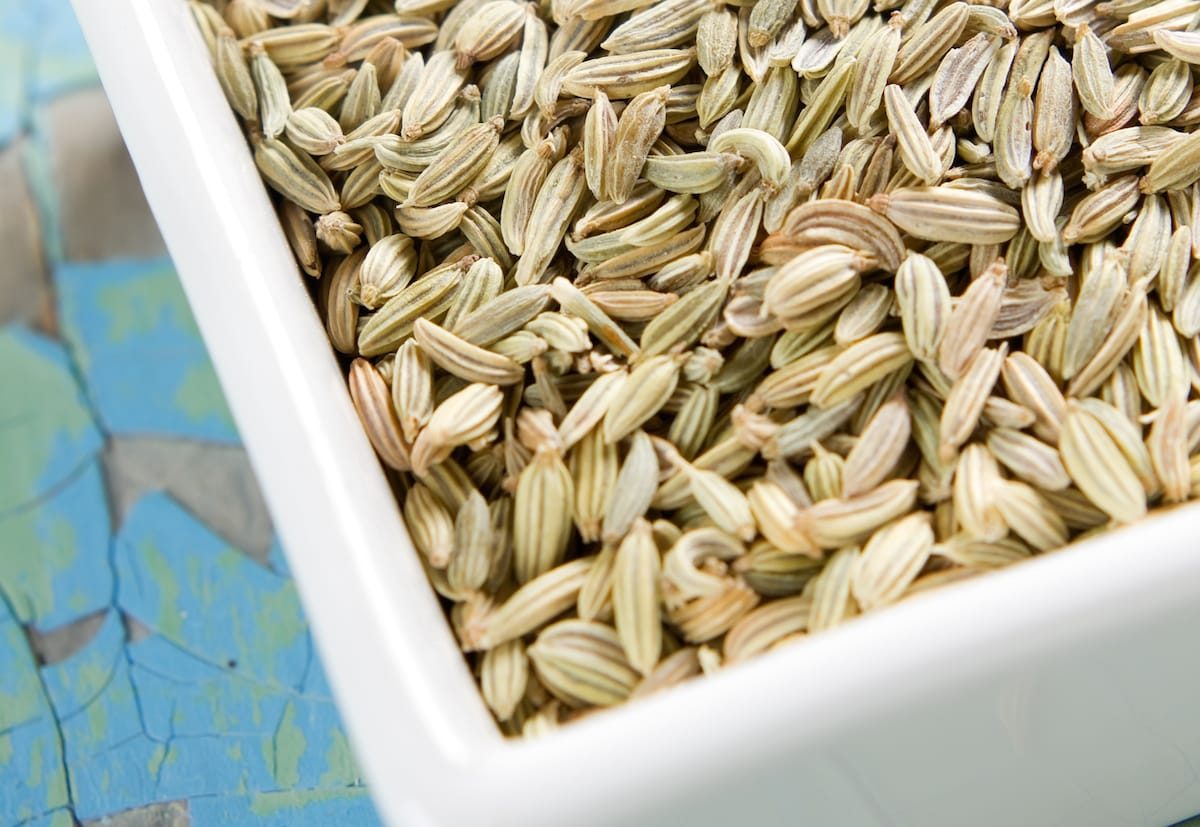
Fennel pollen and fennel seed both come from fennel, Foeniculum vulgare.12 The seed is the plant’s dried fruit, an everyday spice grown as a field crop.34 The pollen is the yellow dust shaken from its flowers, mostly gathered by hand from wild plants and sold in small jars.156 Both taste of fennel, but when America’s Test Kitchen tasted them side by side, the pollen added citrus and a honeyed sweetness that the seed, licorice and little else, did not have.5 That, and a price several times higher,5 is why the pollen is mostly used by the pinch to finish a dish.
Side by side
| Fennel pollen | Fennel seed | |
|---|---|---|
| Plant | Foeniculum vulgare, Apiaceae2 | Foeniculum vulgare, Apiaceae23 |
| Part used | Pollen shaken from the flowers1 | The small dry fruit, sold as “seed”3 |
| What it looks like | A yellow, powdery dust1 | Greenish-brown to yellowish-brown oblong ovals about 6 mm long, with five ridges3 |
| Where it comes from | Mostly wild fennel, collected by hand in Italy, notably Tuscany, and California576 | Cultivated fennel;5 India grew 180,066 tonnes in 2024-254 |
| Key compounds | No published analysis found | Anethole, up to 70–80% of sweet-fennel oil; fenchone in bitter fennel8 |
| Essential oil | Not measured | 3–4% (Britannica); 1.9–3.1% by hydrodistillation (PROSEA)38 |
| Flavor, as sources describe it | Licorice and citrus with a honeyed, marshmallow-like sweetness (ATK);5 sweet fennel with a flowery scent (James Beard Foundation)1 | Licorice, more one-note (ATK);5 sweet fennel tastes sweet and of anise, bitter fennel camphor-like (PROSEA)8 |
| Typical use | A pinch to finish vegetables, pork, fish, grilled meat, pasta or soup5 | Cooked into dishes: pastries, sweet pickles, fish;3 sausage9 |
| Price | Up to $20 an ounce (ATK, undated); $30 to $37 an ounce from two sellers (Tasting Table, 2022)56 | About $5 an ounce (ATK, undated)5 |
| Safety | No data found | Contains estragole; see Safety810 |
The two price columns come from different dates and sellers. They show the gap, not a market price.
Same plant, different parts
Fennel is unusual in how much of it is eaten. Forager Chef’s Alan Bergo notes that the whole plant is edible, from the flowers and pollen to the fronds and seeds,11 and Britannica adds the bulb-like stem base of Florence fennel, eaten as a vegetable.3 University of Illinois Extension says both herb fennel and bulb fennel have an anise or licorice flavor.9
The seed is botanically a dry fruit,3 and in mature fennel about 95% of the plant’s oil is in that fruit, according to PROSEA.8 The pollen comes from the flowers. The James Beard Foundation describes the flowers of blossoming wild fennel as coated in yellow pollen, which is shaken loose to make the spice.1 Writing in Saveur, Peggy Knickerbocker described her own method: plunge the blossoms head first into paper bags, hang them for a few weeks, then shake.7
How the flavor differs
The seed’s chemistry is well studied. Sweet fennel’s oil is led by anethole, the compound PROSEA credits with its anise fragrance and sweet taste; bitter fennel has a pungent, camphor-like odor and taste, with fenchone as its character compound.8
The pollen’s chemistry is not. We found no published analysis of its aroma compounds, so claims that its citrus note comes from limonene, or that it is a “concentrated” form of the seed’s anethole, are untested. What exists are tasting notes. ATK, comparing the two in ratatouille and cookies, found hints of licorice and citrus and a honeyed, marshmallow-like sweetness in the pollen, against the seed’s one-note licorice.5 Knickerbocker called the pollen’s aroma heady, honey-like and herbaceous.7
Is the pollen stronger? Sources say a little goes a long way: Tasting Table notes that a very small amount is usually enough and that too much gives an overly perfumy taste.6 But no one has measured its strength against the seed. The safer description is that the pollen is more complex and more aromatic, not that it is a stronger version of the same flavor.
How each is used
Pollen as a finish. ATK recommends saving fennel pollen as a finishing touch because of its cost: a pinch over vegetables, pork, fish and grilled meats, stirred into oil for bread, or over pasta and creamy soups.5 Mario Batali’s description, quoted by the James Beard Foundation, was a tiny dusting on something hot.1 In Panzano in Chianti, the butcher Dario Cecchini used it to flavor the pork and poultry he sold.7 Tasting Table adds dry rubs, grain dishes and baked goods.6
Seed as a working spice. Fennel seed is cooked into food. Britannica lists pastries, sweet pickles and fish among the foods its seeds and oil flavor,3 and Illinois Extension notes its use in sausage.9 In Italian-American cooking it is the signature seasoning of Italian sausage, by common practice. Our judgment: whole seed goes in early, toasted or bloomed in oil; the pollen goes on at the end, where heat would dull it.
Why the price gap
ATK puts the pollen at as much as $20 an ounce from boutique vendors, against about $5 an ounce for seed from cultivated fennel.5 Tasting Table found it at $30 and $37 an ounce from two sellers in 2022, and says it is usually harvested only from wild fennel, by a time-consuming process with low yields; a quarter teaspoon from one flower head counts as a large yield.6 The common claim that fennel pollen is the third most expensive spice in the world, after saffron and vanilla, could not be traced to a source.
Where the pollen came from
According to the James Beard Foundation, fennel pollen was once a little-known spice used by Tuscans, and the food writer Faith Willinger introduced it to American chefs in the 1990s, taking Mario Batali among others to Cecchini’s butcher shop in Panzano.1 Fennel seed, by contrast, has been used as a flavoring since antiquity, according to PROSEA.8 We found no source for the claim that pollen use was once confined to Liguria.
Can one stand in for the other?
Fennel seed in place of pollen (Method). This is the usual swap, and no published ratio exists. Grind the seed as finely as you can and sift it, then start with the same pinch you would have used of pollen and taste. You will get the licorice but not the citrus or honey. Toasting the seed first and a little grated lemon zest can help; both are kitchen judgment, not tested methods. If you measure seed to grind, McCormick’s volume conversion is 1 teaspoon seed to 1 1/4 teaspoons ground.12 See fennel pollen substitutes.
Fennel pollen in place of seed (Method). It works in a pinch, but it is an expensive way to season a sauce or sausage, and its finer notes tend to get lost in long cooking (our judgment). Start with a small amount, add it near the end, and taste. For other options, see fennel seed substitutes.
Safety
Fennel seed contains estragole, which PROSEA notes is a liver carcinogen in mice.8 The EU’s former Scientific Committee on Food concluded in 2001 that estragole has been demonstrated to be genotoxic and carcinogenic,10 and Germany’s BfR said in 2022 that fennel tea may contain high amounts of such compounds but that the risk could not yet be conclusively assessed.13 We found no estragole data for fennel pollen. For more, see fennel seed.
What isn’t known
- No published analysis of fennel pollen’s aroma compounds or oil content.
- No measurement of the pollen’s strength against the seed, and no tested swap ratio in either direction.
- No current market price or production figure for fennel pollen; the prices above are dated retail snapshots.
- No estragole measurement for fennel pollen.
Related
- Fennel pollen, fennel pollen uses, fennel pollen substitutes
- Fennel seed, fennel seed substitutes
- Fennel seed vs. anise seed, fennel seeds vs. cumin seeds, caraway seeds vs. fennel seeds, fennel vs. dill
- Bronze fennel, saffron, vanilla
Footnotes
-
“Eat This Word: Fennel Pollen”, James Beard Foundation, 2011. jamesbeard.org · Publication ↩ ↩2 ↩3 ↩4 ↩5 ↩6 ↩7 ↩8
-
Foeniculum vulgare Mill., Plants of the World Online, Royal Botanic Gardens, Kew. powo.science.kew.org · Reference work ↩ ↩2 ↩3
-
“Fennel”, Encyclopaedia Britannica. britannica.com · Reference work ↩ ↩2 ↩3 ↩4 ↩5 ↩6 ↩7 ↩8 ↩9
-
Spice wise area and production in India, 2021-22 to 2025-26, Spices Board India. indianspices.com · Regulator ↩ ↩2
-
“Fennel Pollen: What It Is & How to Use It”, America’s Test Kitchen. americastestkitchen.com · Publication ↩ ↩2 ↩3 ↩4 ↩5 ↩6 ↩7 ↩8 ↩9 ↩10 ↩11 ↩12 ↩13
-
Lucy Clark, “What Is Fennel Pollen And How Can It Be Used?”, Tasting Table, 2022. tastingtable.com · Publication ↩ ↩2 ↩3 ↩4 ↩5 ↩6
-
Peggy Knickerbocker, “Pollen Pleasure”, Saveur, 2000. saveur.com · Publication ↩ ↩2 ↩3 ↩4
-
Purwaningsih, Harmida and M. Brink, Foeniculum vulgare, Plant Resources of South-East Asia (PROSEA). uses.plantnet-project.org · Reference work ↩ ↩2 ↩3 ↩4 ↩5 ↩6 ↩7 ↩8
-
“Fennel”, Herb Gardening, University of Illinois Extension. extension.illinois.edu · Reference work ↩ ↩2 ↩3
-
Opinion of the Scientific Committee on Food on Estragole, European Commission, 2001. food.ec.europa.eu · Regulator ↩ ↩2
-
Alan Bergo, “Bronze Fennel”, Forager Chef, 2025. foragerchef.com · Publication ↩
-
“How to Grind Your Own Spices”, McCormick, 2025. mccormick.com · Merchant ↩
-
“Alkenylbenzenes in food: how large is the health risk?”, BfR Communication No. 22/2022, German Federal Institute for Risk Assessment. bfr.bund.de · Regulator ↩