Spice Comparisons · Comparison
Fennel vs. Dill: Two Feathery Herbs With Different Chemistry
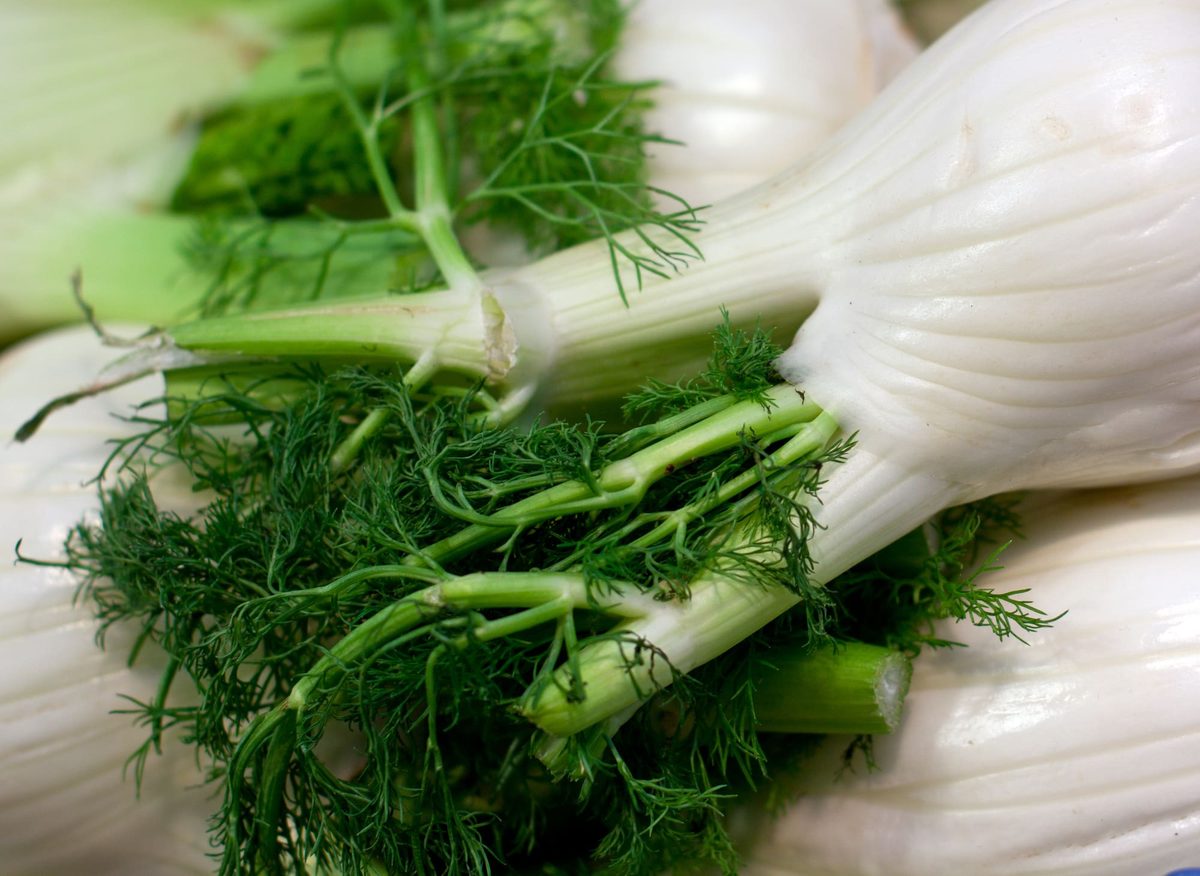
Fennel and dill are both feathery herbs of the carrot and parsley family, Apiaceae, and the leaves look enough alike to fool a shopper.123 They taste different because their oils are built from different compounds. Fennel’s anise flavor comes from anethole.4 Dill leaf oil is led by phellandrene and a compound called dill ether.5 So fennel tastes of licorice and dill does not, and fennel is also a vegetable, while dill is only ever an herb and a seed.
Side by side
| Fennel | Dill | |
|---|---|---|
| Species | Foeniculum vulgare6 | Anethum graveolens7 |
| Family | Apiaceae2 | Apiaceae1 |
| Life cycle | Perennial2 | Annual5 |
| Native range (Kew) | Mediterranean to Ethiopia and western Nepal6 | North Africa to Chad, and Iran to the Arabian Peninsula7 |
| Leaves | Divided into thread-like, blue-green lobes4 | Blue-green plant with finely divided leaves of many linear segments51 |
| Parts used | Leaves, stems and seeds of herb fennel; the swollen leaf bases of Florence fennel as a vegetable43 | Leaves and young flower heads (dill weed); ripe fruits (dill seed)5 |
| Key compounds | Seed oil: anethole, up to 70 to 80% in sweet fennel. Anethole and fenchone run higher in ripe fruits than in stems and leaves4 | Leaf oil: phellandrene about 35%, dill ether about 25%. Seed oil: limonene up to 70%, carvone up to 60%5 |
| Flavor (editorial) | Sweet, clearly anise or licorice | Fresh and grassy; the seed is warmer and caraway-like |
| Typical uses | Fish dishes, soups and stews; bulbs raw in salads or steamed3 | Soups, salads, sauces, fish, sandwich fillings and pickles1 |
| Price | No dated, sourced retail comparison found | No dated, sourced retail comparison found |
Two cautions on the compounds row. The fennel figures describe the seed oil, because no source we opened gives a composition for fennel leaf oil; PROSEA says only that the leaves and stems carry less anethole and fenchone than the ripe fruit.4 And the dill figures are literature values summarized by PROSEA, not measurements of a supermarket bunch.5 The flavor row is our description. It fits the chemistry: anethole is the compound PROSEA credits with fennel’s anise smell and sweet taste,4 and it is not among the main compounds PROSEA lists for dill.5
For each herb on its own, see dill, fennel seed and bronze fennel, a purple-leaved herb fennel.
The differences that change a dish
Flavor
This is the big one. The University of Illinois Extension says both kinds of fennel, the herb and the bulb, taste of anise or licorice.3 Britannica describes dill as warm and slightly sharp, somewhat like caraway.1 In a dish, fennel fronds push a sweet anise note forward; dill reads as green and fresh, with only a faint anise hint some people pick up (editorial).
Leaf and seed are different products
Both plants give a leaf and a seed, and in dill the two taste different because the oils differ: phellandrene and dill ether in the leaf, carvone and limonene in the seed.5 See dill seed vs. dill weed. In fennel the seed is where the flavor concentrates; PROSEA notes that in mature fennel about 95% of the oil sits in the fruit.4
Fennel is also a vegetable
Florence fennel is a group of cultivars grown for the swollen base of the leaf stalks, eaten cooked as a vegetable.4 Britannica calls it the bulb-like stem base of Florence fennel.2 Illinois Extension says the bulbs are used raw in salads or steamed, and that Florence fennel is shorter, with darker green foliage, than herb fennel.3 Dill has no equivalent.
Heat and timing
LSU AgCenter lists dill leaves among the delicate herbs to add at the end of cooking, since long heat costs flavor and aroma.8 We found no comparable guidance for fennel fronds. In practice, fronds are treated the same way, while the bulb and seeds take long cooking (editorial).
Can one stand in for the other?
As a garnish, yes. For flavor, only partly, and less so in one direction than the other.
| Swap | Starting amount | Treatment |
|---|---|---|
| Fennel fronds for fresh dill | Same amount, then taste | Method |
| Fresh dill for fennel fronds | Same amount, as a garnish only | Method |
| Dill seed for fennel seed | Same amount; expect less sweetness | Method |
| Fennel for dill in pickles | Not recommended |
- Fennel fronds for fresh dill. A Couple Cooks names fresh fennel fronds the next best substitute for fresh dill: they look just like it and have a subtle licorice finish, though the food writers say dill is hard to replace.9 They give no amount, so this is a Method starting point: use the same amount and taste. See dill substitutes.
- Fresh dill for fennel fronds. We found no source that recommends this. Dill can match the look, but it brings no anise, so the dish loses fennel’s main note. Method: use it as a garnish, at the same amount.
- Dill seed for fennel seed. The Spice House, a spice merchant, says dill seeds give lasagna a similar texture without the strong licorice or anise flavor, and suggests a small pinch of crushed anise seed to bring some back.10 It gives no amount. Method: start with an equal amount. See fennel seed substitutes.
- Pickles. Dill is the pickle herb. In the National Center for Home Food Preservation’s tested recipe for quick fresh-pack dill pickles, each pint jar gets 1 1/2 heads of fresh dill or 1 1/2 teaspoons of dill seed.11 Fennel would make a different pickle, and in home canning it is safer to follow a tested recipe as written (editorial).
When to use which
- Dill. Pickles above all; Britannica singles them out, and PROSEA lists pickled cucumbers and onions.15 Fish, soups, salads and sauces.1 Britannica says dill is especially popular in eastern European and Scandinavian cooking.1 By common practice it also goes into gravlax, potato salad and sour cream or yogurt sauces.
- Fennel fronds and herb fennel. PROSEA records the leaves as a pot-herb, especially in fish sauces and as a garnish, and Illinois Extension lists fish dishes, soups and stews.43 Illinois also suggests adding a few fronds to a salad.3
- Fennel bulb. Raw in salads or steamed.3 Braised and roasted fennel are common practice.
What isn’t known
- No source we opened gives the composition of fennel leaf oil, so the leaf-to-leaf chemistry comparison is incomplete.
- No published measurement compares the flavor strength of fennel fronds and dill, and no source gives a tested ratio for swapping them.
- Fennel is often said to be a classic cioppino ingredient. We found no source for that and have left it out.
Related
- Tarragon vs. dill, another anise-tinged herb against dill
- Caraway seeds vs. fennel seeds and fennel seed vs. anise seed
- Fresh dill vs. dried dill, cooking with dill and too much dill
- Fennel pollen and caraway seeds
Footnotes
-
“Dill”, Encyclopaedia Britannica. britannica.com · Reference work ↩ ↩2 ↩3 ↩4 ↩5 ↩6 ↩7 ↩8
-
“Fennel”, Encyclopaedia Britannica. britannica.com · Reference work ↩ ↩2 ↩3 ↩4
-
“Fennel”, University of Illinois Extension. extension.illinois.edu · Reference work ↩ ↩2 ↩3 ↩4 ↩5 ↩6 ↩7 ↩8
-
Purwaningsih, Harmida and M. Brink, Foeniculum vulgare, Plant Resources of South-East Asia (PROSEA). uses.plantnet-project.org · Reference work ↩ ↩2 ↩3 ↩4 ↩5 ↩6 ↩7 ↩8 ↩9
-
Nguyen Thi Tâm, C.C. de Guzman and P.C.M. Jansen, Anethum graveolens, Plant Resources of South-East Asia (PROSEA). uses.plantnet-project.org · Reference work ↩ ↩2 ↩3 ↩4 ↩5 ↩6 ↩7 ↩8 ↩9
-
Foeniculum vulgare Mill., Plants of the World Online, Royal Botanic Gardens, Kew. powo.science.kew.org · Reference work ↩ ↩2
-
Anethum graveolens L., Plants of the World Online, Royal Botanic Gardens, Kew. powo.science.kew.org · Reference work ↩ ↩2
-
“Flavorful Herbs”, LSU AgCenter. lsuagcenter.com · Reference work ↩
-
Sonja Overhiser, “Best Dill Substitute”, A Couple Cooks. acouplecooks.com · Publication ↩
-
“12 Best Fennel Substitutes”, The Spice House. thespicehouse.com · Merchant ↩
-
“Quick Fresh-Pack Dill Pickles”, National Center for Home Food Preservation. nchfp.uga.edu · Reference work ↩