Spices · Profile
Fennel Seed: Flavor, Anethole, Uses and Where It Comes From
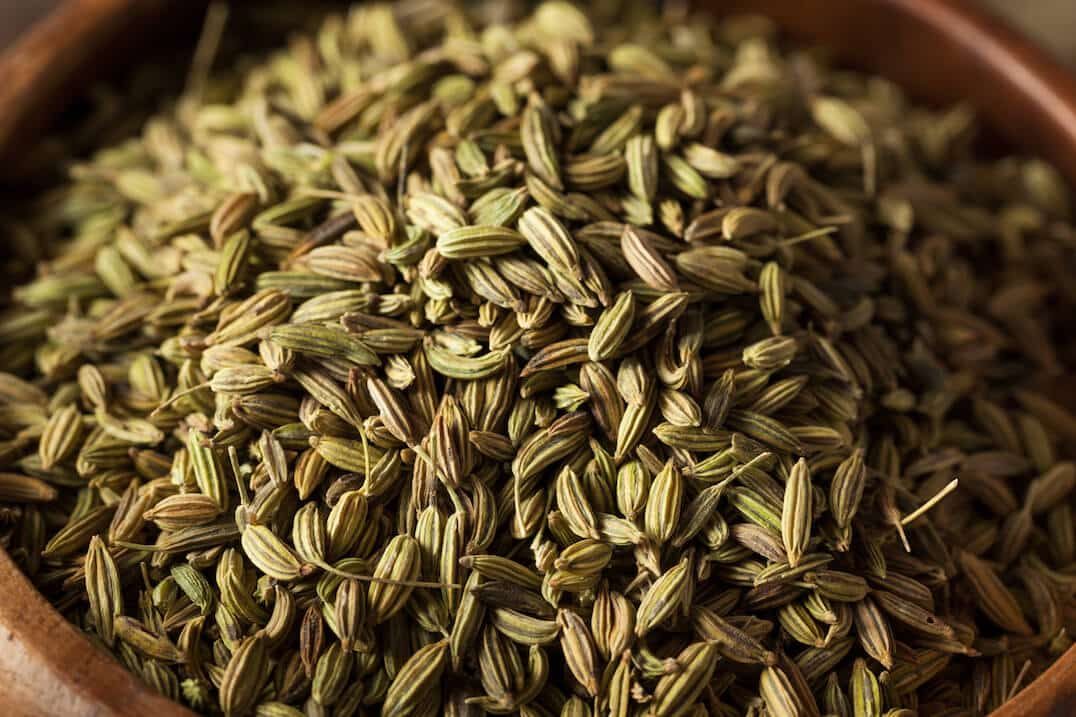
Fennel seed is the dried fruit of Foeniculum vulgare, the same parsley-family plant that gives us fennel fronds and, in one variety, the fennel bulb.12 Its sweet, anise-like taste comes mainly from anethole, the compound it shares with anise seed and star anise.32 It is one of the five spices in Chinese five-spice powder and a common part of Indian curry spicing.45 This page covers what it is, sweet versus bitter fennel, its chemistry, where it grows, how it is used, and what regulators say about it.
At a glance
| Botanical name | Foeniculum vulgare Mill.1 |
| Plant family | Apiaceae (carrot/parsley family)12 |
| Part used | The dried fruit (a schizocarp), sold as “seed”2 |
| Native range | Mediterranean to Ethiopia and western Nepal (Kew); southern Europe and Anatolia (Britannica)12 |
| Main producer | India: 180,066 tonnes in 2024-25 (final)6 |
| Key aroma compounds | Anethole; fenchone in bitter fennel32 |
| Essential oil | 3–4% (Britannica); 1.9–3.1% by hydrodistillation (PROSEA)32 |
| Forms sold | Whole seed, ground, essential oil |
Measured values
6 figures, sourced| Measure | Value | Scope | Source |
|---|---|---|---|
| Essential oil | 3–4 % of seed | BritannicaSources differ; different measurements, not one range | britannica.com |
| Essential oil | 1.9–3.1 % of fruit, by hydrodistillation | PROSEASources differ | uses.plantnet-project.org |
| Share of plant oil in the fruit | about 95 % of the oil | mature fennel (PROSEA) | uses.plantnet-project.org |
| Anethole | up to 70–80 % of oil | sweet-fennel oil (PROSEA) | uses.plantnet-project.org |
| Fenchone | 2.1 % of oil | Italian sweet fennel oils cited by PROSEA | uses.plantnet-project.org |
| Fenchone | 10.2 % of oil | Italian bitter fennel oils cited by PROSEA | uses.plantnet-project.org |
Each figure is quoted as its source states it, with the samples or standard it applies to. Where sources differ, both are shown; nothing is averaged. All measured values
What fennel seed is
Fennel is a perennial herb about 1 m tall with finely divided, thread-like leaves.2 Its small dry fruits are greenish-brown to yellowish-brown oblong ovals about 6 mm long, with five prominent ridges along the back.2 PROSEA notes that in mature fennel about 95% of the plant’s oil is in the fruit.3
The same species gives other foods. Britannica says the bulb-like stem base of Florence fennel (variety azoricum) and the blanched shoots are eaten as a vegetable.2 For fennel’s relatives in the kitchen, see fennel pollen, bronze fennel, and fennel vs. dill.
Sweet fennel and bitter fennel
PROSEA divides cultivated fennel seed into two groups: sweet fennel, with sweet-tasting fruits, and bitter or common fennel, whose fruits have a bitter aftertaste.3 Sweet-fennel fruits smell strongly of anise and taste penetrating and sweet; bitter-fennel fruits have a pungent, camphor-like odor and taste.3 Kew does not accept the varieties as separate names, listing names such as Foeniculum vulgare var. dulce only as synonyms.1
Flavor and the compounds behind it
Fennel seed tastes sweet and licorice-like, lighter and greener than anise, with a faint bitterness in the finish. That description is ours. Britannica says the seeds and oil suggest anise in aroma and taste, and names anethole and fenchone as the principal components of the oil.2
PROSEA gives the detail:
- Anethole. The major compound of sweet-fennel oil, at up to 70–80%, and responsible for the anise fragrance and sweet taste.3
- Fenchone. The character-impact constituent of bitter-fennel oil; Italian oils it cites contained 2.1% fenchone in sweet fennel against 10.2% in bitter.3
- Estragole. Also present; PROSEA notes it is a liver carcinogen in mice.3 See Safety below.
Oil content varies by source: Britannica gives 3–4% for the seeds, PROSEA 1.9–3.1% from hydrodistillation of the fruits.32 These are different measurements, not one range.
Origin and history
| Source | Native range |
|---|---|
| Kew Plants of the World Online | Mediterranean to Ethiopia and western Nepal1 |
| Britannica | Southern Europe and Anatolia2 |
| PROSEA | Most probably southern Europe and the Mediterranean3 |
Kew records fennel as introduced across much of the world, from California and Texas to Australia and South Africa, and Britannica notes that it is considered invasive in Australia and parts of the United States.12
PROSEA says fennel has been used as a flavoring since antiquity, and that Hippocrates and Dioscorides mentioned it as a diuretic and emmenagogue.3 Pliny the Elder repeated a story that snakes cast off their old skin and sharpen their eyesight with fennel juice.7
The names. “Fennel” comes from Latin feniculum or faeniculum, a diminutive of the word for hay, apparently for its hay-like leaves and sweet smell.8 The Greek word for fennel is marathon, and the place name Marathon means “fennel field,” probably because the herb grew there.9 The popular version, that the famous battle was fought in a field of fennel, goes further than the etymology supports.
Claims that Pliny listed fennel in 22 remedies, that it was used against snakebite in India and China, and that Puritans brought it to America and chewed it in church to stave off hunger could not be traced to a source we could open.
Production and trade
India publishes official figures. The Spices Board of India gives fennel at 180,066 tonnes from 105,581 hectares in 2024-25 (final), with an advance estimate of 184,846 tonnes from 109,651 hectares for 2025-26.6 The series swings sharply:
| Season | Area (ha) | Production (t) |
|---|---|---|
| 2021-22 | 64,922 | 114,971 |
| 2022-23 | 88,299 | 151,937 |
| 2023-24 | 216,019 | 376,049 |
| 2024-25 (final) | 105,581 | 180,066 |
| 2025-26 (advance estimate) | 109,651 | 184,846 |
Source: Spices Board India; figures from 2020-21 onward are subject to revision.6 The 2023-24 figure is more than double the years around it, and the table gives no explanation. PROSEA, from older data, names India, China and Egypt as the main suppliers and puts India’s output at 20,000 tonnes a year, of which 2,000 tonnes were exported.3 That figure is decades old and far below what India now reports. We found no current world total.
How fennel seed is used
- China. Britannica lists fennel as one of the five spices in Chinese five-spice powder, with cassia, cloves, star anise and Sichuan pepper.24
- India. PROSEA says ground fennel fruit is often part of curry powder, and Britannica lists fennel seed among the spices that typically flavor Indian curries.35 Great British Chefs lists it among the spices commonly used in garam masala.10 It is also one of the five seeds in panch phoran, by common practice. Roasted or candied fennel seeds offered after a meal are a familiar sight in Indian restaurants; that is common practice rather than something the sources above document.
- Europe and beyond. Britannica lists pastries, sweet pickles and fish among the foods flavored with the seeds and oil, along with candies and liqueurs.2 In Italian-American cooking it is the signature seasoning of Italian sausage, by common practice.
In the kitchen
These are cooking judgments, not measured facts. Whole seeds can be toasted in a dry pan or bloomed in hot oil at the start of a dish; crushing them just before use releases more aroma. Ground fennel blends evenly into rubs and spice mixes but fades faster. Fennel pairs well with pork, fish, tomato, citrus, cumin and coriander.
Buying and quality
PROSEA reports that commercial fennel is sometimes adulterated with sand, stem tissue and fruit residues left after distillation, and that fennel and anise fruits are often confused and substituted for each other.3 It recommends drying the harvested crop carefully in the shade, because sun-drying loses essential oil.3 Good seed is plump, greenish, clean and sweetly aromatic when crushed; that is kitchen judgment. We found no Codex or ISO grading figures we could open for this review.
Storage
We found no shelf-life figure for fennel seed from a regulator or standards body. Because the flavor lives in a volatile oil, store whole seed sealed, cool and dark, grind as needed, and judge freshness by smell.
Health and safety
What regulators accept. The European Medicines Agency’s herbal committee accepts sweet fennel fruit medicines on the basis of traditional use: for mild spasmodic digestive complaints including bloating and flatulence, for minor menstrual cramps, and as an expectorant in coughs with colds.11 Its overview says they are not recommended for children under 4 and, as a general precaution, should not be used in pregnancy or while breastfeeding, because they have not been studied there.11 Traditional-use status rests on long-standing use, not clinical trials.
Estragole. Fennel contains estragole, which the EU’s former Scientific Committee on Food concluded in 2001 has been demonstrated to be genotoxic and carcinogenic.12 In 2022 Germany’s Federal Institute for Risk Assessment (BfR) said that fennel tea, basil pesto and some plant-based supplements may contain high amounts of such compounds, but that the health risk could not yet be conclusively assessed.13 We found no regulatory limit for estragole in fennel seed sold as a spice.
Claims that fennel seed protects against liver cancer, lowers eye pressure by 31% and helps treat glaucoma, prevents osteoporosis, or eases colitis could not be confirmed against any systematic review or regulator assessment, and this page does not make them.
Substitutes and comparisons
Anise seed is the closest substitute in flavor; caraway and cumin cover different parts of fennel’s job. No source we found gives a tested swap ratio. See fennel seed substitutes for the ranked list, and these comparisons: fennel seed vs. anise seed, fennel seeds vs. cumin seeds, caraway seeds vs. fennel seeds, fenugreek vs. fennel seed and fennel pollen vs. fennel seed. Related: anise seed, star anise and caraway seeds.
Footnotes
-
Foeniculum vulgare Mill., Plants of the World Online, Royal Botanic Gardens, Kew. powo.science.kew.org · Reference work ↩ ↩2 ↩3 ↩4 ↩5 ↩6 ↩7
-
“Fennel”, Encyclopaedia Britannica. britannica.com · Reference work ↩ ↩2 ↩3 ↩4 ↩5 ↩6 ↩7 ↩8 ↩9 ↩10 ↩11 ↩12 ↩13 ↩14 ↩15 ↩16
-
Purwaningsih, Harmida and M. Brink, Foeniculum vulgare, Plant Resources of South-East Asia (PROSEA). uses.plantnet-project.org · Reference work ↩ ↩2 ↩3 ↩4 ↩5 ↩6 ↩7 ↩8 ↩9 ↩10 ↩11 ↩12 ↩13 ↩14 ↩15 ↩16
-
Tony Hill, “Five-spice powder”, Encyclopaedia Britannica. britannica.com · Reference work ↩ ↩2
-
“Curry”, Encyclopaedia Britannica. britannica.com · Reference work ↩ ↩2
-
Spice wise area and production in India, 2021-22 to 2025-26, Spices Board India. indianspices.com · Regulator ↩ ↩2 ↩3
-
Pliny the Elder, Natural History 20.95, Perseus Digital Library. perseus.tufts.edu · Reference work ↩
-
“fennel (n.)”, Online Etymology Dictionary. etymonline.com · Reference work ↩
-
“Marathon”, Online Etymology Dictionary. etymonline.com · Reference work ↩
-
“How to make garam masala”, Great British Chefs, 2025. greatbritishchefs.com · Publication ↩
-
“Foeniculi dulcis fructus”, herbal medicine overview, European Medicines Agency. ema.europa.eu · Regulator ↩ ↩2
-
Opinion of the Scientific Committee on Food on Estragole, European Commission, 2001. food.ec.europa.eu · Regulator ↩
-
“Alkenylbenzenes in food: how large is the health risk?”, BfR Communication No. 22/2022, German Federal Institute for Risk Assessment. bfr.bund.de · Regulator ↩