Spice Comparisons · Comparison
Freshly Grated vs. Ground Nutmeg: Flavor, Shelf Life and Measuring
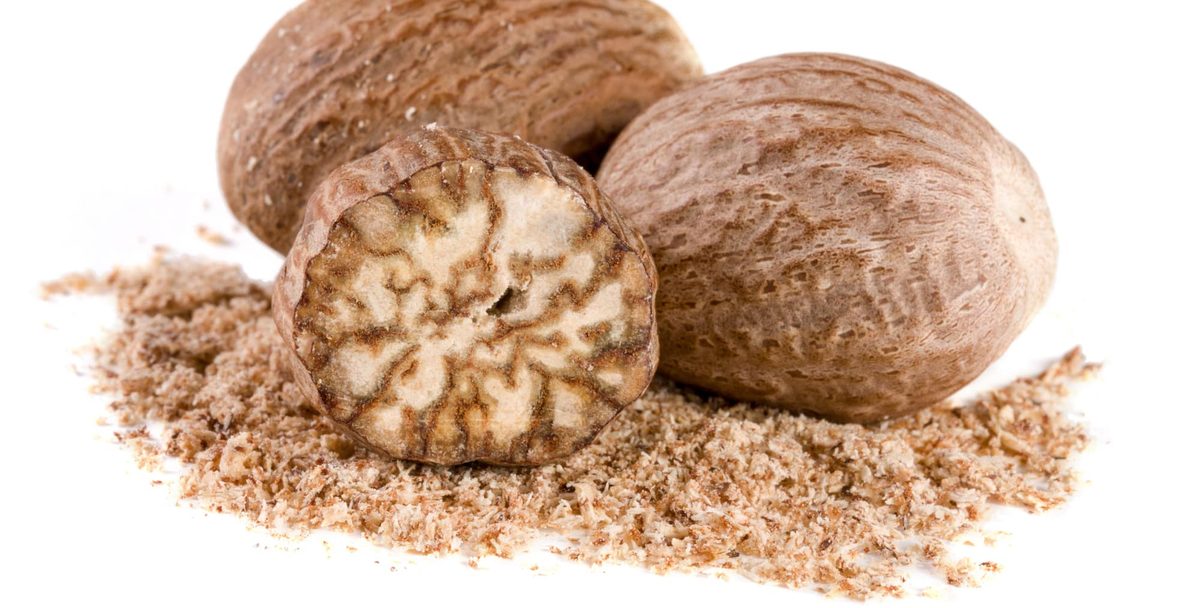
“Fresh” nutmeg means a whole nutmeg you grate yourself; ground nutmeg is the same spice milled in advance. Both come from the seed kernel of the nutmeg tree, Myristica fragrans.12 What separates them is how much aroma survives between grinding and the pot. In a 2025 tasting, freshly grated nutmeg beat pre-ground in every use, and tasters called the pre-ground “flat” and “faint.”3
Side by side
| Freshly grated nutmeg | Pre-ground nutmeg | |
|---|---|---|
| What it is | The dried seed kernel, grated as needed2 | The same kernel, milled before sale2 |
| Plant | Myristica fragrans, family Myristicaceae, native to the Banda Islands1 | Same |
| Aroma compounds | Volatile oil makes up 5–15% of the kernel, led by α- and β-pinene and sabinene, with myristicin the main aromatic ether4 | Same oil; nutmeg’s essential oils are readily volatilized5 |
| In a tasting | Preferred in banana bread, a fruit punch and on fresh mango for its vivid flavor and aroma3 | Described as “flat” and “faint”3 |
| Keeping quality | A year-old whole nutmeg still performed well in that test;3 general guidance gives whole spices 2 years6 | Faded within months of opening in that test;3 general guidance gives ground spices 1 year6 |
| Texture | Fine shavings from a rasp | Uniform powder; 1 teaspoon weighs 2.2 g7 |
| Safety | Same spice, same cautions (see below)8 | Same8 |
Why fresh tastes stronger
Nutmeg’s flavor is carried by its volatile oil. FAO puts that oil at 5 to 15% of the kernel, with α- and β-pinene and sabinene as its main components and myristicin as the main aromatic ether.4 A cargo handbook for the spice trade notes that these essential oils are readily volatilized and may be lost above 25°C.5 The usual explanation for weak pre-ground nutmeg is that it has to hold that oil from the mill to your kitchen, while a whole nutmeg holds it until you grate. That is plausible, but no study we found measured the loss after grinding.
How the nutmeg is ground also matters. A 1993 study compared grinding at room temperature, chilled and frozen with liquid nitrogen, and found the best results, measured as volatile oil and oleoresin, with liquid nitrogen.9 The abstract gives no figures, so the size of the difference is unknown.
The tasting evidence is consistent:
- Milk Street (2025) tested freshly grated nutmeg against a supermarket pre-ground nutmeg in banana bread, a fruity punch and sprinkled on mango. The results “weren’t even close”: tasters preferred freshly grated in all uses.3 It also found ground nutmeg faded within months of opening, while even a year-old whole nutmeg performed well.3
- America’s Test Kitchen compared fresh with pre-ground and concluded that grinding it yourself matters in dishes where nutmeg is the only spice, but that pre-ground is fine in foods with lots of spices.10
Can one replace the other?
Yes. They are the same spice, so the question is only amount.
Whole to ground (Computed, McCormick’s figure): half a nutmeg gives about 1 teaspoon of ground nutmeg.11 Nutmegs vary in size, so treat that as approximate. By weight, an intact nutmeg is 6 to 7 g,12 so half is 3 to 3.5 g, while USDA weighs a level teaspoon of commercial ground nutmeg at 2.2 g7 (our arithmetic). The two figures don’t line up exactly, which is one more reason to measure loosely and taste.
Fresh in place of old pre-ground: use a little less, because fresh is stronger in a tasting.3 Pre-ground in place of fresh: you may need a little more, and more again if the jar has been open a while. No source puts a number on either adjustment; start with the recipe amount and taste (Method).
A common tip says to pack freshly grated nutmeg into the spoon to measure it. We found no source that tests it.
When pre-ground is fine
Following America’s Test Kitchen:10
- Grate fresh where nutmeg is the only spice. America’s Test Kitchen’s examples of nutmeg’s uses include dairy-based savory dishes such as quiche and creamed spinach.10 In our judgment the same goes for eggnog, custards and a dusting over fruit or a drink.
- Pre-ground is fine in foods with lots of spices,10 such as spice cakes and pumpkin pie, where nutmeg is one voice among several.
Storage
General extension guidance gives whole spices 2 years and ground spices 1 year.6 McCormick’s own guidance is longer and overlapping, 2 to 4 years for ground spices,13 and none of these figures was measured on nutmeg. The only nutmeg-specific evidence is the 2025 tasting above.3 Keep both forms tightly closed, dark and cool. Full details are in how to store nutmeg.
A safety note that applies to both
Nutmeg is safe in cooking amounts. The National Capital Poison Center says nutmeg is not dangerous used as recommended and advises keeping nutmeg and mace out of children’s reach.8 Large amounts are another matter. The Missouri Poison Center gives a toxic range of 5 to 30 g of ground nutmeg and notes an intact nutmeg weighs 6 to 7 g;12 the Tennessee Poison Center cites 15 to 20 g, about two to three tablespoons of ground nutmeg.14 A whole nutmeg grates down quickly, so grate what the recipe calls for and stop.
What isn’t known
- No study measures how fast nutmeg loses volatile oil after grinding at home.
- No published adjustment for swapping fresh and pre-ground nutmeg, beyond tasting.
- The home shelf-life figures are general spice guidance; nutmeg-specific data are limited to one tasting.
Related
- Nutmeg, nutmeg substitutes, too much nutmeg and how to store nutmeg
- Cooking with nutmeg and nutmeg uses
- Mace and mace vs. nutmeg: the other spice from the same fruit
- Cinnamon vs. nutmeg and allspice vs. nutmeg
Footnotes
-
Myristica fragrans Houtt., Plants of the World Online, Royal Botanic Gardens, Kew. powo.science.kew.org · Reference work ↩ ↩2
-
Production, handling and processing of nutmeg and mace, Section III: Post harvest handling, FAO. fao.org · Reference work ↩ ↩2 ↩3
-
“Kitchen Insider: Great Grated Nutmeg”, Milk Street, September–October 2025. 177milkstreet.com · Publication ↩ ↩2 ↩3 ↩4 ↩5 ↩6 ↩7 ↩8 ↩9
-
Production, handling and processing of nutmeg and mace, Section VI: Composition and constituents, FAO. fao.org · Reference work ↩ ↩2
-
Nutmegs, Transport Information Service (TIS), German Insurance Association. tis-gdv.de · Reference work ↩ ↩2
-
Anna Martin, “Add a Little Spice to Your Life! Part II”, University of California Cooperative Extension, 2002. ucanr.edu · Reference work ↩ ↩2 ↩3
-
Spices, nutmeg, ground, FDC ID 171326, USDA FoodData Central. fdc.nal.usda.gov · Regulator ↩ ↩2
-
Rose Ann Gould Soloway, “Kitchen surprises and cautions”, National Capital Poison Center. poison.org · Reference work ↩ ↩2 ↩3
-
McKee, Thompson and Harden, “Effect of three grinding methods on some properties of nutmeg”, Lebensmittel-Wissenschaft und Technologie, 1993 (abstract). iifiir.org · Peer-reviewed ↩
-
“Getting to Know: Baking Spices”, America’s Test Kitchen. americastestkitchen.com · Publication ↩ ↩2 ↩3 ↩4
-
McCormick Kitchens, “How to Grind Your Own Spices, Plus Spice Conversions”, McCormick, 2025. mccormick.com · Merchant ↩
-
“Nutmeg Abuse”, Missouri Poison Center, 2022 (modified 2026). missouripoisoncenter.org · Reference work ↩ ↩2
-
McCormick Kitchens, “How Long Do Spices Last?”, McCormick, 2025. mccormick.com · Merchant ↩
-
Nena Bowman, “Nutmeg, a Potentially Uninvited Holiday Guest?”, Tennessee Poison Center, 2020. vumc.org · Reference work ↩