Spice Comparisons · Comparison
Cinnamon vs. Nutmeg: Bark vs. Seed, and How to Swap Them
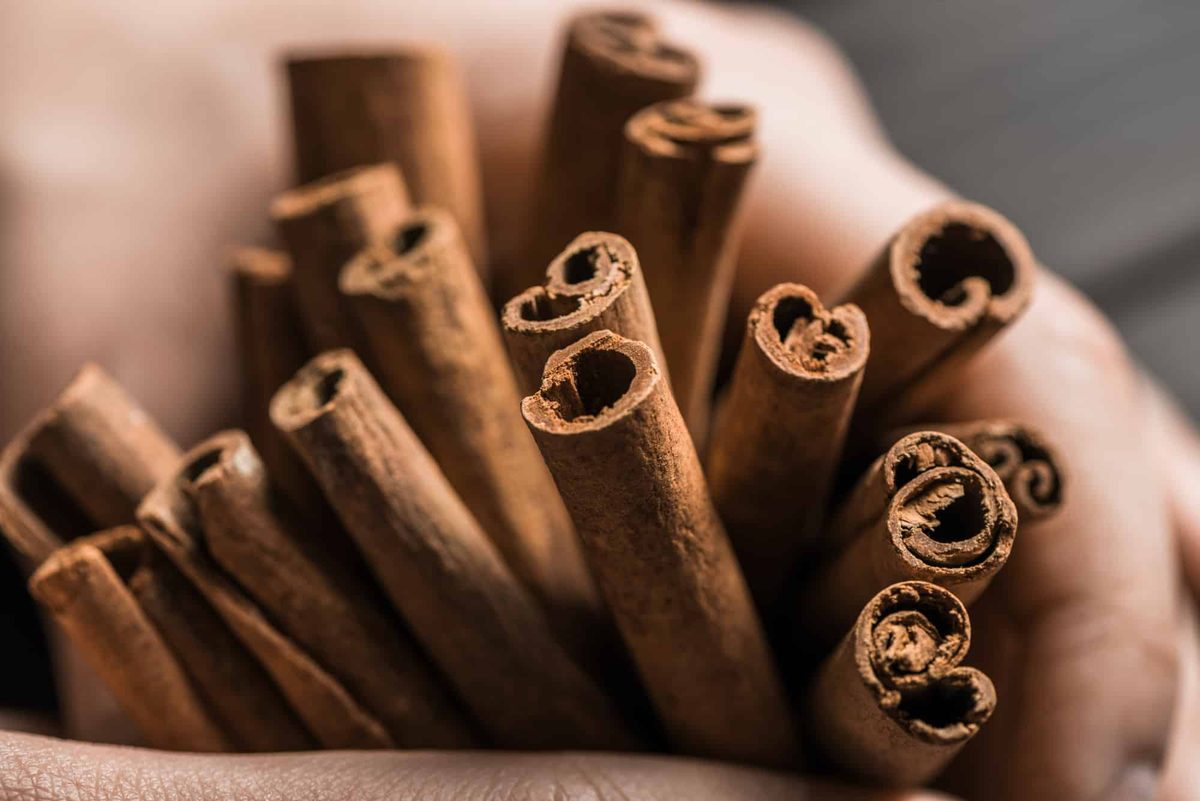
Cinnamon and nutmeg sit side by side in pumpkin pie spice, but they come from unrelated trees and from different parts of them. Cinnamon is the dried inner bark of Cinnamomum trees in the laurel family;1 nutmeg is the dried seed kernel of Myristica fragrans, in the nutmeg family.234 Their aromas come from different compounds: cinnamon bark oil is mostly cinnamaldehyde, while nutmeg’s oil is led by pinenes and sabinene.56 In a recipe, the practical difference is strength. Two spice merchants both say to use a quarter as much nutmeg as the cinnamon called for.78
Side by side
| Cinnamon | Nutmeg | |
|---|---|---|
| Species | Ceylon: Cinnamomum verum;2 cassia types include Chinese cassia, C. aromaticum, and Indonesian cassia, C. burmanni910 | Myristica fragrans3 |
| Family | Lauraceae (laurel family)2 | Myristicaceae (nutmeg family)3 |
| Native range | C. verum: Sri Lanka;2 C. aromaticum: southeast China to Vietnam;9 C. burmanni: south China to western and central Malesia10 | Maluku, in the Banda Islands3 |
| Part used | Dried inner bark1 | Dried seed kernel; the aril around the seed is a second spice, mace411 |
| Forms sold (common retail) | Sticks (quills) and ground | Whole kernels and ground |
| Key compounds | Bark oil 50 to 75% cinnamaldehyde in Ceylon, with 5 to 18% eugenol;5 70 to 95% cinnamaldehyde in Chinese cassia, with only traces of eugenol12 | Volatile oil 5 to 15% of the kernel, led by α- and β-pinene and sabinene;6 aromatic ethers such as myristicin and elemicin 2 to 18% of the oil13 |
| Flavor | Sweet, warm and woody (editorial); CBI calls Ceylon milder and finer than cassia14 | Britannica: a distinctive pungent fragrance and a warm, slightly sweet taste15 |
| Typical uses | Baked goods and sweets, hot drinks, mulled wine; garam masala and masala chai14 | Cakes, cookies, eggnog, milk pudding;16 scalloped potatoes, glazed carrots, creamed spinach17 |
| Main safety issues | Coumarin in cassia;18 FDA lead alerts on specific lots of ground cinnamon19 | Intoxication at doses of many grams;2021 EU aflatoxin limits22 |
| Cost | No dated, sourced price comparison found | No dated, sourced price comparison found |
The compound figures come from different sources and different spices. They show what leads each aroma, not how strong one spice is compared with the other. For the individual spices, see cinnamon and nutmeg.
Bark and seed
Cinnamon is the inner bark of the tree.1 For Ceylon cinnamon, PROSEA describes commercial bark no more than 0.5 cm thick, with smaller curled pieces slid inside longer ones to build the familiar compound quills.5 Cassia is a group of related species, and it is the type most commonly sold in North America; the NIH calls Ceylon the “true” cinnamon.23 For how the two cinnamons differ, see Ceylon vs. cassia cinnamon.
Nutmeg comes from a fruit. FAO is explicit that the spice traded as nutmeg is only the dried seed kernel, and that one fruit produces two separate spices: the kernel is nutmeg, and the lacy aril around the seed is dried as mace.411 See mace vs. nutmeg.
What each aroma is made of
Cinnamon gets its character from cinnamaldehyde, which dominates the bark oil of every type. Ceylon bark oil also carries a meaningful share of eugenol, the clove compound, while Chinese cassia oil has only traces.512
Nutmeg’s volatile oil makes up 5 to 15% of the kernel, and FAO names α-pinene, β-pinene and sabinene as its major components.6 The aromatic ethers, among them myristicin, elemicin and safrole, make up 2 to 18% of the oil in PROSEA’s figures.13 They are a small part of nutmeg’s aroma, but they matter for safety (below).
These are two unrelated sets of compounds. That is why the spices can share a dish without duplicating each other.
How they work together
Many spice blends and recipes use both, which shows that each brings something the other does not. McCormick’s pumpkin pie spice lists cinnamon, ginger, nutmeg and allspice, in that order.24 Saveur’s Cincinnati chili uses cinnamon alongside nutmeg, allspice and cloves.25
Each also has jobs of its own. CBI notes that in Europe cinnamon goes mostly into baked goods and sweets, hot drinks, herbal infusions and mulled wine, and that it is a key ingredient in Indian preparations such as garam masala and masala chai.14 Nutmeg leans toward dairy and savory dishes: FAO’s utilization tables list eggnog, ice cream and milk pudding,16 and McCormick suggests its ground nutmeg for scalloped potatoes, glazed carrots and creamed spinach.17 By common kitchen practice, a pinch of nutmeg also goes into white sauces and cheese sauces, where cinnamon would be out of place.
Safety: different concerns
Cinnamon: coumarin, and lead in some ground cinnamon. Cassia can carry substantial coumarin. BfR puts the average in cassia in German monitoring at about 3 g per kg, and calculates that a 60 kg adult reaches the tolerable daily intake with about 2 g of cassia a day, a 15 kg child with about 0.5 g.18 That intake, 0.1 mg of coumarin per kg of body weight a day, is EFSA’s.26 Separately, a US FDA public health alert on ground cinnamon lists specific products found to contain elevated lead, with results it reports from 2.03 to 7.68 parts per million.19 These are particular products, not cinnamon in general; the cinnamon profile has the details.
Nutmeg: dose, and aflatoxin. Nutmeg is safe in cooking amounts; the National Capital Poison Center says it is not dangerous when used as recommended.27 Eaten in quantity it is a different matter. The Tennessee Poison Center says myristicin is converted in the body to MMDA, a compound with hallucinogenic properties, and puts the dose at which psychogenic effects have been reported at 15 to 20 g, or two to three tablespoons of ground nutmeg.20 The Missouri Poison Center gives 5 to 30 g as the range people take to get high.21 The two figures describe different things and do not line up; both are well beyond the amounts recipes call for, in our judgment. Nutmeg also has its own entry in the EU’s maximum levels for aflatoxins.22 See too much nutmeg.
Can one stand in for the other?
In a blend or a background role, yes, in small amounts. The published ratios below are merchants’ and a food writer’s rules of thumb, and none says how it was set.
| Swap | Treatment | Starting amount | Source |
|---|---|---|---|
| Nutmeg in place of cinnamon | Attributed | 1/4 teaspoon nutmeg per teaspoon of cinnamon | McCormick calls nutmeg, allspice and mace “more powerful spices” and gives 1/4 teaspoon per teaspoon;7 The Spice House also says 1/4 the amount8 |
| Cinnamon in place of nutmeg | Attributed | 1/2 the nutmeg amount, then taste | The Spice House says to start with half as much cinnamon as the nutmeg called for;28 Healthline also says half29 |
These two figures do not come from a single measure of strength. If nutmeg were four times as strong as cinnamon, as the first row implies, replacing nutmeg would take more cinnamon, not half as much. The Spice House gives both figures. Treat each as a cautious starting point for its own direction, and taste.
Where one spice is the point of the recipe, as in cinnamon rolls or a nutmeg-scented custard, the swap will change the dish; that is our judgment. A blend that contains the missing spice is usually the better fix. See cinnamon substitutes and nutmeg substitutes, where mace ranks first for nutmeg.
What isn’t known
- No study compares the flavor strength of cinnamon and nutmeg. The swap ratios are merchants’ and a writer’s guidance.
- The compound figures come from different reviews and different spices; they are not a measure of relative strength.
- No dated, sourced retail price comparison was found.
- It is sometimes said that Ceylon cinnamon is a better stand-in for nutmeg than cassia, or that nutmeg replaces Ceylon better than cassia. No source we found tests either claim.
Related
- Cinnamon, Ceylon vs. cassia cinnamon, ground cinnamon vs. cinnamon sticks and too much cinnamon
- Nutmeg, cooking with nutmeg, fresh vs. ground nutmeg and mace vs. nutmeg
- Cloves vs. cinnamon, allspice vs. nutmeg and nutmeg vs. cloves
- Pumpkin pie spice
Footnotes
-
Ranasinghe et al., “Medicinal properties of ‘true’ cinnamon (Cinnamomum zeylanicum): a systematic review”, 2013. link.springer.com · Peer-reviewed ↩ ↩2 ↩3
-
Cinnamomum verum, Plants of the World Online, Royal Botanic Gardens, Kew. powo.science.kew.org · Reference work ↩ ↩2 ↩3 ↩4
-
Myristica fragrans Houtt., Plants of the World Online, Royal Botanic Gardens, Kew. powo.science.kew.org · Reference work ↩ ↩2 ↩3 ↩4
-
G.B. Marcelle, Production, handling and processing of nutmeg and mace, Section III, FAO, 1995. fao.org · Reference work ↩ ↩2 ↩3
-
Cinnamomum verum, PROSEA Handbook No. 13: Spices. prosea.prota4u.org · Reference work ↩ ↩2 ↩3 ↩4
-
Production, handling and processing of nutmeg and mace, Section VI, FAO, 1995. fao.org · Reference work ↩ ↩2 ↩3
-
“About Cinnamon: Uses, Pairings and Recipes”, McCormick, 2025. mccormick.com · Merchant ↩ ↩2
-
“The 9 Best Cinnamon Substitutes”, The Spice House, 2018. thespicehouse.com · Merchant ↩ ↩2
-
Cinnamomum aromaticum, Plants of the World Online, Royal Botanic Gardens, Kew. powo.science.kew.org · Reference work ↩ ↩2
-
Cinnamomum burmanni, Plants of the World Online, Royal Botanic Gardens, Kew. powo.science.kew.org · Reference work ↩ ↩2
-
Production, handling and processing of nutmeg and mace, Introduction, FAO, 1995. fao.org · Reference work ↩ ↩2
-
Cinnamomum (PROSEA Spices), Pl@ntUse. uses.plantnet-project.org · Reference work ↩ ↩2
-
M. Flach and M. Tjeenk Willink, Myristica fragrans, Plant Resources of South-East Asia (PROSEA). uses.plantnet-project.org · Reference work ↩ ↩2
-
“The European market potential for cinnamon”, CBI. cbi.eu · Reference work ↩ ↩2 ↩3
-
“Nutmeg”, Encyclopaedia Britannica, 2026. britannica.com · Reference work ↩
-
Production, handling and processing of nutmeg and mace, Section VII, FAO, 1995. fao.org · Reference work ↩ ↩2
-
McCormick Ground Nutmeg, product page. mccormick.com · Merchant ↩ ↩2
-
FAQ on coumarin in cinnamon and other foods, BfR. bfr.bund.de · Regulator ↩ ↩2
-
“More Ground Cinnamon Products Added to FDA Public Health Alert Due to Presence of Elevated Levels of Lead”, FDA. fda.gov · Regulator ↩ ↩2
-
Nena Bowman, “Nutmeg, a Potentially Uninvited Holiday Guest?”, Tennessee Poison Center, 2020. vumc.org · Reference work ↩ ↩2
-
“Nutmeg Abuse”, Missouri Poison Center. missouripoisoncenter.org · Reference work ↩ ↩2
-
Commission Regulation (EU) 2023/915, maximum levels for certain contaminants in food. eur-lex.europa.eu · Regulator ↩ ↩2
-
Cinnamon: Usefulness and Safety, NCCIH. nccih.nih.gov · Regulator ↩
-
McCormick Pumpkin Pie Spice, product page. mccormick.com · Merchant ↩
-
“Cincinnati Chili”, Saveur. saveur.com · Publication ↩
-
Coumarin in flavourings and other food ingredients with flavouring properties, EFSA AFC Panel, 2008. efsa.europa.eu · Regulator ↩
-
Rose Ann Gould Soloway, “Kitchen surprises and cautions”, National Capital Poison Center. poison.org · Reference work ↩
-
“Nutmeg Substitute”, The Spice House, 2018. thespicehouse.com · Merchant ↩
-
Katey Davidson, “8 Great Substitutes for Nutmeg”, Healthline, 2019. healthline.com · Publication ↩