Spices · Comparison
Gochugaru vs. Gochujang: Dry Korean Chile Against Fermented Chile Paste
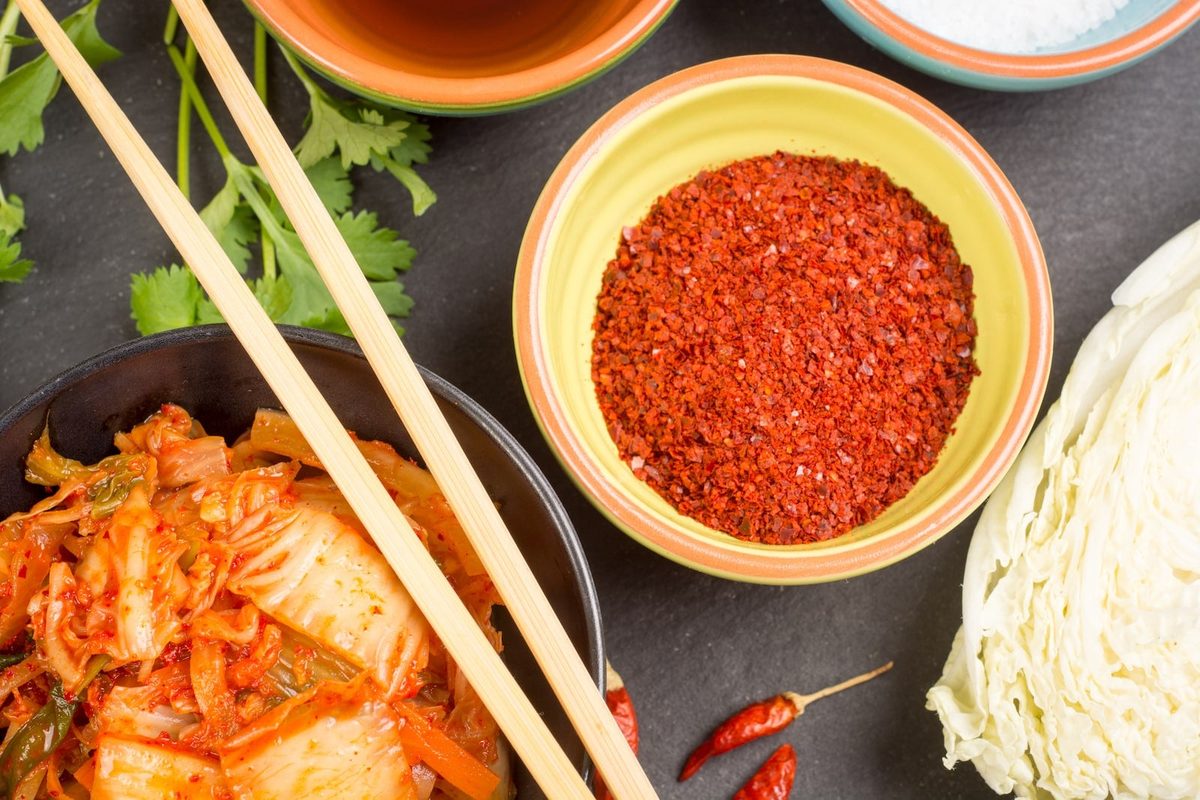
Gochugaru is dried Korean red chile, sold as coarse flakes or a finer powder. Gochujang is something else: a fermented paste in which red pepper powder is one ingredient among grain, salt and water.1 One is a spice you sprinkle; the other is a seasoned, salty, often sweet paste you stir in. They share a chile, but they do different jobs, and only one of the swaps works without adjustment.
Side by side
| Gochugaru | Gochujang | |
|---|---|---|
| What it is | Dried red chile, ground; Maangchi says the flakes are “always coarse and chunky”2 | A red or dark red fermented paste1 |
| Chile | Capsicum annuum, as Codex names it for kimchi seasoning;3 family Solanaceae4 | Red pepper (Capsicum annuum) powder is a basic ingredient;1 Maangchi says the fine powder is mainly used for making gochujang2 |
| Native range of the chile species | Southern United States to Brazil and the Caribbean5 | Same chile |
| Ingredients | Chile only | Basic: grains, red pepper powder, salt and water. Optional: powdered meju, soybeans, sugars, fish sauce and others1 |
| How it is made | Chiles are dried and ground; one type is sun-dried taeyangcho2 | Grain starch is saccharified with powdered malt or Aspergillus cultures, salted, fermented and aged, then mixed with red pepper powder1 |
| Water | Dry | Up to 55.0% moisture under Codex1 |
| Heat | Varies widely; sold in mild and hot versions2 (lab figures below) | Codex minimum of 10.0 ppm capsaicin;1 no survey of retail heat found |
| Other components | None | Codex minimum of 4.0% crude protein1 |
| Flavor (editorial) | Ripe red pepper, fruity, sometimes faintly smoky; PepperScale also calls it fruity with a touch of smoke6 | Sweet, salty, savory and hot, with the depth of fermentation; PepperScale credits most of the flavor to the chiles and fermented soybean paste7 |
| Storage after opening | Maangchi: in the freezer for up to 6 months, with a small jar in the refrigerator for daily use2 | Maangchi: in the refrigerator, used within 3 months8 |
| Typical uses | Kimchi, side dishes, soups and stews23 | Adds spiciness, color and sweetness to many Korean dishes;8 glazing meats and filling lettuce wraps;9 PepperScale adds bulgogi marinades, salad dressings and a dip for fried chicken7 |
| Price | No dated, sourced comparison found | No dated, sourced comparison found |
The flavor row is our description. For the full profile of the dry chile, see gochugaru.
The differences that change a dish
Water and texture
Codex allows gochujang up to 55% moisture,1 so a spoonful is in large part water. It dissolves into soups, stews and sauces, but it cannot be sprinkled and it will not stay in separate red flecks the way flakes do. Gochugaru adds color and heat without adding liquid. In our judgment that is the main reason the two are not interchangeable in kimchi seasoning, dry rubs or garnishes.
Salt and sugar
Salt is a basic ingredient of gochujang under Codex, and sugars are among the optional ones.1 Maangchi describes it as adding sweetness as well as spiciness and color.8 Gochugaru brings neither. Chili Pepper Madness advises adding less salt to a dish when gochujang stands in for gochugaru, because the paste is already somewhat salty.10 As kitchen judgment, watch gochujang glazes and marinades over high heat; the sugar in sweetened pastes can scorch.
Fermentation
Gochujang is fermented and aged, and Codex lists powdered meju, soybeans and fermented soybean paste among its optional ingredients.1 PepperScale notes that the fermentation can take months.7 In our judgment that fermentation is what gives it a savory depth dried chile does not have. Matt Rodbard, writing in Saveur, calls it “the strongest, most assertive ingredient used in Korean cooking” and says to use it sparingly.9
Heat
Neither has one heat level. Each figure below belongs to its own samples and method:
| Scope | Figure | Source |
|---|---|---|
| 20 Korean red peppers, by HPLC (1994) | 7.0 to 75.9 mg capsaicinoids per 100 g | Chai et al.11 |
| Commercial red pepper powders by variety (2000) | Highest: ‘Chungyang’ variety, 126.1 mg per 100 g | Choi et al.12 |
| Korean gochu, as described by Kwon et al. (no samples or method in the abstract) | Under 1,000 SHU | Kwon et al.13 |
| Gochugaru as a category (no samples or method stated) | About 1,500 to 10,000 SHU; elsewhere 4,000 to 8,000 SHU | PepperScale, two articles that disagree614 |
| Gochujang, Codex minimum | 10.0 ppm capsaicin | Codex1 |
| Gochujang, retail (descriptive, no figure) | Most range from mild to moderately hot | PepperScale7 |
The Codex figure is a floor in a product standard, not a measurement of typical tubs, and the chile studies measured dried peppers, not paste. PepperScale’s gochugaru ranges are its own published ranges with no method stated. PepperScale also notes that gochujang packaging may carry a numbered heat level, with 3 for moderate and 4 for very hot.7 The rows cannot be compared to say which is hotter. Maangchi uses mild gochugaru in kimchi so she can add a lot for color without making it too spicy.2 With either product, taste a little from a new bag or tub before committing a whole recipe to it; that is kitchen judgment.
A shared history
Chile is an American plant: Kew gives the native range of Capsicum annuum as the southern United States to Brazil and the Caribbean.5 The oldest surviving Korean record of chile is Jibong yuseol of 1614,1516 and the long-standing account is that it reached the peninsula around the Imjin War, the Japanese invasion that began in 1592.16 Kwon and colleagues reject that account and write that Koreans have grown gochu for 1,500 years;13 Weekly Kyunghyang, surveying the debate in 2026, says the native-chile theory is hard to call mainstream.16 See gochugaru for the full account.
Can one stand in for the other?
The gochugaru substitutes page covers the first direction in detail. No published ratio exists for either swap, so both are Method: a direction and a starting point, not a tested figure.
- Gochujang in place of gochugaru. Chili Pepper Madness says gochujang will give you the taste of gochugaru with a different texture.10 PepperScale agrees it can work in soups and sauces and likewise warns about the added salt.14 It works best where the paste can dissolve: stews, soups and sauces. It works poorly in kimchi seasoning, rubs and garnishes, where the water, salt and sweetness change the result. Ratio (Method): start with an equal amount, cut back on salt and on salty seasonings such as soy or fish sauce, and taste.
- Gochugaru in place of gochujang. This is the harder swap. Gochugaru supplies the chile, but not the grain sweetness, salt, fermented depth or body.1 Ratio (Method): no published figure. As a starting point, use about 1 teaspoon of gochugaru per tablespoon of gochujang, loosen it with a little water, add a pinch of sugar and a little salt or soy sauce, and taste. Expect a thinner, less savory result.
- Making gochujang. Maangchi notes that the finer red pepper powder, not the coarse flakes, is what is mainly used for making gochujang.2 Codex describes a process of saccharifying grain, then fermenting and aging,1 so homemade gochujang is a project, not a quick fix.
Kwon and colleagues take the strictest view, writing that kimchi and gochujang fermented only with Korean gochu “can be eaten”;13 that is their opinion, not a tested finding.
What isn’t known
- No published ratio exists for swapping gochugaru and gochujang in either direction.
- No survey of the heat of retail gochujang was found; Codex sets only a minimum,1 and PepperScale describes the range only in words.7
- No dated, sourced price comparison was found.
- Recipes and labels vary in which optional ingredients a gochujang uses, so sweetness and saltiness differ from tub to tub.
Related
- Gochugaru and gochugaru substitutes
- Korean spices and Korean BBQ spices
- Red pepper flakes, paprika vs. cayenne
Footnotes
-
Regional Standard for Gochujang, CXS 294R-2009, Codex Alimentarius. fao.org · Standard ↩ ↩2 ↩3 ↩4 ↩5 ↩6 ↩7 ↩8 ↩9 ↩10 ↩11 ↩12 ↩13 ↩14 ↩15
-
Maangchi, Korean hot pepper flakes (Gochugaru), Maangchi.com. maangchi.com · Publication ↩ ↩2 ↩3 ↩4 ↩5 ↩6 ↩7 ↩8
-
Standard for Kimchi, CXS 223-2001, Codex Alimentarius. fao.org · Standard ↩ ↩2
-
Standard for Dried or Dehydrated Chilli Pepper and Paprika, CXS 353-2022, Codex Alimentarius. fao.org · Standard ↩
-
Capsicum annuum L., Plants of the World Online, Royal Botanic Gardens, Kew. powo.science.kew.org · Reference work ↩ ↩2
-
Matt Bray, What Is Gochugaru? The Story Behind The Spice, PepperScale, 2023. pepperscale.com · Publication · PepperScale is also owned by Matt Bray, the editor of this site. ↩ ↩2
-
Matt Bray, What Is Gochujang? The Story Behind The Spice, PepperScale, 2023. pepperscale.com · Publication · PepperScale is also owned by Matt Bray, the editor of this site. ↩ ↩2 ↩3 ↩4 ↩5 ↩6
-
Maangchi, Hot pepper paste (Gochujang), Maangchi.com. maangchi.com · Publication ↩ ↩2 ↩3
-
Rodbard, How to Cook With Korean Jangs, Saveur. saveur.com · Publication ↩ ↩2
-
Hultquist, Gochugaru: What It Is and How to Use It, Chili Pepper Madness. chilipeppermadness.com · Publication ↩ ↩2
-
Chai et al., Relationships Between the Content and Sensory Evaluation of Pungent Principles in Red Pepper, Analytical Science and Technology, 1994 (abstract). accesson.kr · Peer-reviewed ↩
-
Choi, Jeon and Park, Comparison of Quality of Red Pepper Powders Produced in Korea, Korean Journal of Food Science and Technology, 2000 (abstract). koreascience.kr · Peer-reviewed ↩
-
Kwon, Jang, Yang and Chung, History of Korean gochu, gochujang, and kimchi, Journal of Ethnic Foods, 2014 (abstract). agris.fao.org · Peer-reviewed ↩ ↩2 ↩3
-
Matt Bray, What’s A Good Gochugaru Substitute?, PepperScale, 2022. pepperscale.com · Publication · PepperScale is also owned by Matt Bray, the editor of this site. ↩ ↩2
-
Kim Jong-deok and Ko Byung-hee, A study on the etymology of gochu, Korean Journal of Medical History. koreascience.kr · Peer-reviewed ↩
-
Jeong Yong-in, 김치는 언제부터 빨개졌을까 (When did kimchi turn red?), Weekly Kyunghyang, 2026. weekly.khan.co.kr · Publication ↩ ↩2 ↩3