Spices · Profile
Red Pepper Flakes: What’s in the Jar, How Hot They Are, and How to Use Them
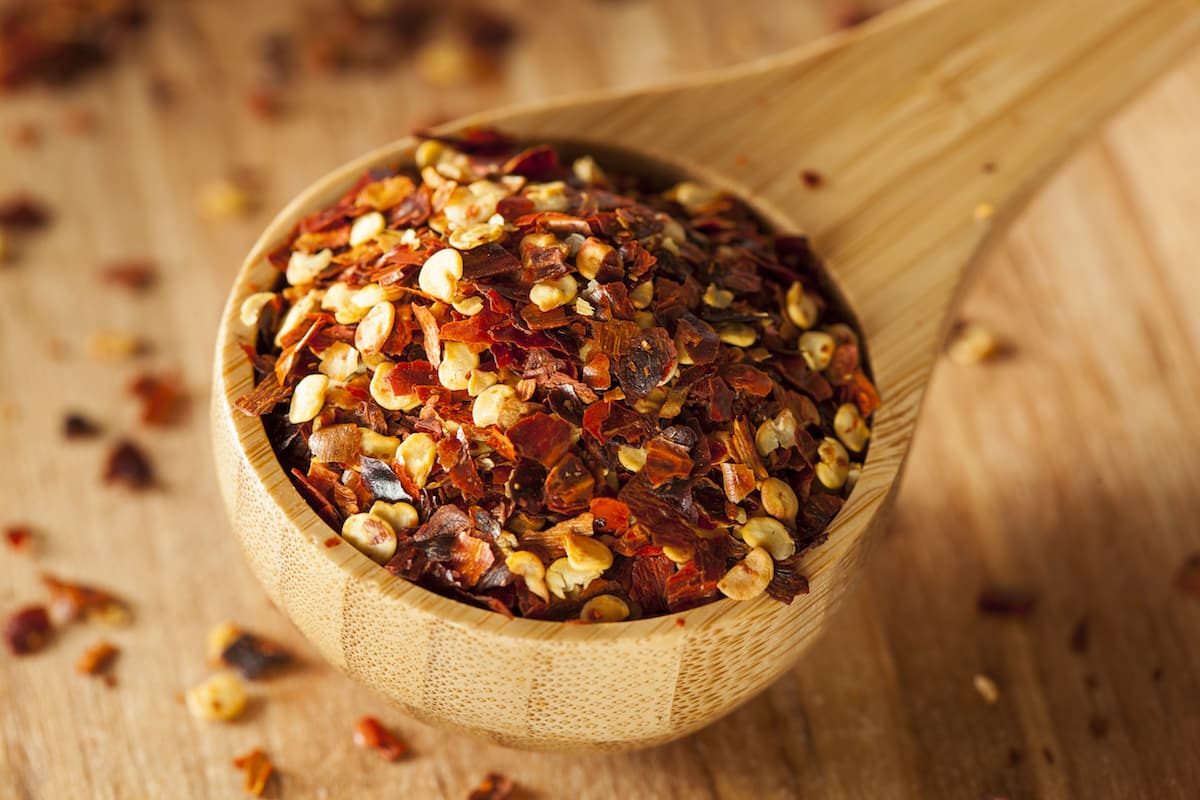
Red pepper flakes, also sold as crushed red pepper, are dried red chiles broken into coarse flakes, seeds and all. In the United States the chile is usually cayenne, alone or blended with other cultivars.1 They are the shaker on the pizzeria table and a quick way to add heat to almost anything. This page covers what goes into them, how hot they are (the published figures measure different things), the related flakes of Turkey and the Balkans, and how to use and store them.
At a glance
| What it is | Dried red chile, crushed to flakes, usually with seeds12 |
| Usual chile (US) | Cayenne, alone or blended with other cultivars (McCormick Science Institute)1 |
| Botanical name | Mostly Capsicum annuum1 |
| Plant family | Solanaceae (nightshade family)1 |
| Native range of the species | Southern United States to Brazil and the Caribbean (Kew)3 |
| Heat compounds | Capsaicinoids, mainly capsaicin and dihydrocapsaicin4 |
| Heat in Scoville units | Depends on the chile; see the table below |
| Appearance | Orange-red to deep dark red, often with visible yellow seeds1 |
| Related products | Turkish pul biber and isot, Macedonian Bukovo pepper, Korean gochugaru |
Measured values
12 figures, sourced| Measure | Value | Scope | Source |
|---|---|---|---|
| Seeds and seed fragments, maximum Limit | 40 % by weight | Turkish Food Codex communiqué on spices 2022/7, pul biber | faolex.fao.org |
| Seeds and seed fragments, maximum Limit | 2 % by weight | Turkish Food Codex communiqué on spices 2022/7, ipek pul biber | faolex.fao.org |
| Added vegetable oil, maximum Limit | 6 % by weight | Turkish Food Codex communiqué on spices 2022/7, pul biber and ipek pul biber | faolex.fao.org |
| Salt, maximum Limit | 7 % | Turkish Food Codex communiqué on spices 2022/7, pul biber and ipek pul biber | faolex.fao.org |
| Total oil, maximum Limit | 18 %, dry basis | Turkish Food Codex communiqué on spices 2022/7, pul biber | faolex.fao.org |
| Total oil, maximum Limit | 9 %, dry basis | Turkish Food Codex communiqué on spices 2022/7, ipek pul biber | faolex.fao.org |
| Pungency, crushed or flaked chilli pepper Limit | 900 SHU or more Scoville heat units | Codex CXS 353-2022, crushed or flaked chilli pepper as a category | fao.org |
| Pungency, crushed hot paprika Limit | above 480 and below 900 Scoville heat units | Codex CXS 353-2022, crushed hot paprika | fao.org |
| Pungency, crushed paprika Limit | 480 SHU or less Scoville heat units | Codex CXS 353-2022, crushed paprika | fao.org |
| Ochratoxin A, maximum Limit | 20 µg/kg | EU Regulation 2023/915, dried Capsicum fruits (includes chillies, chilli powder, cayenne and paprika) | eur-lex.europa.eu |
| Aflatoxin B1, maximum Limit | 5.0 µg/kg | EU Regulation 2023/915, dried Capsicum fruits (includes chillies, chilli powder, cayenne and paprika) | eur-lex.europa.eu |
| Total aflatoxins, maximum Limit | 10.0 µg/kg | EU Regulation 2023/915, dried Capsicum fruits (includes chillies, chilli powder, cayenne and paprika) | eur-lex.europa.eu |
Each figure is quoted as its source states it, with the samples or standard it applies to. Where sources differ, both are shown; nothing is averaged. All measured values
What red pepper flakes are
Under the international standard for dried chile (Codex CXS 353-2022), dried chilli and paprika may be sold whole, “crushed/cracked/broken/flakes”, or ground, and the product may be made with or without seeds or stalks.2 Red pepper flakes are the crushed style.
What goes into a particular jar is up to its maker. McCormick Science Institute says crushed red pepper flakes typically use the cayenne variety alone or blended with other cultivars, and that most commercially available red pepper is Capsicum annuum.1 It describes the dried flakes as orange-red to deep dark red, often with visible yellow seeds.1 It is often said that jalapeños, serranos and Anaheims are standard ingredients and that blends contain three or four cultivars; no source checked for this page shows either.
Where the heat sits. Researchers at The Ohio State University describe capsaicinoids accumulating in small structures called blisters that form along the inner walls of the fruit (the interlocular septum).5 The popular idea that the heat lives in the seeds themselves is not what that source describes.
Turkish pul biber, isot and Balkan flakes
Several countries make their own flakes, and at least one regulates them closely.
Turkey. The Turkish Food Codex communiqué on spices (2022/7) defines pul kırmızıbiber (pul biber) as red pepper conditioned with water and ground or broken into flakes of different sizes, to which edible vegetable oil and salt may be added.6 Its limits:6
| Turkish Food Codex, 2022/7 | Pul biber | İpek pul biber |
|---|---|---|
| Seeds and seed fragments, max | 40% by weight | 2% |
| Added vegetable oil, max | 6% by weight | 6% |
| Salt, max | 7% | 7% |
| Total oil, dry basis, max | 18% | 9% |
So standard pul biber can legally contain a good share of seeds; it is the “silk” grade, ipek, that is nearly seed-free. A widely repeated claim says pul biber is made only from the pepper walls; the Turkish standard does not say that.
The same communiqué defines isot: red pepper conditioned with water, broken, held at 70 to 80 °C for 3 to 12 days, and mixed with vegetable oil and salt.6 It is a different product from ordinary dry flakes.
North Macedonia. Slow Food has supported a Presidium for the Bukovo red pepper, which was close to extinction. The peppers are dried on strings hung beside farm buildings for about three months and often crushed into flakes or powder, still by hand.7 It is widely claimed that red pepper flakes were invented in the village of Bukovo and that words for chile flakes in several languages come from its name; no source checked for this page supports either claim.
Korea. Gochugaru is sold as coarse flakes and as powder; see its page for heat and history.
How hot are red pepper flakes?
The figures below come from different kinds of sources and describe different things, so they are listed side by side and not combined:
| Scope | Heat | Source |
|---|---|---|
| Crushed or flaked chilli pepper, as a category under the international standard | 900 SHU or more | Codex CXS 353-20222 |
| Crushed hot paprika, same standard | Above 480 and below 900 SHU | Codex CXS 353-20222 |
| Crushed paprika, same standard | 480 SHU or less | Codex CXS 353-20222 |
| Cayenne peppers (no sample or method stated) | About 8,000 SHU | McCormick Science Institute1 |
| Red pepper flakes compared with cayenne powder | Cayenne powder is “typically hotter” than the flakes | McCormick Science Institute1 |
| Blended red pepper flakes, as widely repeated | 30,000–50,000 SHU | No traceable source found |
How to read this:
- The Codex figures are category boundaries, the lines a product must meet to be labeled chilli rather than paprika or hot paprika. They are not measurements of any jar.2
- The 30,000 to 50,000 range is untraceable, not wrong. No study, standard or named measurement behind it was found. McCormick Science Institute’s statement that cayenne powder is usually hotter than flakes, with cayenne itself at about 8,000 SHU, does not sit easily with it,1 but neither source states its samples, so the two cannot be settled against each other.
- Heat varies by chile and by lot. Scoville taste tests are subjective; high-performance liquid chromatography (HPLC), which measures the heat compounds directly, is the most accurate method.4 Retail jars rarely state either.
For the cultivar measurements behind cayenne, see cayenne pepper.
Flavor
Flakes taste of dried red chile with a quick, sharp heat; seeds add a little nuttiness and texture, and the heat arrives in small bursts rather than evenly as with a fine powder. A blend’s character depends on its chiles. That description is ours.
Origin and history
Chiles are New World plants. Kew gives the native range of Capsicum annuum as the southern United States to Brazil and the Caribbean,3 and a 2014 study combining genetics, ecology, archaeobotany and linguistics points to domestication in central-east Mexico.8 McCormick Science Institute notes that after red peppers were brought back to Europe, Portuguese traders spread them quickly through Asia.1
Several stories told about red pepper flakes could not be traced for this page: that southern Italians took them up in the 19th century, that early Italian immigrants brought them to the United States and that the oldest Italian-American restaurants served them, and that China and Turkey are the leading producers. They may be true; no source checked here shows them.
How they are used
- At the table. McCormick Science Institute notes that red pepper sits on kitchen tables in many households, used as a finishing sprinkle on pizza, pasta and anything that wants a dash of heat.1 See good spices for pizza.
- Pickles. It notes that crushed red pepper adds color and heat to pickle brines.1
- Meats, seafood and blends. It lists red pepper in seasoning blends, meats, pickles and seafood, and in Italian, Indian, Mexican and Caribbean cooking.1 Italian sausage is a familiar example; that one is common practice rather than a sourced finding.
- In cooking. By kitchen practice, flakes go into oil with garlic at the start of a pasta sauce or stir-fry, where the heat spreads through the dish. Added at the end, they stay sharper and more visible. Start with about ¼ teaspoon for a dish for four and adjust; that is a cooking judgment, not a measured figure.
For more ideas, see cayenne pepper uses.
Buying and quality
- Color. Look for bright orange-red to deep red flakes, as described by McCormick Science Institute.1 Brown, dull flakes have likely lost color and aroma; that part is kitchen judgment.
- Seeds. A high proportion of pale seeds is normal in American flakes. If you want fewer seeds, Turkish ipek pul biber is held to 2% seeds by its standard.6
- Salt and oil. Turkish pul biber and isot may contain added salt and oil within the codex limits;6 check the label before salting a dish.
Storage
Keep flakes airtight, away from light and the stove. No shelf-life figure from a regulator or standards body was found for red pepper flakes; figures that circulate online could not be traced. When the color has dulled and the flakes smell of little, replace them.
Nutrition and health
No USDA nutrient entry for crushed red pepper was checked for this page, and red pepper flakes are used in amounts too small to matter much nutritionally. Claims that they prevent or treat diabetes, prostate cancer or constipation were not supported by any source reviewed for this page.
Capsaicin. The strongest human evidence on capsaicin concerns a prescription skin patch, not chile in food. A 2017 Cochrane systematic review found moderate-quality evidence that a high-concentration (8%) capsaicin patch gave moderate pain relief to a minority of people with postherpetic neuralgia.9 No claim is made here that red pepper flakes treat or prevent any disease.
Safety
- Mycotoxins (EU). EU law caps ochratoxin A at 20 µg/kg in dried Capsicum fruits, a category it says includes chillies, chilli powder, cayenne and paprika, and sets 5.0 µg/kg for aflatoxin B1 and 10.0 µg/kg for total aflatoxins.10
- Handling. Keep flakes away from eyes and wash hands after handling them. Common-sense guidance rather than a sourced finding.
Substitutes and comparisons
- Red pepper flakes substitutes
- Ground chiles: cayenne pepper, chile de árbol powder, paprika, chili powder
- Other flakes: gochugaru
- Black pepper vs. cayenne
Footnotes
-
“Red Pepper”, McCormick Science Institute. mccormickscienceinstitute.com · Merchant ↩ ↩2 ↩3 ↩4 ↩5 ↩6 ↩7 ↩8 ↩9 ↩10 ↩11 ↩12 ↩13 ↩14 ↩15 ↩16
-
Standard for Dried or Dehydrated Chilli Pepper and Paprika, CXS 353-2022, Codex Alimentarius. fao.org · Standard ↩ ↩2 ↩3 ↩4 ↩5 ↩6
-
Capsicum annuum L., Plants of the World Online, Royal Botanic Gardens, Kew. powo.science.kew.org · Reference work ↩ ↩2
-
Bosland and Walker, Measuring Chile Pepper Heat, NMSU Guide H-237, 2010. pubs.nmsu.edu · Reference work ↩ ↩2
-
Hernandez-Garcia and Zhang, Pepper Heat, eXtension Plant Breeding and Genomics, The Ohio State University. plant-breeding-genomics.extension.org · Reference work ↩
-
Türk Gıda Kodeksi Baharat Tebliği (2022/7), Ministry of Agriculture and Forestry of Türkiye, 2022. faolex.fao.org · Regulator ↩ ↩2 ↩3 ↩4 ↩5
-
Slow Food Presidium Product Receives Well-Deserved Recognition, Slow Food, 2017. slowfood.com · Publication ↩
-
Kraft et al., Multiple lines of evidence for the origin of domesticated chili pepper, PNAS, 2014. escholarship.org · Peer-reviewed ↩
-
Derry et al., Topical capsaicin (high concentration) for chronic neuropathic pain in adults, Cochrane Database of Systematic Reviews, 2017. cochrane.org · Peer-reviewed ↩
-
Commission Regulation (EU) 2023/915, EUR-Lex. eur-lex.europa.eu · Regulator ↩