Cooking · Profile
Korean Spices and Seasonings: Gochugaru, Gochujang, Sesame, Soybean Paste and Fish Sauce
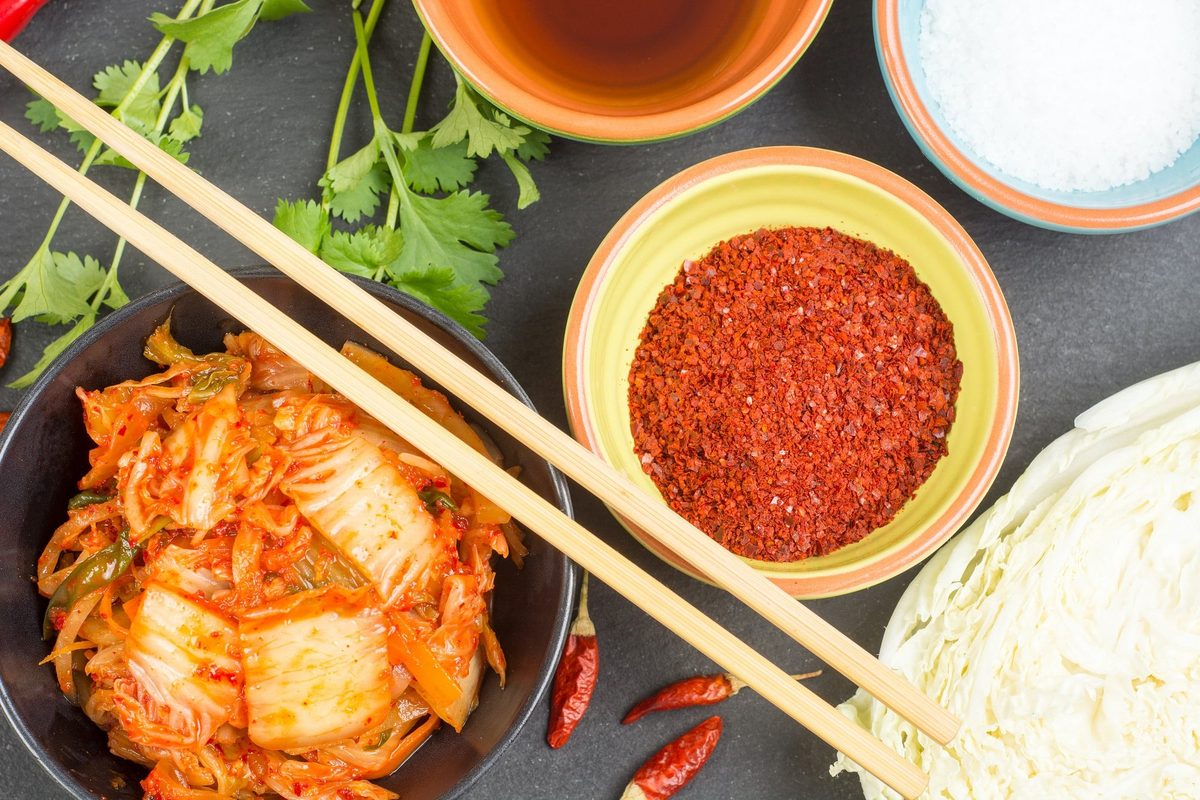
Korean cooking gets much of its character from a few seasonings: gochugaru (red pepper powder), the fermented pastes gochujang and soybean paste, toasted sesame and its oil, and fermented fish sauce. Several are defined in international food standards, which makes it possible to say what they are made of rather than relying on description. This page covers each, with links to our full profiles.
At a glance
| Seasoning | What it is | Uses in the sources | Full profile |
|---|---|---|---|
| Gochugaru | Korean red pepper (Capsicum annuum) powder or flakes1 | The main seasoning in kimchi1 | Gochugaru |
| Gochujang | Fermented paste of grain, red pepper powder and salt2 | Gochugaru vs. gochujang | |
| Soybean paste | Fermented paste whose essential ingredient is soybean3 | ||
| Sesame and sesame oil | Toasted seeds; oil pressed from toasted seeds4 | Sprinkled over dishes; oil used drop by drop4 | Sesame seeds |
| Fish sauce | Salt-fermented anchovy or sand lance sauce5 | Kimchi may include salted fermented seafood1 | |
| Perilla leaf | Kkaennip, “sesame leaf”6 | Aromatic leaf | Shiso |
Measured values
8 figures, sourced| Measure | Value | Scope | Source |
|---|---|---|---|
| Capsaicinoids, Korean red peppers | 7.0 to 75.9 mg per 100 g | 1994 HPLC study of 20 Korean red peppers | accesson.kr |
| Capsaicinoids, highest level found | 126.1 mg% (mg per 100 g) | 2000 study; 'Chungyang' variety | koreascience.kr |
| Gochujang: capsaicin, minimum Limit | 10.0 ppm | Codex regional standard for gochujang, CXS 294R-2009 | fao.org |
| Gochujang: crude protein, minimum Limit | 4.0 % | Codex regional standard for gochujang, CXS 294R-2009 | fao.org |
| Gochujang: moisture, maximum Limit | 55 % | Codex regional standard for gochujang, CXS 294R-2009 | fao.org |
| Fermented soybean paste: total nitrogen, minimum (soybean-only paste) Limit | 1.6 % | Codex regional standard for fermented soybean paste (Asia) | fao.org |
| Fermented soybean paste: total nitrogen, minimum (soybean-and-grain paste) Limit | 0.6 % | Codex regional standard for fermented soybean paste (Asia) | fao.org |
| Fermented soybean paste: moisture, maximum Limit | 60 % | Codex regional standard for fermented soybean paste (Asia), both types | fao.org |
Each figure is quoted as its source states it, with the samples or standard it applies to. Where sources differ, both are shown; nothing is averaged. All measured values
Gochugaru
Gochugaru is Korean red pepper powder, ground from Capsicum annuum, a species native from the southern United States to Brazil and the Caribbean.17 It is sold from fine powder to coarse flakes, both styles the Codex chile standard recognizes.8 The Codex standard for kimchi defines the dish as cabbage processed with a seasoning mixture mainly of red pepper powder, garlic, ginger, other alliums and radish, and says kimchi should have red color originating from red pepper.1
How chile reached Korea is debated. The long-accepted account is that it arrived around the Imjin War of the 1590s;9 the oldest surviving Korean record of the chile is the Jibong yuseol of 1614.10 Some Korean researchers argue for a much older native gochu, a view Weekly Kyunghyang says has not become mainstream.911 Chile in kimchi is documented later: a 1766 text describes cucumber kimchi with gochugaru and garlic.9
Heat varies by variety. A 1994 HPLC study of 20 Korean red peppers measured capsaicinoids from 7.0 to 75.9 mg per 100 g,12 and a 2000 study found the highest level, 126.1 mg%, in the Chungyang variety.13 The common claim that mild gochugaru is used mainly for color could not be traced. See gochugaru, gochugaru substitutes and red pepper flakes.
Gochujang
Codex defines gochujang as a red or dark red pasty fermented food.2 Its basic ingredients are grains, red pepper powder, salt and water; the optional list includes powdered meju, soybeans, sugars, soybean paste and fish sauce. The process saccharifies grain starch with malt or Aspergillus, adds salt, ferments and ages the mixture, then adds red pepper powder and heat-treats it.2 The standard sets a minimum of 10.0 ppm capsaicin and 4.0% crude protein, and a maximum of 55% moisture.2 It names “grains” without specifying glutinous rice, and gives no fermentation time. Claims that gochujang is fermented for years in clay pots could not be traced. See gochugaru vs. gochujang.
Soybean paste
Codex’s regional standard for fermented soybean paste in Asia defines it as a fermented food whose essential ingredient is soybean, made with salt, water and Bacillus and/or Aspergillus.3 Grains and flour (wheat, rice, barley) are optional, and the standard sets separate criteria for soybean-only pastes (total nitrogen at least 1.6%) and soybean-and-grain pastes (at least 0.6%), with moisture at most 60% for both.3 The standard does not name doenjang or miso. The common contrast that Korean paste is only soybeans and salt while miso contains rice is a generalization the standard does not make: both kinds of paste exist under the same definition.
Sesame and toasted sesame oil
Katzer calls toasted sesame a common spice in East Asia, often sprinkled over Japanese and Korean dishes.4 Dark sesame oil is made by toasting the seeds before pressing; its flavor comes from compounds that form only during toasting, and it has a strong, somewhat dominant nutty odor.4 Katzer describes it as a common flavoring in Korea and Sichuan, used drop by drop as a condiment, and says it is not suitable for frying unless diluted with bland oil.4 On storage, he notes that sesame oil in general keeps well, thanks to its antioxidants and the absence of triply unsaturated fatty acids.4 Sesame is a major food allergen in the United States.14 See sesame seeds, black vs. white sesame and hulled vs. unhulled sesame.
Katzer also warns that “sesame leaves” in Korean cookbooks are perilla, called kkaennip (“sesame leaf”) in Korean.6 See shiso.
Fish sauce
Korean fish sauce (aekjeot) is salt-fermented. A 1999 study compared traditional and commercial anchovy and sand lance sauces and found nucleotides such as IMP and hypoxanthine among their principal components; anchovy sauce was higher in total and amino nitrogen, sand lance sauce higher in acidity.5 Codex lists salted and fermented seafood as an optional kimchi ingredient.1 Claims that Korean fish sauce is stronger than Thai or Vietnamese versions, or contains live cultures that kimchi needs, could not be traced.
Other seasonings
Garlic and ginger are part of the kimchi seasoning mixture defined by Codex.1 Korea’s chopi, Katzer notes, is the same species as Japanese sansho.15 See garlic, ginger, sansho pepper and Korean BBQ spices.
Related pages
Footnotes
-
Standard for Kimchi (CXS 223-2001), Codex Alimentarius Commission, FAO/WHO. fao.org · Standard ↩ ↩2 ↩3 ↩4 ↩5 ↩6 ↩7
-
Regional Standard for Gochujang (CXS 294R-2009), Codex Alimentarius Commission, FAO/WHO. fao.org · Standard ↩ ↩2 ↩3 ↩4
-
Regional Standard for Fermented Soybean Paste (Asia) (CXS 298R-2009, amended 2025), Codex Alimentarius Commission, FAO/WHO. fao.org · Standard ↩ ↩2 ↩3
-
Sesame (Sesamum indicum), Gernot Katzer’s Spice Pages, Gernot Katzer. gernot-katzers-spice-pages.com · Reference work ↩ ↩2 ↩3 ↩4 ↩5 ↩6
-
Quality Characteristics of Salt-Fermented Anchovy Sauce and Sandlance Sauce (Oh Kwang-Soo), Korean Journal of Fisheries and Aquatic Sciences 32(3):252-255, 1999, abstract, Korean Society of Fisheries and Aquatic Science, via KoreaScience. koreascience.or.kr · Peer-reviewed ↩ ↩2
-
Perilla (Perilla frutescens), Gernot Katzer’s Spice Pages. gernot-katzers-spice-pages.com · Reference work ↩ ↩2
-
Capsicum annuum L., Plants of the World Online, Royal Botanic Gardens, Kew. powo.science.kew.org · Reference work ↩
-
Standard for Dried or Dehydrated Chilli Pepper and Paprika (CXS 353-2022, amended 2025), Codex Alimentarius Commission, FAO/WHO. fao.org · Standard ↩
-
김치는 언제부터 빨개졌을까 (When did kimchi turn red?), by 정용인 (Jeong Yong-in), 24 Sep 2026, Weekly Kyunghyang (주간경향). weekly.khan.co.kr · Publication ↩ ↩2 ↩3
-
고추(番椒, 苦椒)의 語源연구 (A study on the etymology of gochu), 金鍾德 and 高炳熙, Korean Journal of Medical History 12(2), via KoreaScience. koreascience.kr · Peer-reviewed ↩
-
History of Korean gochu, gochujang, and kimchi (Kwon, Jang, Yang, Chung; Journal of Ethnic Foods 1(1):3-7, 2014), abstract, Journal of Ethnic Foods (abstract via FAO AGRIS). agris.fao.org · Peer-reviewed ↩
-
Relationships Between the Content and Sensory Evaluation of Pungent Principles in Red Pepper (Chai, Kim, Han, Lee, Yeo; Analytical Science and Technology 7(4):541-545, 1994), abstract, Analytical Science and Technology, via AccessON. accesson.kr · Peer-reviewed ↩
-
Comparison of Quality of Red Pepper Powders Produced in Korea (Choi, Jeon, Park; Korean Journal of Food Science and Technology 32(6):1251-1257, 2000), abstract, Korean Journal of Food Science and Technology, via KoreaScience. koreascience.kr · Peer-reviewed ↩
-
Food Allergies, U.S. Food and Drug Administration. fda.gov · Regulator ↩
-
Sichuan pepper (Zanthoxylum species), Gernot Katzer’s Spice Pages, Gernot Katzer’s Spice Pages. gernot-katzers-spice-pages.com · Reference work ↩