Blog · Storage
How to Dry Lavender for Cooking: When to Cut, How to Hang, and Other Methods
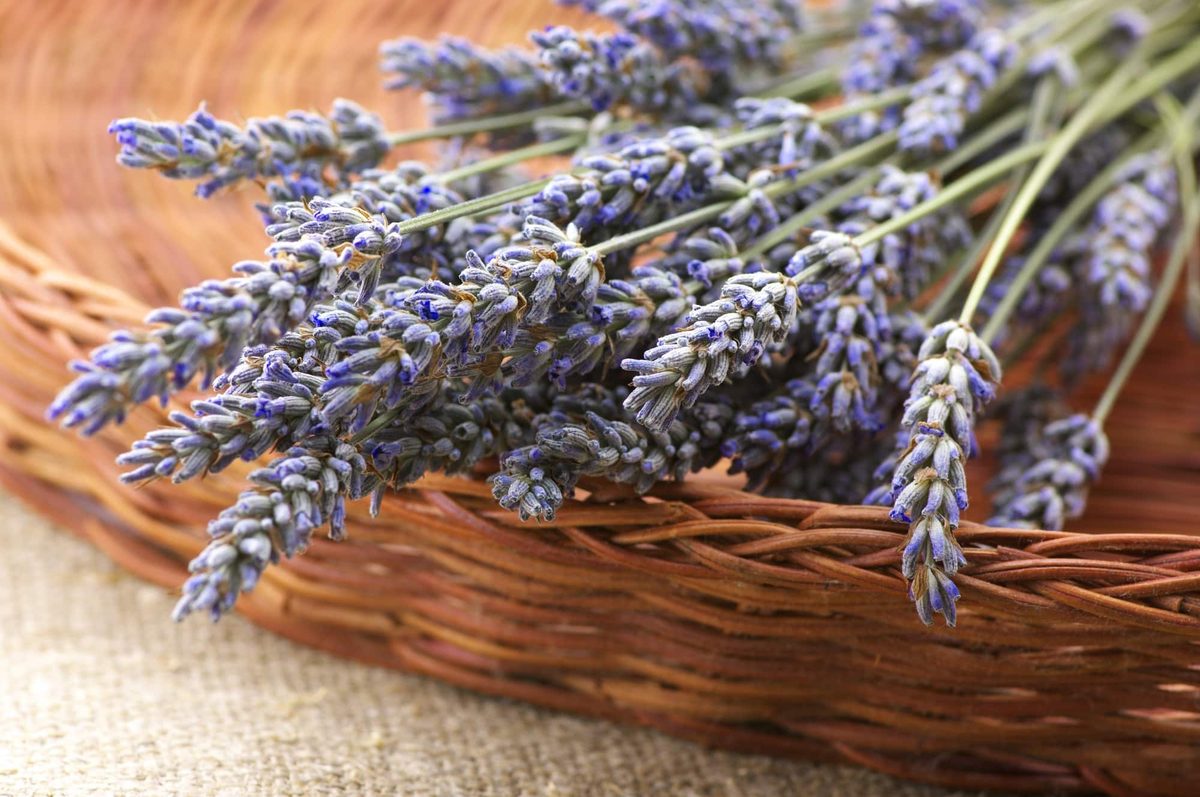
Lavender is usually dried the simple way, on the stem in hanging bunches. Growers dry it that way to sell as bundles or as loose buds,1 and it is the method extension services describe for home gardeners.23 The two things that matter most are when you cut and where you hang. If the lavender is for the kitchen, a third thing matters as much: which lavender you dry.
At a glance
| Question | Short answer |
|---|---|
| When to cut | As the flowers start to open, when the spikes smell strongest (Illinois Extension).2 New Mexico State says when the lower third of the spike has opened.3 |
| How to dry | Hang bunches upside down in a dark, dry, well-ventilated room.23 |
| Bunch size | Sources disagree (see below). |
| Dehydrator | 95 to 115°F (35 to 46°C), up to 125°F in humid areas, 1 to 4 hours, per general herb guidance.4 |
| Oven | Penn State: generally not recommended for herbs; if used, no hotter than 180°F (82°C), door open.5 |
| Sun | Not recommended for herbs.46 |
| Done when | Flowers crumble easily; strip them from the stems by hand.53 |
| For cooking | Lavandula angustifolia is the Herb Society of America’s pick; use sparingly.72 |
When to cut
| Source | Harvest stage |
|---|---|
| Illinois Extension2 | Just as the flowers start to open, when the spikes have the strongest scent |
| New Mexico State University3 | When the lower third of the flower spike has opened |
| University of Kentucky1 | Lavender grown for essential oil is cut when the flowers are less open than lavender cut for fresh or dried flowers |
Both of the first two point to early bloom rather than full bloom. New Mexico State says to cut in the morning, leaving the stems attached.3 General herb guidance is to rinse in cool water, shake off the excess,4 and dry only leaves and stems that aren’t bruised or soiled.6
Hang-drying in bunches
- Bundle the stems. New Mexico State ties them with string or rubber bands.3
- Hang them upside down somewhere dark, dry and well ventilated.23 Penn State notes that air drying needs low humidity and good air circulation, and that herbs should hang away from the sink, stove or dishwasher.5
- Wait until thoroughly dry, then strip the flowers from the stems by hand.3 Penn State’s test for herbs is that they are crispy and crumble easily between your fingers.5
The sources differ on two details:
| Detail | Illinois Extension | New Mexico State University |
|---|---|---|
| Bunch size | Small bunches2 | 30 to 75 stems per bundle3 |
| Room temperature | Cool2 | Relatively warm3 |
Both agree on dark, dry and airy. For a home harvest, start with modest bunches, which are easier to check; that is our judgment, not a figure from either source. Neither source gives a drying time for lavender. Illinois Extension says air drying herbs in general can take up to a month.8
Darkness matters for the finished product as well as the drying: Penn State advises keeping dried herbs away from air, heat and light.5
Other methods
These come from general guidance for herbs; none of the sources names lavender.
Dehydrator. The National Center for Home Food Preservation (NCHFP) gives 95 to 115°F (35 to 46°C), up to 125°F (52°C) in humid areas, for 1 to 4 hours, in a single layer.4 Penn State gives 95 to 110°F and says stems should not touch on the trays.5 A commonly quoted range of 95 to 120°F for up to five hours runs a little past both.
Oven. Penn State says oven drying is generally not recommended. If you use it, set the lowest temperature, no higher than 180°F (82°C), for 3 to 4 hours with the door open.5 Illinois Extension calls 90 to 110°F ideal, also for 3 to 4 hours.8 Short methods of 10 minutes a side at 180 to 200°F have no named source behind them.
Microwave. Penn State: one layer between microwave-safe paper towels, high for 2 to 3 minutes per cup, starting with 1 minute and mixing every 30 seconds.5 Illinois: 1 to 3 minutes on high, checking every 30 seconds.8 Penn State warns that a microwave rated 1,000 watts or more may heat too fast, and that with too little in the oven the paper towels can catch fire.5
Sun. The NCHFP and Penn State both advise against sun drying herbs; the NCHFP says they lose flavor and color.46
Storing dried lavender
Keep the buds in airtight containers in a cool, dry, dark place, away from the stove and sink.5 Penn State says most dried herbs keep well for up to a year, and that whole herbs hold their oils and flavor longer than crushed ones.5 That figure is for herbs in general; we found no shelf life measured on lavender. See how to store lavender.
Drying lavender to cook with
Choose the right plant. The Herb Society of America calls true or English lavender, Lavandula angustifolia, the most delightful species to cook with. It notes that lavandins and Spanish lavender have high levels of cineole and camphor.7 Garden lavender may be any of these, so check the label or the plant. The lavender profile lists the cultivars the Herb Society recommends.
Use less dried than fresh. The Herb Society says dried lavender buds are three times more concentrated than fresh blooms.7 That is their figure, not one we could check against a measurement. Illinois Extension advises using lavender sparingly in cooking, because a little goes a long way.2
Safety. NCCIH says lavender is likely safe in the amounts typically used in food.9 Lavender grown for crafts or landscaping may have been treated with garden products not meant for food; that is a practical caution, not a sourced finding.
For recipes and amounts, see cooking with lavender; if you run out, see lavender substitutes.
Not yet measured
- Lavender-specific drying times for any method.
- Shelf life of home-dried culinary lavender.
- Whether the dried-to-fresh strength ratio holds across cultivars.
Related
- Lavender
- How to store lavender
- Cooking with lavender
- Lavender substitute
- Rosemary vs. lavender
- Herbes de Provence
- How to dry rosemary
Footnotes
-
Matt Ernst, Lavender, University of Kentucky Center for Crop Diversification, 2017. publications.mgcafe.uky.edu · Reference work ↩ ↩2
-
Herb Gardening: Lavender, University of Illinois Extension. extension.illinois.edu · Reference work ↩ ↩2 ↩3 ↩4 ↩5 ↩6 ↩7 ↩8 ↩9
-
Aromatic Lavender Livens Herb and Flower Gardens, Melon Patch, New Mexico State University, 2005. melonpatch.nmsu.edu · Reference work ↩ ↩2 ↩3 ↩4 ↩5 ↩6 ↩7 ↩8 ↩9 ↩10 ↩11
-
Drying Herbs, National Center for Home Food Preservation. nchfp.uga.edu · Reference work ↩ ↩2 ↩3 ↩4 ↩5
-
Zepp, Hirneisen and LaBorde, Let’s Preserve: Drying Herbs, Penn State Extension, 2023. extension.psu.edu · Reference work ↩ ↩2 ↩3 ↩4 ↩5 ↩6 ↩7 ↩8 ↩9 ↩10 ↩11
-
Stacy Reed, Preserving Herbs by Drying, Penn State Extension, 2024. extension.psu.edu · Reference work ↩ ↩2 ↩3
-
Paola Legarre, Lavender in the Kitchen, The Herb Society of America blog, 2025. blog.herbsociety.org · Publication ↩ ↩2 ↩3
-
Herb Gardening: Preserving, University of Illinois Extension. extension.illinois.edu · Reference work ↩ ↩2 ↩3
-
Lavender, National Center for Complementary and Integrative Health. nccih.nih.gov · Regulator ↩