Spice Comparisons · Comparison
Rosemary vs. Lavender: Two Mint-Family Herbs, One Piney and One Floral
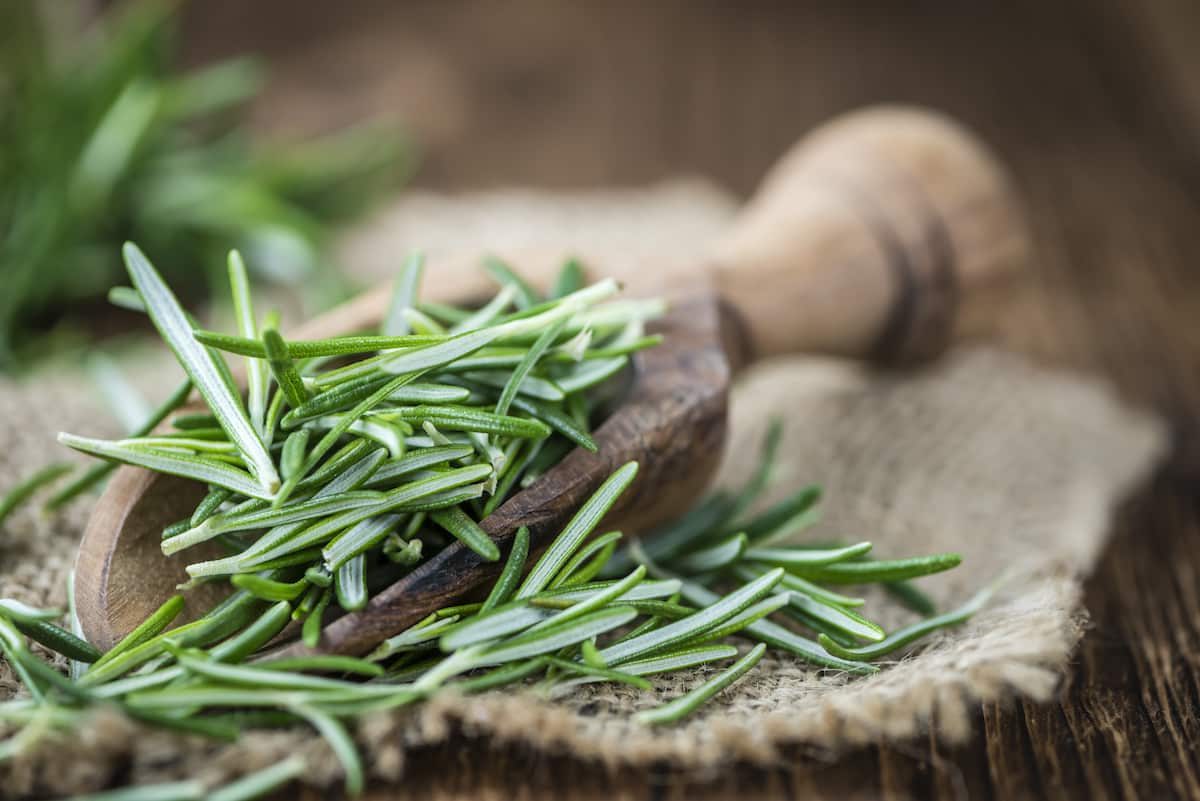
Rosemary is a resinous leaf herb for roasts, breads and soups; culinary lavender is a floral bud used mostly in sweets and drinks.12 They are cousins in the mint family, and their oils share a few minor compounds, but the main aroma compounds differ: rosemary oil is led by α-pinene and 1,8-cineole, lavender oil by linalool and linalyl acetate.234 That difference decides where each one belongs and how far one can stand in for the other.
Side by side
| Rosemary | Lavender (culinary) | |
|---|---|---|
| Species | Salvia rosmarinus, formerly Rosmarinus officinalis5 | Lavandula angustifolia, English or true lavender, the species the Herb Society of America recommends for cooking67 |
| Family | Lamiaceae (mint family)5 | Lamiaceae (mint family)6 |
| Native range | The Mediterranean5 | Northeastern Spain to Italy6 |
| Part used | Leaves, fresh or dried1 | Flower buds, usually dried7 |
| The plant | Dark green, glossy, linear, leathery leaves with curled margins1 | Small evergreen shrubs with gray-green, hoary, linear leaves2 |
| Key oil compounds | α-pinene 13.5 to 37.7%, 1,8-cineole 16.1 to 29.3%, camphor 0.7 to 7.0%, in oils from six countries3 | Linalool 11.4 to 46.7% and linalyl acetate 7.4 to 44.2%, in 13 Ukrainian cultivars4 |
| Flavor (editorial) | Piney, resinous, with a camphor edge; Britannica calls the taste pungent and slightly bitter1 | Floral and sweet, slightly resinous; bitter and soapy when overused |
| Forms | Fresh sprigs, dried leaves, ground | Dried culinary buds, fresh flowers |
| Typical uses | Meats, vegetables, soups and beverages; baking and infused oils1 | Beverages and sweets;2 some savory roasts7 |
| US food status | GRAS spice (listed as Rosmarinus officinalis)8 | GRAS spice (listed as Lavandula officinalis)8 |
The two compound rows come from different studies on different plants and are given as ranges, so read them as each herb’s own profile, not as a head-to-head measurement. The flavor row is our description.
The leaves are where the two can look alike: both have narrow, linear leaves.12 Rosemary’s are glossy and dark green, while lavender’s are gray-green and covered in fine hairs.12 In the kitchen the confusion rarely arises, since rosemary is sold as leaves and culinary lavender as dried buds.
The flavor difference, and where it comes from
Rosemary’s smell sits in an essential oil that makes up 1 to 2 percent of the dried leaf, and PROSEA credits its warm, piny note to α-pinene.9 A 2017 study of rosemary oils from six countries found them dominated by α-pinene and 1,8-cineole, with camphor at up to 7 percent, and identified at least five chemotypes.3 One Spanish oil of the camphor type reported by PROSEA carried 35.3 percent camphor.9
English lavender oil is built differently. Linalool and linalyl acetate were the principal constituents of every sample in the Ukrainian cultivar study, and the authors note that the species is valued for its low camphor content.4 Britannica lists pinene and cineole among lavender oil’s fragrant constituents too,2 so there is some overlap, but in true lavender they are not the leading compounds.
The overlap matters for one reason. The Herb Society of America says the harsher lavenders, lavandin and Lavandula stoechas, have high levels of cineole and camphor,7 the same pair that gives rosemary its bite.3 So the closer a lavender gets to rosemary chemically, the less pleasant cooks find it. Buy lavender labeled L. angustifolia if you want the floral version.
How each behaves in cooking
Rosemary goes in early. America’s Test Kitchen groups it with the hearty herbs added early in cooking, whose flavor compounds are somewhat more heat-stable than those of tender herbs.10 Dried rosemary also held up reasonably well in ATK’s tests of long-cooked dishes with plenty of liquid.11 The University of Delaware puts rosemary in its strong-herb group and warns that the flavor can be extremely objectionable if too much is used.12
Lavender goes in carefully. The Herb Society’s advice is to use less than you think, because it is easier to add as you go.7 It also says dried buds are three times more concentrated than fresh blooms, a figure we could not check against a measurement.7 Most of its suggested uses rely on infusing the buds in a simple syrup or honey, or in a dairy base such as custard or ice cream.7 Straining the buds out after infusing is common practice rather than a sourced finding.
Savory dishes are where they meet. The Herb Society suggests the lower-camphor lavandins ‘Provence’ and ‘Gros Bleu’ for savory cooking, under the skin of a roast chicken or with beef, “especially when pairing with rosemary, sage, and thyme.”7 In other words, the two herbs often share a pan rather than replace each other.
Herbes de Provence. Rosemary is one of the five herbs in the French Label Rouge specification for herbes de Provence, at 26 to 27 percent of the blend.13 Lavender is not among them,13 although some commercial blends sold under the name add it. Check the label. See herbes de Provence.
Pairings beyond these sources are cooking judgment: rosemary with lamb, pork, potatoes, white beans and focaccia; lavender with honey, lemon, berries, stone fruit and cream.
Can one stand in for the other?
Only partly, and only in one direction with any confidence.
- Rosemary for lavender, in savory dishes. Rosemary covers lavender’s resinous side, not its floral top note. Our lavender substitutes page treats this as Method: no published ratio exists, so start with half as much rosemary as lavender, finely chopped, and taste. Dried rosemary suits slow cooking.11
- Rosemary for lavender, in sweets and drinks. We would not. A rosemary syrup is a good thing in its own right, but it will taste of pine, not flowers. For a floral note the lavender substitutes page suggests rose petals or citrus zest instead.
- Lavender for rosemary. None of the sources we reviewed suggests it, and our rosemary substitutes page does not list it. If you try it in a roast (Method, no published ratio), start with a small pinch of dried buds, about a quarter of the rosemary amount, and taste. Thyme or sage is the better swap for rosemary.
Safety
Both are listed by the FDA as spices generally recognized as safe.8 NCCIH says lavender is likely safe in the amounts typically used in foods; its health research concerns lavender oil products, not the culinary herb.14 The European Medicines Agency lists rosemary among plants that contain thujone in highly variable amounts, a point that concerns herbal medicines rather than seasoning.15 See the rosemary and lavender profiles for details.
What isn’t known
- No study we found measures the two herbs side by side in the same lab, so the compound ranges above come from different plants and methods.
- No published ratio exists for swapping either herb for the other. Both starting points above are our own.
- The Herb Society’s “three times” figure for dried versus fresh lavender is their statement; we found no measurement behind it.
- Claims that rosemary “cuts through” fatty meat describe a cooking impression; we found no source that tests it.
Related
- Profiles: rosemary and lavender
- Substitutes: rosemary substitutes and lavender substitutes
- Comparisons: rosemary vs. sage, sage vs. lavender, hyssop vs. lavender and rosemary vs. thyme
- Cooking: cooking with rosemary, cooking with lavender and too much rosemary
Footnotes
-
“Rosemary”, Encyclopaedia Britannica. britannica.com · Reference work ↩ ↩2 ↩3 ↩4 ↩5 ↩6 ↩7
-
“Lavender”, Encyclopaedia Britannica. britannica.com · Reference work ↩ ↩2 ↩3 ↩4 ↩5 ↩6 ↩7
-
Satyal et al., “Chemotypic Characterization and Biological Activity of Rosmarinus officinalis”, Foods, 2017. mdpi.com · Peer-reviewed ↩ ↩2 ↩3 ↩4
-
Pokajewicz et al., “Chemical Composition of the Essential Oil of the New Cultivars of Lavandula angustifolia Mill. Bred in Ukraine”, Molecules, 2021. mdpi.com · Peer-reviewed ↩ ↩2 ↩3
-
Salvia rosmarinus Spenn., Plants of the World Online, Royal Botanic Gardens, Kew. powo.science.kew.org · Reference work ↩ ↩2 ↩3
-
Lavandula angustifolia Mill., Plants of the World Online, Royal Botanic Gardens, Kew. powo.science.kew.org · Reference work ↩ ↩2 ↩3
-
Paola Legarre, “Lavender in the Kitchen: Flavor Profiles Across Species and Cultivars”, The Herb Society of America, 2025. blog.herbsociety.org · Publication ↩ ↩2 ↩3 ↩4 ↩5 ↩6 ↩7 ↩8
-
21 CFR 182.10, US Food and Drug Administration. ecfr.gov · Regulator ↩ ↩2 ↩3
-
C.C. de Guzman, Rosmarinus officinalis, Plant Resources of South-East Asia (PROSEA). uses.plantnet-project.org · Reference work ↩ ↩2
-
Liz Bomze, “Our Guide to Fresh Herbs”, America’s Test Kitchen, 2019. americastestkitchen.com · Publication ↩
-
“Science: Substituting Dried Herbs for Fresh”, America’s Test Kitchen. americastestkitchen.com · Publication ↩ ↩2
-
“Using Herbs and Spices”, University of Delaware Cooperative Extension, 2025. udel.edu · Reference work ↩
-
Label Rouge “Herbes de Provence” (LA 02/03), specification modification request, INAO, 2014. extranet.inao.gouv.fr · Regulator ↩ ↩2
-
“Lavender”, National Center for Complementary and Integrative Health, 2025. nccih.nih.gov · Regulator ↩
-
Public statement on herbal medicinal products containing thujone, European Medicines Agency, 2012. ema.europa.eu · Regulator ↩