Spice Fixes · Fix
How to Fix Salty Gravy: Dilute, Rethicken, Then Balance
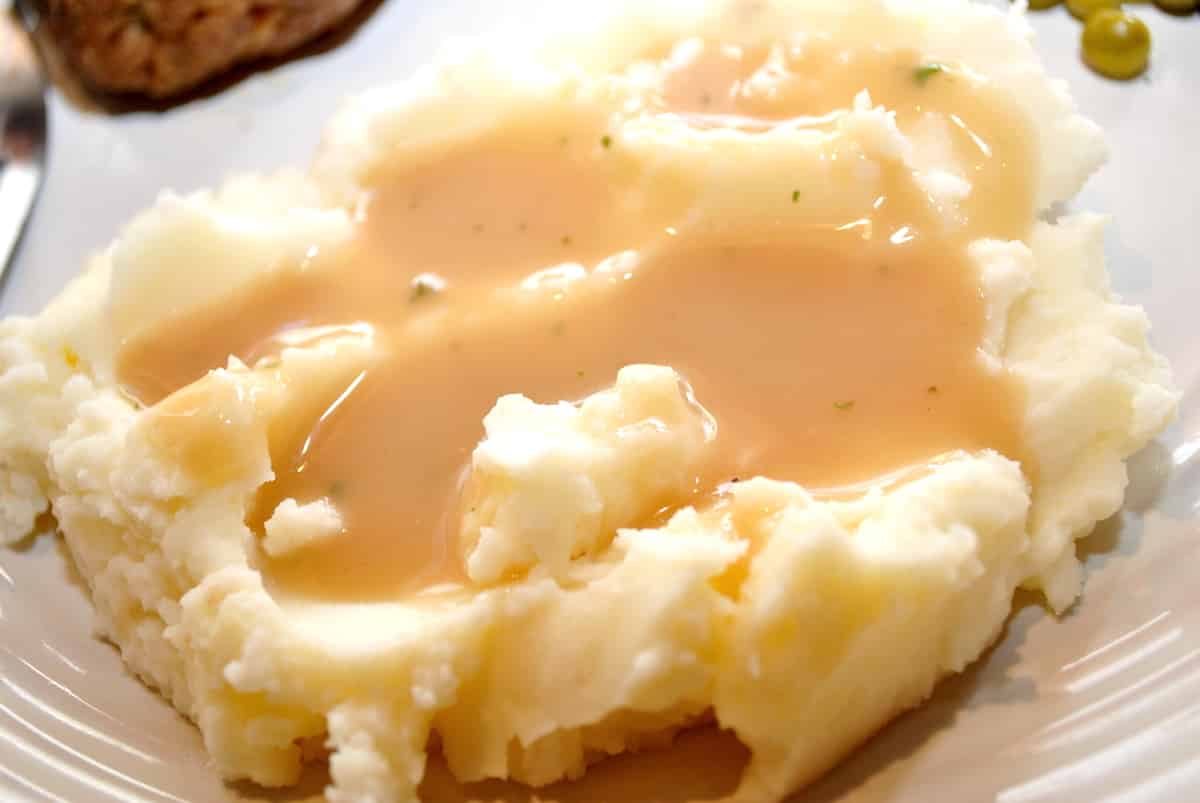
Gravy usually gets too salty in one of two ways: too much salt went in, or the gravy boiled down and concentrated the salt that was already there from drippings and broth. Either way, the salt is dissolved, so the dependable fix is to add more unsalted gravy-making liquid and then bring the thickness back. Sugar, acid and butter can soften what’s left, but they don’t take any salt out.
Quick answer
| What’s wrong | Fastest fix | If that’s not enough |
|---|---|---|
| Slightly too salty | Whisk in a splash of unsalted broth or water | A pat of butter or splash of cream |
| Very salty | Make a batch of unsalted gravy and combine | Serve over unsalted potatoes or meat |
| Salty and too thick (over-reduced) | Thin with water or unsalted broth, not regular broth | Adjust pepper and herbs after thinning |
| Thin after diluting | Rethicken with a slurry or a little more roux | Simmer briefly, taste again |
Dilute with unsalted liquid
Taste of Home calls adding unsalted liquid, such as water or unseasoned broth, the simplest fix for salty gravy, and says heavy cream works too where dairy isn’t a problem.1 Whisk it in a little at a time and taste after each addition.
Use the right liquid. Thinning an over-reduced gravy with regular store-bought stock can leave it far too salty, Tasting Table warns, while plain water dilutes the flavor along with the salt.2 Unsalted or low-sodium broth is the middle path: it brings back body without bringing back salt. If the gravy is very salty, make a second small batch of gravy with no salt at all (fat, flour and unsalted broth) and whisk the two together. Two equal batches halve the salt per spoonful.
Diluting also thins the gravy and flattens its other seasonings. Taste of Home notes you may need to adjust pepper and herbs, and add more thickener to get the right consistency back.1
Rethicken without adding salt
Slurry. Whisk cornstarch or flour into a little cold water and stir it into the simmering gravy. This is standard practice for thickening; it adds no salt.
Roux. A roux (butter or drippings cooked with flour) is another way to thicken. A roux doesn’t absorb salt or neutralize it. What it does is let you add more unsalted liquid and still end up with gravy rather than soup, so it works hand in hand with dilution.
Purée. Puréed potato or beans can thicken and add bulk. That’s dilution with flavor, so use what suits the meal.
Balance what’s left
Butter or cream. Tasting Table suggests a pat of butter to ease saltiness without thinning the gravy much.2 Cream adds volume as well as richness.1 We found no source showing that fat or dairy changes how salty a food tastes, so think of these as dilution plus richness rather than a neutralizer.
A little sweetness. In a lab study, sucrose cut the perceived saltiness of a salt solution by 82.6%.3 That’s a result from pure solutions, and its authors say it may not carry over to real food.3 Gravy should taste savory, so add a very small pinch of sugar, or a spoonful of something sweet that suits the meal (onions cooked down until sweet, a splash of apple cider with pork), and taste before adding more.
Acid, carefully. A squeeze of lemon or a drop of vinegar is often suggested. The evidence cuts both ways: in a 1967 study, lower acid levels in water generally made salt taste saltier and higher levels made it taste less salty, and in a vegetable purée the tasters split evenly.4 Sara Moulton says lemon juice masks salt more than anything else.5 If you try it, use a few drops and taste.
Go easy on salt elsewhere on the plate. Gravy rarely gets eaten alone. Leaving salt off the mashed potatoes, stuffing or the meat’s surface means each forkful carries less salt overall. That’s common kitchen practice.
Fixes that don’t hold up
A raw potato simmered in the gravy. The idea is that the potato absorbs the salt and gets thrown out. It doesn’t work that way. In Robert L. Wolke’s experiment, as Sara Moulton reports it, potato simmered in salted water came out salty because it absorbed salt water rather than pulling out the salt alone.5 Even a writer who still uses the trick in soup calls it “more of an aid than a final answer.”6 When you throw the potato out, the gravy it absorbed goes with it, and nothing more.
Coating the taste buds. The idea that dairy works by coating the tongue so it can’t taste salt has no source we could find. Cream helps because it’s more liquid with no salt in it.
Why gravy gets salty, and how to prevent it
Reduction concentrates salt. Water boils off; salt doesn’t. Tasting Table points out that long cooking concentrates the flavor of gravy even more.2 A restaurant chef quoted by Tasting Table salts reduction sauces at the end because an over-reduced sauce becomes “really salty.”7
Start unsalted, salt last. Taste of Home’s advice is to make gravy with unsalted broth and add salt only at the end.1 If the drippings came from a brined or salted roast, or the broth came from bouillon, taste the finished gravy before you add any salt at all.
Know the stakes. The FDA’s Daily Value for sodium is less than 2,300 mg a day, about a teaspoon of table salt.8 A heavily salted gravy ladled over an already salted meal adds up fast, which is another reason to fix it by dilution rather than masking. For seasoning that isn’t salt, see turkey gravy spices.
Related
Footnotes
-
How to Fix Gravy, Lindsay D. Mattison, Taste of Home, 2023. tasteofhome.com · Publication ↩ ↩2 ↩3 ↩4
-
The Common Mistake To Avoid When Fixing Gravy That’s Too Thick, Sara Klimek, Tasting Table, 2026. tastingtable.com · Publication ↩ ↩2 ↩3
-
Green BG et al., Taste Mixture Interactions: Suppression, Additivity, and the Predominance of Sweetness, Physiology & Behavior, 2010. pmc.ncbi.nlm.nih.gov · Peer-reviewed ↩ ↩2
-
Pangborn RM, Trabue IM, Detection and apparent taste intensity of salt–acid mixtures in two media, Perception & Psychophysics, 1967 (abstract). doi.org · Peer-reviewed ↩
-
Sara’s Kitchen Revelations: Oversalted it? There is one solution, Sara Moulton, saramoulton.com, 2012 (updated 2016), reporting Robert L. Wolke’s experiment. saramoulton.com · Publication ↩ ↩2
-
How To Fix An Oversalted Soup, Alison Spiegel, Tasting Table, 2016. tastingtable.com · Publication ↩
-
Seasoning 101: When To Salt And Season Sauces For Maximum Flavor, Martha Brennan, Tasting Table, 2025. tastingtable.com · Publication ↩
-
Sodium in Your Diet, U.S. Food and Drug Administration. fda.gov · Regulator ↩