Cooking · Dish guide
Turkey Gravy Spices: Thyme, Bay Leaf and the Herbs That Go Into the Broth
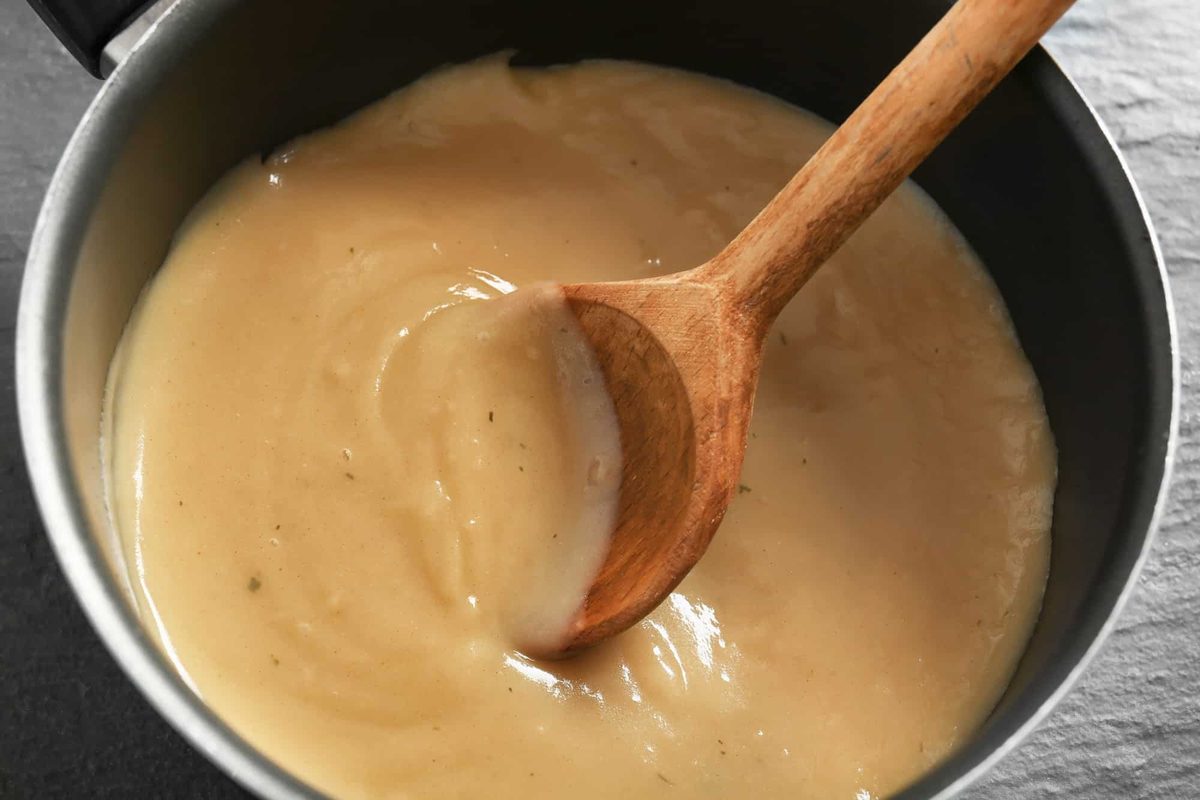
Turkey gravy gets most of its seasoning before the flour ever goes in. The two tested recipes below both simmer the turkey’s neck and giblets in broth with onion, thyme and a bay leaf, then strain it; the gravy is built on that broth and the roasting-pan drippings. Sage, rosemary and parsley are optional extras, and garlic and celery, often listed as essentials, appear in neither recipe. This page covers what each seasoning does, how the two recipes differ, how to keep the salt in check, and the reheating rule from USDA.
At a glance
| Seasoning | Job | In the recipes below |
|---|---|---|
| Onion (or leek or shallot) | Sweet, savory base for the broth | Both12 |
| Thyme | The main herb; savory, warm | Both12 |
| Bay leaf | Background herbal note | Both, one leaf each12 |
| Sage, rosemary, parsley | Optional herbs alongside thyme | One, “and/or”2 |
| Black pepper and salt | Seasoning to taste | One2 |
| Worcestershire sauce | A dash of savory depth | One2 |
| Poultry seasoning | Thyme, sage and more in one jar | Neither; a common shortcut |
| Garlic, celery | Optional | Neither |
Two recipes side by side
| America’s Test Kitchen, Make-Ahead Giblet Gravy1 | Food Network Kitchen, Classic Turkey Gravy2 | |
|---|---|---|
| Yield | About 6 cups (serves 10 to 12) | 8 cups |
| Broth | 4 cups low-sodium chicken broth plus 2 cups water | 8 cups low-sodium chicken broth |
| Turkey parts | Neck and giblets, liver left out | Neck and giblets, liver discarded |
| Onion | 1, chopped | 1 medium onion or leek, or 2 shallots |
| Herbs | 4 sprigs fresh thyme (dried allowed); 1 bay leaf | 3 sprigs thyme, parsley, rosemary and/or sage; 1 bay leaf |
| Thickener | 4 tbsp butter, 6 tbsp flour | Pan drippings, 1/2 cup flour |
| Finish | Dash of Worcestershire; kosher salt and freshly ground pepper |
These are the publishers’ recipes, not a house standard. Both leave out the liver: America’s Test Kitchen found its strong flavor overpowered the gravy.1
The core seasonings and what each one does
Thyme: the constant
Thyme is the one herb both recipes agree on: four fresh sprigs in America’s Test Kitchen’s version, three sprigs of thyme and/or other herbs in Food Network’s.12 Its savory character comes from thymol and carvacrol in its oil.3 America’s Test Kitchen classes thyme as a hearty herb to add early in cooking.4 Food Network’s broth simmers about two hours while the turkey roasts.2 America’s Test Kitchen says dried thyme may be used instead of fresh.1 The University of Delaware’s extension guide gives 3/4 to 1 teaspoon of dried crumbled herb for 2 to 3 teaspoons of fresh as a general rule.5 See fresh vs. dried thyme and too much thyme.
Bay leaf: one, in the broth
Both recipes add a single bay leaf to the simmering broth,12 and America’s Test Kitchen strains the broth and discards the solids before making the gravy.1 In one analysis of bay leaf oil, 1,8-cineole (31.9%), sabinene and linalool were the main components.6 J. Kenji López-Alt, speaking to The Splendid Table, says bay leaves bring out the meaty flavors of beef and chicken; that is a cook’s observation rather than a measured effect.7 Strain it out: he compares eating one to eating a fish bone.7 See cooking with bay leaves and too much bay leaf.
Sage: optional, and strong
Only Food Network’s recipe mentions sage, as one of the herbs that can go into the three sprigs.2 Sage’s place in American cooking is well documented: PROSEA lists stuffings among its main spice uses and names the United States as the biggest user, at about 4,000 tonnes a year.8 Thujones give it its strong, characteristic smell.8 The Delaware guide warns that sage’s flavor can be “extremely objectionable” if too much is used.5 One sprig among the three is a sensible starting point (our suggestion, following Food Network’s “and/or”). See fresh vs. dried sage and too much sage.
Rosemary: optional
Rosemary is another of Food Network’s optional sprigs.2 PROSEA attributes its warm, piny scent to α-pinene,9 and Kew now classifies it as Salvia rosmarinus, in sage’s genus.10 One sprig is a sensible starting point for a pot of broth (our suggestion). See rosemary vs. sage and too much rosemary.
Parsley
Parsley is the third optional herb in Food Network’s broth.2 The LSU AgCenter groups it with delicate herbs that lose flavor under prolonged heat and are best added at the end,11 so chopped fresh parsley stirred into the finished gravy is an alternative (our suggestion).
Onion
Both recipes cook an onion with the giblets for the broth, and Food Network allows a leek or two shallots instead.12 Onion powder can stand in when there is no time for a broth, though neither recipe uses it.
Black pepper, salt and Worcestershire
Food Network finishes with a dash of Worcestershire sauce and kosher salt and freshly ground pepper.2 Pepper’s bite comes principally from piperine.12 Both recipes start from low-sodium broth,12 and Taste of Home’s gravy guide says it is best to start with unsalted broth.13 Season at the end. If it goes too far, see how to fix salty gravy.
Poultry seasoning: the shortcut
Neither recipe uses it, but a pinch of poultry seasoning puts thyme and sage into a gravy in one step. There is no single formula: McCormick Culinary’s blend lists thyme, sage, marjoram, rosemary, black pepper and nutmeg,14 and Bell’s, the New England brand, lists rosemary, oregano, sage, ginger, marjoram, thyme and pepper.15 See poultry seasoning and poultry seasoning substitutes.
Allspice: an old gravy spice
PROSEA notes that whole allspice berries are used in meat broth and gravies.16 A couple of berries in the simmering broth is a variation, not part of either recipe here. See allspice.
Garlic and celery
Neither recipe uses garlic or celery.12 Both are reasonable additions to the broth if you like them, garlic in moderation. See garlic powder and celery salt.
Food safety: reheat to a boil
USDA’s Food Safety and Inspection Service says to reheat sauces, soups and gravies by bringing them to a rolling boil.17 Leftovers should be refrigerated within 2 hours and keep 3 to 4 days in the refrigerator or 3 to 4 months in the freezer.17
Related
- Spices for turkey
- Good stuffing spices
- Thanksgiving herbs and spices
- Dried herbs vs. fresh
- The master list of herbs and spices
Footnotes
-
“Make-Ahead Giblet Turkey Gravy”, America’s Test Kitchen, 2011. americastestkitchen.com · Publication ↩ ↩2 ↩3 ↩4 ↩5 ↩6 ↩7 ↩8 ↩9 ↩10 ↩11 ↩12
-
“Classic Turkey Gravy”, Food Network Kitchen, Food Network. foodnetwork.com · Publication ↩ ↩2 ↩3 ↩4 ↩5 ↩6 ↩7 ↩8 ↩9 ↩10 ↩11 ↩12 ↩13 ↩14 ↩15 ↩16 ↩17
-
S.H. Widodo, “Thymus vulgaris”, PROSEA. uses.plantnet-project.org · Reference work ↩
-
Liz Bomze, “Our Guide to Fresh Herbs”, America’s Test Kitchen, 2019. americastestkitchen.com · Publication ↩
-
“Using Herbs and Spices”, University of Delaware Cooperative Extension, revised 2025. udel.edu · Reference work ↩ ↩2
-
Caputo et al., “Laurus nobilis: Composition of Essential Oil and Its Biological Activities”, Molecules, 2017. mdpi.com · Peer-reviewed ↩
-
David Leite with J. Kenji López-Alt, “Bay leaves are an optional ingredient”, The Splendid Table, 2014. splendidtable.org · Publication ↩ ↩2
-
U.A. Dasuki, “Salvia officinalis”, PROSEA. uses.plantnet-project.org · Reference work ↩ ↩2
-
C.C. de Guzman, “Rosmarinus officinalis”, PROSEA. uses.plantnet-project.org · Reference work ↩
-
“Salvia rosmarinus Spenn.”, Plants of the World Online, Royal Botanic Gardens, Kew. powo.science.kew.org · Reference work ↩
-
“Flavorful Herbs”, LSU AgCenter. lsuagcenter.com · Reference work ↩
-
“Black pepper”, Encyclopaedia Britannica. britannica.com · Reference work ↩
-
Lindsay D. Mattison, “How to Fix Gravy”, Taste of Home, 2023. tasteofhome.com · Publication ↩
-
“Poultry Seasoning, 12 oz”, McCormick Culinary. mccormick.com · Merchant ↩
-
Aimee Tucker, “Bell’s Seasoning: A New England Thanksgiving Classic”, Yankee Magazine, 2021. newengland.com · Publication ↩
-
D. Sulistiarini, “Pimenta dioica”, PROSEA. uses.plantnet-project.org · Reference work ↩
-
“Leftovers and Food Safety”, USDA Food Safety and Inspection Service, 2020. fsis.usda.gov · Regulator ↩ ↩2