Spice Fixes · Fix
Too Much Soy Sauce? How to Fix a Dish That’s Too Salty
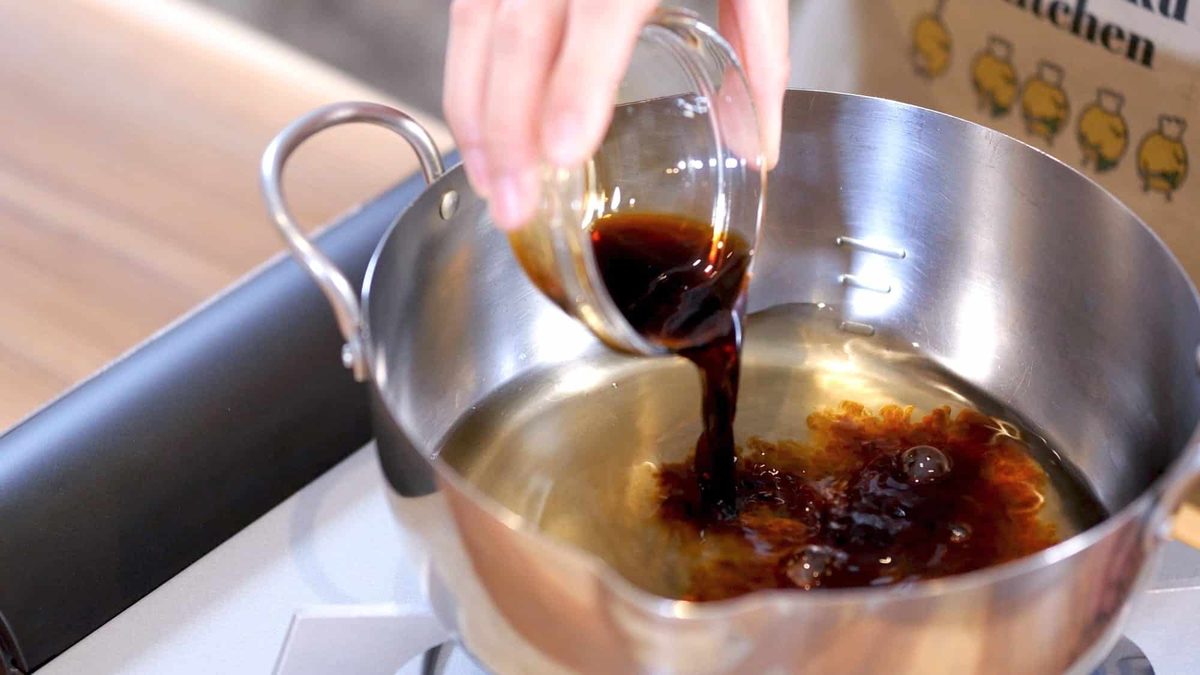
Soy sauce is mostly a salt problem. Traditional soy sauce contains 15% to 20% salt, and its taste is mainly salty and umami, with sour, bitter and sweet notes behind them.1 Too much of it makes a dish taste harsh and salty, and in our judgment it also darkens the color and can bring a bitter edge forward. The fixes below start with the one that actually lowers the soy sauce in each bite.
Quick answer
| What’s wrong | Fastest fix | If that’s not enough |
|---|---|---|
| Stir-fry, sauce or marinade too salty | Add more of the other ingredients, or more unsalted liquid | A little sugar or honey |
| Braise or stew too salty | Add water or unsalted stock; pour off some liquid if the pot is too full | Serve over plain rice or noodles |
| Salty with a bitter edge | A little sweetness | Fresh aromatics such as scallions or garlic |
| Glaze or dipping sauce too strong | Make more of it without soy sauce and combine | Thin with water or unsalted stock |
Too salty: dilute first
Add more of everything else. More vegetables, protein or noodles in a stir-fry, more of the base in a sauce. If you can’t stretch the dish, make a second batch with no soy sauce and combine them.
Add unsalted liquid to a braise. Water or unsalted stock lowers the saltiness of a braising liquid. If the pot gets too full, ladle some of the diluted liquid off. What stays keeps much of the soy sauce’s color and savory character, with less salt in each spoonful.
Serve it with something plain. Unsalted rice, plain noodles or steamed vegetables dilute each bite on the plate. That’s common practice in the dishes soy sauce usually goes into.
Balance: soften the salt and bitterness
Sweetness. This has the best lab support. In a 2010 taste-mixture study, sucrose cut the perceived saltiness of a salt solution by 82.6%, and sweet tastes and sodium salts both suppressed bitterness.2 Those results come from pure solutions, and the authors say it’s unclear whether they hold for real food.2 Many soy-sauce dishes already have sugar, honey or mirin in them, so adding a little more of what’s there fits naturally. Add a small amount, cook briefly and taste.
In our judgment, keep the heat moderate once you’ve added sugar to a dish that’s still cooking dry, so the sauce doesn’t scorch, and remember that honey or syrup adds moisture to a stir-fry.
Acid, with care. Rice vinegar, lime or lemon add a sour note that gives your palate something besides salt. The evidence on whether acid makes salt taste less salty is mixed: in a 1967 study, lower acid levels in water generally made salt taste saltier while higher levels made it taste less salty, and in a vegetable purée the tasters split evenly.3 In the 2010 study, citric acid was also the weakest suppressor of the four tastes tested, bitterness included.2 Use it for brightness, a few drops at a time, not as a cure.
Fresh aromatics. Scallions, garlic, ginger or shallots add their own flavor and some volume, which in our judgment can pull a soy-heavy dish back toward balance. No source tests them against excess soy sauce, so count this as cooking judgment.
Rice wine. A splash of Shaoxing wine or sake adds liquid with no added salt, so it dilutes, and it belongs in many of the same dishes. Don’t count on the alcohol cooking off completely. In USDA’s measurements, a dish that simmered or baked for 15 minutes after alcohol was stirred in still kept about 40% of the alcohol, and one simmered for 2½ hours kept about 5%.4
Fixes that don’t hold up
A potato to soak up salt and bitterness. Diced potato simmered in a braise and removed before serving is often recommended. Robert L. Wolke’s experiment, as reported by Sara Moulton, found potato simmered in salted water came out salty because it absorbed the salty water, not the salt alone.5 A Tasting Table writer who still uses the trick calls it “more of an aid than a final answer.”6 We found no test of a potato against soy sauce’s bitterness. If you like potato in the dish, leave it in: then it’s just more unsalted food, which is dilution.
How much sodium is in soy sauce?
| Product | Serving | Sodium | % Daily Value |
|---|---|---|---|
| Kikkoman Soy Sauce (label, via Giant Food Stores listing)7 | 1 tbsp | 960 mg | 42% |
| Kikkoman Less Sodium Soy Sauce (label, via Hannaford listing)8 | 1 tbsp | 590 mg | 26% |
These are one brand’s labels, not averages for soy sauce in general; check your own bottle. The FDA’s Daily Value for sodium is less than 2,300 mg a day.9 An extra tablespoon of regular soy sauce in a four-serving dish adds roughly 240 mg of sodium to each serving, by the label above.
Preventing it next time
Add soy sauce in stages and taste, and add the last of it after any reducing. That’s common practice.
Consider a less-sodium version where you use soy sauce for its savory flavor more than its salt. Kikkoman’s label states its less-sodium soy sauce has 38% less sodium than its regular soy sauce.8
Season the rest of the dish with soy sauce in mind. If soy sauce is in the marinade and the sauce, you may not need any added salt at all. For a dry, shakeable form, see soy sauce powder.
Related
Footnotes
-
Li S et al., Multivariate Analysis of Key Taste Compounds in Soy Sauce and Model Construction for Its Saltiness Intensity, Foods, 2025. mdpi.com · Peer-reviewed ↩
-
Green BG et al., Taste Mixture Interactions: Suppression, Additivity, and the Predominance of Sweetness, Physiology & Behavior, 2010. pmc.ncbi.nlm.nih.gov · Peer-reviewed ↩ ↩2 ↩3
-
Pangborn RM, Trabue IM, Detection and apparent taste intensity of salt–acid mixtures in two media, Perception & Psychophysics, 1967 (abstract). doi.org · Peer-reviewed ↩
-
USDA Table of Nutrient Retention Factors, Release 6, USDA Agricultural Research Service, 2007. ars.usda.gov · Regulator ↩
-
Sara’s Kitchen Revelations: Oversalted it? There is one solution, Sara Moulton, saramoulton.com, 2012 (updated 2016), reporting Robert L. Wolke’s experiment. saramoulton.com · Publication ↩
-
How To Fix An Oversalted Soup, Alison Spiegel, Tasting Table, 2016. tastingtable.com · Publication ↩
-
Kikkoman Soy Sauce, Nutrition Facts as listed by Giant Food Stores. giantfoodstores.com · Merchant ↩
-
Kikkoman Less Sodium Soy Sauce, Nutrition Facts and label claim as listed by Hannaford. hannaford.com · Merchant ↩ ↩2
-
Sodium in Your Diet, U.S. Food and Drug Administration. fda.gov · Regulator ↩