Spice Fixes · Fix
Too Much Sea Salt? How to Fix a Dish That’s Too Salty
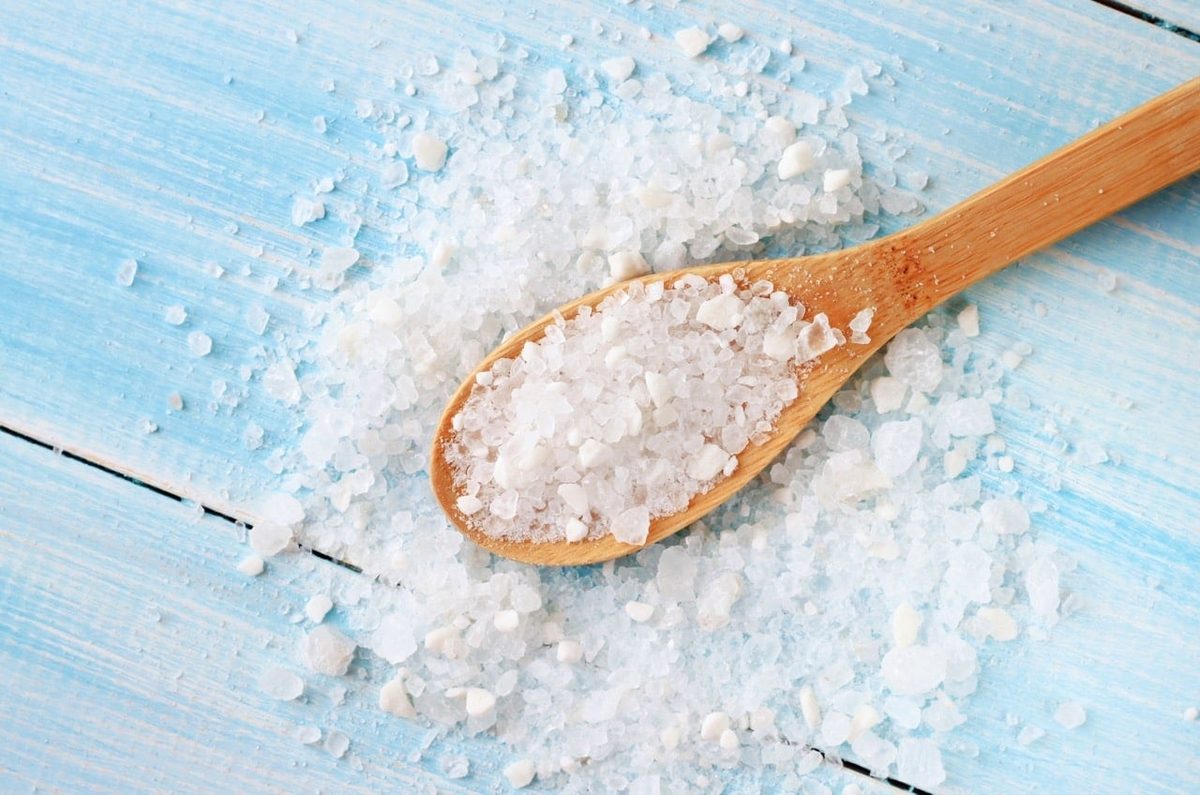
Sea salt is made by evaporating seawater, and table salt, kosher salt and most sea salts all contain about 40% sodium.1 So once sea salt has dissolved, it behaves like any other salt, and the fixes are the ones in our too much salt guide. What’s different about sea salt is its crystals. Coarse and flaky sea salt is often sprinkled on at the end, where you can still get it back, and its crystal size makes it easy to over- or under-measure by the spoon.
Quick answer
| What’s wrong | Fastest fix | If that’s not enough |
|---|---|---|
| Flakes or coarse crystals sprinkled on a finished dish | Brush or pick them off before they dissolve | Serve with something unsalted |
| Sea salt in a soup, sauce or stew | Add unsalted liquid or more of the other ingredients | A little sweetness; something creamy |
| Measured into dry ingredients, not yet mixed | Scoop out the excess | Scale up the other ingredients |
| Rubbed on raw meat | Brush or wipe it off | Don’t rinse it under the tap |
Get the crystals off before they dissolve
America’s Test Kitchen recommends sea salt mainly as a finishing salt, for the crunch of large, flaky crystals on a finished dish.2 That is good news when you overdo it: flakes on top of a steak, a salad or a tray of cookies haven’t dissolved yet, and you can brush, pick or tip them off. Work quickly on anything moist or hot, since the crystals start dissolving into the food.
Coarse crystals in a pot of soup can sometimes be skimmed or fished out if you catch them right away. Once they’ve dissolved, they’re in the whole pot.
If sea salt went into flour or other dry ingredients and you haven’t stirred, spoon out what you can see. If it’s already mixed in, scale up everything else in the recipe instead.
On raw meat, brush or wipe off excess salt rather than rinsing. The USDA does not recommend washing raw poultry, beef, pork, lamb or veal before cooking.3
Dilute
Dilution is the only fix that lowers the salt in each bite once it has dissolved. Add water, unsalted stock or more of the main ingredients, a little at a time, tasting as you go. Sara Moulton points out that water dilutes the other flavors too, so unsalted stock or tomatoes are better where they fit.4 If the pot can’t take more, make a second batch with no salt and combine them. Then readjust the other seasonings so the dish doesn’t swing to bland.
Balance the taste
These change how salty the dish tastes, not how much sodium is in it.
Sweetness. In a lab study of taste mixtures, sucrose cut the perceived saltiness of a salt solution by 82.6%.5 That was tested with pure solutions, and the authors say it is unclear whether the effect holds in real food.5 In practice, a pinch of sugar or a sweeter ingredient the dish already uses, added slowly, can take the edge off a dish that’s only slightly too salty. The goal is balance, not a dish that tastes sweet.
Acid, with caution. In a 1967 study, lower levels of citric acid in water generally made salt taste saltier, while higher levels made it taste less salty; in a vegetable purée, tasters split evenly on which way it went.6 A squeeze of lime or a splash of vinegar might help or might make things worse. Add a little and taste.
Something creamy. Cream, yogurt, sour cream or coconut milk adds bulk and a mild, rich flavor. That’s kitchen judgment; we found no source showing that dairy or fat reduces how salty food tastes, so count on the dilution part, not on a masking effect.
Fixes that don’t hold up
A potato as a “flavor sponge.” A raw potato doesn’t pull salt out of a soup. Robert L. Wolke’s experiment, as reported by Sara Moulton, found that potato simmered in salted water came out salty because it soaked up salt water, not salt alone.4 A Tasting Table writer who uses the trick still calls it “more of an aid than a final answer.”7 Leaving the potato in to eat simply adds unsalted food to the pot.
Is too much sea salt healthier than too much table salt?
No. The American Heart Association says most sea salts contain about the same 40% sodium as table salt.1 A teaspoon of a coarse sea salt can hold less sodium than a teaspoon of table salt only because fewer large crystals fit in the spoon; the AHA suggests checking the Nutrition Facts label.1 The FDA’s Daily Value for sodium is less than 2,300 mg a day, about a teaspoon of table salt.8
Preventing it next time
Measure by the crystal, not the name. Salts with different crystal sizes put different amounts of salt in a teaspoon. ATK’s rule for kosher salt shows how big the gap can be: 1 teaspoon of table salt equals 1½ teaspoons of Morton kosher salt or 2 teaspoons of Diamond Crystal.2 We found no single published volume conversion for sea salt, which is sold in everything from fine grains to large flakes. If a recipe doesn’t say which salt, use less than it calls for and taste.
Cook with cheap salt, finish with sea salt. ATK’s tasters found no noticeable benefit from cooking with sea salt instead of table salt and suggest saving it for finishing.2 Seasoning the pot with a salt you know well and adding flaky sea salt only at the table makes the mistake both less likely and easier to undo. More in kosher salt vs. sea salt and cooking with sea salt.
Related
Footnotes
-
Sodium Sources: Where Does All That Sodium Come From?, American Heart Association, 2025. heart.org · Reference work ↩ ↩2 ↩3
-
Salt Types and Measurements, America’s Test Kitchen. americastestkitchen.com · Publication ↩ ↩2 ↩3
-
Washing Food: Does it Promote Food Safety?, USDA Food Safety and Inspection Service. fsis.usda.gov · Regulator ↩
-
Sara’s Kitchen Revelations: Oversalted it? There is one solution, Sara Moulton, saramoulton.com, 2012 (updated 2016), reporting Robert L. Wolke’s experiment. saramoulton.com · Publication ↩ ↩2
-
Green BG et al., Taste Mixture Interactions: Suppression, Additivity, and the Predominance of Sweetness, Physiology & Behavior, 2010. pmc.ncbi.nlm.nih.gov · Peer-reviewed ↩ ↩2
-
Pangborn RM, Trabue IM, Detection and apparent taste intensity of salt–acid mixtures in two media, Perception & Psychophysics, 1967 (abstract). doi.org · Peer-reviewed ↩
-
How To Fix An Oversalted Soup, Alison Spiegel, Tasting Table, 2016. tastingtable.com · Publication ↩
-
Sodium in Your Diet, U.S. Food and Drug Administration. fda.gov · Regulator ↩