Herbs · Profile
Huacatay (Peruvian Black Mint): The Marigold Behind Ocopa
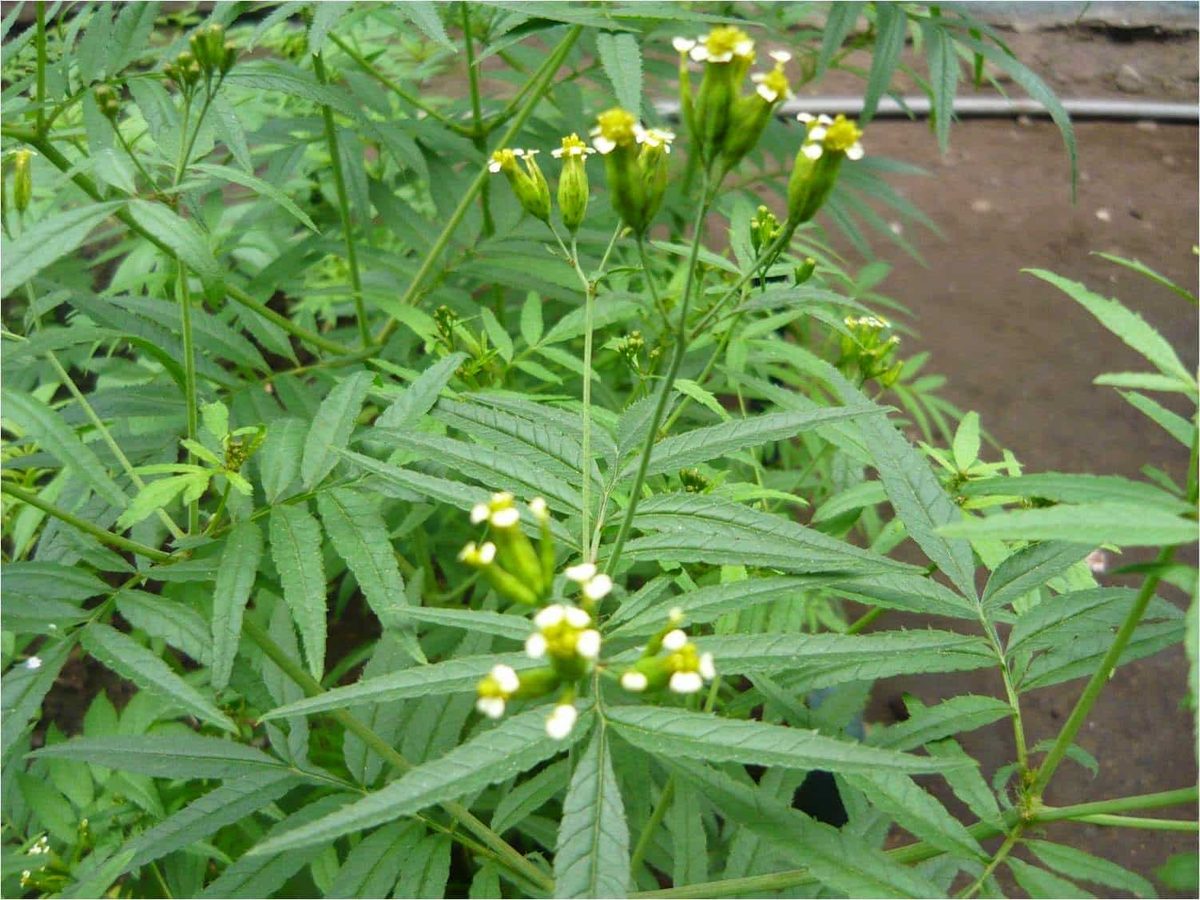
Huacatay is the Quechua name for Tagetes minuta, a strong-smelling marigold from South America whose leaves flavor Peruvian sauces, above all ocopa.123 In English it is often sold as Peruvian black mint, though it is not a mint at all. Elsewhere it grows as a weed, and its oil is used in perfumery and flavoring.24 This page covers the plant, its chemistry, how it is used, and the one regulatory limit worth knowing.
At a glance
| Botanical name | Tagetes minuta L.1 |
| Other names | Huacatay (Quechua, Peru); black mint; chinchilla enana (Spanish); wild marigold, Mexican marigold, khakibush and stinking-Roger (English)23 |
| Plant family | Asteraceae (daisy family); the genus Tagetes is the marigolds15 |
| Part used | Fresh leaves; also sold as a paste3 |
| Native range | Brazil to southern South America, per Kew1 |
| Key aroma compounds | Tagetone, dihydrotagetone, tagetenone and (Z)-β-ocimene, in proportions that vary widely4 |
| US status | Approved as a natural flavoring only as an oil5 |
Measured values
10 figures, sourced| Measure | Value | Scope | Source |
|---|---|---|---|
| Essential oil: tagetone | 14.1 % of the oil | commercial oil from Madagascar, as reported in a 2018 reviewDistilled oil, not the fresh leaf | mdpi.com |
| Essential oil: dihydrotagetone | 11.6 % of the oil | commercial oil from Madagascar, as reported in a 2018 review | mdpi.com |
| Essential oil: (E)-tagetenone | 9.0 % of the oil | commercial oil from Madagascar, as reported in a 2018 review | mdpi.com |
| Essential oil: (Z)-tagetenone | 6.7 % of the oil | commercial oil from Madagascar, as reported in a 2018 review | mdpi.com |
| Essential oil: limonene | 66.3 % of the oil | sample from Argentina, as reported in a 2018 review | mdpi.com |
| Essential oil: (E)-tagetenone | 19.1 % of the oil | sample from Argentina, as reported in a 2018 reviewDiffers from the Madagascar sample; different samples, not a disagreement over the same scope | mdpi.com |
| Essential oil: beta-caryophyllene | 14.8 % of the oil | sample from Argentina, as reported in a 2018 review | mdpi.com |
| Essential oil: alpha-pinene | 11.8 % of the oil | sample from Argentina, as reported in a 2018 review | mdpi.com |
| Essential oil: (Z)-beta-ocimene | 7.2 to 37.5 % of the oil | studies cited in a 2018 review; rose as the plant developedSome studies found the opposite trend | mdpi.com |
| Essential oil: dihydrotagetone | 51 to 14 % of the oil | studies cited in a 2018 review; fell as the plant developedSome studies found the opposite trend | mdpi.com |
Each figure is quoted as its source states it, with the samples or standard it applies to. Where sources differ, both are shown; nothing is averaged. All measured values
The plant
Kew’s Plants of the World Online lists Tagetes minuta as an annual of the subtropics, native from Brazil to southern South America.1 Kew counts Peru among the places it has been introduced, not among its native range; USDA’s GRIN taxonomy likewise lists native records for Brazil, Bolivia, Ecuador, Paraguay, Uruguay, Chile and Argentina, not Peru.12 GRIN records the name huacatay as Quichua, from Peru.2
The plant has traveled far: Kew’s list of places where it has been introduced is long, starting alphabetically with Alabama, Albania, Algeria and Angola.1 GRIN notes it as a potential seed contaminant and weed, and records uses in plant and weed control when intercropped.2 One of its English names is stinking-Roger.2
Flavor and the compounds behind it
Fresh huacatay smells loud and resinous, somewhere between mint, basil, tarragon and citrus peel, with a musky marigold edge; that description is ours, and it is easy to use too much.
The chemistry is variable. A 2018 review of Tagetes essential oils in Molecules says the main compounds of T. minuta oil are acyclic monoterpene ketones: tagetone, dihydrotagetone and tagetenone.4 Reported figures differ a great deal by sample:
| Oil sample (as reported in the 2018 review) | Main compounds |
|---|---|
| Commercial oil from Madagascar | Tagetone 14.1%, dihydrotagetone 11.6%, (E)-tagetenone 9.0%, (Z)-tagetenone 6.7%4 |
| Sample from Argentina | Limonene 66.3%, (E)-tagetenone 19.1%, β-caryophyllene 14.8%, α-pinene 11.8%4 |
The review also reports studies in which (Z)-β-ocimene rose from 7.2% to 37.5% as the plant developed, and others in which dihydrotagetone fell from 51% to 14%; it notes that some studies found the opposite trend and concludes that composition is very variable and may depend more on the plant’s growth stage than on where it grew.4 These figures are for distilled oil, not for the fresh leaf a cook uses, and we found no analysis of the leaves sold in Peruvian markets.
How huacatay is used
- Ocopa. Ocopa is a sauce from Arequipa, poured over boiled potatoes. In chef Flavio Solórzano’s recipe, published on Peru Delights, huacatay is described as its main ingredient, blended with mirasol and ají amarillo chiles, onion, garlic, toasted peanuts, crackers, evaporated milk and queso fresco, then served over potatoes with lettuce, egg, cheese and black olives.3 The same recipe’s ingredient list marks the huacatay as optional and offers 1 teaspoon of huacatay paste in place of fresh leaves.3
- As a cilantro alternative. Some cooks use small amounts in salsas in place of cilantro. The flavors are not similar; huacatay is far more pungent. That is kitchen judgment.
Use it sparingly, chopped fine or blended; a small handful flavors a whole batch of sauce. Outside South America, huacatay paste, which the recipe above accepts in place of fresh leaves, is the practical option; that is common practice, not a sourced finding.
Buying and storage
Fresh leaves should be bright green and very aromatic; that is kitchen judgment. We found no published shelf-life figure for fresh huacatay or its paste. Treat an opened jar of paste as a refrigerated product and follow the label.
Safety
US federal rules list “Tagetes (marigold)”, naming Tagetes minuta among the species, as a natural flavoring substance permitted as oil only.5 That listing covers the commercial flavoring use; it does not address eating the fresh leaf as a home cook does. GRIN’s records include T. minuta under vertebrate poisons, toxic to humans or livestock, without giving doses or circumstances.2 The 2018 review mentions ambiguous data on phototoxic thiophenes in Tagetes, in connection with T. erecta, a different species.4
None of these sources assesses the small amounts of fresh leaf used in a sauce, and we found no regulator opinion on that use. The NIH’s National Center for Complementary and Integrative Health has no fact sheet on it.6 GRIN lists its medicinal uses as folklore.2 Claims that it treats colds, parasites or bacterial infections have no support from a systematic review or health agency that we could find, and this page makes no such claims.
Substitutes and comparisons
There is no close substitute. A mix of mint, basil and a little tarragon gets in the neighborhood; that is a cook’s approach, not a tested ratio. See huacatay substitutes and these related pages:
Footnotes
-
Tagetes minuta L., Plants of the World Online, Royal Botanic Gardens, Kew. powo.science.kew.org · Reference work ↩ ↩2 ↩3 ↩4 ↩5 ↩6 ↩7
-
Tagetes minuta L., GRIN Taxonomy, USDA Agricultural Research Service. npgsweb.ars-grin.gov · Reference work ↩ ↩2 ↩3 ↩4 ↩5 ↩6 ↩7 ↩8 ↩9
-
Flavio Solórzano, “Ocopa Sauce”, Peru Delights, 2017. perudelights.com · Publication ↩ ↩2 ↩3 ↩4 ↩5
-
Salehi et al., “Tagetes spp. Essential Oils and Other Extracts: Chemical Characterization and Biological Activity”, Molecules, 2018. mdpi.com · Peer-reviewed ↩ ↩2 ↩3 ↩4 ↩5 ↩6 ↩7
-
21 CFR 172.510, Natural flavoring substances and natural substances used in conjunction with flavors, US Food and Drug Administration. ecfr.gov · Regulator ↩ ↩2 ↩3
-
Herbs at a Glance, National Center for Complementary and Integrative Health. nccih.nih.gov · Regulator ↩