Herbs · Profile
Basil: Flavor, Chemistry, Origins and How to Use It
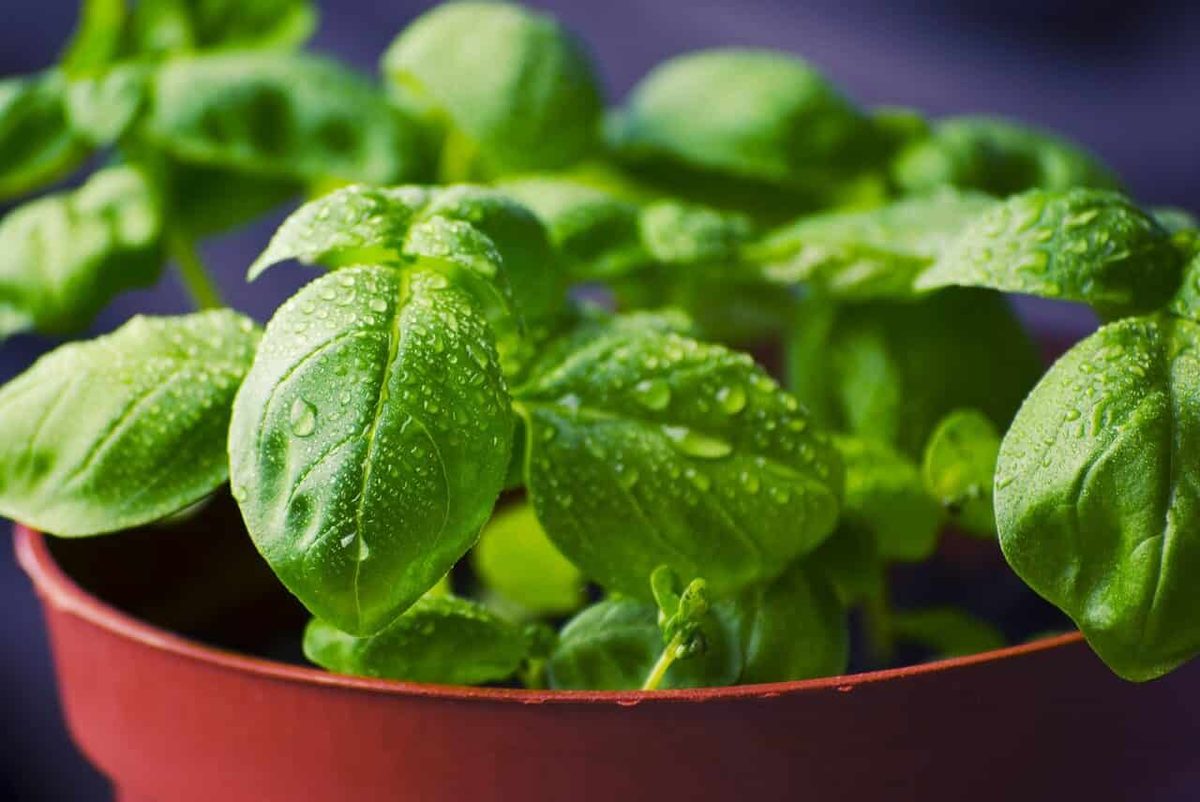
Basil is the leaf of Ocimum basilicum, a tender, frost-sensitive herb in the mint family. It is the herb in pesto, a fixture of Italian tomato cooking, and an important ingredient in Thai food. This page covers what basil is, where its smell comes from, where it is native and grown, how cooks use it fresh and dried, and the one safety question that regulators have looked at closely: estragole.
At a glance
| Botanical name | Ocimum basilicum L.1 |
| Plant family | Lamiaceae (mint family)12 |
| Part used | Leaves, fresh or dried; seeds in some drinks23 |
| Native range | Tropical and subtropical Asia to northern Australia per Kew; other references differ (see Origin)123 |
| Main growing areas | The Mediterranean, the United States, Madagascar and neighboring islands, India and Thailand3 |
| Production figures | No published figure found; PROSEA says reliable data are hardly available3 |
| Key aroma compounds | Methyl chavicol (estragole) and linalool, in proportions that vary by type23 |
| Forms sold | Fresh leaves, dried leaves, ground dried basil, essential oil |
Measured values
14 figures, sourced| Measure | Value | Scope | Source |
|---|---|---|---|
| Essential oil | about 1.5 % of leaves | PROSEA; sample and basis (fresh or dry) not statedSources differ sharply; not reconciled | uses.plantnet-project.org |
| Essential oil | 0.1 % | Britannica; sample and basis not statedSources differ sharply; not reconciled | britannica.com |
| Methyl chavicol (estragole) / linalool / eugenol | 53.3 / 22.0 / 1.4 % of oil | "French basil" oil distilled in the Philippines (PROSEA) | uses.plantnet-project.org |
| Methyl chavicol (estragole) | 84.7 % of oil | "Réunion basil" oil from Taiwan (PROSEA) | uses.plantnet-project.org |
| Methyl chavicol (estragole) | 20–43 % of oil | sweet basil oil, range in the EU Scientific Committee on Food assessment (2001) | food.ec.europa.eu |
| Vitamin K Nutrient | 1,710 µg per 100 g | dried basil, USDA FoodData Central FDC 171317 | fdc.nal.usda.gov |
| Iron Nutrient | 89.8 mg per 100 g | dried basil, USDA FoodData Central FDC 171317 | fdc.nal.usda.gov |
| Calcium Nutrient | 2,240 mg per 100 g | dried basil, USDA FoodData Central FDC 171317 | fdc.nal.usda.gov |
| Vitamin C Nutrient | 0.8 mg per 100 g | dried basil, USDA FoodData Central FDC 171317 | fdc.nal.usda.gov |
| Vitamin K Nutrient | 415 µg per 100 g | fresh basil, USDA FoodData Central FDC 172232USDA notes several fresh-basil values have no analytical data points | fdc.nal.usda.gov |
| Iron Nutrient | 3.17 mg per 100 g | fresh basil, USDA FoodData Central FDC 172232USDA notes several fresh-basil values have no analytical data points | fdc.nal.usda.gov |
| Calcium Nutrient | 177 mg per 100 g | fresh basil, USDA FoodData Central FDC 172232USDA notes several fresh-basil values have no analytical data points | fdc.nal.usda.gov |
| Vitamin C Nutrient | 18.0 mg per 100 g | fresh basil, USDA FoodData Central FDC 172232USDA notes several fresh-basil values have no analytical data points | fdc.nal.usda.gov |
| Pyrrolizidine alkaloids, maximum Limit | 400 µg/kg | EU, dried herbs (category does not name basil individually) | eur-lex.europa.eu |
Each figure is quoted as its source states it, with the samples or standard it applies to. Where sources differ, both are shown; nothing is averaged. All measured values
What basil is
Kew describes Ocimum basilicum as an annual or subshrub of the seasonally dry tropics.1 Its leaves are glossy and oval, smooth or slightly toothed at the edge, and typically cup a little; the plant is extremely sensitive to frost and does best in warm weather.2 The name comes through Old French from Greek basilikon (phyton), “royal plant,” from basileus, “king.” The Online Etymology Dictionary says this was probably because the herb was believed to go into royal perfumes.4
Basil is unusually variable. PROSEA counts at least six chemotypes within the species and notes that variety names are often taxonomically unclear.3 Kew currently accepts just two varieties, var. basilicum and var. minimum.1
Basil and its relatives
- Thai basil is a form of O. basilicum sold under the Thai name horapha.3 See our Thai basil profile and basil vs. Thai basil.
- Holy basil is a separate species, Ocimum tenuiflorum (formerly O. sanctum), native from tropical and subtropical Asia to the western Pacific.5 Britannica notes it is considered sacred by followers of Hinduism.2 See holy basil and holy basil vs. basil.
- Lemon basil is a hybrid. Britannica calls it O. ×citriodorum; Kew treats that name as a synonym of Ocimum × africanum.26 See lemon basil.
- Genovese and cinnamon basil are cultivars of sweet basil. See Genovese basil, Genovese vs. sweet basil and cinnamon basil.
Flavor and aroma
Fresh sweet basil smells sweet and green with a peppery, faintly anise-like edge and a hint of clove; that description is ours. Britannica describes dried large-leaf basil as warm, sweet, aromatic and mildly pungent.2 The University of Delaware’s extension service puts basil among the medium-strength herbs, alongside oregano, marjoram and thyme.7
The compounds
Basil’s flavor and fragrance come from a volatile oil in the leaves.3 The two reference works we checked disagree sharply on how much oil there is:
Neither states the sample or basis (fresh or dry weight), so the two figures cannot be reconciled here.
Both name methyl chavicol as a principal component; Britannica pairs it with linalool.23 PROSEA gives estragole as another name for methyl chavicol, the compound that also makes up 60–75% of tarragon oil.38 How much of the oil each compound makes up depends on the type of basil:
| Scope | Methyl chavicol (estragole) | Linalool | Eugenol | Source |
|---|---|---|---|---|
| “French basil” oil distilled in the Philippines | 53.3% | 22.0% | 1.4% | PROSEA3 |
| “Réunion basil” oil from Taiwan | 84.7% | not given | not given | PROSEA3 |
| Sweet basil oil, range in the EU assessment | 20–43% | not given | not given | EU Scientific Committee on Food8 |
PROSEA describes French-type oil as sweet-spicy, slightly green and fresh, and Réunion-type oil as coarser and more herbaceous with a slightly camphor-like top note.3 It also records selections rich in methyl cinnamate and camphor, and says a single gene is an important source of variation in the oil.3 For the essential oil trade, PROSEA notes that linalool is sometimes added to Réunion oil to imitate French oil.3
Origin and history
Where it comes from
Sources disagree on where basil is native:
| Source | Native range |
|---|---|
| Kew Plants of the World Online | Tropical and subtropical Asia to northern Australia, including India, Thailand, Vietnam and Queensland1 |
| Britannica | “Likely native to India”2 |
| PROSEA | “Probably originated in western Asia”3 |
Kew’s list of native regions does not include Iran, and it records the species as introduced in about 120 regions, from Mexico and West Africa to Great Britain.1 We follow Kew for botany, but the wild origin of a plant cultivated this long is not settled.
Spread
PROSEA says basil was already cultivated in Egypt 3,000 years ago, spread from the Middle East to Greece, Italy and the rest of Europe, reached England in the 16th century, and reached North America in the early 17th century.3 Claims that basil has been cultivated in India or Persia for 5,000 years circulate widely; no source for that figure could be found.
How basil is used
- Italy. PROSEA lists pizzas, pasta, chicken and cheese dishes, and pesto.3 Classic Genoese pesto pounds basil with garlic, pine nuts, hard cheese and olive oil; that is common practice rather than a sourced recipe. Tasting Table notes that blending the leaves too long can bruise them and release bitter compounds, and that mature or damaged leaves tend to taste more bitter than young ones.9
- France. PROSEA singles out omelets and soups.3
- Thailand. PROSEA calls sweet basil an important ingredient of Thai cuisine.3 The basils most used there are covered on our Thai basil page and in Thai spices.
- Seeds. The seed turns mucilaginous in water and goes into non-alcoholic drinks.3
- General. Britannica lists meats, fish, salads and sauces.2 Tomato, mozzarella, eggs and summer vegetables are the classic pairings by common practice.
Technique
LSU AgCenter groups basil with the delicate herbs that are best added a minute or two before cooking ends, because prolonged heat costs flavor and aroma.10 The University of Delaware gives a gentler general rule for long-simmered dishes: add herbs in the last 45 minutes, or add part at the start and the rest later.7 Its starting amount for medium-strength herbs is 1 to 2 teaspoons for six servings.7
For swapping forms, LSU AgCenter’s rule of thumb is that one tablespoon of finely cut fresh herbs equals one teaspoon of crumbled dried herbs.10 See dried basil vs. fresh for how the two forms differ, and basil uses and cooking with basil for more. If a dish has gone over, see too much basil.
Buying and quality
PROSEA says basil grown for fresh or dried leaves is best harvested just before it starts to flower, and that leaves should be dried at no more than 35°C to keep their aroma and color.3 We found no Codex or other international grading standard for dried basil that we could open for this review. For fresh basil, perky leaves with no black spots or slime are the obvious test; that is kitchen judgment.
Storage
PROSEA records an Italian practice of preserving dried leaves in olive oil: they turn black but keep their flavor for several months.3 We found no published shelf-life figure for fresh or dried basil from a regulator or standards body. Because the flavor sits in a volatile oil, the practical test for dried basil is smell. For methods, see how to store basil, can you freeze basil? and how to dry basil.
Nutrition
Dried basil is dense in some nutrients by weight, but a teaspoon of dried leaves weighs only 0.7 g.11 Per typical serving, using USDA values and FDA Daily Values:
| Nutrient | Dried, 1 tsp leaves (0.7 g) | Fresh, 2 tbsp chopped (5.3 g) |
|---|---|---|
| Vitamin K | 12 µg, about 10% DV | 22 µg, about 18% DV |
| Iron | 0.63 mg, about 3.5% DV | 0.17 mg, about 1% DV |
| Calcium | 16 mg, about 1% DV | 9 mg, under 1% DV |
| Vitamin C | under 0.1 mg | 1 mg, about 1% DV |
Figures are computed from USDA FoodData Central per-100 g values (dried: 1,710 µg vitamin K, 89.8 mg iron, 2,240 mg calcium, 0.8 mg vitamin C; fresh: 415 µg, 3.17 mg, 177 mg, 18.0 mg) and the FDA Daily Values of 120 µg vitamin K, 18 mg iron, 1,300 mg calcium and 90 mg vitamin C.111213 USDA notes that several of the fresh-basil values have no analytical data points behind them.12 Vitamin K is the only nutrient here that a normal serving supplies in a meaningful amount.
Safety
Estragole
Estragole is the main safety question for basil, and the evidence is from animal studies and exposure estimates, not from studies of people eating basil.
- In 2001 the EU Scientific Committee on Food concluded that estragole is genotoxic and carcinogenic, based mainly on studies in mice dosed orally, and said it could not establish a safe exposure limit; it called for reductions in exposure and restrictions on use levels.8 It estimated average intake from all sources at 4.3 mg per day among people who consume it.8
- In 2022 Germany’s Federal Institute for Risk Assessment (BfR) said the health risk of estragole and related compounds in food cannot yet be conclusively assessed. It named basil-containing pesto among foods that may contain high amounts, and made no consumption recommendation for consumers.14
Neither body tells people to stop eating basil. Tarragon oil carries more estragole than basil oil; see tarragon.
Vitamin K and blood thinners
Because fresh and dried basil carry vitamin K, the NIH Office of Dietary Supplements’ general advice applies: people taking warfarin should keep their vitamin K intake about the same from day to day, since a sudden change can be dangerous.15
Contaminant limits
The EU sets a maximum of 400 µg/kg for pyrrolizidine alkaloids in dried herbs, a category that does not name basil individually.16
Health claims
Basil is used in traditional medicine; PROSEA notes, for example, its use in Vietnam against fever and malaria.3 The NIH’s National Center for Complementary and Integrative Health has no fact sheet on basil.17 This page makes no claim that basil treats or prevents any condition.
Substitutes and comparisons
There is no single stand-in for fresh basil. Thai basil is closest in aroma but more anise-forward; mint or parsley can stand in for the fresh green note in some dishes; dried basil works in cooked sauces but not in pesto or as a garnish. These are kitchen judgments, not tested swaps. For side-by-side comparisons:
- Basil vs. oregano
- Basil vs. mint
- Basil vs. parsley
- Basil vs. cilantro
- Bay leaves vs. basil
- Lemon basil vs. basil
- Italian seasoning
Footnotes
-
Ocimum basilicum L., Plants of the World Online, Royal Botanic Gardens, Kew. powo.science.kew.org · Reference work ↩ ↩2 ↩3 ↩4 ↩5 ↩6 ↩7
-
“Basil”, Encyclopaedia Britannica, 2026. britannica.com · Reference work ↩ ↩2 ↩3 ↩4 ↩5 ↩6 ↩7 ↩8 ↩9 ↩10 ↩11 ↩12
-
N.O. Aguilar, Pham Truong Thi Tho and L.P.A. Oyen, Ocimum basilicum, Plant Resources of South-East Asia (PROSEA). uses.plantnet-project.org · Reference work ↩ ↩2 ↩3 ↩4 ↩5 ↩6 ↩7 ↩8 ↩9 ↩10 ↩11 ↩12 ↩13 ↩14 ↩15 ↩16 ↩17 ↩18 ↩19 ↩20 ↩21 ↩22 ↩23 ↩24 ↩25
-
“basil”, Online Etymology Dictionary. etymonline.com · Reference work ↩
-
Ocimum tenuiflorum L., Plants of the World Online, Royal Botanic Gardens, Kew. powo.science.kew.org · Reference work ↩
-
Ocimum × africanum Lour., Plants of the World Online, Royal Botanic Gardens, Kew. powo.science.kew.org · Reference work ↩
-
“Using Herbs and Spices”, University of Delaware Cooperative Extension, 2025. udel.edu · Reference work ↩ ↩2 ↩3
-
Opinion of the Scientific Committee on Food on Estragole, European Commission, 2001. food.ec.europa.eu · Regulator ↩ ↩2 ↩3 ↩4
-
Sara Klimek, “5 Possible Reasons Your Homemade Pesto Has A Bitter Taste”, Tasting Table, 2026. tastingtable.com · Publication ↩
-
“Flavorful Herbs”, LSU AgCenter. lsuagcenter.com · Reference work ↩ ↩2
-
Spices, basil, dried (FDC 171317), USDA FoodData Central. fdc.nal.usda.gov · Regulator ↩ ↩2
-
Basil, fresh (FDC 172232), USDA FoodData Central. fdc.nal.usda.gov · Regulator ↩ ↩2
-
Daily Value on the Nutrition and Supplement Facts Labels, U.S. Food and Drug Administration. fda.gov · Regulator ↩
-
“Alkenylbenzenes in food: how large is the health risk?”, BfR Communication No. 22/2022. bfr.bund.de · Regulator ↩
-
Vitamin K: Fact Sheet for Consumers, NIH Office of Dietary Supplements, 2021. ods.od.nih.gov · Regulator ↩
-
Commission Regulation (EU) 2023/915, Annex I, point 2.4. eur-lex.europa.eu · Regulator ↩
-
Herbs at a Glance, National Center for Complementary and Integrative Health. nccih.nih.gov · Regulator ↩