Spice Substitutes · Substitutes
Cilantro Substitutes, Whether You’ve Run Out or Can’t Stand It
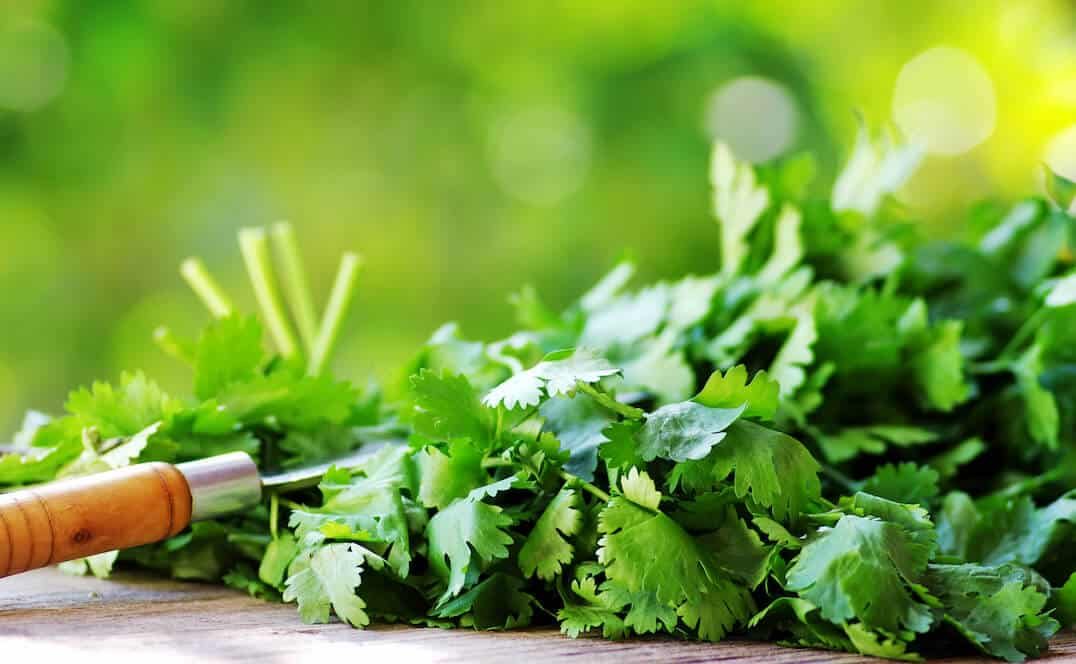
Cilantro is the fresh leaf of Coriandrum sativum, a member of the parsley family (Apiaceae) whose dried fruit is sold as the spice coriander.1 Its smell comes from aldehydes: PROSEA says they make up more than 80% of the leaf’s volatile oil, led by (E)-2-dodecenal at 15.6%.2 Those same compounds are why the herb divides people. Eriksson and colleagues note that the (E)-2-alkenals in cilantro are described as soapy, fatty, “like cilantro” or pungent,3 and the Wisconsin Master Gardener program says descriptions of its flavor run from citrusy with a biting tang to soapy.4
That gives this page two different answers. If you like cilantro and have run out, the best substitute shares its aldehydes. If cilantro tastes like soap to you, the best substitute is one that doesn’t.
Quick answer
| Your situation, or what cilantro is doing | Best substitute | Starting amount, per 1 part cilantro | Treatment |
|---|---|---|---|
| You like cilantro; raw finishing herb in salsa, tacos, guacamole | Culantro, finely chopped | 1/2 part, then taste | Method |
| Same job, no culantro | Flat-leaf parsley | 1 part | Method |
| Southeast Asian dishes (pho, noodle salads) | Thai basil or mint | 1 part | Attributed |
| Cooked into soups or curries | Celery leaves | 1 part | Attributed |
| Cilantro tastes like soap to you | Parsley, Thai basil or mint, or leave it out | 1 part, or none | Method / Attributed |
The rest of the page explains each choice.
How the ratios on this page are labeled
Every ratio carries one of four labels.
- Computed: based on a measurable physical relationship, such as converting fresh herbs to dried, with the source named.
- Attributed: a named source publishes this ratio. We quote it as theirs.
- Disputed: named sources give different answers to the same swap. We show each one and do not average them.
- Method: we found no published ratio. We give a direction and a cautious starting point, and say so.
The attributed ratios below are a food writer’s rules of thumb, not measurements of flavor strength.
If you like cilantro and it is a raw finishing herb
In Mexican cooking cilantro goes into salsas and meat dishes,4 and Britannica notes that the young leaves are widely used in Latin American, Indian and Chinese dishes.1 Here you want the same bright, aldehyde-driven aroma, added raw at the end.
1. Culantro
Culantro, Eryngium foetidum, is a different plant in the same family, and it is the closest match in chemistry. PROSEA says its leaves smell like coriander and that the Chinese brought it to Southeast Asia as a substitute for coriander.5 In one Malaysian sample summarized by PROSEA, (E)-2-dodecenal, the largest single component of cilantro leaf oil, made up 59.7% of culantro leaf oil.52 Those figures come from different samples and methods, so they show a shared chemistry, not a measured ratio of strength.
The University of Florida says culantro smells similar to cilantro but has a stronger flavor, and that its tough leaves are best used finely chopped.6 Andrea Nguyen describes it as having a strong, slightly sweet cilantro flavor, and says it is usually sold at Vietnamese, Latin and Caribbean markets.7 A widely repeated claim says culantro is “ten times” stronger than cilantro; no measurement supports that figure.
Ratio (Method): We found no published ratio. Because UF describes the flavor as stronger,6 start with about half the cilantro amount, chopped very fine, and add more to taste.
2. Flat-leaf parsley
PROSEA describes parsley as playing a role in Western cooking similar to that of coriander leaves in Asia, and calls the flat-leaved type stronger flavored than the curly.8 It looks the part and stays fresh and green, but it does not taste like cilantro. Sonja Overhiser of A Couple Cooks puts it plainly: parsley is grassy and citrusy, but it doesn’t taste like cilantro.9 PROSEA describes parsley oil’s flavor as warm but slightly burning and bitter.8
Ratio (Method): A Couple Cooks lists parsley first but gives no amount.9 Start with the same amount as the cilantro. In our kitchen judgment, a squeeze of lime helps fill in some of cilantro’s brightness in salsa or guacamole.
3. Pápalo
Pápalo, Porophyllum ruderale, is an herb of the aster family.10 University of Maryland Extension’s Maryland Grows blog says its flavor is not exactly like cilantro but close enough to work as an alternative, warns against overdoing it until you get used to the flavor, and advises using it raw or adding it at the very end of cooking.10 It is a hot-weather plant, which makes it useful in summer when cilantro, a cool-weather herb, bolts.10
Ratio (Method): No published ratio was found. Given the advice not to overdo it, start with about a third of the cilantro amount and taste.
4. Rau ram (Vietnamese coriander)
Rau ram, Persicaria odorata, is in a different family from cilantro, the Polygonaceae.11 PROSEA describes its flavor as reminiscent of lemon and coriander leaves with a slight radish-like, pungent aftertaste, and its leaf oil as mainly alkane aldehydes: in an Australian sample, 44.1% dodecanal and 27.7% decanal.11 PROSEA adds that the flavor is destroyed by prolonged cooking, so it belongs at the end.11
Ratio (Method): No published ratio was found. Start with about half the cilantro amount and taste, since the radish-like bite builds.
If the dish is Southeast Asian
In pho, noodle salads and fresh rolls, cilantro is one herb on a plate of several. Andrea Nguyen’s pho garnish plate includes culantro alongside mint and Thai basil,7 so the other herbs on that plate can stand in for one another.
Thai basil or mint
Ratio (Attributed): A Couple Cooks suggests Thai basil or mint for Southeast Asian recipes, used as a 1:1 substitute.9
Thai basil brings a related brightness by a different route. In a 2018 study of basils grown in Chiang Mai, Thai basil oil was led by estragole, geranial and neral, and was linked to anise, lime-like and fresh aromas.12 Expect an anise-and-lime note rather than cilantro.
Culantro and rau ram, above, also suit these dishes.
If cilantro is cooked into soups, curries or stews
Cilantro does not take long cooking well. LSU AgCenter lists it among the delicate herbs best added in the last minute or two, because prolonged heat costs flavor and aroma.13 When a recipe cooks it in, a sturdier green leaf can do the job.
1. Celery leaves
Ratio (Attributed): A Couple Cooks says celery leaves have a similar fresh flavor and look and can be used as a 1:1 swap, suggesting them for soups and curries.9
Their aroma is different: a review attributes celery’s characteristic odor to phthalides such as sedanenolide and 3-n-butylphthalide.14 Celery leaves give green, savory freshness, not cilantro’s citrus.
2. Culantro
PROSEA lists soups, curries, stews, rice and fish dishes among culantro’s uses.5
Ratio (Method): As above, start with about half the cilantro amount.
If cilantro tastes like soap to you
The soapy taste has a partly genetic basis. In a genome-wide study of 14,604 people of European ancestry, Eriksson and colleagues found a variant in a cluster of smell-receptor genes, including OR6A2, a receptor with high binding specificity for several of the aldehydes that give cilantro its odor.3 Genes explain only part of it: the heritability tagged by common variants was low, about 0.087.3
The chemistry suggests which substitutes to avoid, though no study has tested this directly. Culantro’s leaf oil is dominated by (E)-2-dodecenal,5 the same compound that leads cilantro’s,2 so it may well taste soapy to the same people. Rau ram is less certain: its oil is mostly n-aldehydes such as dodecanal and decanal,11 and Eriksson’s team counts n-aldehydes as well as (E)-2-alkenals among cilantro’s key aroma components, while the soapy description is given for the (E)-2-alkenals.3 Avoid both if you want to be safe.
Parsley, Thai basil or mint, or nothing
Ratio (Method, and Attributed for Thai basil and mint): Flat-leaf parsley at the same amount gives the green, fresh look (Method). Thai basil or mint at 1:1 suits Southeast Asian dishes (Attributed to A Couple Cooks).9 A Couple Cooks’ last option is to omit cilantro entirely.9 In a salsa or guacamole with lime, onion and chile, the dish will still work without it; that is our judgment.
Dried cilantro and coriander seed
Dried cilantro (Computed, with a caveat): The general extension rule is 1 tablespoon of finely cut fresh herbs to 1 teaspoon of crumbled dried,13 and America’s Test Kitchen’s testing found that 1 part dried to 3 parts fresh came closest to equal strength for herbs in general.15 But ATK’s Danielle Lapierre lists cilantro among the herbs that are better fresh, saying such herbs are much weaker in flavor when dried.16 No source we found measures how much aroma dried cilantro loses, so treat the 3:1 figure as a starting point and expect less flavor.
Coriander seed (not a substitute): The seed comes from the same plant but tastes nothing like the leaf. PROSEA says the aldehydic components of the oil disappear as the fruit ripens, and that its smell changes notably.2 See coriander vs. cilantro.
What isn’t known
- No published ratio exists for culantro, pápalo, rau ram or parsley in place of cilantro. Those are Method starting points.
- No study has tested whether people who find cilantro soapy also find culantro or rau ram soapy. The advice above follows from shared compounds, not a taste test.
- The Eriksson study gives no figure for what share of people taste soap, and neither does this page.
- No source measures aroma loss when cilantro is dried.
Related
- Cilantro, cooking with cilantro and too much cilantro
- Culantro, culantro vs. cilantro and culantro substitutes
- Cilantro vs. parsley, basil vs. cilantro and chervil vs. cilantro
- Thai basil, mint, parsley and celery leaves
- Coriander, coriander vs. cilantro and dried vs. fresh cilantro
Footnotes
-
“Coriander”, Encyclopaedia Britannica. britannica.com · Reference work ↩ ↩2
-
Coriandrum sativum, Plant Resources of South-East Asia (PROSEA). uses.plantnet-project.org · Reference work ↩ ↩2 ↩3 ↩4
-
Eriksson et al., “A genetic variant near olfactory receptor genes influences cilantro preference”, Flavour, 2012. link.springer.com · Peer-reviewed ↩ ↩2 ↩3 ↩4
-
Susan Mahr, “Cilantro”, Wisconsin Master Gardener Program, University of Wisconsin-Madison, 2017. mastergardener.extension.wisc.edu · Reference work ↩ ↩2
-
M.H. van den Bergh, Eryngium foetidum, Plant Resources of South-East Asia (PROSEA). uses.plantnet-project.org · Reference work ↩ ↩2 ↩3 ↩4
-
“Culantro”, Gardening Solutions, University of Florida IFAS Extension. gardeningsolutions.ifas.ufl.edu · Reference work ↩ ↩2
-
Andrea Nguyen, Pho Garnish Plate, from The Pho Cookbook, via The Splendid Table, 2017. splendidtable.org · Publication ↩ ↩2
-
I.B. Ipor and L.P.A. Oyen, Petroselinum crispum, Plant Resources of South-East Asia (PROSEA). uses.plantnet-project.org · Reference work ↩ ↩2
-
Sonja Overhiser, “Best Cilantro Substitute”, A Couple Cooks, 2026. acouplecooks.com · Publication ↩ ↩2 ↩3 ↩4 ↩5 ↩6
-
Erica Smith, “Papalo: the ‘summer cilantro’”, Maryland Grows, University of Maryland Extension, 2019. marylandgrows.umd.edu · Reference work ↩ ↩2 ↩3
-
L.P.A. Oyen and Dzuong Duc Huyen, Persicaria odorata, Plant Resources of South-East Asia (PROSEA). uses.plantnet-project.org · Reference work ↩ ↩2 ↩3 ↩4
-
Tangpao, Chung and Sommano, “Aromatic Profiles of Essential Oils from Five Commonly Used Thai Basils”, Foods, 2018. mdpi.com · Peer-reviewed ↩
-
“Flavorful Herbs”, LSU AgCenter. lsuagcenter.com · Reference work ↩ ↩2
-
Salehi et al., “Apium Plants: Beyond Simple Food and Phytopharmacological Applications”, Applied Sciences, 2019. mdpi.com · Peer-reviewed ↩
-
“Science: Substituting Dried Herbs for Fresh”, America’s Test Kitchen. americastestkitchen.com · Publication ↩
-
Danielle Lapierre, “When You Should Actually Use Dried Herbs (and Which Ones to Avoid)”, America’s Test Kitchen, 2022. americastestkitchen.com · Publication ↩