Herbs · Profile
Mint: Peppermint, Spearmint, the Compounds Behind the Cool, and How to Cook With It
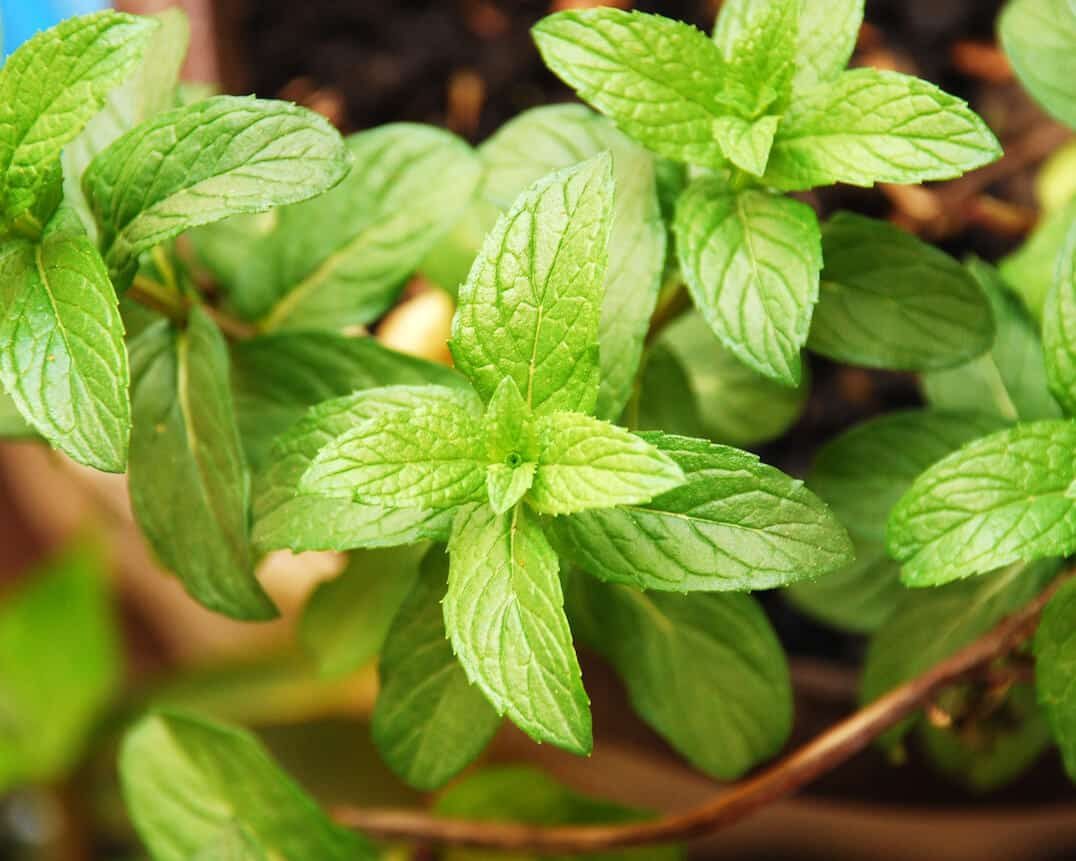
Mint is the genus Mentha, a group of aromatic perennial herbs in the Lamiaceae, the mint family.12 In the kitchen the word nearly always means one of two plants, peppermint or spearmint, and the difference between them comes down to which compounds dominate their oil.12 This page covers the main mints, the chemistry behind their flavor, their history, how they are used, how to handle them, and what the health evidence actually shows.
At a glance
| Genus | Mentha L., about 25 species per Britannica; 25–30 per a 2018 review12 |
| Plant family | Lamiaceae (mint family)2 |
| Culinary species | Peppermint (Mentha × piperita) and spearmint (Mentha spicata)341 |
| Part used | Leaves, fresh or dried; essential oil from leaves and flowering tops5 |
| Key aroma compounds | Peppermint: menthol and menthone. Spearmint: carvone2 |
| Native range | Peppermint: Europe to Central Asia. Spearmint: Europe to China (Kew)34 |
| Forms sold | Fresh sprigs, dried leaf, essential oil and extracts |
| US status of the oils | Peppermint and spearmint oils are on FDA’s GRAS list for essential oils6 |
Measured values
12 figures, sourced| Measure | Value | Scope | Source |
|---|---|---|---|
| Peppermint oil: menthol | 29–48 % of the oil | Clark and Menory, 1980, as tabulated in Singh and Pandey 2018 review, as tabulated | frontiersin.org |
| Peppermint oil: menthone | 20–31 % of the oil | Clark and Menory, 1980, as tabulated in Singh and Pandey 2018 review, as tabulated | frontiersin.org |
| Peppermint oil: menthyl acetate | 3–10 % of the oil | Clark and Menory, 1980, as tabulated in Singh and Pandey 2018 review, as tabulated | frontiersin.org |
| Peppermint oil: menthofuran | 6.8 % of the oil | Clark and Menory, 1980, as tabulated in Singh and Pandey 2018 review, as tabulated | frontiersin.org |
| Spearmint oil: carvone | 59.50 % of the oil | Spearmint, Pakistan, sample 1, Singh and Pandey 2018 review, as tabulated | frontiersin.org |
| Spearmint oil: carvone | 63.24 % of the oil | Spearmint, Pakistan, sample 2, Singh and Pandey 2018 review, as tabulated | frontiersin.org |
| Spearmint oil: limonene | 10.44 % of the oil | Spearmint, Pakistan, sample 1, Singh and Pandey 2018 review, as tabulated | frontiersin.org |
| Spearmint oil: limonene | 9.09 % of the oil | Spearmint, Pakistan, sample 2, Singh and Pandey 2018 review, as tabulated | frontiersin.org |
| Spearmint oil: carvone | 69.5 % of the oil | Spearmint, Serbia, Singh and Pandey 2018 review, as tabulated | frontiersin.org |
| Spearmint oil: menthone | 21.9 % of the oil | Spearmint, Serbia, Singh and Pandey 2018 review, as tabulated | frontiersin.org |
| Spearmint oil: carvone | 40.8 % of the oil | Spearmint, Tunisia, Singh and Pandey 2018 review, as tabulated | frontiersin.org |
| Spearmint oil: limonene | 20.8 % of the oil | Spearmint, Tunisia, Singh and Pandey 2018 review, as tabulated | frontiersin.org |
Each figure is quoted as its source states it, with the samples or standard it applies to. Where sources differ, both are shown; nothing is averaged. All measured values
What mint is
True mints have square stems and opposite, aromatic leaves, and every Mentha species carries volatile oil in tiny resin dots on its leaves and stems.1 Britannica counts about 25 species, and Singh and Pandey’s 2018 review gives 25 to 30.12 The often-repeated claim that there are “hundreds” of mint species does not match either source.
Peppermint and spearmint
- Spearmint (Mentha spicata) is an accepted species whose native range Kew gives as Europe to China. It has been introduced across the Americas, Australia and New Zealand.4
- Peppermint (Mentha × piperita) is a hybrid. Kew lists its parents as water mint (M. aquatica) and spearmint, and NCCIH describes it as a natural cross between the two.35 Kew gives its native range as Europe to Central Asia and notes that it is mostly known as a cultivated plant that occasionally goes wild.3
Other culinary mints are covered on their own pages: watermint, apple mint, ginger mint, orange mint, chocolate mint, Moroccan mint and Korean mint. For an overview, see types of mint.
Flavor and aroma
Both main mints taste fresh and sweet with a cooling finish, but they are easy to tell apart. Peppermint is sharper and more penetrating, with a cold, almost medicinal edge; spearmint is softer, sweeter and greener. That description is ours. The chemistry behind it is below.
The compounds
The difference is in the oil. Peppermint oil is prized mostly for its two major components, menthol and menthone, while spearmint is rich in carvone.2 Proportions vary by sample, and the figures below come from the tables in Singh and Pandey’s review, which collects results from many separate studies:
| Mint and sample | Main compounds in the oil (%) | Source |
|---|---|---|
| Peppermint (Clark and Menory, 1980, as tabulated in the review) | Menthol 29–48, menthone 20–31, menthyl acetate 3–10, menthofuran 6.8 | 2 |
| Spearmint, Pakistan (two samples) | Carvone 59.50 and 63.24, limonene 10.44 and 9.09 | 2 |
| Spearmint, Serbia | Carvone 69.5, menthone 21.9 | 2 |
| Spearmint, Tunisia | Carvone 40.8, limonene 20.8 | 2 |
These are individual samples and should not be merged into a single typical value. What they show consistently is the split: menthol and menthone for peppermint, carvone for spearmint.
Origin and history
- Greek myth. The geographer Strabo records a mountain near Pylos named after Minthe, who in the myth became the concubine of Hades, was trampled by Core (Persephone) and was turned into garden mint.7 Versions of the story that call it a Roman myth, or name the nymph “Metha”, do not match this source.
- Rome. Pliny the Elder praised the smell of mint and noted that it was a common ingredient in Roman sauces. He also listed a long series of medicinal uses for it.8
- The Bible. Matthew 23:23 has Jesus rebuke those who tithe “mint and anise and cummin” while neglecting weightier matters.9 Britannica says the mint of the Bible is presumed to be Mentha longifolia, not peppermint.1 So the widely repeated idea that “mint” in old texts usually means peppermint is not supported; peppermint is a hybrid, and no source we found shows which mint most historical writers meant.
- Traditional medicine. NCCIH notes that mint plants were used for digestive complaints in ancient Greece, Rome and Egypt.5
Several other historical claims circulate widely: dried mint leaves found in Egyptian tombs from about 1000 BC, mint as a Greek symbol of hospitality and a funeral herb, Romans bringing mint to England, a 15th-century mention by “John Gardiner”, and the Pilgrims carrying it to North America. None of them could be traced to a source we could open, so they are left out.
How mint is used
Singh and Pandey’s review lists mint as a flavoring in confectionery, cough drops and chewing gum, and as an ingredient in spice mixtures.2 Some well-documented culinary uses:
- England. Mint sauce, made from fresh mint, sugar and vinegar, is the traditional partner for roast lamb; Saveur quotes the view that serving lamb without it is an offense to taste and tradition.10
- Rome. As noted above, Pliny describes mint as a common ingredient in sauces.8
- Drinks. In cocktails such as the mojito, hard muddling can bruise the leaves and bring out vegetal, bitter flavors; Tasting Table suggests shaking the leaves with ice instead.11
By common practice, mint also turns up in yogurt sauces, salads, fruit, peas, desserts and tea; those are kitchen habits rather than sourced facts. For more, see mint uses and cooking with mint.
Technique
LSU AgCenter groups mint with the delicate herbs (basil, chives, cilantro, dill leaves, parsley) that are best added near the end of cooking, because prolonged heat costs flavor and aroma.12 Its rule of thumb for swapping is that one tablespoon of finely cut fresh herbs equals one teaspoon of crumbled dried herbs, a general guide rather than a mint-specific measurement.12 If a dish has gone over, see too much mint.
Buying and quality
There is no grading standard for fresh culinary mint that we could find. In practice, look for bright, unwilted leaves with a strong smell when rubbed, and no black or slimy patches; that is kitchen judgment. Make sure you know which mint you are buying, since peppermint and spearmint are not interchangeable in flavor.
Storage
We found no published shelf-life figure for fresh or dried mint from a regulator or extension service. Because the flavor is carried in volatile oil,1 the practical test for dried mint is smell: crush a little, and if the aroma is faint, it has faded. For methods, see how to store mint, can you freeze mint and how to dry mint.
Health and safety
Most of the health research on mint concerns peppermint oil, not the leaf, and NCCIH says very little research has been done on peppermint leaf.5 What it reports:
- Irritable bowel syndrome. A small body of research suggests enteric-coated peppermint oil capsules may improve IBS symptoms in adults. A 2022 review of 10 studies with 1,030 participants found peppermint oil better than placebo, and a 2021 American College of Gastroenterology guideline recommended it.5
- Indigestion. Some combination products with peppermint and caraway oil may help, but NCCIH found no evidence that peppermint oil alone does, and it may make indigestion worse in some people.5
- Side effects. Oral peppermint oil can cause heartburn, nausea, abdominal pain and dry mouth, and rarely allergic reactions. It should not be applied to the face of infants or young children.5
- Food amounts. Peppermint tea appears to be safe, though the long-term safety of large amounts of peppermint leaf is unknown, and peppermint in amounts commonly found in food is likely safe in pregnancy.5
Peppermint and spearmint oils appear on FDA’s list of essential oils generally recognized as safe for their intended use.6 This page makes no claim that mint treats or prevents any condition. Claims that mint fights prostate cancer, protects against ulcers, or works as a weight-loss diuretic could not be traced to human evidence.
Substitutes and comparisons
Swapping one mint for another works, with a shift in character: spearmint for peppermint gives a gentler result, and peppermint for spearmint a sharper, colder one (editorial). For other options, see mint substitutes and peppermint substitutes.
Comparisons:
- Spearmint vs. peppermint
- Apple mint vs. peppermint
- Basil vs. mint
- Oregano vs. mint
- Lemon balm vs. mint
Profiles: spearmint, peppermint.
Footnotes
-
“Mint (plant)”, Encyclopaedia Britannica. britannica.com · Reference work ↩ ↩2 ↩3 ↩4 ↩5 ↩6 ↩7 ↩8
-
Pooja Singh and Abhay K. Pandey, “Prospective of Essential Oils of the Genus Mentha as Biopesticides: A Review”, Frontiers in Plant Science, 2018. frontiersin.org · Peer-reviewed ↩ ↩2 ↩3 ↩4 ↩5 ↩6 ↩7 ↩8 ↩9 ↩10 ↩11 ↩12
-
Mentha × piperita L., Plants of the World Online, Royal Botanic Gardens, Kew. powo.science.kew.org · Reference work ↩ ↩2 ↩3 ↩4
-
Mentha spicata L., Plants of the World Online, Royal Botanic Gardens, Kew. powo.science.kew.org · Reference work ↩ ↩2 ↩3
-
“Peppermint Oil”, National Center for Complementary and Integrative Health, 2025. nccih.nih.gov · Regulator ↩ ↩2 ↩3 ↩4 ↩5 ↩6 ↩7 ↩8
-
21 CFR 182.20, US Food and Drug Administration. ecfr.gov · Regulator ↩ ↩2
-
Strabo, Geography 8.3.14, Perseus Digital Library. perseus.tufts.edu · Reference work ↩
-
Pliny the Elder, Natural History 20.53, Perseus Digital Library. perseus.tufts.edu · Reference work ↩ ↩2
-
Matthew 23:23, King James Version, Bible Hub. biblehub.com · Reference work ↩
-
“Mint Sauce”, Saveur, quoting Megan Wetherall, 2000. saveur.com · Publication ↩
-
Sylvia Tomczak, “Why You Should Think Twice Before Muddling Mint In Your Next Mojito”, Tasting Table, 2024. tastingtable.com · Publication ↩
-
“Flavorful Herbs”, LSU AgCenter. lsuagcenter.com · Reference work ↩ ↩2