Herbs · Profile
Kaffir Lime Leaves (Makrut Lime): Flavor, Chemistry, Uses and the Name
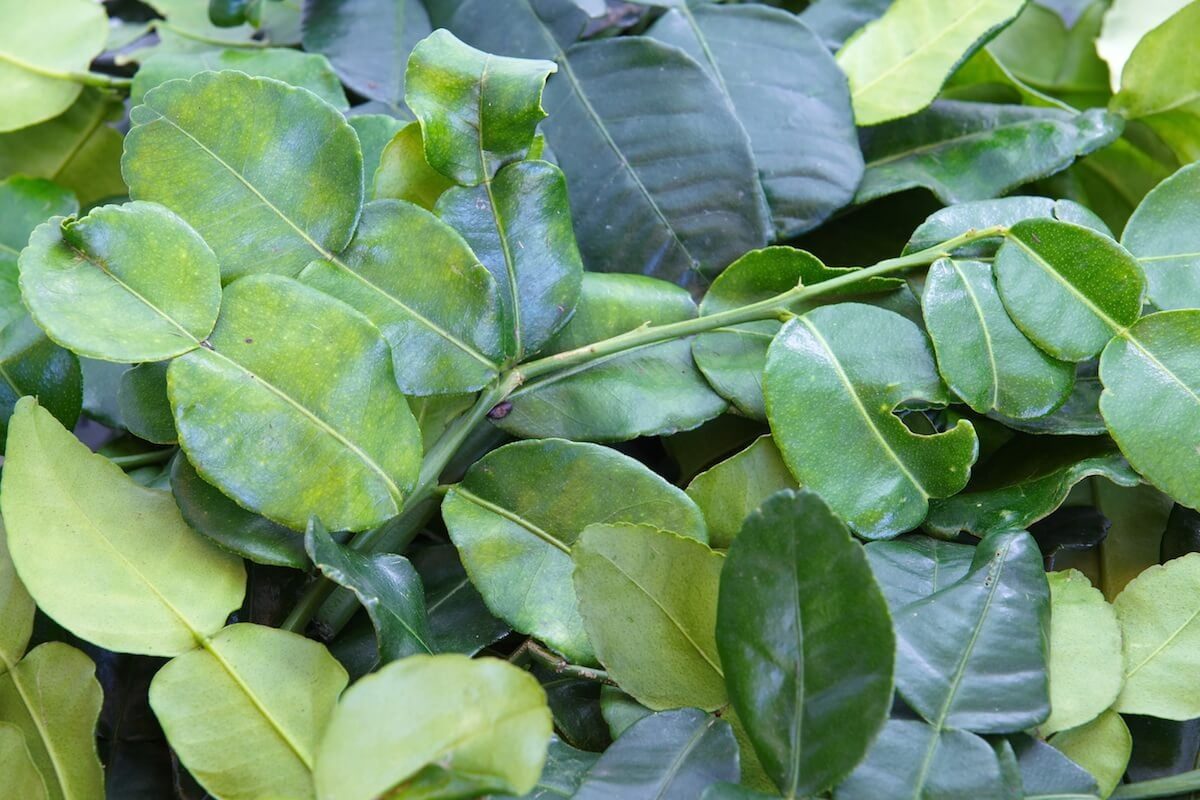
Kaffir lime leaves come from Citrus hystrix, a small citrus tree of tropical Asia, and they carry one of the sharpest citrus aromas in the kitchen. In Thailand the tree is called makrut, and many cooks, shops and food writers now use that name because “kaffir” is a racial slur in South Africa.1 The leaves season curries, curry pastes and soups across Southeast Asia.213 This page covers the plant, the chemistry behind the smell, how the leaves are used, and where the name comes from.
At a glance
| Botanical name | Citrus hystrix DC.4 |
| Other names | Makrut (Thai; PROSEA spells it ma kruut), jeruk purut (Indonesian), limau purut (Malay), Mauritius papeda and leech-lime (English)21 |
| Plant family | Rutaceae (citrus family)4 |
| Part used | Leaves; the fruit’s juice is also used2 |
| Native range | Eastern Himalaya to southern China (Yunnan, northern Guangxi) and Wallis Island, per Kew; PROSEA says the origin is not known42 |
| Main aroma compound | Citronellal, 77.7% of the leaf oil in one 2023 study5 |
| Forms sold | Fresh, frozen and dried leaves |
Measured values
3 figures, sourced| Measure | Value | Scope | Source |
|---|---|---|---|
| Leaf oil: citronellal | 77.7 % of the leaf oil | 2023 study; steam-distilled leaf oil, C. hystrix leaves from orchards in Negeri Sembilan, Malaysia | mdpi.com |
| Leaf oil: sabinene | 3.0 % of the leaf oil | 2023 study; steam-distilled leaf oil, C. hystrix leaves from orchards in Negeri Sembilan, Malaysia | mdpi.com |
| Leaf oil: citronellol acetate | 2.8 % of the leaf oil | 2023 study; steam-distilled leaf oil, C. hystrix leaves from orchards in Negeri Sembilan, Malaysia | mdpi.com |
Each figure is quoted as its source states it, with the samples or standard it applies to. Where sources differ, both are shown; nothing is averaged. All measured values
The plant
Kew’s Plants of the World Online describes Citrus hystrix as a shrub or tree of the wet tropics, with a native range running from the eastern Himalaya to southern China and Wallis Island.4 The Plant Resources of South-East Asia handbook (PROSEA) is more cautious: it says the species’ origin is not known, but that it is widely naturalized in Malesia, Sri Lanka and Burma, and is often grown in home gardens.2 Kew lists 47 synonyms for the species, among them Citrus macroptera and Citrus papeda.4
PROSEA gives the leaves as broadly ovate to ovate-oblong, 3 to 15 cm long, and the fruit as a green to yellow berry 5 to 7 cm across with a very bumpy skin.2 PROSEA says the fruit’s juice is used for seasoning and drinks, and that its main use seems to be as an insecticide, for washing the head and for treating the feet against land leeches.2
Flavor and the compounds behind it
The leaves smell intensely of lime peel with a floral, almost lemongrass-like edge, and a little goes a long way; that description is ours.
The chemistry points to citronellal. A 2023 study of leaf oils steam-distilled from four citrus species, with C. hystrix leaves collected from orchards in Negeri Sembilan, Malaysia, found citronellal to be the principal constituent of the makrut leaf oil, at 77.7%.5 The same oil had the highest share of oxygenated monoterpenes of the four, and contained sabinene (3.0%) and citronellol acetate (2.8%), which the authors found only in this species.5 Limonene made up just 0.2% of the makrut leaf oil.5
This is one set of samples, distilled from one orchard’s leaves. It shows what can dominate the leaf’s aroma, not a fixed specification. A widely repeated claim says limonene is responsible for the leaves’ fragrance; the analysis above does not support it.
How the leaves are used
PROSEA notes simply that the leaves are used to season food.2 Specific uses in named sources:
- Thai curry pastes and soups. Britannica lists makrut lime leaf with lemongrass, garlic and other herbs in the thick curry pastes of the region.3 In SBS Food’s reporting, Sydney restaurateur Vinita Chumsri puts julienned leaves into Panang, green and hor mok curry pastes and uses bruised leaves in coconut and tom yum soups.1
- Infusing. The same article describes the leaf as often used to infuse curries.1 Whole leaves are usually left in the pot and pushed aside when eating, as with bay leaves; that is common practice.
- Raw, finely sliced. Restaurateur Palisa Anderson tells SBS Food she slices the leaves finely through a warm salad and always adds them at the end rather than during heating.1
The midrib is tough, so cooks usually strip it out before slicing; that is kitchen practice, not a sourced finding.
Buying and storage
Fresh leaves should be glossy, dark green and stiff, with a strong smell when bent; that is kitchen judgment. Many cooks freeze fresh leaves in a sealed bag rather than buying dried ones; we found no published study or shelf-life figure for makrut leaves from a regulator, standards body or extension service.
Health claims
The National Center for Complementary and Integrative Health has no fact sheet on makrut lime.6 The 2023 study above measured antioxidant activity in lab assays and tested the leaf oil against a human cervical cancer cell line in culture.5 Those are laboratory results on a concentrated oil. They do not show that eating the leaves prevents or treats any disease, and this page makes no such claim. Claims that the leaves protect teeth, ease acid reflux or treat arthritis when applied to the skin have no support from a systematic review or health agency that we could find.
Where the name comes from
“Kaffir” comes from the Arabic kafir, “unbeliever, infidel,” according to the Online Etymology Dictionary, which dates its use for Bantu peoples in South Africa to 1731 and says it has been a term of abuse at least since 1934.7 SBS Food writes that in South Africa it is a racist slur comparable to the “n” word.1
How the word attached itself to a lime is less clear. SBS Food reports that the name was assigned by the Scottish botanist H.F. Macmillan in his 1910 Handbook of Tropical Gardening and Planting, and that the word there referred to an ethnic group in Sri Lanka.1 We have not seen Macmillan’s book, so that account is SBS Food’s. Other origin stories circulate, including one tracing the name to a nineteenth-century British reference text; we found no source for those.
The Thai name is makrut.1 This page keeps “kaffir lime leaves” in its address because that is still what many readers search for, and uses makrut alongside it.
Substitutes and comparisons
No other ingredient reproduces the citronellal-heavy aroma. Lime zest with a little lemongrass gets part of the way; that is a cook’s approach, not a tested ratio. See kaffir lime leaves substitutes for options, and these related pages:
- Lemongrass, its usual partner in Thai curry paste
- Lemongrass substitutes
- Thai spices
- Curry paste vs. curry powder
Footnotes
-
Lee Tran Lam, “Why people now call this lime by its Thai name”, SBS Food, 2021. sbs.com.au · Publication ↩ ↩2 ↩3 ↩4 ↩5 ↩6 ↩7 ↩8 ↩9
-
P.C.M. Jansen, J. Jukema, L.P.A. Oyen and T.G. van Lingen, Citrus hystrix, Plant Resources of South-East Asia (PROSEA). uses.plantnet-project.org · Reference work ↩ ↩2 ↩3 ↩4 ↩5 ↩6 ↩7 ↩8
-
Tony Hill, “Lemongrass”, Encyclopaedia Britannica. britannica.com · Reference work ↩ ↩2
-
Citrus hystrix DC., Plants of the World Online, Royal Botanic Gardens, Kew. powo.science.kew.org · Reference work ↩ ↩2 ↩3 ↩4 ↩5
-
Al Othman et al., “Phytochemical Composition, Antioxidant and Antiproliferative Activities of Citrus hystrix, Citrus limon, Citrus pyriformis, and Citrus microcarpa Leaf Essential Oils against Human Cervical Cancer Cell Line”, Plants, 2023. mdpi.com · Peer-reviewed ↩ ↩2 ↩3 ↩4 ↩5
-
Herbs at a Glance, National Center for Complementary and Integrative Health. nccih.nih.gov · Regulator ↩
-
“kaffir (n.)”, Online Etymology Dictionary. etymonline.com · Reference work ↩