Spice Comparisons · Comparison
Curry Paste vs. Curry Powder: Wet and Dry, Thai and British-Indian
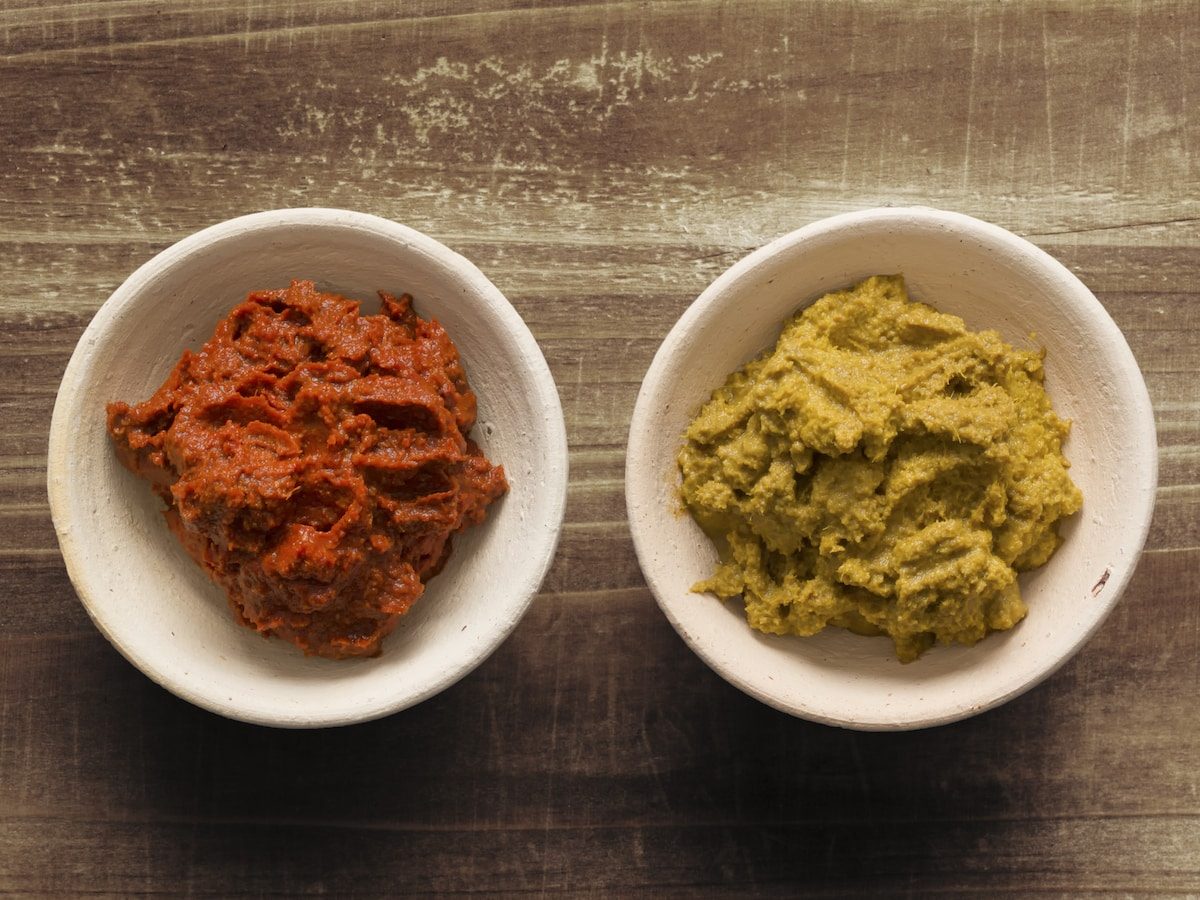
Curry paste and curry powder share a word and a few spices, but they are built differently. A Thai curry paste is a ground mixture of chiles with other fresh aromatics, some dried spices and, typically, shrimp paste or dried fish.1 Curry powder is a dry blend of ground spices, adapted by British settlers in India, with turmeric for color and no chile required.23 The paste brings heat, moisture and fresh herb flavor; the powder brings warm, dried-spice flavor and a yellow color. They can stand in for each other only loosely.
“Curry paste” doesn’t always mean Thai, either. Britannica notes that some Indian masalas are blended with a liquid, such as water or vinegar, to make a curry paste.2 This page compares Thai-style pastes, the ones most cooks mean, with ordinary curry powder.
Side by side
| Thai curry paste | Curry powder | |
|---|---|---|
| What it is | A ground mixture of chiles with other fresh spices, dried spices and typically shrimp paste or dried fish1 | A dry blend of ground spices with no set recipe4 |
| Typical contents | Chiles; fresh spices such as ginger, fingerroot, galangal, garlic and onion; dried cumin and coriander seeds; shrimp paste or dried fish; fragrant leaves such as makrut lime leaves, lemongrass and coriander1 | USDA minimum list: turmeric, coriander, fenugreek, cinnamon, cumin, black pepper, ginger and cardamom, “not limited to” these3 |
| Shared spices | Cumin and coriander seed15 | Cumin and coriander seed3 |
| Texture | Wet paste | Dry powder; the USDA specification caps moisture at 9 percent3 |
| Where the color comes from | The chiles or other ingredients: green chiles and coriander leaves (green); ripe red chiles (red); fresh turmeric (orange or yellow)1 | Turmeric, through curcumin6 |
| Heat | From the chiles, so it varies with the paste and the chiles used (see below)15 | No chile in the USDA list;3 some styles, such as Madras, were historically made with plenty of chili or cayenne7 |
| How it’s cooked | Often fried briefly in oil or coconut cream, then dissolved in coconut milk15 | Bloomed briefly in hot fat; ground spices burn fairly quickly8 |
| Typical dishes | Thai curries, which Katzer describes as coconut-milk based and thin, almost soupy1 | British-style curries; Britannica says the powder let British cooks recreate the flavor of Indian food2 |
| Flavor (editorial) | Bright, fresh, herbal and savory, with chile heat up front | Warm, earthy and toasty, slightly bitter |
Two kinds of “curry”
In Thailand, Katzer writes, the word curry (kaeng or gaeng) almost always refers to food cooked in coconut milk.1 The paste is the seasoning base for that dish. Curry powder comes from a different history: Britannica says it was adapted by British settlers in India, while in traditional Indian cookery spice mixtures are called masala and are prepared at home.2 Atlas Obscura adds that there has never been a set combination of spices in curry powder.4 So the two products answer different questions: what goes into a Thai coconut curry, and what stands in for an Indian spice mix in a British kitchen.
What goes into a Thai paste
Katzer lists chiles, fresh spices (ginger, fingerroot, galangal, garlic, onion), dried spices (cumin and coriander seeds), typically shrimp paste or dried fish, and fragrant leaves such as makrut lime leaves, lemongrass and coriander leaves.1 Rebecca Seal, writing in National Geographic, gives a similar list for a fresh green curry paste: white pepper, ground cumin, ground coriander, fresh galangal, lemongrass, shallots, green chilies, coriander root, garlic and kapi, the Thai shrimp paste.5 Britannica’s lemongrass entry describes lemongrass combined with garlic, makrut lime leaf and other herbs to make a thick curry paste,9 and a Thai restaurant featured by SBS Food uses makrut lime leaves in its Panang, green and hor mok pastes.10
The variants differ mostly in their chiles. Katzer describes green paste as made with green chiles, plenty of garlic and coriander leaves; red paste as taking its color from ripe red chiles, often dried and toasted; an orange variant with lots of fresh turmeric; and masaman as a slightly milder red paste with aromatic spices “in the Indian fashion.”1
Most of a Thai paste’s distinctive ingredients are fresh: galangal, lemongrass, makrut lime leaf, coriander root, shallots and garlic. A dry curry powder has none of them, which is the main reason the two can’t be swapped cleanly.
Which is hotter?
Curry powder’s heat depends entirely on whether the blend includes chile; the USDA’s specification lists black pepper but no chile.3 Thai pastes are chile-based, but sources disagree about how the colors compare:
| Source | What it says |
|---|---|
| Gernot Katzer | Red paste is “much hotter” than green, because it gets its color from ripe red chiles1 |
| National Geographic (Rebecca Seal) | Many people think of green curry as milder and slightly sweeter than red; chef Sebby Holmes says that using bird’s eye chiles makes for a spicier curry5 |
We found no source that ranks green as the hottest and yellow as the mildest, a ranking that circulates widely. The practical answer is that heat depends on the chiles in the jar or the mortar, so taste a small amount of an unfamiliar paste before adding the rest.
How each is cooked
Paste. Katzer says the paste may first be fried in a little oil until it smells aromatic, then dissolved in coconut milk and brought to a boil; some recipes skip the frying, and he notes that opinions about it vary except for masaman, where it brings out more flavor.1 Seal says the most common method is to fry the paste gently in a little coconut cream.5 She also reports that almost all chefs and food writers agree that paste made from scratch beats paste from a jar.5
Powder. Curry powder can be fried in fat too, but carefully. America’s Test Kitchen recommends blooming ground spices in fat for anywhere from 30 seconds to several minutes, warns that ground spices burn fairly quickly, and notes that ground spices and spice pastes bloom at different rates.8
Can one stand in for the other?
Loosely, and no published ratio exists in either direction.
Curry powder in place of curry paste (Method). Powder can supply the cumin and coriander a paste contains,13 but not its fresh chiles, galangal, lemongrass, lime leaf or shrimp paste. If you have them, build a quick base: soften garlic, ginger or galangal, and fresh chile in oil, add the curry powder for the last 30 seconds or so, then add coconut milk. Our starting point, not a tested figure: about 1 teaspoon of curry powder for each tablespoon of paste, adjusted after tasting. The result will be closer to a British-style curry than to a Thai one.
Curry paste in place of curry powder (Method). A paste adds chile heat and, in Thai pastes, shrimp paste or dried fish,1 neither of which a curry powder recipe expects. Start with a small amount, about a teaspoon of paste per teaspoon of powder, fry it in the fat, taste, and add more only if the dish needs it.
Both swaps work best in dishes that are simply “a curry”; in a recipe built around a specific Thai paste or a specific powder, the difference will show.
What isn’t known
- No source compares the heat of commercial green, red and yellow pastes by measurement; the sources available disagree.
- No published ratio exists for swapping paste and powder in either direction.
- Shelf life for opened jarred paste was not researched for this page.
Related
- Curry powder, curry spices, is curry powder spicy?, cooking with curry powder and too much curry powder?
- Thai spices, galangal, lemongrass and makrut lime leaves
- Madras curry powder vs. curry powder, cumin vs. curry powder and garam masala vs. curry powder
Footnotes
-
Gernot Katzer, “Coconut (Cocos nucifera)”, Gernot Katzer’s Spice Pages. gernot-katzers-spice-pages.com · Reference work ↩ ↩2 ↩3 ↩4 ↩5 ↩6 ↩7 ↩8 ↩9 ↩10 ↩11 ↩12 ↩13 ↩14 ↩15
-
“Curry”, Encyclopaedia Britannica. britannica.com · Reference work ↩ ↩2 ↩3 ↩4
-
Commercial Item Description A-A-20001C, Spices and Spice Blends, USDA Agricultural Marketing Service, 2023. ams.usda.gov · Regulator ↩ ↩2 ↩3 ↩4 ↩5 ↩6 ↩7
-
Rohini Chaki, “The Subversive, Surprising History of Curry Powder”, Atlas Obscura, 2019. atlasobscura.com · Publication ↩ ↩2
-
Rebecca Seal, “Thai green curry: revealing the spicy secrets of a culinary classic”, National Geographic, 2020 (updated 2023). nationalgeographic.com · Publication ↩ ↩2 ↩3 ↩4 ↩5 ↩6 ↩7
-
“Turmeric: Usefulness and Safety”, NCCIH, 2025. nccih.nih.gov · Regulator ↩
-
Julia Fine, “From Delhi to Durban: The Many Homes of Madras Curry Powder”, Diaspora Co., 2022. diasporaco.com · Merchant ↩
-
“How to Bloom Spices”, America’s Test Kitchen, 2023. americastestkitchen.com · Publication ↩ ↩2
-
Tony Hill, “Lemongrass”, Encyclopaedia Britannica. britannica.com · Reference work ↩
-
Lee Tran Lam, “Why people now call this lime by its Thai name”, SBS Food, 2021. sbs.com.au · Publication ↩