Cooking · Profile
Thai Spices and Herbs: Galangal, Lemongrass, Makrut Lime, Thai Basils and Bird’s Eye Chiles
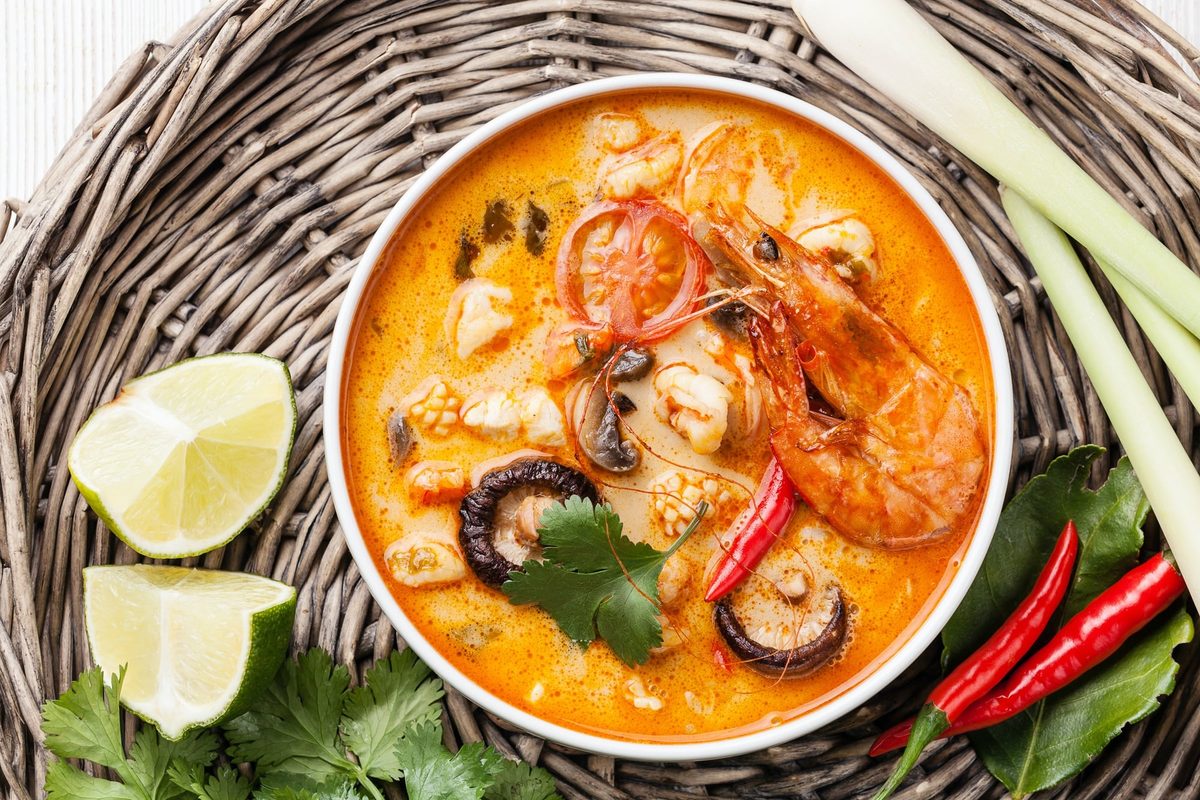
Thai cooking gets most of its character from fresh aromatics rather than dried spices: galangal, lemongrass and makrut lime leaf pounded into curry pastes or simmered in soups, three different basils, cilantro (including the root), and small, very hot chiles. Britannica describes the core paste technique: lemongrass pounded with garlic, makrut lime leaf and other herbs into a thick curry paste.1 Each entry below links to the full profile.
At a glance
| Ingredient | Thai name | What it brings | Typical use |
|---|---|---|---|
| Galangal | kha2 | Strong, pungent, peppery2 | Curry pastes; tom kha3 |
| Lemongrass | Lemon without the acidity1 | Curry pastes; infused and removed1 | |
| Makrut lime leaf | makrut4 | Sharp citrus | Curry pastes, tom yum and coconut soups4 |
| Thai basil | horapha5 | Anise and citrus6 | Curries, stir-fries |
| Holy basil | kaphrao7 | Peppery7 | Phat kaphrao7 |
| Lemon basil | maenglak8 | Lemony | Eaten raw as a side vegetable8 |
| Cilantro | Leaf and root | Leaves as garnish; roots eaten in Thailand9 | |
| Small hot chiles | prik khee nu10 | Heat | Pastes, sauces, stir-fries |
| Fingerroot | krachai11 | Distinctive | Important Thai flavoring12 |
Measured values
1 figure, sourced| Measure | Value | Scope | Source |
|---|---|---|---|
| Heat (pungency), prik khee nu Conventional range | 30,000 to 50,000 Scoville heat units | Thai prik khee nu on Dave DeWitt's heat scale (2008)Not a lab measurement. No source was found for the 130,000 SHU figure sometimes given. | fieryfoodscentral.com |
Each figure is quoted as its source states it, with the samples or standard it applies to. Where sources differ, both are shown; nothing is averaged. All measured values
Galangal
Galangal is the reddish brown rhizome of plants in the Alpinia genus, a ginger relative also sold as Siamese or Thai ginger.13 PROSEA gives its Thai name as kha, describes the taste as strong and pungent, like a mix of pepper and ginger, and names Thailand, Indonesia and India as the main suppliers.2 A tom kha kai recipe from Northern Illinois University’s Southeast Asia site uses six thin slices of young galangal.3 See galangal, galangal vs. ginger and galangal substitutes.
Lemongrass
Britannica describes lemongrass as tasting of rich lemon without the acidity, and says its tough stalks are usually steeped in oils or liquids and then removed.1 In Thailand, Laos and Vietnam it is pounded with garlic and makrut lime leaf into curry pastes.1 See lemongrass, cooking with lemongrass and lemongrass substitutes.
Makrut lime leaves
The leaves of Citrus hystrix are used to season food, PROSEA notes,14 and Thai cooks call the fruit makrut. Many English-language cooks now use that name too, because “kaffir” is a racist slur in South Africa.4 SBS Food reports one Sydney Thai chef bruising the leaves into coconut and tom yum soups and cutting them fine for Panang, green and hor mok curry pastes.4 We found no source for the widely repeated claim that the leaves freeze with no loss of quality. See makrut lime leaves and substitutes.
Three basils
A 2018 study analyzed five basils used as food in Thailand;6 three turn up most often in recipes.
- Horapha (Thai basil) is the Thai name for Ocimum basilicum, which PROSEA calls an important ingredient of Thai cuisine.5 In the study, its oil was dominated by anise and citrus scents.6 See Thai basil.
- Kaphrao (holy or hot basil) is the herb that gives phat kaphrao its name; Andy Ricker describes it as peppery with a distinctive aroma.7 In the study, methyl eugenol was the leading compound in red holy basil oil, followed by beta-caryophyllene.6 See holy basil and Thai basil vs. holy basil.
- Maenglak (lemon basil) is the Thai name PROSEA gives for Ocimum americanum, whose young leaves are eaten raw as a side vegetable.8 See lemon basil.
Cilantro
PROSEA notes that the taproots of the coriander plant are eaten as a vegetable in China and Thailand.9 Using the leaves raw as a garnish and pounding the roots into pastes is common practice. See cilantro and coriander vs. cilantro.
Bird’s eye chiles
“Bird’s eye” is a loose label: Katzer notes it is used for almost any small, pointed, very hot chile.15 Dave DeWitt’s heat scale puts the Thai prik khee nu at 30,000 to 50,000 SHU.10 We found no source for the 130,000 SHU figure sometimes given for Thai chiles. See cayenne pepper and red pepper flakes for other dried chile heat.
Fingerroot
Fingerroot, Boesenbergia rotunda, is called krachai in Thailand.11 Katzer writes that Thai cooking is the only cuisine where it is an important flavoring.12 See fingerroot.
Cassia
Cassia bark appears in some Thai dishes, massaman curry among them; that is common practice. PROSEA lists the Chinese cassia tree as occurring in southern China, Myanmar, Laos and Vietnam.16 We found no source for the claim that cassia is the only cinnamon Thai cooks use. See cassia cinnamon and Ceylon vs. cassia cinnamon.
Ginger
Ginger is used alongside galangal in Thai cooking; that is common practice, and the two are not interchangeable in flavor. See ginger and galangal vs. ginger.
Related pages
- Thai cardamom
- Korean spices, Japanese spices and Indian spices
- Curry paste vs. curry powder
- The master list of herbs and spices
Footnotes
-
Tony Hill, “Lemongrass”, Encyclopaedia Britannica. britannica.com · Reference work ↩ ↩2 ↩3 ↩4 ↩5
-
Alpinia galanga, PROSEA, via Pl@ntUse. uses.plantnet-project.org · Reference work ↩ ↩2 ↩3
-
“Tomkha Kai”, SEAsite, Northern Illinois University. seasite.niu.edu · Reference work ↩ ↩2
-
Lee Tran Lam, “Why people now call this lime by its Thai name”, SBS Food, 2021. sbs.com.au · Publication ↩ ↩2 ↩3 ↩4
-
Ocimum basilicum, PROSEA, via Pl@ntUse. uses.plantnet-project.org · Reference work ↩ ↩2
-
Tangpao, Chung and Sommano, “Aromatic Profiles of Essential Oils from Five Commonly Used Thai Basils”, Foods, 2018. mdpi.com · Peer-reviewed ↩ ↩2 ↩3 ↩4
-
Andy Ricker with J.J. Goode, “Stir-fried chicken with hot basil”, The Splendid Table, from Pok Pok (2013). splendidtable.org · Publication ↩ ↩2 ↩3 ↩4
-
Ocimum americanum, PROSEA, via Pl@ntUse. uses.plantnet-project.org · Reference work ↩ ↩2 ↩3
-
Coriandrum sativum, PROSEA, via Pl@ntUse. uses.plantnet-project.org · Reference work ↩ ↩2
-
Dave DeWitt, “Heat Scale Updated”, Fiery Foods & Barbecue Central, 2008. fieryfoodscentral.com · Publication ↩ ↩2
-
Boesenbergia rotunda, PROSEA, via Pl@ntUse. uses.plantnet-project.org · Reference work ↩ ↩2
-
Gernot Katzer, Fingerroot (Boesenbergia pandurata), Gernot Katzer’s Spice Pages. gernot-katzers-spice-pages.com · Reference work ↩ ↩2
-
Jennifer Murtoff, “Galangal”, Encyclopaedia Britannica. britannica.com · Reference work ↩
-
Citrus hystrix, PROSEA, via Pl@ntUse. uses.plantnet-project.org · Reference work ↩
-
Gernot Katzer, Chiles (Capsicum), Gernot Katzer’s Spice Pages. gernot-katzers-spice-pages.com · Reference work ↩
-
Cinnamomum (cassia species), PROSEA Handbook 13: Spices. prosea.prota4u.org · Reference work ↩