Spice Substitutes · Substitutes
Lemongrass Substitutes, Ranked by the Job Lemongrass Is Doing
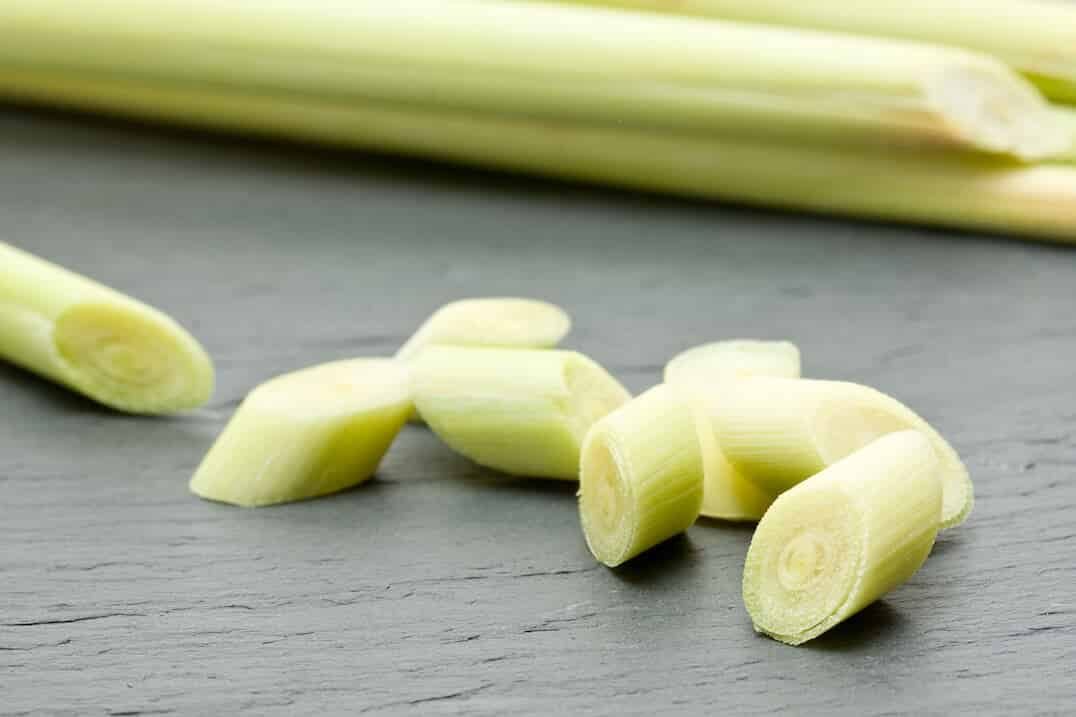
Lemongrass, Cymbopogon citratus, is a tropical grass whose stalks and leaves smell of lemon.12 Britannica describes the flavor as a rich lemon without the acidity,3 and PROSEA names citral, a mix of geranial and neral, as the main constituent of its oil.2 Cooks in Thailand, Laos and Vietnam pound it with garlic, makrut lime leaf and other herbs into curry pastes,3 and in Cambodia it is the backbone of the pastes called kroeung.4 Nothing else has quite its grassy lemon scent, so the best substitute depends on what the lemongrass is doing in the recipe.
Quick answer
| What lemongrass is doing | Best substitute | Starting amount | Treatment |
|---|---|---|---|
| Simmered in a soup, curry or braise, or pounded into a paste | Dried lemongrass | Half as much dried as fresh | Attributed |
| Same job, no lemongrass of any kind | Finely grated lemon zest, plus a torn makrut lime leaf if you have one | 1/2 teaspoon zest per stalk, then taste | Method |
| Raw or barely cooked (salads, stir-fries, marinades) | Finely grated lemon zest, added at the end | 1/2 teaspoon per stalk, then taste | Method |
| Tea and drinks | Lemon verbena | About 1 tablespoon fresh leaves per stalk | Method |
| A Cambodian dish that starts with kroeung | Kroeung paste | About 3 tablespoons per stalk, other aromatics reduced | Method |
How the ratios on this page are labeled
- Computed: based on a measurable physical relationship, with the source named.
- Attributed: a named source publishes this ratio. We quote it as theirs.
- Disputed: named sources give different answers to the same swap. We show each one and do not average them.
- Method: we found no published ratio. We give a direction and a cautious starting point, and say so.
The only tested lemongrass conversion we found is America’s Test Kitchen’s figure for dried lemongrass. Every other amount on this page is a starting point. Stalks vary in size; “one stalk” here means an ordinary supermarket stalk, trimmed to its pale lower part.
If lemongrass is simmered or pounded into a paste
This is lemongrass’s main job: Britannica notes that the fibrous stalks are usually infused, in oil or with other spices, and then removed, while the tender center can be chopped and eaten.3 In a soup, curry or braise there is liquid and time to draw the flavor out, which is when the substitutes below work best.
1. Dried lemongrass
Britannica says that cooks outside Southeast Asia often rely on lemongrass powder and dried stalks.3 America’s Test Kitchen compared fresh and dried lemongrass in a curry paste, a Thai chicken soup and a stir-fry. Fresh had “a bright mix of citrus, floral, and minty notes,” while dried tasted woodsier and less complex.5 Dried was “an acceptable substitute for fresh in the paste and the soup.”5
Ratio (Attributed): ATK used “half as much dried lemon grass as fresh in each recipe.”5 Use dried only where there is “enough liquid for the herb to hydrate and soften,” in ATK’s words.5 In the stir-fry, the dried pieces “retained the texture of hay.”5
2. Lemon zest
Zest gives a clear lemon aroma, and like lemongrass it adds no sourness (kitchen judgment). It lacks the grassy, tea-like side that PROSEA describes in lemongrass oil.2 A widely repeated rule says the zest of one lemon equals two stalks of lemongrass. We found no source for it. NDSU Extension counts 1 to 2 teaspoons of rind from one medium lemon,6 so that rule would mean roughly 1/2 to 1 teaspoon of zest per stalk.
Ratio (Method): No published ratio was found. Start at the low end, 1/2 teaspoon of finely grated zest per stalk, then taste and add more. Zest can turn bitter if overdone, and adding it toward the end of cooking keeps it fresher; both points are kitchen judgment.
3. Makrut lime leaves, with lemon zest
Makrut lime leaves, from the citrus tree Citrus hystrix,7 are lemongrass’s usual partner in Thai curry pastes, not a copy of it.3 Their oil is dominated by citronellal, at 77.7 percent in a 2023 study of Malaysian leaves,8 while lemongrass oil is dominated by citral.2 Both read as citrus, but they smell different, so a leaf is best used alongside zest rather than instead of it. SBS Food reports that one Sydney restaurateur bruises the leaves for coconut and tom yum soups and juliennes them into curry pastes.9
Ratio (Method): No published ratio was found. For each stalk of lemongrass, start with 1/2 teaspoon of lemon zest and one makrut lime leaf, torn or bruised. Remove whole leaves before serving if they are tough (kitchen practice).
4. Lemon myrtle
Lemon myrtle leaf is an unusually concentrated source of citral: its distilled oil is typically 90 to 98 percent citral.10 Gernot Katzer groups it with lemongrass, lemon verbena and lemon balm as the herbs with the purest lemon scent, and notes that Australian cooks use it in place of makrut lime leaves in Southeast Asian recipes.11 He also cautions that it does not go so well with pungent fish pastes,11 which many Southeast Asian curry pastes contain.
Ratio (Method): No published ratio was found. Start with a small pinch of ground dried leaf per stalk, then taste.
5. Kroeung, in Cambodian cooking
Saveur describes kroeung as “an umbrella Khmer term” for a family of spice and herb pastes.4 Its yellow kroeung recipe combines 6 stalks of lemongrass with makrut lime leaves, garlic, shallots, fresh galangal, fresh turmeric and prahok, and makes 1 1/4 cups.4 By that recipe’s proportions, about 3 tablespoons of paste carry one stalk of lemongrass. Store-bought pastes will differ.
Ratio (Method): No published ratio was found. If a Cambodian recipe calls for lemongrass and also for garlic, shallot, galangal or turmeric, use about 3 tablespoons of kroeung per stalk of lemongrass and cut back on those other aromatics. Outside Cambodian dishes, its garlic, prahok and turmeric will be out of place (editorial).
If lemongrass is eaten raw or barely cooked
In salads, quick stir-fries and marinades, the tender center of the stalk is chopped fine and eaten.3 Dried lemongrass does not work here: in ATK’s stir-fry it never softened.5
Lemon zest (Method): No published ratio was found. Use about 1/2 teaspoon of finely grated zest per stalk, added at the end. If the dish also needs sourness, add lime or lemon juice separately; lemongrass itself has no acidity, according to Britannica,3 so juice alone changes the balance of the dish.
If lemongrass is for tea or drinks
Kew notes that lemongrass stems are widely used in teas and other drinks.1
Lemon verbena (Method): Its oil is also led by the two forms of citral, geranial and neral,12 and Penn State Extension says it has “the brightest and most intense lemon scent and flavor” of the lemon herbs.13 No published ratio was found. Start with about 1 tablespoon of fresh leaves per stalk, steep, and taste.
Lemon balm (Method): Its leaf oil is mainly citral, neral and citronellal,14 and it is milder (kitchen judgment). No published ratio was found. Start with about 2 tablespoons of fresh leaves per stalk.
What isn’t known
- No published measurement compares the lemon strength of lemongrass with lemon zest, makrut lime, lemon verbena, lemon balm or lemon myrtle. Apart from ATK’s dried-lemongrass figure, every amount above is a starting point.
- Lemon tree leaves are sometimes suggested in place of lemongrass. In one 2023 analysis, limonene was the major compound of lemon leaf oil, not citral,8 and we found no culinary source for using them as a lemongrass substitute.
- Arugula is sometimes recommended to supply lemongrass’s herbal note. We found no source for this.
- We could not open a maker’s page for ready-made lemongrass paste in tubes, so we have no published conversion for it. Check the label for added oil, salt or sugar.
Related
- Lemongrass, cooking with lemongrass and lemongrass uses
- Lemon verbena vs. lemongrass and lemon balm vs. lemongrass
- Makrut (kaffir) lime leaves, kaffir lime leaves substitutes, lemon myrtle, lemon verbena and lemon balm
- Galangal, galangal substitutes, turmeric and Thai spices
- Lemon verbena substitutes and lemon balm substitutes
Footnotes
-
Cymbopogon citratus (DC.) Stapf, Plants of the World Online, Royal Botanic Gardens, Kew. powo.science.kew.org · Reference work ↩ ↩2
-
L.P.A. Oyen, Cymbopogon citratus, Plant Resources of South-East Asia (PROSEA). uses.plantnet-project.org · Reference work ↩ ↩2 ↩3 ↩4
-
Tony Hill, “Lemongrass”, Encyclopaedia Britannica. britannica.com · Reference work ↩ ↩2 ↩3 ↩4 ↩5 ↩6 ↩7
-
“Khmer Yellow Curry Paste (Kroeung)”, Saveur, 2015. saveur.com · Publication ↩ ↩2 ↩3
-
“Dried vs. Fresh Lemongrass”, America’s Test Kitchen. americastestkitchen.com · Publication ↩ ↩2 ↩3 ↩4 ↩5 ↩6
-
Julie Garden-Robinson, “Ingredient Substitutions” (FN198), NDSU Extension, 2018. ksre.ksu.edu · Reference work ↩
-
Citrus hystrix DC., Plants of the World Online, Royal Botanic Gardens, Kew. powo.science.kew.org · Reference work ↩
-
Al Othman et al., “Phytochemical Composition, Antioxidant and Antiproliferative Activities of Citrus hystrix, Citrus limon, Citrus pyriformis, and Citrus microcarpa Leaf Essential Oils”, Plants, 2023. mdpi.com · Peer-reviewed ↩ ↩2
-
Lee Tran Lam, “Why people now call this lime by its Thai name”, SBS Food, 2021. sbs.com.au · Publication ↩
-
Ian Southwell, “Backhousia citriodora F. Muell. (Lemon Myrtle), an Unrivaled Source of Citral”, Foods, 2021. mdpi.com · Peer-reviewed ↩
-
“Lemon Myrtle (Backhousia citriodora F. Muell.)”, Gernot Katzer’s Spice Pages. gernot-katzers-spice-pages.com · Reference work ↩ ↩2
-
Sprea et al., “Volatile Compounds and Biological Activity of the Essential Oil of Aloysia citrodora Paláu”, Molecules, 2023. mdpi.com · Peer-reviewed ↩
-
Smith and Marquesen, “Lemon-Scented Herbs in the Garden and the Kitchen”, Penn State Extension, 2025. extension.psu.edu · Reference work ↩
-
Assessment report on Melissa officinalis L., folium, European Medicines Agency. ema.europa.eu · Regulator ↩