Spice Substitutes · Substitutes
Kaffir (Makrut) Lime Leaf Substitutes, Ranked by the Job the Leaf Is Doing
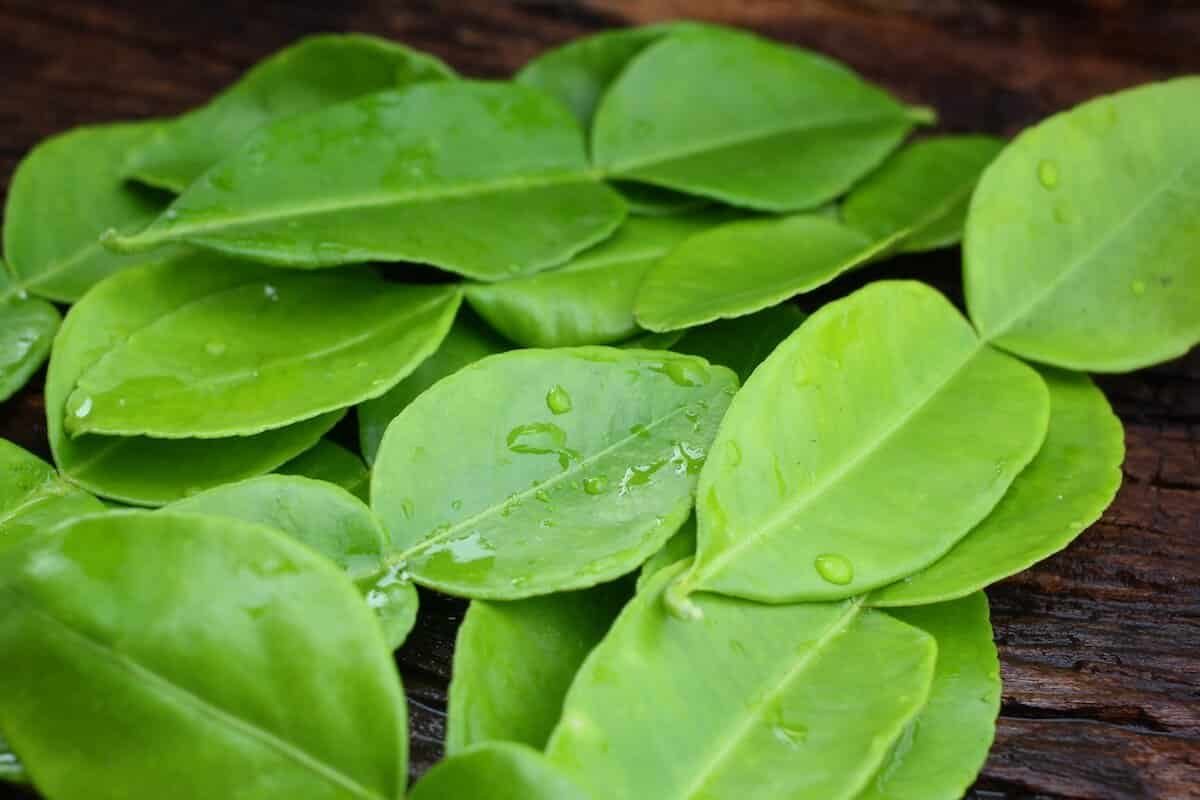
Kaffir lime leaves, now often sold under their Thai name, makrut, are the leaves of Citrus hystrix. Thai cooks pound them into curry pastes and bruise them into soups such as tom yum.12 Their aroma is unusual even among citrus. In a 2023 study of leaf oils from four citrus species, citronellal made up 77.7 percent of the makrut leaf oil, while the oil from lemon leaves was led instead by limonene, at 33.6 percent.3 That is why nothing common in a Western kitchen matches the leaf closely, and why the first step is to look for the leaf itself in another form.
Quick answer
| What the leaf is doing | Best substitute | Starting amount | Treatment |
|---|---|---|---|
| Any job, if you can find them | Frozen or dried makrut leaves | Frozen: same number. Dried: a few more than the recipe calls for | Attributed (direction only) |
| Infusing a soup or curry | Lime zest | Zest of 1/2 lime for 7 to 8 leaves | Attributed |
| Pounded into a curry paste | Lime zest plus a little extra lemongrass | Zest as above; lemongrass to taste | Method |
| Sliced raw into a salad or finished dish | Finely grated lime zest | A little at a time, to taste | Method |
How the ratios on this page are labeled
Every ratio carries one of four labels.
- Computed: based on a measurable physical relationship, with the source named.
- Attributed: a named source publishes this ratio. We quote it as theirs.
- Disputed: named sources give different answers to the same swap. We show each one and do not average them.
- Method: we found no published ratio. We give a direction and a cautious starting point, and say so.
The only published figure we found is one cook’s estimate, given as a guess in reply to a reader’s question. Nobody has measured how much lime zest matches a makrut leaf.
First choice: makrut leaves in another form
Hot Thai Kitchen, the site of Thai cooking teacher Pailin Chongchitnant, says frozen makrut leaves “work perfectly well” and are often sold in the freezer section of stores that carry Southeast Asian groceries.4 Marion’s Kitchen says whole leaves keep in the freezer for up to a year.5 Both sites treat dried leaves as a step down:
- Hot Thai Kitchen calls dried leaves fine but not ideal. They work in soups and curries where they have time to rehydrate, but not in salads, where they stay crunchy.4
- Marion’s Kitchen says dried leaves are less intense and bright than fresh.5
Ratio (Attributed, direction only): Hot Thai Kitchen says to add a few more dried leaves than the recipe calls for and simmer them a few minutes longer; Marion’s Kitchen also says you may want to use more.45 Neither gives a number. Hot Thai Kitchen also suggests grinding dried leaves to a powder in a coffee grinder before adding them.4
If the leaf is infusing a soup or curry
Lime zest
Both Thai-cooking sources name lime zest as the fallback. Hot Thai Kitchen calls it the best substitute when no form of the leaf can be found, while noting that it does not have the same aroma and only gives the same citrusy feel.4 Marion’s Kitchen says nothing will give the intensity of makrut leaves and that you can either leave them out or add some regular lime zest.5
Ratio (Attributed): Asked how much lime zest replaces 7 to 8 leaves, Chongchitnant replied that her guess would be the zest of half a lime, and that she would not add much more because the two don’t taste the same and the dish could turn too “limey.”4 Treat that as one experienced cook’s estimate, not a measured equivalent.
In our judgment, zest is best added toward the end of cooking rather than simmered from the start; taste and add more only if the dish needs it.
If the leaf is pounded into a curry paste
Britannica describes lemongrass, garlic and makrut lime leaf pounded together into the thick curry pastes of mainland Southeast Asia.2 If the leaf is missing, lime zest is still the closest citrus note, and a little more lemongrass can carry some of the lost lemony aroma.
Lemongrass does not bring the same compound. PROSEA names citral, a mixture of geranial and neral, as the main constituent of lemongrass oil,6 while the makrut leaf oil in the 2023 study was dominated by citronellal.3 Both read as “lemony,” but they are different molecules.
Ratio (Method): No published ratio was found. Use the lime zest amount above, then increase the recipe’s lemongrass a little, by up to about a quarter, and taste the paste before frying it. That is a starting point, not a measured equivalence.
If the leaf is sliced raw
In SBS Food’s reporting, restaurateur Palisa Anderson slices makrut leaves finely through a warm salad and always adds them at the end rather than during heating.1 Raw, the leaf’s aroma is front and center, and no substitute will hide the difference.
Ratio (Method): Grate lime zest very finely and add it a pinch at a time to the dressed salad, tasting as you go. No published ratio was found.
Other options
- Lemon myrtle. Gernot Katzer writes that Australian cooks tend to use lemon myrtle leaves instead of kaffir lime leaves in Southeast Asian recipes.7 Its oil is mostly citral (Katzer gives 90 to 95 percent),7 so it is lemony rather than makrut-like. Method: no published ratio; start with a small pinch of the dried, ground leaf per two or three makrut leaves and taste.
- Lemon balm. The European Medicines Agency’s assessment describes lemon balm’s leaf oil as mainly citral, neral and citronellal.8 The EMA names those compounds without percentages, and no study we found compares lemon balm with makrut leaf directly. Method: no published ratio; tear in a few fresh leaves at the end.
- Lemon thyme. University of Florida Extension describes it as adding a citrus overtone to the usual thyme flavor.9 It adds a thyme note the dish doesn’t otherwise have. Method: a sprig in a simmered dish, removed before serving.
What to skip
- Other citrus leaves. Hot Thai Kitchen says ordinary lime leaves and other citrus leaves can’t be used instead because they are not aromatic.4 The chemistry backs up the difference: lemon leaf oil in the 2023 study was led by limonene, not citronellal.3
- Lime juice. Hot Thai Kitchen says regular lime juice can stand in for other lime juices but not for makrut leaves.4 Juice brings sourness, not the leaf’s aroma.
- Curry leaves. Nik Sharma describes their aroma as citrusy, grassy and burnt, sulfur-like.10 In one leaf oil analysis, the main compound was 3-carene (54.2 percent),11 not citronellal. They are a different flavor with their own uses; see curry leaves.
What isn’t known
- No published measurement compares the aroma strength of makrut leaves with lime zest or any other substitute. The only figure on this page is one cook’s estimate.
- How much dried leaf replaces fresh has not been published; both sources say only “more.”
- The 77.7 percent citronellal figure comes from one study’s leaves, collected from orchards in one Malaysian state.3 Leaf oil composition may differ elsewhere.
Related
- Kaffir lime leaves
- Lemongrass, lemongrass substitutes, cooking with lemongrass
- Lemon myrtle, lemon balm, lemon thyme
- Curry leaves, curry paste vs. curry powder
Footnotes
-
Lee Tran Lam, “Why people now call this lime by its Thai name”, SBS Food, 2021. sbs.com.au · Publication ↩ ↩2
-
Tony Hill, “Lemongrass”, Encyclopaedia Britannica. britannica.com · Reference work ↩ ↩2
-
Al Othman et al., “Phytochemical Composition, Antioxidant and Antiproliferative Activities of Citrus hystrix, Citrus limon, Citrus pyriformis, and Citrus microcarpa Leaf Essential Oils against Human Cervical Cancer Cell Line”, Plants, 2023. mdpi.com · Peer-reviewed ↩ ↩2 ↩3 ↩4
-
“Kaffir Lime Leaves 101”, Hot Thai Kitchen (Pailin Chongchitnant). hot-thai-kitchen.com · Publication ↩ ↩2 ↩3 ↩4 ↩5 ↩6 ↩7 ↩8
-
“Makrut lime leaves: the ultimate explainer guide”, Marion’s Kitchen, 2023. marionskitchen.com · Publication ↩ ↩2 ↩3 ↩4
-
L.P.A. Oyen, Cymbopogon citratus, Plant Resources of South-East Asia (PROSEA). uses.plantnet-project.org · Reference work ↩
-
Gernot Katzer, “Lemon Myrtle (Backhousia citriodora)”, Gernot Katzer’s Spice Pages. gernot-katzers-spice-pages.com · Reference work ↩ ↩2
-
Assessment report on Melissa officinalis L., folium, European Medicines Agency. ema.europa.eu · Regulator ↩
-
Busbee, Andrews and Criss, “Lemon Thyme”, University of Florida IFAS Extension, 2024. sfyl.ifas.ufl.edu · Reference work ↩
-
Nik Sharma, “A Guide to Curry Leaves”, Nik Sharma Cooks, 2022. niksharmacooks.com · Publication ↩
-
Chowdhury, Bhuiyan and Yusuf, “Chemical composition of the leaf essential oils of Murraya koenigii and Murraya paniculata”, Bangladesh Journal of Pharmacology, 2008. bdpsjournal.org · Peer-reviewed ↩