Herbs · Profile
Rose Petals: Damask Rose, Rose Water and the Petals in Persian and Middle Eastern Cooking
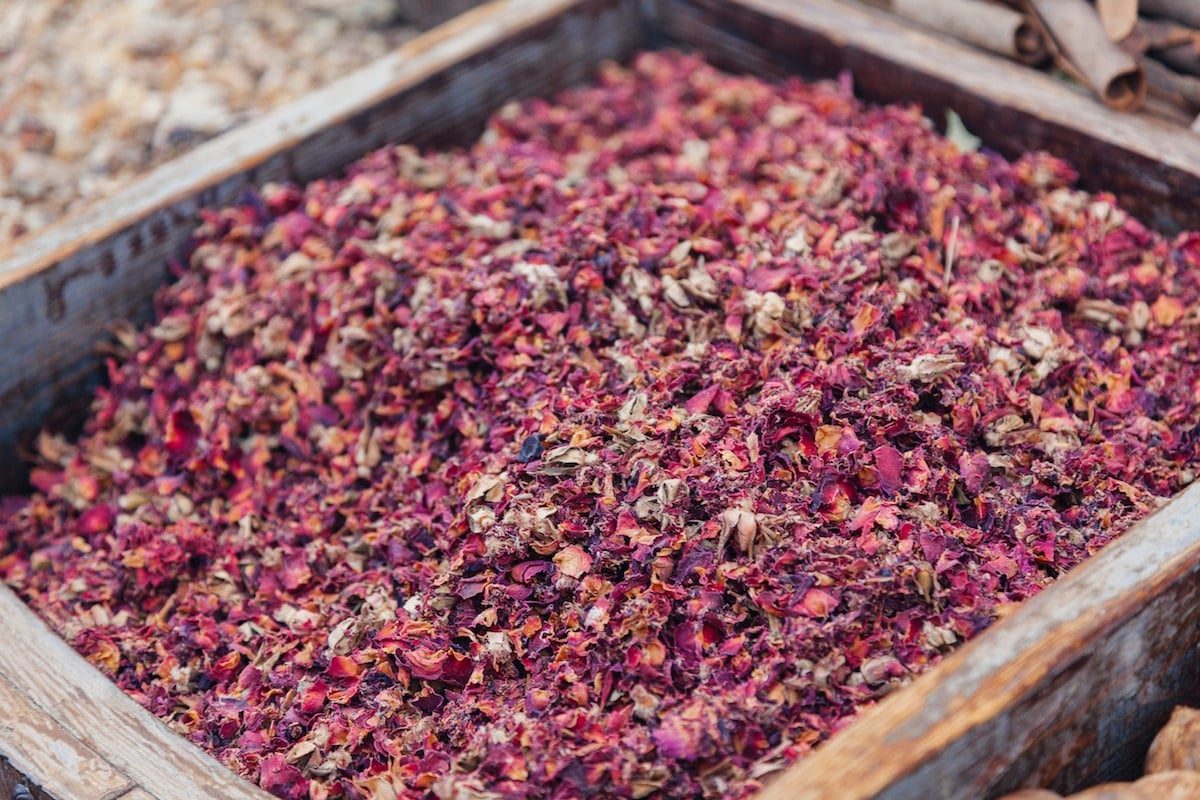
Culinary rose petals are the dried or fresh petals of fragrant roses, above all the damask rose, Rosa × damascena. They bring a sweet, perfumed floral note to Persian spice blends, Moroccan ras el hanout and Middle Eastern sweets, and they are the raw material for rose water. This page covers which roses are used, what is behind the scent, the history that can and cannot be documented, how cooks use the petals, and how to buy roses that are safe to eat.
At a glance
| Main species | Damask rose, Rosa × damascena; also R. gallica, R. centifolia and R. alba for rose products123 |
| Plant family | Rosaceae (rose family)4 |
| Part used | Petals2 |
| Key aroma compounds | Geraniol, citronellol and nerol in rose oil; 2-phenylethanol in rose water2 |
| Main producing areas | Iran (Qamsar, Kashan, Shiraz), Turkey (Isparta), Bulgaria (Kazanlak valley)25 |
| Forms sold | Dried whole buds, dried petals, ground petals, rose water, rose oil |
| US status | Rose buds, flowers and absolute are on FDA’s GRAS list of natural extractives3 |
Measured values
6 figures, sourced| Measure | Value | Scope | Source |
|---|---|---|---|
| Geraniol | up to 75 % of rose oil | Rose oil, per Katzer | gernot-katzers-spice-pages.com |
| Citronellol | around 20 % of rose oil | Rose oil, per Katzer | gernot-katzers-spice-pages.com |
| Nerol | around 20 % of rose oil | Rose oil, per Katzer | gernot-katzers-spice-pages.com |
| Nonadecane and other long-chain hydrocarbons | up to 10 % of rose oil | Rose oil, per Katzer | gernot-katzers-spice-pages.com |
| C13-norisoprenoid (trace) | about 0.01 % of rose oil | Rose oil, per Katzer | gernot-katzers-spice-pages.com |
| Essential oil yield | about 10 g per 100 kg (0.01) % of fresh flowers | Fresh rose flowers, at best, per KatzerKatzer also gives roughly 3,000 to 5,000 kg of flowers per 1 kg of oil. | gernot-katzers-spice-pages.com |
Each figure is quoted as its source states it, with the samples or standard it applies to. Where sources differ, both are shown; nothing is averaged. All measured values
Which roses
Kew treats the damask rose as an artificial hybrid, with the formula R. gallica × R. moschata.1 Katzer describes it as a fertile hybrid of R. gallica with either R. phoenicia or R. moschata, so the second parent is not settled.2 He adds that most European rose varieties descend at least partly from R. gallica, and that the “hundred-leaved” rose, R. centifolia, is most popular in Provence.2
FDA’s list of natural extractives generally recognized as safe covers rose absolute, otto of roses, rose buds, rose flowers and rose hips from Rosa alba, R. centifolia, R. damascena and R. gallica, and rose leaves from any Rosa species.3
Taste depends on the rose. The New York Botanical Garden’s library notes that heirloom species taste best and that dark red varieties can taste too strong.6
Flavor and aroma
Katzer describes the petals as flowery, perfume-like, sweet and very pleasant.2 Tina Wasserman, writing about Persian advieh, says dried rose petals add a light, sweet, floral accent.7 In larger amounts the floral note can tip into soapy or perfumed; that is a cook’s judgment.
The compounds
Rose oil is dominated by alcohols. Katzer gives geraniol at up to 75%, with citronellol and nerol at around 20% each, plus long-chain hydrocarbons such as nonadecane at up to 10%.2 A trace C13-norisoprenoid at about 0.01% has, in his words, notable influence on the quality of the oil.2 Another key compound, 2-phenylethanol, is lost from the oil during steam distillation and collects in the rose water instead.2
The oil is extremely scarce. Katzer says that even at best, 100 kg of fresh flowers give only about 10 g of oil (0.01%), and that roughly 3,000 to 5,000 kg of flowers are needed for 1 kg of rose oil.2
Origin and history
Katzer suspects the damask rose first arose in Anatolia several millennia ago, and says its cultivation later spread to Greece and Rome.2 In Persian cooking, Najmieh Batmanglij’s pantry notes say rose petals and rose water have been used since ancient times, in both savory and sweet dishes.8
Several widely repeated history claims could not be traced to any source we could open: that the Chinese first cultivated roses 5,000 years ago, that roses were used in ancient Egypt, that Romans crowned brides and grooms with roses or added petals to wine to prevent drunkenness, that Persians have cooked with roses for exactly 3,000 years, and that Arab conquest carried Persian rose cookery across the Middle East. They are left out here.
Rose water and production
Rose water is mostly made by distilling fresh flowers of Rosa × damascena, according to a 2024 review, which says it has a long history as a drink and flavoring in Iran and the Persian Gulf countries, though most rose water now goes into cosmetics.5 The review calls Qamsar in Iran the main origin of rose flowers in the world and names Fars (Maymand), Kerman, Isfahan (Kashan) and East Azerbaijan as the provinces with the most land under roses.5 Katzer lists Shiraz and Meshed in Iran, Isparta in Turkey and Bulgaria’s Kazanlak valley as famous production sites, and says far more oil is produced in Turkey and Iran.2
No production statistics for culinary dried petals were found.
How rose petals are used
- Persian advieh. Rose petals appear in many advieh blends. Wasserman’s recipe uses 2 tablespoons of dried rose petals; Batmanglij’s Qazvini blend is used in the wedding dish of rice, lamb, rose petals and barberries.79 See advieh.
- Moroccan ras el hanout. The Oxford Companion to Food lists rosebud (damask rose) among the ingredients usually included, all powdered, and Katzer also counts rose among its many components.102 See ras el hanout.
- Turkish delight. Katzer describes Turkish lokum as a very sweet, rubbery confection with a strong rose fragrance.2
- Rice and sweets. Rose water is often used to give a light floral fragrance to Arabic and Iraqi rice dishes, and many Indian sweets may contain a hint of it.2
- Marzipan and tea. Katzer notes that rose water flavors marzipan, and mentions roses used to produce rose-flavored black tea.2
Dried petals are usually crumbled into blends or scattered over finished rice and desserts, while rose water goes into syrups, pastries and drinks. A little goes a long way; that is kitchen practice rather than a measured rule.
Buying and quality
Buy petals sold for food, from a spice merchant or Middle Eastern or Persian grocer. The NYBG library advises not eating roses that have been sprayed, and not eating flowers from florists or nurseries.6 Good dried petals or buds are fragrant, with color that has not faded to brown; that is kitchen judgment rather than a standard. We found no grading standard for culinary rose petals.
Storage
We found no published shelf-life figure for dried rose petals. The practical test is smell: if the petals no longer smell of rose when crushed, they have faded. Common practice is to keep them in an airtight container away from light and heat, as for other dried herbs.
Safety and health claims
FDA lists rose buds, flowers and absolute as generally recognized as safe for their intended use.3 We found no recall or regulator warning involving culinary rose petals, and no NCCIH summary for rose.
Claims that rose petals are a meaningful source of vitamins A, C, D, E or B3, calcium or potassium, or that they contain antioxidants such as myrcene and quercetin in useful amounts, could not be traced to any composition data. Claims that rose petals treat menstrual pain, infections or bronchitis in traditional Chinese medicine could not be traced either. This page makes no claim that rose petals treat or prevent any condition.
Substitutes and comparisons
Rose water is the closest stand-in for dried petals in sweets and drinks, though it adds liquid; no source gives a tested conversion. See rose petal substitutes for ranked options. Related pages:
- Advieh
- Ras el hanout and ras el hanout substitutes
- Moroccan spices
- Lavender, another floral seasoning
- Saffron and cardamom, frequent partners in Persian and Indian sweets (kitchen judgment)
Footnotes
-
Rosa × damascena Herrm., Plants of the World Online, Royal Botanic Gardens, Kew. powo.science.kew.org · Reference work ↩ ↩2
-
“Rose (Rosa damascena)”, Gernot Katzer’s Spice Pages. gernot-katzers-spice-pages.com · Reference work ↩ ↩2 ↩3 ↩4 ↩5 ↩6 ↩7 ↩8 ↩9 ↩10 ↩11 ↩12 ↩13 ↩14 ↩15 ↩16 ↩17
-
21 CFR 182.20, US Food and Drug Administration, via eCFR. ecfr.gov · Regulator ↩ ↩2 ↩3 ↩4
-
Rosa × damascena Herrm., International Plant Names Index. ipni.org · Reference work ↩
-
Mahboubi and Lu, “Rose water, quality control, and its application”, Journal of Medicinal Plants, 2024. jmp.ir · Peer-reviewed ↩ ↩2 ↩3
-
Anita Finkle, “Which flowers are edible?”, LuEsther T. Mertz Library, New York Botanical Garden, 2021. libanswers.nybg.org · Reference work ↩ ↩2
-
Tina Wasserman, “Persian Advieh Spice Mix”, ReformJudaism.org. reformjudaism.org · Publication ↩ ↩2
-
Susan Low, “Najmieh’s Persian Pantry”, ckbk, 2021. ckbk.com · Publication ↩
-
Najmieh Batmanglij, “Qazvini Four-Spice Advieh”, in Cooking in Iran, 2020, via ckbk. app.ckbk.com · Publication ↩
-
Alan Davidson, “Ras-el-hanout”, The Oxford Companion to Food, via ckbk. app.ckbk.com · Reference work ↩