Cooking · Profile
Moroccan Spices: Cumin, Ginger, Saffron, Cinnamon, Turmeric and the Ras el Hanout Cupboard
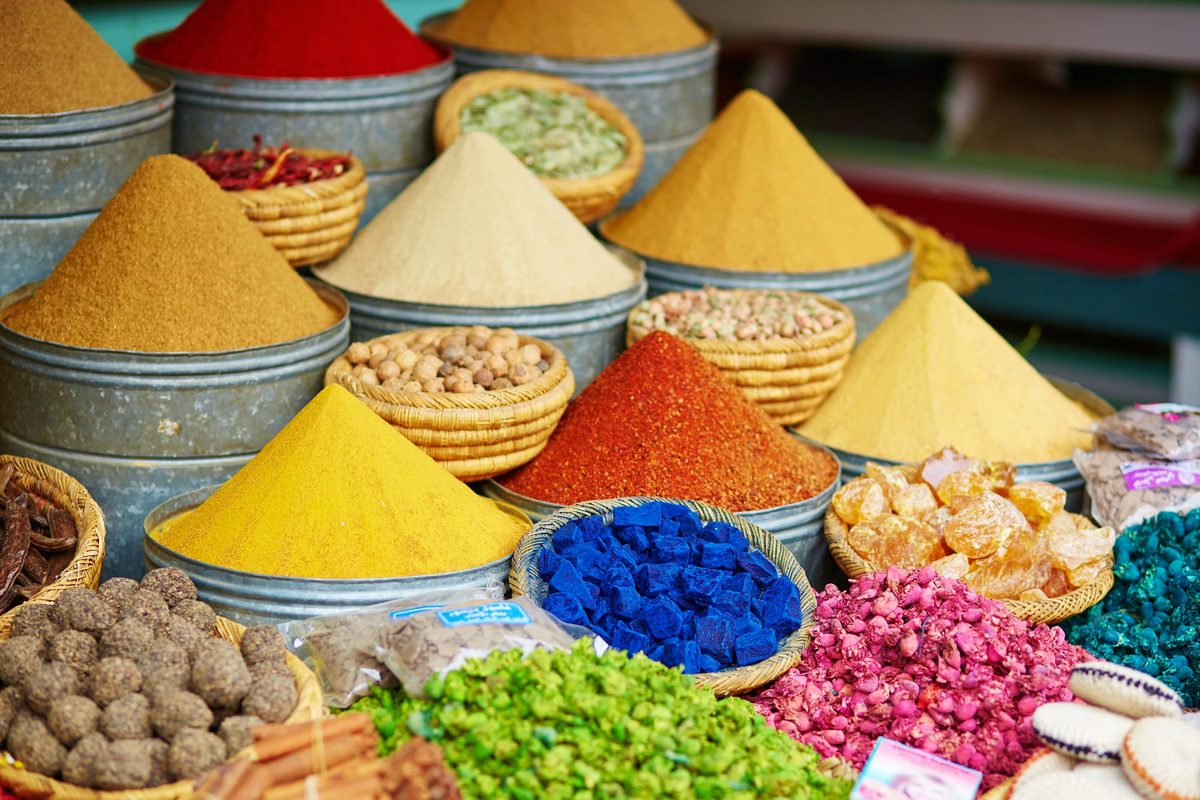
Moroccan cooking uses a wide spice cupboard with a light hand. Food writer Paula Wolfert describes Moroccan cooks using spices to stretch the taste of food without overwhelming its own flavor.1 Cumin, ginger, saffron, cinnamon, turmeric and paprika do most of the everyday work, and the house blend ras el hanout gathers many more. This page covers each, with what the sources say and links to our full profiles.
At a glance
| Spice | What it brings | Where it shows up |
|---|---|---|
| Cumin | Earthy warmth; cuminaldehyde leads its oil2 | Mechoui, carrot salads,1 a table condiment3 |
| Ginger (dried, ground) | Pungent heat from gingerols4 | Ras el hanout,5 tagines (common practice) |
| Saffron | Golden color and aroma | Spice stalls,1 tagines (common practice); grown in Morocco6 |
| Cinnamon | Sweet warmth; cinnamaldehyde leads true cinnamon bark oil7 | Ras el hanout,8 sweet-savory dishes |
| Turmeric | Yellow color from curcumin9 | Ras el hanout5 |
| Paprika | Color and, in hot versions, heat | Carrots with cumin and hot paprika1 |
| Coriander seed | Floral, citrusy; linalool leads its oil10 | Ras el hanout5 |
| Cardamom, nutmeg, mace | Perfume and warmth | Ras el hanout58 |
Measured values
6 figures, sourced| Measure | Value | Scope | Source |
|---|---|---|---|
| Cumin oil: cuminaldehyde | 20 to 72 % of the oil | PROSEA; scope not further statedComponent spice | uses.plantnet-project.org |
| Ceylon cinnamon bark oil: cinnamaldehyde | 49.9 to 62.8 % of the bark oil (about) | systematic reviewComponent spice | link.springer.com |
| Coriander seed oil: terpene alcohols, chiefly linalool | 60 to 80 % of the oil | 2023 review in MoleculesComponent spice | mdpi.com |
| Cardamom oil: 1,8-cineole | 20 to 60 % of the oil | PROSEA; scope not further statedComponent spice | uses.plantnet-project.org |
| Cardamom oil: alpha-terpinyl acetate | 20 to 53 % of the oil | PROSEA; scope not further statedComponent spice | uses.plantnet-project.org |
| Nutmeg oil: aromatic ethers, including myristicin | 2 to 18 % of the oil | PROSEA; scope not further statedComponent spice | uses.plantnet-project.org |
Each figure is quoted as its source states it, with the samples or standard it applies to. Where sources differ, both are shown; nothing is averaged. All measured values
Cumin
Wolfert picks out “the rich, earthy cumin seed” among the spices in Moroccan stalls, and two of her examples of the cuisine are cumin-scented: mechoui, spit-roasted lamb, and carrots with cumin and hot paprika.1 AramcoWorld adds that in Morocco ground cumin often sits on the table in a small dish next to the salt.3 The main compound in cumin oil is cuminaldehyde, which PROSEA puts at 20 to 72% of the oil.2
A claim that cumin is less used in Morocco than elsewhere in the region is not supported by any source we found, and the examples above point the other way. See cumin, cumin uses and too much cumin.
Ginger
Wolfert names “the pungent powdered ginger” in the same breath as cumin and saffron,1 and ginger is one of the six standard ras el hanout ingredients listed by The Oxford Companion to Food.5 Its heat comes from gingerols, non-volatile phenolic compounds, according to PROSEA.4 Fresh ginger has its place too, but the dried, ground form is the one these sources describe. See ginger, cooking with ginger and is ginger spicy?.
Saffron
Saffron is among the first spices Wolfert names in Moroccan markets.1 Morocco also grows it. AHPA’s history of saffron names Iran as the main producer, with 430 tons reported in 2019, and lists Morocco at 2.6 tons, behind Afghanistan at 6 and just ahead of Spain at 2.3; the article gives a year only for the Iran figure.6 We found no price comparison to support the claim that saffron is cheaper in Morocco than in the West.
See saffron, cooking with saffron, saffron uses, why is saffron so expensive? and too much saffron.
Cinnamon
Cinnamon is in Wolfert’s list of market spices1 and in World Spice Merchants’ 24-spice ras el hanout, which uses both Indonesian and true cinnamon.8 In true cinnamon the main aroma compound is cinnamaldehyde, about 49.9 to 62.8% of the bark oil in a systematic review.7 Wolfert writes that the Moroccan pairing of sweet with spicy, and of meat with fruit, recalls Persia and Catalonia;1 cinnamon with lamb and in couscous fits that pattern and is common practice.
See cinnamon, Ceylon cinnamon, cassia, Ceylon vs. cassia and too much cinnamon.
Turmeric
Turmeric is one of the Oxford Companion’s standard ras el hanout spices.5 Its yellow color comes from curcumin, according to NCCIH.9 Its earthy, slightly bitter taste, something like a muted ginger, is our description rather than a sourced one. See turmeric, cooking with turmeric and too much turmeric.
Coriander seed
Coriander seed is another standard ras el hanout ingredient.5 Its oil is 60 to 80% terpene alcohols, chiefly linalool, according to a 2023 review in Molecules.10 See coriander, cooking with coriander and too much coriander.
Cardamom, nutmeg and mace
All three show up in ras el hanout. Cardamom and nutmeg are on the Oxford Companion’s standard list,5 and World Spice Merchants’ blend includes nutmeg and mace.8 Mace is the dried aril, the lacy covering around the nutmeg seed; Britannica describes those arils as the source of the spice.11
- Cardamom. PROSEA gives its oil as mainly 1,8-cineole (20 to 60%) and α-terpinyl acetate (20 to 53%).12 See cardamom and cooking with cardamom.
- Nutmeg. Aromatic ethers, including myristicin, make up 2 to 18% of nutmeg oil, per PROSEA.13 Large amounts of nutmeg are a safety matter; see too much nutmeg. For keeping it, see how to store nutmeg and nutmeg uses.
- Mace. See mace and cooking with mace.
We found no source for how often mace appears in Moroccan dishes on its own, or for the claim that it is mostly kept for “fancy” dishes because of its price.
Ras el hanout
Ras el hanout is the blend that ties the cupboard together. The Oxford Companion says the name means something like “top of the shop,” that it is found in varying forms in Morocco, Algeria and Tunisia, and that its standard ingredients are cumin, coriander seed, turmeric, ginger, cardamom and nutmeg.5 Saveur’s headnote says it is used in virtually every dish from the region.14 Longer versions add rarer spices: Katzer notes that grains of paradise may appear in Moroccan spice mixtures,15 and a 2022 review of cubeb pepper says cubeb is popular in Moroccan savory dishes and pastries such as markouts.16
See ras el hanout, ras el hanout substitutes and ras el hanout vs. garam masala, plus grains of paradise and cubeb pepper.
Spice names
Moroccan spice names are widely repeated in transliterated forms, but we did not find a reference source that sets them out, so they are not listed here.
History
Morocco is often said to have been a stop on an ancient spice road between Asia and Europe, with Andalusian and Berber influences on its spice use. We found no source in this review that documents the spice-route claim. Wolfert’s comparison of Moroccan sweet-and-spicy cooking with Persian and Catalan cooking is one documented observation of outside influence.1
Related pages
- Moroccan mint and spearmint
- Harissa powder, dukkah and za’atar
- Egyptian spices and Ethiopian spices
- Paprika and anise seed
- The master list of herbs and spices
Footnotes
-
Paula Wolfert, “Basics of Moroccan Food”, Saveur, 2007. saveur.com · Publication ↩ ↩2 ↩3 ↩4 ↩5 ↩6 ↩7 ↩8 ↩9 ↩10
-
P.C.M. Jansen, Cuminum cyminum (PROSEA), Plant Resources of South-East Asia. uses.plantnet-project.org · Reference work ↩ ↩2
-
Jeff Koehler, “Spice Migrations: Cumin”, AramcoWorld, 2021. aramcoworld.com · Publication ↩ ↩2
-
H. Sutarno, E.A. Hadad and M. Brink, Zingiber officinale (PROSEA), Plant Resources of South-East Asia. uses.plantnet-project.org · Reference work ↩ ↩2
-
“Ras-el-hanout”, The Oxford Companion to Food, Alan Davidson, Oxford University Press. app.ckbk.com · Reference work ↩ ↩2 ↩3 ↩4 ↩5 ↩6 ↩7 ↩8 ↩9
-
Touwaide and Appetiti, “Herbs in History: Saffron”, American Herbal Products Association, 2022. ahpa.org · Publication ↩ ↩2
-
Ranasinghe et al., “Medicinal properties of ‘true’ cinnamon (Cinnamomum zeylanicum): a systematic review”, BMC Complementary and Alternative Medicine, 2013. link.springer.com · Peer-reviewed ↩ ↩2
-
Ras El Hanout, World Spice Merchants. worldspice.com · Merchant ↩ ↩2 ↩3 ↩4
-
“Turmeric: Usefulness and Safety”, National Center for Complementary and Integrative Health, 2025. nccih.nih.gov · Regulator ↩ ↩2
-
Al-Khayri et al., “Essential Oil from Coriandrum sativum: A Review”, Molecules, 2023. mdpi.com · Peer-reviewed ↩ ↩2
-
“Nutmeg”, Encyclopaedia Britannica. britannica.com · Reference work ↩
-
T.H. Wardini and A. Thomas, Elettaria cardamomum (PROSEA), Plant Resources of South-East Asia. uses.plantnet-project.org · Reference work ↩
-
M. Flach and M. Tjeenk Willink, Myristica fragrans (PROSEA), Plant Resources of South-East Asia. uses.plantnet-project.org · Reference work ↩
-
“Ras el Hanout (North African Spice Mix)”, Saveur, 2012. saveur.com · Publication ↩
-
Gernot Katzer, Grains of Paradise (Aframomum melegueta), Gernot Katzer’s Spice Pages. gernot-katzers-spice-pages.com · Reference work ↩
-
“Cubeb (Piper cubeba L.f.): A comprehensive review”, Frontiers in Nutrition, 2022. frontiersin.org · Peer-reviewed ↩