Spice Substitutes · Substitutes
Sorrel Substitutes: How to Replace Its Sourness and Its Leaves
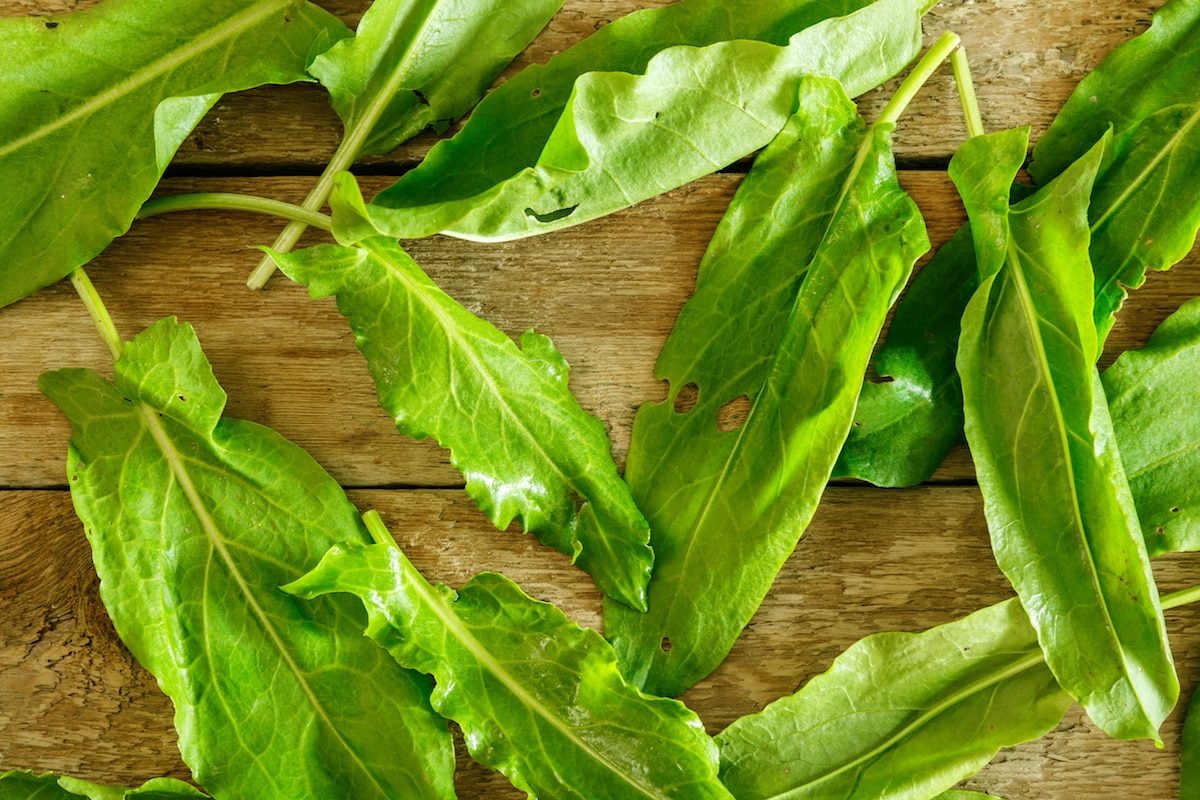
Sorrel is a leafy herb grown for its sourness. Britannica says the sorrels, hardy perennials of the buckwheat family, get their flavor from oxalic acid; garden sorrel, Rumex acetosa, is one of them.12 The forager and food writer Hank Shaw puts it neatly: “it tastes like lemonade in a leaf.”3 No other common green is that sour, so a sorrel substitute is usually two things together: a leaf for body and an acid for the tang.
Quick answer
| What sorrel is doing | Best substitute | Starting amount, per 1 cup sorrel leaves | Treatment |
|---|---|---|---|
| Melting into a sauce for fish or eggs | Spinach plus lemon juice | 1 cup spinach + 1 tsp lemon juice, then taste | Method |
| The base of a creamed or puréed soup | Spinach plus lemon juice | 1 cup spinach + 1 tsp lemon juice, then taste | Method |
| A sour leaf in a salad | Young arugula or spinach, with a lemony dressing | 1 cup | Method |
| Just the sourness | Lemon juice, or sumac to finish | Add a little at a time | Method |
The rest of the page explains each choice and the alternatives.
How the ratios on this page are labeled
Every ratio carries one of four labels.
- Computed: based on a measurable physical relationship, with the source named.
- Attributed: a named source publishes this ratio. We quote it as theirs.
- Disputed: named sources give different answers to the same swap. We show each one and do not average them.
- Method: we found no published ratio. We give a direction and a cautious starting point, and say so.
Every ratio on this page is Method. One cookbook author recommends spinach with lemon juice in place of sorrel but gives no amounts, and we found no published measure of how much acid matches sorrel’s sourness.
What you are replacing
Researchers who measured two cultivars of garden sorrel in New Zealand attribute its sour taste to its high oxalate content.4 They found 273.0 to 953.8 mg of total oxalate per 100 g in the leaves, with more in larger, more mature leaves than in smaller ones.4 So sorrel’s sharpness varies from bunch to bunch, and a substitute amount can only ever be a starting point.
Cooked, sorrel changes completely. Shaw notes that it “will cook down a lot and turn Army green” as it melts.3 That melting is why it suits sauces and soups, and it is one way a substitute will differ: in our judgment, spinach softens but keeps more of its shape and color.
If sorrel is melting into a sauce
Britannica lists sauces and omelets among sorrel’s main uses.1 A sorrel sauce is typically leaves stirred into butter or cream until they collapse, served with fish or eggs; that is common practice.
1. Spinach plus lemon juice
The recipe writer Katie Webster says that if you can’t find sorrel, you can substitute spinach and a little lemon juice, noting that fresh spinach can also taste acidic.5 The spinach supplies the green leaf and soft texture; the lemon supplies the sourness.
The acid is different. Sorrel’s sourness is attributed to oxalate,4 and spinach contains only small amounts of oxalic acid, according to NDSU Extension.6 Lemon juice makes up the difference in sourness, not in chemistry.
Ratio (Method): Webster gives no amounts.5 Start with an equal volume of spinach leaves, and about 1 teaspoon of lemon juice per cup of leaves, added at the end. Taste, then add more lemon a few drops at a time. These figures are our starting point, not a measured match.
2. Spinach plus lemon zest
Ratio (Method): If the sauce is rich with cream or butter, grated lemon zest adds a bright, sour-smelling note with less liquid. Start with about 1/2 teaspoon of zest per cup of spinach, alongside a smaller squeeze of juice. This is our judgment, not a sourced figure.
If sorrel is the base of a soup
Britannica names sorrel as the main ingredient of creamed sorrel soup.1 The same spinach-plus-acid approach works here, with the acid added after cooking so its brightness isn’t dulled; that is kitchen judgment.
Ratio (Method): No published ratio was found. Use an equal volume of spinach and start with about 1 teaspoon of lemon juice per cup of leaves, then adjust once the soup is seasoned.
Rhubarb, for a tart note
Rhubarb stalks add tartness, and NDSU Extension describes rhubarb as bringing “lots of tart flavor” to recipes.6 It is not the same acid as sorrel’s, though. NDSU says the stalks naturally contain only a very small amount of oxalic acid, while the leaves hold it in abundance.6 Use the stalks only: NDSU’s advice is to remove and discard the leaves and not eat them.6
Ratio (Method): No published ratio was found. Add a few thin slices of rhubarb stalk to the soup with the greens, simmer until soft, purée, and taste. Rhubarb has no leafy body, so use it alongside spinach rather than in place of all the sorrel.
If sorrel is a sour leaf in a salad
Young sorrel leaves go into salads and are used as a garnish.1 For a raw salad, you want a leaf with some bite.
1. Young arugula
Britannica describes arugula, a member of the mustard family, as having a “peppery, nutty taste,” and notes that the young leaves are often eaten raw.7 It gives a salad the punch sorrel would, but as pepperiness, not sourness. Choose young leaves: Britannica says the leaves become increasingly bitter as the season goes on and are generally unpalatable once the plant bolts.7
Ratio (Method): No published ratio was found. Use the same amount of leaves and make the dressing more lemony than usual.
2. Baby spinach
Mild and tender; it needs the dressing to provide all the sourness, per Webster’s spinach-and-lemon approach.5
Ratio (Method): No published ratio was found. Use the same amount of leaves, with a sharp lemon or vinegar dressing.
If you only need the sourness
Lemon juice
The simplest fix where the leaf itself doesn’t matter, such as a sauce that will be strained or a dish where sorrel is a minor note. Add it at the end and taste as you go.
Sumac
Sumac adds sourness without liquid. A 2021 review reports that malic acid accounts for its sour taste,8 and Katzer describes it as tart and sour with slightly astringent overtones.9 He notes it is sprinkled over rice,9 and the 2021 review notes it is served with minced meat to add a lemony taste.8 Use it as a finishing sprinkle on eggs, fish or a salad. It adds a dark red color, not green.
Ratio (Method): No published ratio was found. Start with about 1/4 teaspoon of ground sumac per serving, sprinkled on at the end, and add more to taste.
Substitutes that work less well
| Substitute | Why it falls short |
|---|---|
| Mustard greens | Assertive and peppery when raw, and tougher than sorrel when mature; it adds bite, not sourness. That description is ours. |
| Rhubarb on its own | Tart, but no leafy body, and only a very small amount of oxalic acid in the stalks.6 Never use the leaves.6 |
| Vinegar on its own | Gives sourness, but sharper and with its own aroma; in our judgment lemon is closer to sorrel’s fresh tang. |
What isn’t known
- No published source gives an amount of spinach, lemon juice or any other substitute that matches a quantity of sorrel.
- Sorrel’s sourness varies with the leaf: in one study, larger, more mature leaves carried more oxalate.4 Taste your substitute against the dish, not against a fixed figure.
- Claims that sorrel soup was a popular dish in the colonial era could not be traced to a source we could open.
Related
- Sorrel
- Sumac, sumac substitutes, cooking with sumac, sumac uses
- Lemon thyme substitutes, lemon balm substitutes
- Dried herbs vs. fresh, the master list of herbs and spices
Footnotes
-
“Sorrel”, Encyclopaedia Britannica. britannica.com · Reference work ↩ ↩2 ↩3 ↩4
-
Rumex acetosa L., Plants of the World Online, Royal Botanic Gardens, Kew. powo.science.kew.org · Reference work ↩
-
Hank Shaw, “Sorrel Sauce”, Hunter Angler Gardener Cook, 2014. honest-food.net · Publication ↩ ↩2
-
Tuazon-Nartea and Savage, “Investigation of Oxalate Levels in Sorrel Plant Parts and Sorrel-Based Products”, Food and Nutrition Sciences, 2013. researcharchive.lincoln.ac.nz · Peer-reviewed ↩ ↩2 ↩3 ↩4
-
Katie Webster, “Sorrel Pesto”, Healthy Seasonal Recipes, 2011 (updated 2023). healthyseasonalrecipes.com · Publication ↩ ↩2 ↩3
-
Julie Garden-Robinson, “Prairie Fare: Can Rhubarb Become Toxic?”, NDSU Extension, 2015. ag.ndsu.edu · Reference work ↩ ↩2 ↩3 ↩4 ↩5 ↩6
-
“Arugula”, Encyclopaedia Britannica. britannica.com · Reference work ↩ ↩2
-
Alsamri et al., “Pharmacological and Antioxidant Activities of Rhus coriaria L. (Sumac)”, Antioxidants, 2021. mdpi.com · Peer-reviewed ↩ ↩2
-
Gernot Katzer, “Sumac (Rhus coriaria L.)”, Gernot Katzer’s Spice Pages. gernot-katzers-spice-pages.com · Reference work ↩ ↩2