Spice Substitutes · Substitutes
Lemon Thyme Substitutes, Ranked by the Job Lemon Thyme Is Doing
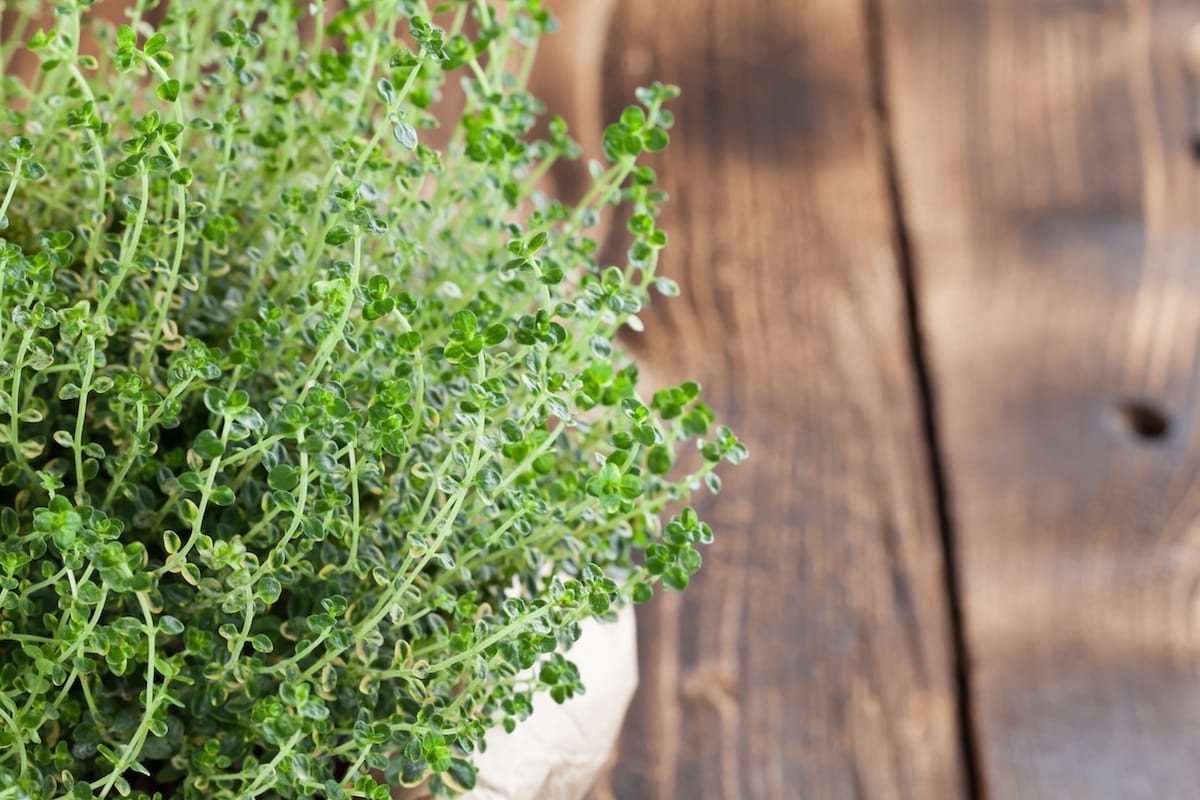
Lemon thyme, Thymus × citriodorus, is a small mint-family thyme that Kew lists as a hybrid of T. pulegioides and common thyme, T. vulgaris.12 Penn State Extension describes it as having “a distinct thyme flavor with just overtones of lemon.”3 That two-part flavor is the key to replacing it: you either rebuild both parts, thyme and lemon, or you pick the part your dish actually needs.
Quick answer
| What lemon thyme is doing | Best substitute | Starting amount, per 1 part fresh lemon thyme | Treatment |
|---|---|---|---|
| Thyme and lemon together in savory food (chicken, fish, vegetables, marinades) | Common thyme plus finely grated lemon zest | 3/4 part fresh thyme plus 1/4 part zest | Method |
| Same job, but you only have dried thyme | Dried common thyme plus lemon zest | 1/4 part dried thyme plus 1/4 part zest | Computed (thyme) and Method (zest) |
| Lemon is the main point (sweets, drinks, light sauces) | Lemon balm or lemon verbena | 1 part lemon balm, or 1/2 part lemon verbena | Method |
| You have dried lemon thyme, not fresh | Dried lemon thyme | 1 teaspoon dried per 1 tablespoon fresh | Computed |
How the ratios on this page are labeled
- Computed: based on a measurable physical relationship, with the source named.
- Attributed: a named source publishes this ratio. We quote it as theirs.
- Disputed: named sources give different answers to the same swap. We show each one and do not average them.
- Method: we found no published ratio. We give a direction and a cautious starting point, and say so.
We found no published ratio for replacing lemon thyme with anything. The fresh-to-dried figures are general herb conversions from extension services; everything else is a starting point.
If lemon thyme is seasoning a savory dish
Penn State suggests lemon thyme in a marinade for chicken and in a butter for grilled fish,3 and NC State Extension notes that the leaves and flowers can be eaten raw in salads or cooked.2 This is where lemon thyme is most often used, and where a homemade version works best.
1. Common thyme plus lemon zest
Lemon thyme shares a parent with common thyme,1 and UF/IFAS Extension describes its flavor as the usual thyme flavor with a citrus overtone.4 Rebuilding that from common thyme and lemon is the obvious route. World Spice Merchants, which sells dried lemon thyme, describes its product as a stand-in for recipes that call for both thyme and lemon zest.5 Here the logic runs the other way.
The thyme half will not be an exact match. Common thyme oil is characterized by thymol and carvacrol,6 and one 2023 analysis of T. vulgaris oil found 42.44 percent thymol.7 Lemon thyme oil is less consistent. One study describes it as a natural source of geraniol and citral,8 while a Turkish study found its oil led instead by terpinolene, α-terpineol, linalool, bornyl acetate and borneol.9 Tasting Table’s Emery Pearson notes that lemon thyme has less bitterness than common thyme,10 so use a little less common thyme than the lemon thyme called for.
Ratio (Method): No published ratio was found. For each teaspoon of fresh lemon thyme leaves, start with 3/4 teaspoon of fresh common thyme leaves and 1/4 teaspoon of finely grated lemon zest, then taste. For scale, NDSU Extension counts 1 to 2 teaspoons of rind from one medium lemon.11 Add the zest near the end if the dish cooks for a long time; that is kitchen judgment, as no source we found measures how zest holds up to heat.
With dried thyme (Computed): NDSU and Penn State Extension both convert 1 tablespoon of fresh herbs to 1 teaspoon dried,1112 and America’s Test Kitchen found that 1 part dried herb to 3 parts fresh came closest to equal flavor.13 ATK also found that dried thyme fared reasonably well in dishes cooked for more than 20 minutes with a good amount of liquid.13 So the 3/4 teaspoon of fresh thyme above becomes 1/4 teaspoon of dried. Keep the zest the same.
With ground thyme (Disputed):
| Source | 1 tablespoon fresh herbs equals |
|---|---|
| NDSU Extension | 1/2 teaspoon ground herbs11 |
| Penn State Extension | 1/4 teaspoon powdered herb12 |
The two disagree by a factor of two, and neither says how its figure was reached. Start with the lower Penn State figure, a pinch for each teaspoon of fresh lemon thyme, and add more after tasting.
2. Lemongrass, in Southeast Asian-style dishes
Lemongrass gives lemon without thyme. Its oil is led by citral,14 and Britannica describes its flavor as a rich lemon without the acidity.15 The stalks are fibrous, so they are usually infused and removed, while the tender center can be chopped finely.15 It suits a marinade or a broth, not a classic roast chicken with thyme (editorial).
Ratio (Method): No published ratio was found. Start with about 1 teaspoon of finely chopped tender lemongrass for each teaspoon of lemon thyme leaves, and add a pinch of common thyme if the dish needs the herbal note.
If lemon is the main point
In sweets, drinks and delicate sauces, the lemon side of lemon thyme matters more than the thyme. UF/IFAS even suggests lemon thyme for any recipe calling for lemon juice, lemon zest or lemon flavoring.4 Penn State’s lemon thyme recipes include a cobbler.3
1. Lemon balm
Lemon balm is another mint-family herb with lemon-scented leaves.16 Its oil is mainly citral, neral and citronellal.17 It has no thyme flavor at all, so it fits desserts, fruit and drinks better than a roast.
Ratio (Method): No published ratio was found. Start with the same amount as the lemon thyme called for, then taste.
2. Lemon verbena
Lemon verbena, Aloysia citrodora, is a South American shrub in the verbena family,18 with an oil led by the two forms of citral, geranial and neral.19 Penn State says its leaves have “the brightest and most intense lemon scent and flavor” of the lemon herbs.3 The leaves are tough, so chop them very fine or infuse them and take them out (kitchen practice).
Ratio (Method): No published ratio was found. Start with half as much lemon verbena as lemon thyme, then taste.
3. Lemon basil
Citral was the predominant compound in all the lemon-scented basils in one Purdue comparison of commercial cultivars.20 Basil is a delicate herb that LSU AgCenter recommends adding near the end of cooking,21 so use lemon basil raw or at the last minute.
Ratio (Method): No published ratio was found. Start with the same amount, torn or chopped, and taste.
If you have dried lemon thyme instead of fresh
Fresh to dried (Computed): Use the general herb conversion of 1 tablespoon fresh to 1 teaspoon dried.1112 Penn State notes that lemon thyme dries easily and “retains its flavor quite well.”3
What isn’t known
- No published measurement compares the strength of lemon thyme with common thyme, lemon zest or any other substitute. The Method amounts above are starting points.
- The two studies of lemon thyme oil we could open found very different main compounds,89 so lemon thyme bought in one place may taste different from another.
- It is sometimes said that lemon thyme and lemon verbena both hold their flavor through long cooking. We found no source for either.
Related
- Lemon thyme, thyme vs. lemon thyme and lemon thyme uses
- Thyme, fresh thyme vs. dried, thyme substitutes and too much thyme
- Lemon balm, lemon verbena, lemongrass and lemon basil
- Lemon balm substitutes, lemon verbena substitutes and lemongrass substitutes
- Dried vs. fresh herbs
Footnotes
-
Thymus × citriodorus (Pers.) Schreb., Plants of the World Online, Royal Botanic Gardens, Kew. powo.science.kew.org · Reference work ↩ ↩2
-
Thymus citriodorus (Lemon Thyme), North Carolina Extension Gardener Plant Toolbox, NC State University. plants.ces.ncsu.edu · Reference work ↩ ↩2
-
Smith and Marquesen, “Lemon-Scented Herbs in the Garden and the Kitchen”, Penn State Extension, 2025. extension.psu.edu · Reference work ↩ ↩2 ↩3 ↩4 ↩5
-
Busbee, Andrews and Criss, “Lemon Thyme”, UF/IFAS Extension, 2024. sfyl.ifas.ufl.edu · Reference work ↩ ↩2
-
“Lemon Thyme”, World Spice Merchants. worldspice.com · Merchant ↩
-
S.H. Widodo, Thymus vulgaris, Plant Resources of South-East Asia (PROSEA). uses.plantnet-project.org · Reference work ↩
-
Dong et al., “Chemical Compositions of Essential Oil Extracted from Eight Thyme Species and Potential Biological Functions”, Plants, 2023. mdpi.com · Peer-reviewed ↩
-
Jurevičiūtė et al., “Composition of essential oil of lemon thyme (Thymus × citriodorus) at different hydrodistillation times”, Natural Product Research, 2019. iris.unipa.it · Peer-reviewed ↩ ↩2
-
Toncer et al., “Essential Oil Composition of Thymus x citriodorus (Pers.) Schreb. at Different Harvest Stages”, Notulae Botanicae Horti Agrobotanici Cluj-Napoca, 2017. acikerisim.dicle.edu.tr · Peer-reviewed ↩ ↩2
-
Emery Pearson, “What To Know When Cooking With Lemon Thyme”, Tasting Table, 2024. tastingtable.com · Publication ↩
-
Julie Garden-Robinson, “Ingredient Substitutions” (FN198), NDSU Extension, 2018. ksre.ksu.edu · Reference work ↩ ↩2 ↩3 ↩4
-
“Preserving Herbs by Drying”, Penn State Extension. extension.psu.edu · Reference work ↩ ↩2 ↩3
-
“Science: Substituting Dried Herbs for Fresh”, America’s Test Kitchen. americastestkitchen.com · Publication ↩ ↩2
-
L.P.A. Oyen, Cymbopogon citratus, Plant Resources of South-East Asia (PROSEA). uses.plantnet-project.org · Reference work ↩
-
Tony Hill, “Lemongrass”, Encyclopaedia Britannica. britannica.com · Reference work ↩ ↩2
-
Melissa Petruzzello, “Lemon balm”, Encyclopaedia Britannica. britannica.com · Reference work ↩
-
Assessment report on Melissa officinalis L., folium, European Medicines Agency. ema.europa.eu · Regulator ↩
-
Aloysia citrodora Paláu, Plants of the World Online, Royal Botanic Gardens, Kew. powo.science.kew.org · Reference work ↩
-
Sprea et al., “Volatile Compounds and Biological Activity of the Essential Oil of Aloysia citrodora Paláu”, Molecules, 2023. mdpi.com · Peer-reviewed ↩
-
“Comparative evaluation of North American commercially available Ocimum basil cultivars”, Perspectives on New Crops and New Uses, Purdue University, 1999. hort.purdue.edu · Peer-reviewed ↩
-
“Flavorful Herbs”, LSU AgCenter. lsuagcenter.com · Reference work ↩