Spice Substitutes · Substitutes
Lemon Balm Substitutes, Ranked by the Job Lemon Balm Is Doing
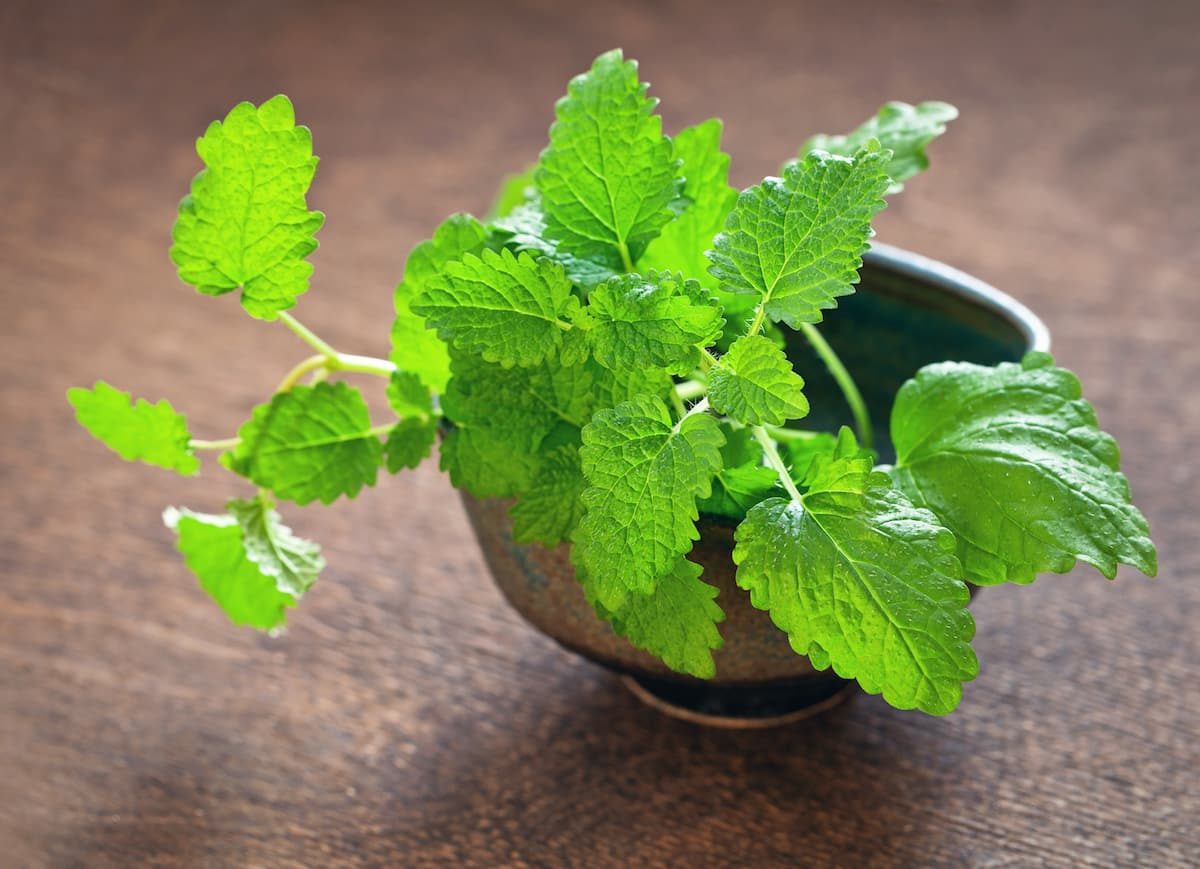
Lemon balm, Melissa officinalis, is a mint-family herb grown for its lemon-scented leaves.12 Its scent comes from a small amount of oil, 0.06 to 0.8 percent of the leaf, made up mainly of citral, neral and citronellal.3 Citral is itself a pair of compounds, geranial and neral, and it is the same pair behind lemongrass and lemon verbena.45 That shared chemistry is why the other lemon herbs are the best stand-ins. The right one depends on whether lemon balm is going into a cup of tea, a fruit salad or a pot of soup.
Quick answer
| What lemon balm is doing | Best substitute | Starting amount, per 1 part lemon balm | Treatment |
|---|---|---|---|
| Herbal tea or a sweet infusion | Lemon verbena | 1 part (same volume) in a mixed tea blend | Attributed |
| Fresh lemon note in salads, fruit and cold sauces | Finely grated lemon zest with a little fresh mint | 1/4 part zest plus 1/2 part mint | Method |
| Lemon note in cooked savory dishes | Lemon thyme | 1/2 part, then taste | Method |
| You have dried lemon balm, not fresh | Dried lemon balm | 1 teaspoon dried per 1 tablespoon fresh | Computed |
How the ratios on this page are labeled
- Computed: based on a measurable physical relationship, with the source named.
- Attributed: a named source publishes this ratio. We quote it as theirs.
- Disputed: named sources give different answers to the same swap. We show each one and do not average them.
- Method: we found no published ratio. We give a direction and a cautious starting point, and say so.
We found only one published ratio involving lemon balm and another herb, and it comes from a single tea recipe. The rest are starting points, not measured equivalences.
If lemon balm is going into tea or a sweet infusion
Britannica lists herbal teas, fruit drinks, liqueurs and wine among lemon balm’s uses,2 and Penn State Extension notes that its leaves flavor teas, infusions and iced water.6 Here you want a lemon scent that steeps well.
1. Lemon verbena
Lemon verbena, Aloysia citrodora, is not a close relative. It belongs to the verbena family, while lemon balm is in the mint family.71 The overlap is in the oil: in a 2023 study, geranial and neral were the major compounds of lemon verbena oil,5 and those are the two halves of the citral that dominates lemon balm oil.3 One analysis of an Algerian lemon balm oil found 45.06 percent geranial and 31.72 percent neral.8
Lemon verbena is the stronger of the two. Penn State says its leaves “have the brightest and most intense lemon scent and flavor” of the lemon herbs.6 It lacks lemon balm’s soft green, faintly minty background, which is our tasting note.
Ratio (Attributed): The Herb Society of America’s Sunshine Tea blend calls for 2 tablespoons of lemon verbena “or substitute lemon balm,” mixed with chamomile, green tea and lavender.9 That treats the two as interchangeable by volume in a mixed blend. If lemon verbena will be the only flavor in the cup, start with half the volume, since Penn State rates it more intense; that adjustment is our judgment, not a published figure.
2. Lemongrass
Lemongrass oil is also led by citral,4 and Kew notes that the stems are widely used in teas and other drinks.10 Its scent is grassier: PROSEA describes the oil as fresh-grassy, lemon-like and tea-like.4 Bruise or slice the stalk so it releases its flavor into the water.
Ratio (Method): No published ratio was found. Start with a 2- to 3-inch piece of fresh stalk, sliced, for each tablespoon of fresh lemon balm leaves, steep, and taste.
3. Lemon myrtle
Lemon myrtle, the leaf of an Australian tree, is an unusually rich source of citral: its distilled oil is typically 90 to 98 percent citral.11 Gernot Katzer groups it with lemon verbena, lemon balm and lemongrass as the herbs with the purest lemon scent.12 It is much more concentrated than lemon balm.
Ratio (Method): No published ratio was found. Start with about a quarter of the lemon balm volume and taste.
A note on the calming reputation
Lemon balm tea is often drunk to relax. The European Medicines Agency accepts lemon balm leaf as a traditional herbal medicine for mild stress and to aid sleep, based on long-standing use, and concludes that the evidence does not establish its efficacy.133 The same agency gives lemon verbena leaf the same kind of traditional-use status for mild stress and sleep.14 For lemongrass, Memorial Sloan Kettering reports that in clinical studies lemongrass tea did not lower anxiety or have a calming effect.15 None of these substitutes, and not lemon balm itself, has been shown to treat anxiety or insomnia.
If lemon balm is a fresh lemon note in salads, fruit and cold dishes
In salads and raw dishes,2 lemon balm gives lemon scent without the fruit’s sourness. Two pantry ingredients can rebuild that together.
1. Lemon zest plus fresh mint
Zest supplies the lemon aroma and mint the green, cool background. In cooking, “mint” usually means spearmint or peppermint;16 spearmint is rich in carvone, while peppermint is led by menthol and menthone.17 Spearmint is the gentler choice here (editorial). Add both at the end: LSU AgCenter groups mint with the delicate herbs and says prolonged heat costs flavor and aroma.18
Ratio (Method): No published ratio was found. For each tablespoon of chopped fresh lemon balm, start with about 3/4 teaspoon of finely grated lemon zest and 1 1/2 teaspoons of chopped fresh mint, then taste. For scale, NDSU Extension counts 1 to 2 teaspoons of rind from one medium lemon.19
2. Lemon verbena, chopped very fine
Ratio (Method): No published ratio was found. Start with half the volume, because Penn State rates verbena more intense,6 and chop the leaves finely or use only the most tender ones (kitchen judgment).
If lemon balm is seasoning a cooked savory dish
Britannica lists soups, sauces and stuffings among lemon balm’s uses.2 Its scent fades with long cooking, which is common kitchen experience rather than a measured finding, so in cooked dishes a sturdier herb may serve better.
1. Lemon thyme
Penn State describes lemon thyme as having “a distinct thyme flavor with just overtones of lemon,”6 and UF/IFAS Extension says it adds a citrus overtone to the usual thyme flavor.20 It suits chicken, fish and stuffings, but its thyme character makes it a poor fit for desserts and tea (editorial).
Ratio (Method): No published ratio was found. Start with half as much lemon thyme as lemon balm, then taste.
2. Lemongrass
Lemongrass gives a rich lemon flavor without acidity, according to Britannica, which also notes that the fibrous stalks are usually infused and removed, while the tender center of the stalk can be chopped and eaten.21 Use it in soups, broths and sauces where a piece can simmer and come out.
Ratio (Method): No published ratio was found. Start with one 2- to 3-inch piece of bruised stalk per tablespoon of fresh lemon balm, simmer, taste and remove.
3. Makrut lime leaves
Makrut lime leaf oil is dominated by citronellal, 77.7 percent in a 2023 study of Malaysian leaves.22 Lemon balm oil contains citronellal too, though far less of it: 6.42 percent in the Algerian sample.8 The leaves taste of lime more than lemon (editorial) and suit Southeast Asian soups and curries better than European dishes. Kew gives the native range of the tree as the eastern Himalaya to Yunnan and northern Guangxi in China.23
Ratio (Method): No published ratio was found. Start with one leaf, torn, per tablespoon of fresh lemon balm, and remove it before serving.
Fresh or dried lemon balm
Fresh to dried (Computed): NDSU and Penn State Extension both give the general herb rule of 1 tablespoon fresh to 1 teaspoon dried.1924 The rule is generic, not measured for lemon balm. In America’s Test Kitchen’s tests of dried herbs, tasters preferred fresh herbs in all but one application,25 so expect dried lemon balm to taste flatter than fresh.
What isn’t known
- No published measurement compares the lemon strength of lemon balm with lemon verbena, lemongrass, lemon thyme or lemon myrtle. The amounts above, apart from the Herb Society’s tea recipe, are starting points.
- No source gives a ratio of lemon zest or mint for lemon balm.
- It is sometimes said that makrut lime leaves are never used in tea or desserts, or that lemon thyme is never used for tea. We found no source either way.
Related
- Lemon balm, lemon balm vs. lemon verbena, lemon balm vs. lemongrass and lemon balm vs. mint
- Lemon verbena, lemongrass, lemon thyme, lemon myrtle, kaffir lime leaves, mint and spearmint
- Lemon verbena substitutes, lemongrass substitutes, lemon thyme substitutes and mint substitutes
- Dried vs. fresh herbs and cooking with mint
Footnotes
-
Melissa officinalis L., Plants of the World Online, Royal Botanic Gardens, Kew. powo.science.kew.org · Reference work ↩ ↩2
-
Melissa Petruzzello, “Lemon balm”, Encyclopaedia Britannica. britannica.com · Reference work ↩ ↩2 ↩3 ↩4
-
Assessment report on Melissa officinalis L., folium, European Medicines Agency. ema.europa.eu · Regulator ↩ ↩2 ↩3
-
L.P.A. Oyen, Cymbopogon citratus, Plant Resources of South-East Asia (PROSEA). uses.plantnet-project.org · Reference work ↩ ↩2 ↩3
-
Sprea et al., “Volatile Compounds and Biological Activity of the Essential Oil of Aloysia citrodora Paláu”, Molecules, 2023. mdpi.com · Peer-reviewed ↩ ↩2
-
Smith and Marquesen, “Lemon-Scented Herbs in the Garden and the Kitchen”, Penn State Extension, 2025. extension.psu.edu · Reference work ↩ ↩2 ↩3 ↩4
-
Aloysia citrodora Paláu, Plants of the World Online, Royal Botanic Gardens, Kew. powo.science.kew.org · Reference work ↩
-
Abdellatif et al., “Minerals, Essential Oils, and Biological Properties of Melissa officinalis L.”, Plants, 2021. pmc.ncbi.nlm.nih.gov · Peer-reviewed ↩ ↩2
-
Paola Legarre, “Lavender in the Kitchen”, The Herb Society of America, 2025. blog.herbsociety.org · Publication ↩
-
Cymbopogon citratus (DC.) Stapf, Plants of the World Online, Royal Botanic Gardens, Kew. powo.science.kew.org · Reference work ↩
-
Ian Southwell, “Backhousia citriodora F. Muell. (Lemon Myrtle), an Unrivaled Source of Citral”, Foods, 2021. mdpi.com · Peer-reviewed ↩
-
“Lemon Myrtle (Backhousia citriodora F. Muell.)”, Gernot Katzer’s Spice Pages. gernot-katzers-spice-pages.com · Reference work ↩
-
“Melissa leaf”, summary for the public, European Medicines Agency, 2014. ema.europa.eu · Regulator ↩
-
European Union herbal monograph on Aloysia citrodora Paláu, folium, European Medicines Agency. ema.europa.eu · Regulator ↩
-
“Lemongrass”, About Herbs, Memorial Sloan Kettering Cancer Center, 2022. mskcc.org · Reference work ↩
-
“Mint (plant)”, Encyclopaedia Britannica. britannica.com · Reference work ↩
-
Singh and Pandey, “Prospective of Essential Oils of the Genus Mentha as Biopesticides: A Review”, Frontiers in Plant Science, 2018. frontiersin.org · Peer-reviewed ↩
-
“Flavorful Herbs”, LSU AgCenter. lsuagcenter.com · Reference work ↩
-
Julie Garden-Robinson, “Ingredient Substitutions” (FN198), NDSU Extension, 2018. ksre.ksu.edu · Reference work ↩ ↩2
-
Busbee, Andrews and Criss, “Lemon Thyme”, UF/IFAS Extension, 2024. sfyl.ifas.ufl.edu · Reference work ↩
-
Tony Hill, “Lemongrass”, Encyclopaedia Britannica. britannica.com · Reference work ↩
-
Al Othman et al., “Phytochemical Composition, Antioxidant and Antiproliferative Activities of Citrus hystrix, Citrus limon, Citrus pyriformis, and Citrus microcarpa Leaf Essential Oils”, Plants, 2023. mdpi.com · Peer-reviewed ↩
-
Citrus hystrix DC., Plants of the World Online, Royal Botanic Gardens, Kew. powo.science.kew.org · Reference work ↩
-
“Preserving Herbs by Drying”, Penn State Extension. extension.psu.edu · Reference work ↩
-
“Science: Substituting Dried Herbs for Fresh”, America’s Test Kitchen. americastestkitchen.com · Publication ↩