Spice Comparisons · Comparison
Dried Herbs vs. Fresh: Which Herbs Dry Well, How to Convert, and What Drying Changes
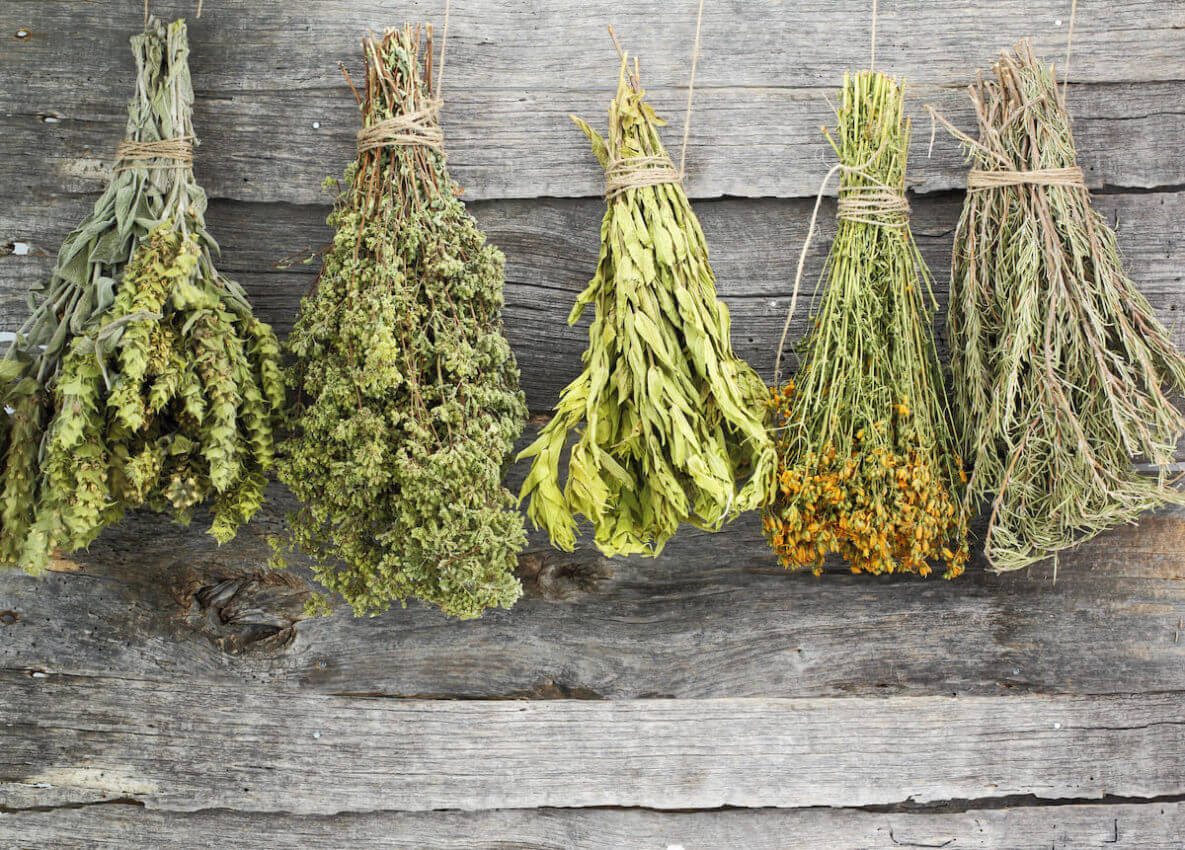
Dried herbs are not simply fresh herbs with the water removed. Drying drives off some of the aroma compounds and changes others, and how much survives depends on the herb. When America’s Test Kitchen cooked fresh and dried herbs side by side in 24 recipes, tasters preferred fresh in all but one; the exception was chili, where dried oregano won.1 The hardy herbs (oregano, rosemary, sage, thyme, marjoram) hold up well enough to use dried in long-cooked dishes. The delicate ones (basil, parsley, chives, mint, cilantro, dill, tarragon) are much weaker dried and belong fresh.12
For conversions, the standard rule is 1 tablespoon of fresh herbs for 1 teaspoon of dried, and ATK’s tasting supports it for the hardy herbs.31
Side by side
| Fresh herbs | Dried herbs | |
|---|---|---|
| Water | Most of the weight: fresh basil, for example, is 92.1 g water per 100 g4 | Little: dried basil is 10.4 g water per 100 g5 |
| Strength, measure for measure | The baseline | About three times stronger by volume for most herbs: 1 teaspoon dried for 1 tablespoon fresh36 |
| What drying does to aroma | Not applicable | Volatile compounds are lost or changed; drying also leads to oxidation and a stale note1 |
| Flavor (editorial) | Bright, green, sharp top notes | Deeper, duller, often tea- or hay-like |
| Herbs that work in this form | All of them | Mainly the hardy herbs: oregano, sage, thyme, rosemary, marjoram2 |
| Best uses | Raw dishes, garnishes, and adding at the end of cooking3 | Dishes that cook more than 20 minutes with a good amount of liquid1 |
| When to add | Delicate herbs in the last minute or two of cooking3 | At the same point you would add fresh (ATK);2 in long simmers, during the last 45 minutes (Delaware)7 |
| Keeps | Varies by herb; cilantro, for example, about a week in the refrigerator once cut8 | Most dried herbs keep well for a year (Penn State)6 |
Which herbs dry well
Two sources sort herbs by how they survive drying and heat, and they agree on every herb they both list.
| Herb | America’s Test Kitchen | LSU AgCenter | In practice |
|---|---|---|---|
| Oregano | Dries well;2 dried oregano beat fresh in chili1 | Less delicate3 | Dried works, in cooked dishes |
| Thyme | Dries well; fared reasonably well dried in long cooking21 | Less delicate3 | Dried works, in cooked dishes |
| Rosemary | Dries well; fared reasonably well dried in long cooking21 | Less delicate3 | Dried works, in cooked dishes |
| Sage | Dries well; fared reasonably well dried in long cooking21 | Not listed | Dried works, in cooked dishes |
| Marjoram | Dries well2 | Not listed | Dried works, in cooked dishes |
| Basil | Better fresh;2 volatile1 | Delicate3 | Use fresh |
| Parsley | Better fresh;2 volatile1 | Delicate3 | Use fresh |
| Chives | Better fresh;2 volatile1 | Delicate3 | Use fresh |
| Mint | Better fresh2 | Delicate3 | Use fresh |
| Cilantro | Better fresh2 | Delicate3 | Use fresh |
| Dill leaf | Volatile1 | Delicate (dill seed is listed as less delicate)3 | Use fresh |
| Tarragon | Volatile1 | Not listed | Use fresh |
ATK’s explanation is chemical: the flavor compounds in the hardy herbs stay stable at high temperatures, so they survive both drying and cooking,2 while the delicate herbs’ compounds are more volatile.1 It also notes that drying leads to oxidation, which is part of why dried herbs drew complaints of tasting “dusty” and “stale.”1 ATK adds that moisture hydrates a dried herb’s cells and makes them porous, part of its case for using dried herbs in dishes with liquid.1
A widely repeated claim says dried thyme is much weaker than fresh and needs to be used in larger amounts. ATK’s testing puts thyme among the herbs that hold up dried, used at a third of the fresh amount.21
Is dried stronger than fresh? It depends on the herb
The general rules and the herb-specific testing point in different directions, and both are worth knowing.
| Source | What it says |
|---|---|
| University of Delaware Extension | Dried herbs are stronger than fresh herbs7 |
| Penn State Extension | Dried herbs are 3 to 4 times stronger than fresh, so use a quarter to a third as much6 |
| America’s Test Kitchen, tasting test | 1 part dried to 3 parts fresh came closest to equal strength (tested with newly purchased jars)1 |
| America’s Test Kitchen, herb guide | Basil, parsley, chives, mint and cilantro are much weaker in flavor when dried2 |
These don’t contradict each other as much as they first seem. The extension rules are general, and ATK pairs its 1:3 finding with the advice that dried herbs work best in long-cooked dishes with liquid.1 For the delicate herbs, ATK says the dried form is much weaker than the rule implies,2 so the rule is a floor, not a match. ATK’s note that it used only newly purchased jars matters too:1 an old jar will be weaker still.
How drying is done changes the result
Lab studies show that the drying method can matter as much as the herb.
- Basil. In a 2004 study, aroma compounds fell considerably when basil was oven-dried at 45°C or freeze-dried, but air drying at room temperature caused only small losses. The panel described fresh basil as fresh, herbaceous and floral, and the dried samples as mentholated, spicy, hay-like and earthy.9 A 1999 study found vacuum-microwave-dried basil gave off about 2.5 times the linalool of air-dried basil, and more volatiles than fresh leaves.10
- Cilantro. In a 2021 study, hot-air drying at 70°C (alone, or followed by vacuum-microwave finishing) best preserved cilantro aroma quality; vacuum-microwave drying alone scored lowest.11 Hot-air-dried samples were described with terms such as “dry grass”, “hay-like” and “parsley-like”.11
Those studies dried their own herbs. Retail jars rarely say how the contents were dried, so two jars of the same herb can differ. For each herb, see dried vs. fresh basil and dried vs. fresh cilantro.
Converting between fresh, dried and ground
| Source | Fresh herbs | Dried, crumbled | Ground or powdered |
|---|---|---|---|
| NDSU Extension | 1 tablespoon | 1 teaspoon | 1/2 teaspoon12 |
| Penn State Extension | 1 tablespoon | 1 teaspoon | 1/4 teaspoon6 |
| University of Delaware Extension | 2 to 3 teaspoons | 3/4 to 1 teaspoon | not given7 |
| LSU AgCenter | 1 tablespoon | 1 teaspoon | not given3 |
| America’s Test Kitchen, tasting test | 3 parts | 1 part | not given1 |
Fresh to dried (Computed). The sources agree: about 1 tablespoon fresh to 1 teaspoon dried, a factor of three, since a tablespoon holds three teaspoons. Penn State gives the range as a quarter to a third,6 and Delaware’s 3/4 to 1 teaspoon dried for 2 to 3 teaspoons fresh spans the same ground.7 ATK’s tasting found 1 part dried to 3 parts fresh came closest to equal strength.1 For example, 1 tablespoon of fresh oregano becomes 1 teaspoon dried. For the delicate herbs, expect to need more dried than this, and taste as you go.2
Dried to ground (Disputed). NDSU puts 1 tablespoon of fresh herbs at 1/2 teaspoon ground, while Penn State says 1/4 teaspoon powdered, a twofold difference.126 Neither says how its figure was reached. Start with the smaller amount and add more after tasting.
Fresh for dried is the easy direction: use about three times as much, chopped, and add delicate herbs late.3
Cooking with each
- Delicate fresh herbs go in at the end. LSU AgCenter groups basil, chives, cilantro, dill leaves, parsley and mint as delicate herbs best added in the last minute or two, because prolonged heat costs flavor and aroma.3
- Hardy herbs handle heat better; LSU lists oregano, rosemary, thyme and dill seed as less delicate.3 Delaware’s rule for long-simmered dishes is to add herbs in the last 45 minutes.7
- Dried herbs need time and liquid. ATK found they work best with more than 20 minutes of cooking and a good amount of liquid,1 and advises adding them at the same point as fresh.2 Delaware suggests crushing dried herbs first to release some of their oils.7
- As a garnish, use fresh. ATK warns that dried herbs sprinkled on at the end can add an unpleasant texture and taste dusty.2
Nutrition: what changes, using basil as the example
USDA’s figures for basil show what drying does to nutrients, though at the amounts herbs are eaten the differences are small. The table compares one tablespoon of each, and an equal-flavor swap of 1 tablespoon fresh against 1 teaspoon dried.
| Fresh, 1 tbsp chopped | Dried, 1 tbsp leaves | Dried, 1 tsp leaves | |
|---|---|---|---|
| Weight | about 2.65 g | 2.1 g | 0.7 g |
| Vitamin C | about 0.48 mg | about 0.02 mg | under 0.01 mg |
| Vitamin K | about 11 µg | about 36 µg | about 12 µg |
| 18:3 polyunsaturated fat (USDA’s “PUFA 18:3”) | about 8.4 mg | about 6.2 mg | about 2.1 mg |
These figures are our arithmetic from USDA’s per-100 g values: fresh basil 18.0 mg vitamin C, 415 µg vitamin K and 0.316 g PUFA 18:3; dried basil 0.8 mg, 1,710 µg and 0.296 g. USDA gives 5.3 g for two tablespoons of chopped fresh basil, 2.1 g for a tablespoon of dried leaves and 0.7 g for a teaspoon.54
Two things stand out. Vitamin C almost disappears with drying, even though dried leaves are far more concentrated. Vitamin K comes through drying concentrated, so a teaspoon of dried basil supplies about what a tablespoon of fresh does. A widely repeated claim says a tablespoon of dried basil has less than a third of the vitamin K of fresh; USDA’s figures show the reverse. The basil profile covers vitamin K and blood thinners.
About antioxidant scores. Older articles compare fresh and dried herbs by ORAC, a laboratory measure of antioxidant capacity. In 2012 the USDA withdrew its online ORAC database, saying such values have no relevance to the effects of specific bioactive compounds on human health and were routinely misused to promote products.13 ORAC scores are not a reason to choose dried herbs over fresh, or the reverse.
Drying and storing your own
- When to harvest. Penn State advises picking herbs for drying just before the flowers first open.6
- How. Penn State covers air-drying, oven drying, microwave drying and dehydrators, and says sun-drying herbs is not recommended.6 ATK’s quick method is to microwave washed, dried leaves for 30 to 40 seconds.2
- Storage. Penn State recommends airtight containers in a cool, dry, dark place, and says storing herbs whole is preferred, because whole leaves keep their oil and flavor longer.6 Most dried herbs keep well for one year, by Penn State’s figure.6 ATK suggests up to 3 months for herbs dried in the microwave and stored airtight.2
- Delicate herbs. Freezing is the other way to keep them; see can you freeze basil?, can you freeze parsley? and can you freeze cilantro?.
- Rehydrating. See how to rehydrate herbs.
What isn’t known
- No study we found compares a range of retail dried herbs with fresh on a taste panel; ATK’s test is the closest, and it reports results, not measurements.
- How much weaker each delicate herb is when dried. No source gives herb-by-herb figures, so their conversions are floors.
- The 2x disagreement between NDSU and Penn State on ground herbs is unresolved.
- How long fresh herbs keep varies by herb, and named-source figures are scarce.
- How retail dried herbs are dried; the studies above show the method matters.
The fresh-vs-dried pages
- Herbs: basil, cilantro, dill, oregano, parsley, rosemary, sage, tarragon and thyme
- Seeds and rhizomes: coriander seed, green vs. dried, galangal, ginger and turmeric
Related
- Herb vs. spice: what separates the two
- Do spices go bad?
- How to dry basil, how to dry oregano, how to dry parsley and how to dry mint
- The master list of herbs and spices
Footnotes
-
“Science: Substituting Dried Herbs for Fresh”, America’s Test Kitchen. americastestkitchen.com · Publication ↩ ↩2 ↩3 ↩4 ↩5 ↩6 ↩7 ↩8 ↩9 ↩10 ↩11 ↩12 ↩13 ↩14 ↩15 ↩16 ↩17 ↩18 ↩19 ↩20 ↩21 ↩22 ↩23 ↩24
-
Danielle Lapierre, “When You Should Actually Use Dried Herbs (and Which Ones to Avoid)”, America’s Test Kitchen, 2022. americastestkitchen.com · Publication ↩ ↩2 ↩3 ↩4 ↩5 ↩6 ↩7 ↩8 ↩9 ↩10 ↩11 ↩12 ↩13 ↩14 ↩15 ↩16 ↩17 ↩18 ↩19 ↩20 ↩21 ↩22
-
“Flavorful Herbs”, LSU AgCenter. lsuagcenter.com · Reference work ↩ ↩2 ↩3 ↩4 ↩5 ↩6 ↩7 ↩8 ↩9 ↩10 ↩11 ↩12 ↩13 ↩14 ↩15 ↩16 ↩17
-
Basil, fresh (FDC 172232), USDA FoodData Central. fdc.nal.usda.gov · Regulator ↩ ↩2
-
Spices, basil, dried (FDC 171317), USDA FoodData Central. fdc.nal.usda.gov · Regulator ↩ ↩2
-
Stacy Reed, “Preserving Herbs by Drying”, Penn State Extension, 2024. extension.psu.edu · Reference work ↩ ↩2 ↩3 ↩4 ↩5 ↩6 ↩7 ↩8 ↩9 ↩10
-
“Using Herbs and Spices”, University of Delaware Cooperative Extension, 2025. udel.edu · Reference work ↩ ↩2 ↩3 ↩4 ↩5 ↩6
-
Susan Mahr, “Cilantro”, Wisconsin Master Gardener Program, University of Wisconsin-Madison, 2017. mastergardener.extension.wisc.edu · Reference work ↩
-
Díaz-Maroto et al., “Changes produced in the aroma compounds and structural integrity of basil during drying”, Journal of the Science of Food and Agriculture, 2004 (abstract, via FAO AGRIS). agris.fao.org · Peer-reviewed ↩
-
Yousif et al., “Flavor volatiles and physical properties of vacuum-microwave- and air-dried sweet basil”, Journal of Agricultural and Food Chemistry, 1999 (abstract, via FAO AGRIS). agris.fao.org · Peer-reviewed ↩
-
Łyczko et al., “Coriandrum sativum L.: Effect of Multiple Drying Techniques on Volatile and Sensory Profile”, Foods, 2021. mdpi.com · Peer-reviewed ↩ ↩2
-
Julie Garden-Robinson, Ingredient Substitutions (FN198), NDSU Extension, 2018. ksre.ksu.edu · Reference work ↩ ↩2
-
Stephen Daniells, “ORAC has ‘ongoing value’, says expert, as USDA removes online database”, NutraIngredients, 2012. nutraingredients.com · Publication ↩