Herbs · Profile
Sweet Woodruff: The Hay-Scented Herb of German May Wine, and Its Coumarin
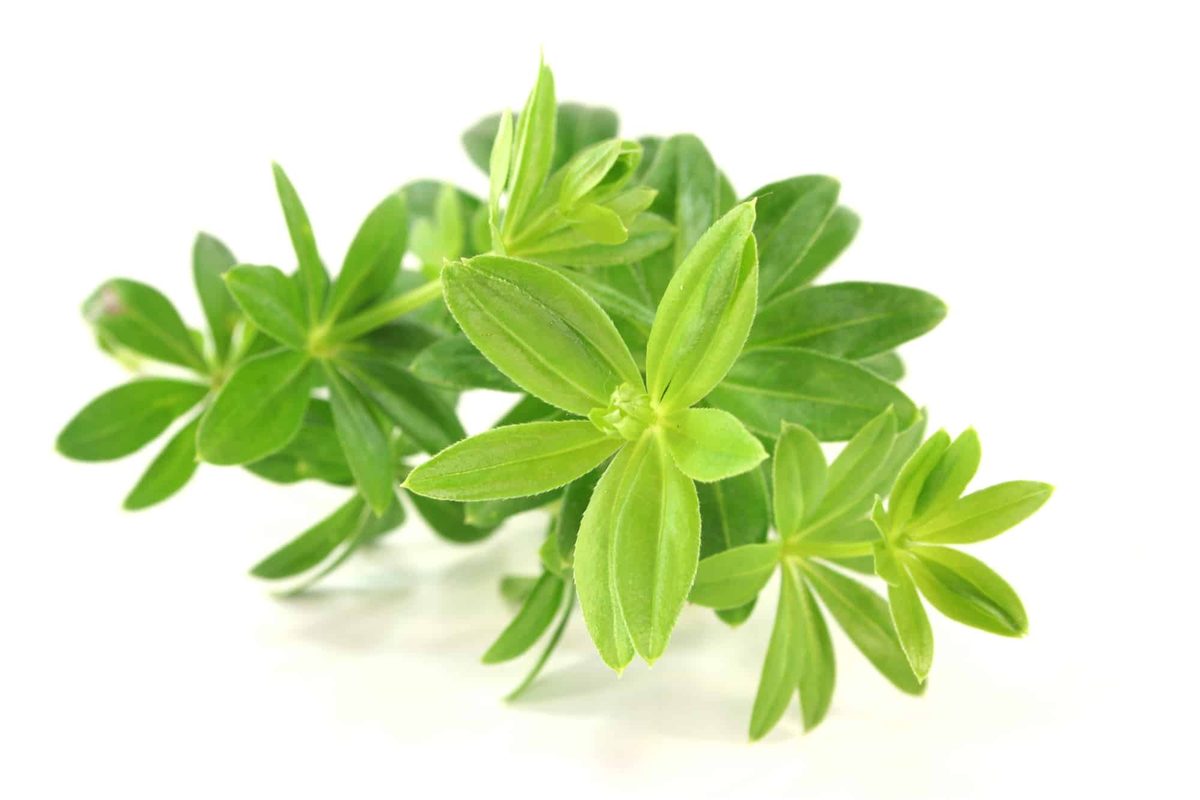
Sweet woodruff is Galium odoratum, a small temperate perennial best known as the flavoring of German May wine. It smells of hay, and it contains coumarin, a compound that is released as the cut plant dries and that regulators limit in food. This page covers what the plant is, where it grows, what is behind the scent, how it is used, and what the coumarin rules mean for a cook.
At a glance
| Botanical name | Galium odoratum (L.) Scop.; older name Asperula odorata L.12 |
| Plant family | Rubiaceae (madder family)3 |
| Part used | Aerial parts (leaves, stems, flowers)42 |
| Native range | Temperate Eurasia and Algeria1 |
| Other names | Waldmeister, master of the wood, sweet-scented bedstraw34 |
| Key compound | Coumarin, mostly bound as a glucoside in the fresh plant34 |
| Production figures | None found |
| Forms sold | Live plants; dried herb |
| US status | Permitted as a natural flavoring in alcoholic beverages only5 |
Measured values
4 figures, sourced| Measure | Value | Scope | Source |
|---|---|---|---|
| Coumarin | 203 mg/kg (0.02%) mg/kg | Aerial parts, from a 2008 table by Rychlik as adapted by ANSESSources differ widely; one study cited by the Drugs.com monograph detected no coumarins. | anses.fr |
| Coumarin | 0.6 % | Content stated for the plant, Drugs.com (Wolters Kluwer) monographSources differ. | drugs.com |
| Coumarin | 1.06 % of dry weight, average | Average in dry weight of the plant, Drugs.com (Wolters Kluwer) monographSources differ. | drugs.com |
| Asperuloside | 0.05 % | Minor component listed by the Drugs.com (Wolters Kluwer) monograph | drugs.com |
Each figure is quoted as its source states it, with the samples or standard it applies to. Where sources differ, both are shown; nothing is averaged. All measured values
What sweet woodruff is
Kew describes Galium odoratum as a perennial of the temperate biome.1 The Wolters Kluwer monograph on Drugs.com describes a small perennial up to 30 cm tall.3 The French Pharmacopoeia’s monograph uses the fresh, blooming aerial part of the plant and lists Asperula odorata as its older name.2
Where it comes from
Kew gives the native range as temperate Eurasia and Algeria, from Spain, France and Great Britain across Europe and Russia to Iran, China, Korea and Japan.1 It lists the plant as introduced in Colorado, Illinois, Minnesota, New York and Vermont.1 The Drugs.com monograph says it is native to Eurasia and North Africa and grows throughout North America, a broader claim than Kew’s list supports.3
Flavor and aroma
The French Pharmacopoeia describes the odor as that of harvested hay.2 To us the dried herb smells of hay and vanilla with an almond-like sweetness, and the fresh leaves smell of very little; that is a cook’s description. Steeped too long, it turns bitter, so cooks keep infusions short; that is kitchen practice.
Coumarin
Coumarin is the compound regulators track in sweet woodruff. One food-chemistry paper describes coumarin as well known for its pleasant vanilla-like odor.6 ANSES, the French food safety agency, says that in the aerial parts of sweet woodruff the precursor of coumarin is mostly found as a glucoside.4 The Drugs.com monograph says the coumarin is freed by enzyme action during drying.3 Many May wine recipes call for wilted or dried woodruff; that is common practice.
How much coumarin the plant contains is not settled. The figures below come from different samples and methods and should not be averaged:
| Scope | Coumarin | Source |
|---|---|---|
| Aerial parts, from a 2008 table by Rychlik as adapted by ANSES | 203 mg/kg (0.02%) | ANSES4 |
| Content stated for the plant | 0.6% | Drugs.com monograph3 |
| Average in dry weight of the plant | 1.06% | Drugs.com monograph3 |
| One study cited by the monograph | No coumarins detected | Drugs.com monograph3 |
The monograph also lists asperuloside at 0.05% among minor components.3
How sweet woodruff is used
- May wine. Steeping woodruff in wine is, in the words of one 2024 lab study, a popular spring tradition in Germany.7 The Drugs.com monograph describes May wine as woodruff soaked in sweet white wine, and adds that woodruff flavors vermouth and some bitters.3
- Perfumery. The monograph notes that the extract is used in perfumes and other fragrances.3
Claims that woodruff flavors sorbets, ice cream and fruit salads, Cheshire cheese, German sherbet powder or Scandinavian cordials could not be traced.
How much coumarin ends up in May wine
The 2024 study by Bollig and Schad hung bundles of dried woodruff in white wine, using a ratio the authors describe as common in recipes, and measured coumarin over time.7 The concentration rose continuously throughout the 20-hour experiment, and only after 20 hours of steeping did a glass of the finished drink reach 6.9 mg.7 The authors concluded that with steeping kept under 5 hours, and the batch shared rather than drunk by one person, no harmful effects of coumarin are to be expected.7
The Drugs.com monograph cites a suggested safety limit of under 5 ppm coumarin in spiced wine, which it equates to about 3 to 3.5 g of fresh woodruff per liter.3 That is the monograph’s figure, not a regulation.
Buying and storage
We found no grading standard and no published shelf-life figure for the dried herb.
Safety and regulation
Coumarin limits
- EU. EFSA keeps a tolerable daily intake of 0.1 mg coumarin per kg of body weight.8 EU flavoring rules set maximum coumarin levels in certain foods that contain flavorings or flavoring ingredients, including 5 mg/kg in desserts and 20 mg/kg in breakfast cereals.9 The 2024 May wine study notes that there is no defined limit for beverages.7
- US. Coumarin added to food is treated as adulteration under 21 CFR 189.130.10 Sweet woodruff itself appears on FDA’s list of natural flavoring substances with the restriction “in alcoholic beverages only”.5 The Drugs.com monograph’s statement that the plant is generally recognized as safe as a food flavoring does not match that listing.35
Health effects
The main concern with coumarin is the liver. The Drugs.com monograph says hepatotoxicity may occur with long-term exposure, and reports clotting anomalies and liver damage in animal studies; it advises avoiding woodruff during pregnancy and breastfeeding.3 It also says excessive doses may cause internal bleeding.3 ANSES disagrees on that point for coumarin itself: it states that simple coumarins do not have anticoagulant properties, which belong to dimeric derivatives such as dicoumarol.4 No source we opened supports the widely repeated claim that sweet woodruff is a blood thinner or is grown as a source of a coumarin drug.
The monograph reports anti-inflammatory activity from woodruff extract in rats, but says research reveals no clinical data on woodruff for any condition.3 Claims that it improves circulation, calms anxiety, treats insomnia or arthritis, or relieves constipation through anthraquinones could not be traced. This page makes no claim that sweet woodruff treats or prevents any condition.
Substitutes and comparisons
For the vanilla-and-hay note, a little vanilla is the closest stand-in in desserts and drinks; that is kitchen judgment, and no source gives a tested ratio. Related pages:
- Vanilla and too much vanilla
- Mahlab, another coumarin-scented flavoring
- Cassia cinnamon, another source of coumarin
- German spices
- Lemon verbena and lavender, other herbs for flavoring drinks and desserts
Footnotes
-
Galium odoratum (L.) Scop., Plants of the World Online, Royal Botanic Gardens, Kew. powo.science.kew.org · Reference work ↩ ↩2 ↩3 ↩4 ↩5
-
“Sweet Woodruff for Homoeopathic Preparations”, French Pharmacopoeia, ANSM, 2009. ansm.sante.fr · Regulator ↩ ↩2 ↩3 ↩4
-
“Woodruff, Sweet”, Natural Products monograph, Drugs.com (Wolters Kluwer Health), 2026. drugs.com · Reference work ↩ ↩2 ↩3 ↩4 ↩5 ↩6 ↩7 ↩8 ↩9 ↩10 ↩11 ↩12 ↩13 ↩14 ↩15 ↩16 ↩17
-
ANSES, Opinion on the risk of hepatotoxicity associated with the coumarin content of certain plants, Request No 2018-SA-0180, 2021. anses.fr · Regulator ↩ ↩2 ↩3 ↩4 ↩5 ↩6
-
21 CFR 172.510, US Food and Drug Administration, via eCFR. ecfr.gov · Regulator ↩ ↩2 ↩3
-
Ieri, Pinelli and Romani, “Simultaneous determination of anthocyanins, coumarins and phenolic acids in fruits, kernels and liqueur of Prunus mahaleb L.”, Food Chemistry, 2012. flore.unifi.it · Peer-reviewed ↩
-
Brigitte Bollig and Gesa J. Schad, “Quantitative HPLC Analysis of Coumarin in Alcoholic Woodruff Extracts in May Wine”, LCGC International, 2024. chromatographyonline.com · Publication ↩ ↩2 ↩3 ↩4 ↩5
-
EFSA, “Coumarin in flavourings and other food ingredients with flavouring properties”, EFSA Journal 793, 2008. efsa.europa.eu · Regulator ↩
-
Regulation (EC) No 1334/2008, Annex III Part B, EUR-Lex. eur-lex.europa.eu · Regulator ↩
-
21 CFR 189.130, US Food and Drug Administration, via eCFR. ecfr.gov · Regulator ↩