Cooking · Profile
German Spices: Mustard, Caraway, Juniper, Horseradish, Bay and Currywurst’s Curry Powder
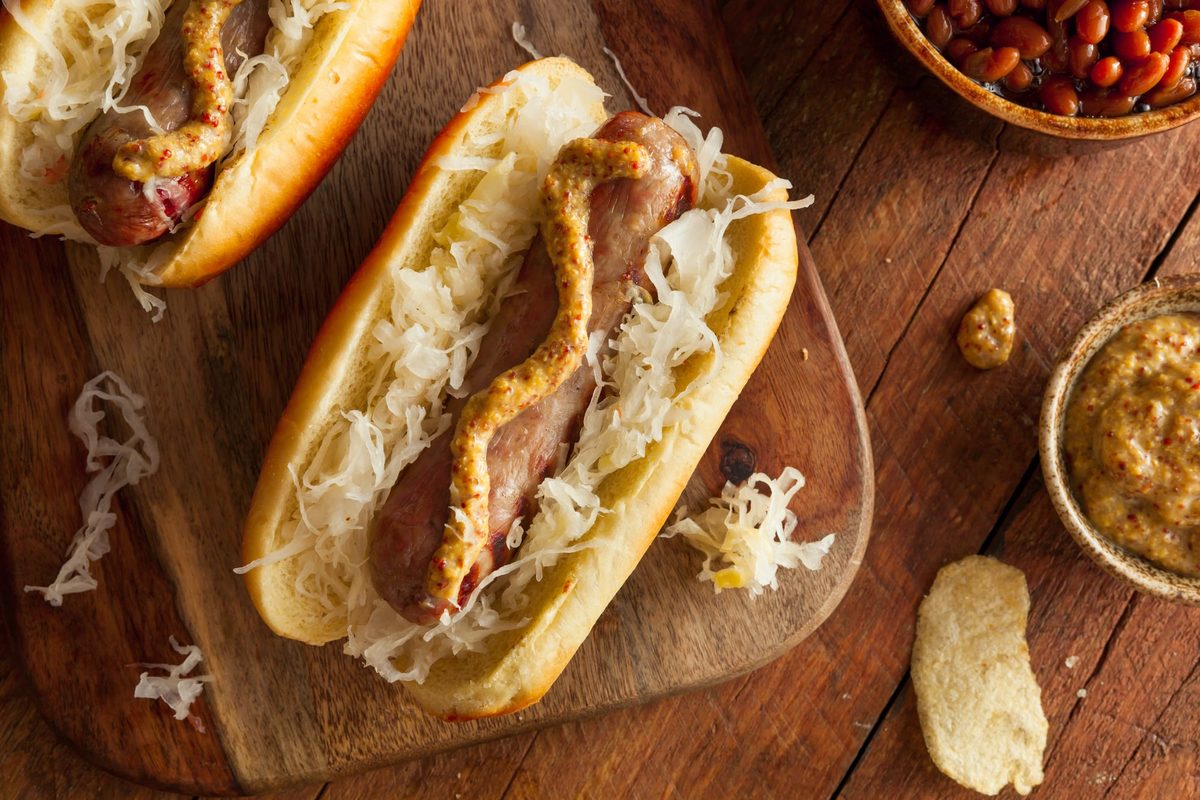
German cooking draws on a small set of strong, pungent seasonings rather than a long spice list: mustard on sausages, caraway in sauerkraut and bread, juniper with game, horseradish with meat, and bay in the long braises. Since the late 1940s it has also had its own curry powder dish, currywurst. This page covers each, with what the sources say and links to our full profiles.
At a glance
| Seasoning | What it is | Where it shows up in German cooking | Full profile |
|---|---|---|---|
| Mustard | Seed paste; Düsseldorf hot, Bavarian sweet1 | Sausages, boiled and broiled meat1 | Yellow mustard seeds |
| Caraway | Seed of Carum carvi, Apiaceae2 | Sauerkraut, bread, cheese, kümmel34 | Caraway seeds |
| Juniper | Berry-like cone; gin’s main flavor5 | Venison and game; sauerkraut63 | Juniper berries |
| Horseradish | Root of the mustard family7 | Meat and ham; Kren in the south8 | Horseradish |
| Bay leaf | Leaf of Laurus nobilis | Sauerbraten; soups, stews, pickles, sausages910 | Bay leaves |
| Curry powder | Blend | Currywurst sauce11 | Curry powder |
Mustard
Mustard is the German condiment. Katzer describes mustard paste as a common condiment for boiled or broiled meat across Central and Northern Europe, and says Germany has two main traditional styles.1 Düsseldorf, which he calls Germany’s mustard capital, makes a pungent mustard similar to Dijon; Bavarian sweet mustard is made from coarsely ground white mustard seeds, honey and various herbs, and is the mustard eaten with the Bavarian veal sausage Weißwurst.1 Germany also produces a large number of mild, smooth mustards from ground white mustard seed.1
Two claims often made about German mustard could not be traced: that it is much less acidic than American yellow mustard, and that Bavarian sweet mustard contains applesauce. Mustard seed also goes into the marinade for sauerbraten in Alton Brown’s version.9 See yellow mustard seeds, brown mustard seeds, mustard powder and mustard seed uses.
Caraway
Caraway is the seed of Carum carvi, a member of the carrot family, Apiaceae, native across temperate Eurasia according to Kew.2 Its flavor comes from an oil whose principal components are d-carvone and d-limonene.12 Katzer calls it the spice that gives southern German and Austrian foods their character, and says sauerkraut is always flavored with caraway, often with juniper as well.3 Britannica lists meat dishes, breads and cheese among its uses, and notes that it flavors aquavit and kümmel.4 Katzer adds that some Central European cheeses contain the seeds.3
Caraway is widely said to be essential to German rye breads such as pumpernickel; the sources reviewed support bread generally but not those specific claims. See caraway seeds, cooking with caraway seeds and caraway vs. cumin.
Juniper
Juniper berries are best known as the principal flavoring of gin.5 In the kitchen, Lisa Bramen of Smithsonian describes a slightly piney flavor with touches of fruitiness and pepper.13 Katzer says juniper is much used in the traditional cooking of Central Europe and is felt to be indispensable for venison,6 and he pairs it with caraway in sauerkraut.3 Saveur’s choucroute garnie (sauerkraut with pork and sausages) bundles juniper berries with cloves, garlic and bay leaf.14 Alton Brown’s sauerbraten marinade uses 12 whole juniper berries.9
The claim that German cooks use juniper for wild goose could not be traced. See juniper berries, juniper berry substitutes and allspice vs. juniper berries.
Horseradish
Horseradish is a hardy perennial of the mustard family, Brassicaceae,7 and its heat comes from isothiocyanates, compounds related to those in mustard and radish.15 Katzer calls it a very popular spice in Central and Northern Europe and notes that Germany has two words for it: Meerrettich, and Kren, the name used by southern Germans and Austrians.8 In Austria, cured ham with horseradish is a traditional Easter meal, and freshly grated horseradish is often mixed with grated apple to make Apfelkren.8
Horseradish served with Tafelspitz (boiled beef) and used in place of mustard in parts of Germany are widely repeated pairings, but neither was found in the sources reviewed. See horseradish, cooking with horseradish and horseradish powder.
Bay leaves
Bay leaves suit German braises because, as Katzer notes, they can be cooked for a long time without much loss of aroma; he lists soups, stews, sauces, pickles and sausages among their uses.10 Atlas Obscura describes the flavor as herbal, bitter and slightly piney.16 For sauerbraten, Alton Brown’s marinade uses two bay leaves with whole cloves, juniper berries and mustard seeds, and thickens the sauce with crushed gingersnaps.9
Bay in Rotkohl (braised red cabbage) is often mentioned, but no source for it was opened for this page. See bay leaves, cooking with bay leaves and bay leaf substitutes.
Paprika
The sources reviewed say little about paprika in German cooking specifically. Katzer notes that goulash has been much copied, and often altered, in the cooking of other European countries, and that in Austria it is often seasoned with caraway.17 Hungary’s Hungarikum Committee notes that Hungarian paprika was hot until the 1940s.18
Three claims about paprika in Germany could not be traced: that it became popular there only after World War II, that German cooks usually use sweet Hungarian paprika, and the dish Paprikaschnitzel. See paprika and smoked paprika.
Curry powder and currywurst
Currywurst, sausage served with a curry-spiced tomato sauce, is the best-known German use of curry powder. According to Germany’s Patent and Trade Mark Office (DPMA), Herta Heuwer created her sauce on 4 September 1949 at her sausage stand on the corner of Kantstraße and Kaiser-Friedrich-Straße in Berlin-Charlottenburg, experimenting with tomato paste, curry powder and Worcestershire sauce.11 She registered the name “Chillup” as a trademark, granted on 21 January 1959 on an application of 21 February 1958, but she never patented the recipe.11
The origin story has rivals. The DPMA notes that the writer Uwe Timm claimed currywurst for Hamburg, saying he ate it there as a child in 1947, and that the Ruhr area and Duisburg make claims too.11 The often-told detail that British soldiers gave Heuwer the curry powder and ketchup is not in the DPMA’s account. See curry powder and Worcestershire powder.
Related pages
- Yellow mustard seeds and mustard powder
- Caraway seeds and caraway seed substitutes
- Juniper berries and horseradish
- Bay leaves, cloves and paprika
- The master list of herbs and spices
Footnotes
-
White Mustard (Sinapis alba), Gernot Katzer’s Spice Pages, Gernot Katzer. gernot-katzers-spice-pages.com · Reference work ↩ ↩2 ↩3 ↩4 ↩5
-
Carum carvi L., Plants of the World Online, Royal Botanic Gardens, Kew. powo.science.kew.org · Reference work ↩ ↩2
-
Caraway (Carum carvi L.), Gernot Katzer’s Spice Pages, Gernot Katzer. gernot-katzers-spice-pages.com · Reference work ↩ ↩2 ↩3 ↩4 ↩5
-
Caraway, Encyclopaedia Britannica. britannica.com · Reference work ↩ ↩2
-
Gin, Encyclopaedia Britannica. britannica.com · Reference work ↩ ↩2
-
Juniper (Juniperus communis L.), Gernot Katzer’s Spice Pages, Gernot Katzer. gernot-katzers-spice-pages.com · Reference work ↩ ↩2
-
Horseradish (revised by Melissa Petruzzello, updated 18 Sep 2026), Encyclopaedia Britannica. britannica.com · Reference work ↩ ↩2
-
Horseradish (Armoracia rusticana Gaertn., Mey. et Scherb.), Gernot Katzer’s Spice Pages. gernot-katzers-spice-pages.com · Reference work ↩ ↩2 ↩3
-
Sauerbraten (recipe), by Alton Brown, altonbrown.com. altonbrown.com · Publication ↩ ↩2 ↩3 ↩4
-
Bay Leaf (Laurus nobilis L.), Gernot Katzer’s Spice Pages. gernot-katzers-spice-pages.com · Reference work ↩ ↩2
-
The Spirit of Currywurst (page dated 13 Mar 2026), Deutsches Patent- und Markenamt (German Patent and Trade Mark Office). dpma.de · Regulator ↩ ↩2 ↩3 ↩4
-
Carum carvi (PROSEA), H. Toxopeus and J.H. Lubberts, Plant Resources of South-East Asia, via Pl@ntUse. uses.plantnet-project.org · Reference work ↩
-
What the Heck Do I Do With Juniper Berries? (Lisa Bramen, 28 Dec 2011), Smithsonian Magazine. smithsonianmag.com · Publication ↩
-
Sauerkraut With Pork and Sausages (Choucroute Garnie), Saveur. saveur.com · Publication ↩
-
Isothiocyanate (updated 29 Jun 2026), Encyclopaedia Britannica. britannica.com · Reference work ↩
-
What Is a Bay Leaf, Exactly? (Andrew Coletti, 2023), Atlas Obscura. atlasobscura.com · Publication ↩
-
Paprika (Capsicum annuum), Gernot Katzer’s Spice Pages. gernot-katzers-spice-pages.com · Reference work ↩
-
Ground paprika from Szeged, Hungarikum Committee (Collection of Hungarikums). hungarikum.hu · Reference work ↩