Herbs · Profile
Lemon Verbena: The South American Shrub With the Strongest Lemon Scent
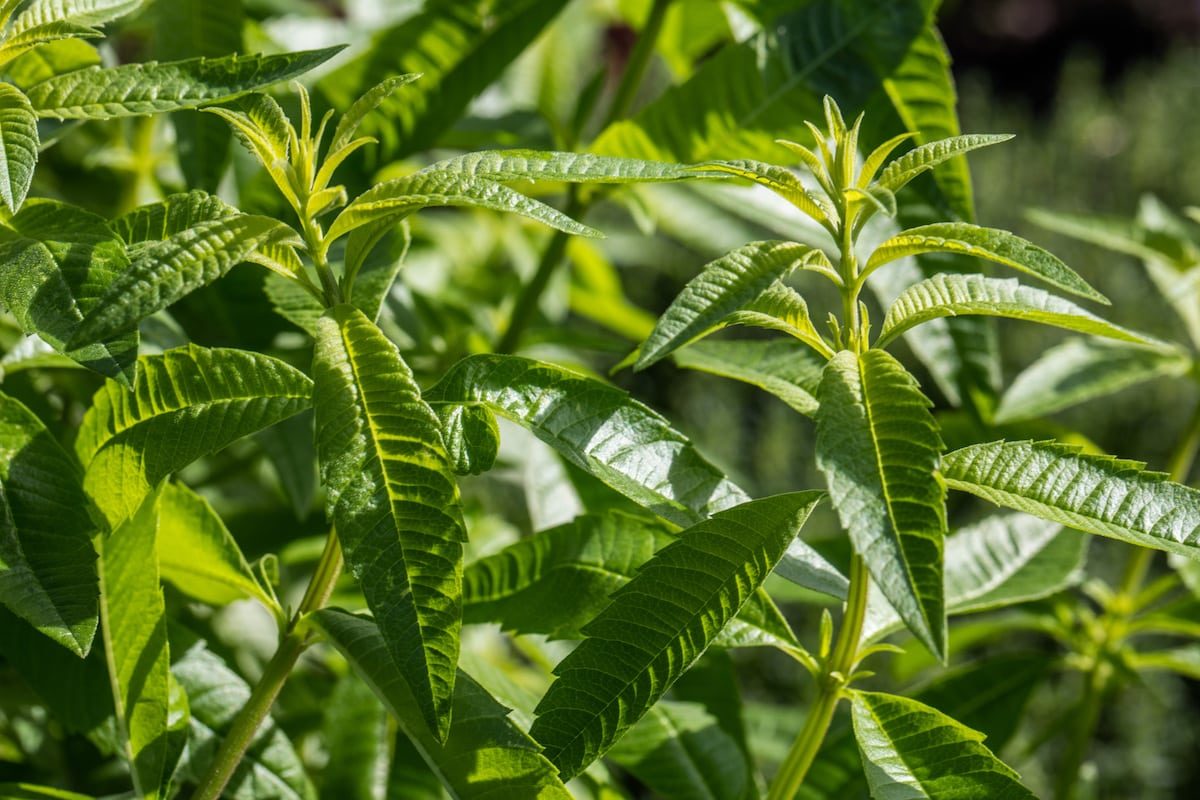
Lemon verbena is Aloysia citrodora, a shrub native to southern Bolivia, Paraguay and northwestern Argentina, grown for its intensely lemon-scented leaves.1 The leaves go into teas and cold drinks and flavor liqueurs, puddings and jams.2 This page covers what the plant is, the compounds behind its scent and how much they vary, how cooks use it, and what regulators say about it.
At a glance
| Botanical name | Aloysia citrodora Paláu (named in 1784)13 |
| Older names | Aloysia triphylla, Lippia citrodora, Verbena citrodora, Verbena triphylla (synonyms per Kew)1 |
| Plant family | Verbenaceae (verbena family)1 |
| Part used | Leaves, fresh or dried; essential oil2 |
| Native range | Southern Bolivia to northwestern Argentina, including Paraguay (Kew)1 |
| Key aroma compounds | Citral (geranial and neral), often with limonene; varies by origin24 |
| Forms sold | Fresh sprigs, dried leaf and tea, essential oil |
| US status | Listed among natural flavoring substances, not on the GRAS spice list (see Safety)5 |
Measured values
17 figures, sourced| Measure | Value | Scope | Source |
|---|---|---|---|
| Essential oil: geranial | 18.7–21.1 % of the oil | Sprea et al. 2023, their own samples, two distillation methods | mdpi.com |
| Essential oil: neral | 15.3–16.2 % of the oil | Sprea et al. 2023, their own samples, two distillation methods | mdpi.com |
| Essential oil: limonene | 5.0–5.4 % of the oil | Sprea et al. 2023, their own samples, two distillation methods | mdpi.com |
| Essential oil: geranial | 26.8–38.3 % of the oil | Portugal (Santos-Gomes et al. 2005), as reviewed in Sprea et al. 2023 review | mdpi.com |
| Essential oil: neral | 20.8–29.6 % of the oil | Portugal (Santos-Gomes et al. 2005), as reviewed in Sprea et al. 2023 review | mdpi.com |
| Essential oil: limonene | 5.7–20.6 % of the oil | Portugal (Santos-Gomes et al. 2005), as reviewed in Sprea et al. 2023 review | mdpi.com |
| Essential oil: geranial | 26.8–38.7 % of the oil | Greece, as reviewed in Sprea et al. 2023 review | mdpi.com |
| Essential oil: neral | 21.8–24.5 % of the oil | Greece, as reviewed in Sprea et al. 2023 review | mdpi.com |
| Essential oil: limonene | 5.8–17.7 % of the oil | Greece, as reviewed in Sprea et al. 2023 review | mdpi.com |
| Essential oil: geranial | 11.93 % of the oil | Ozek et al. (country not stated in the review), as reviewed in Sprea et al. 2023 review | mdpi.com |
| Essential oil: neral | 5.99 % of the oil | Ozek et al. (country not stated in the review), as reviewed in Sprea et al. 2023 review | mdpi.com |
| Essential oil: limonene | 18.59 % of the oil | Ozek et al. (country not stated in the review), as reviewed in Sprea et al. 2023 review | mdpi.com |
| Essential oil: neral | 6.27–10.02 % of the oil | Morocco (Oukerrou et al. 2017), as reviewed in Sprea et al. 2023 reviewGeranial not detected in these oils | mdpi.com |
| Essential oil, minimum (whole dried leaf) Limit | 3.0 mL per kg | European Pharmacopoeia, as set out in the EMA assessment report | ema.europa.eu |
| Essential oil, minimum (fragmented dried leaf) Limit | 2.0 mL per kg | European Pharmacopoeia, as set out in the EMA assessment report | ema.europa.eu |
| Verbascoside (acteoside), minimum (dried leaf) Limit | 2.5 % | European Pharmacopoeia, as set out in the EMA assessment report | ema.europa.eu |
| Pyrrolizidine alkaloids, maximum (herbal infusions) Limit | 400 µg/kg | EU Regulation 2023/915 | eur-lex.europa.eu |
Each figure is quoted as its source states it, with the samples or standard it applies to. Where sources differ, both are shown; nothing is averaged. All measured values
What lemon verbena is
Kew describes lemon verbena as a shrub of the subtropics, native to Argentina Northwest, Bolivia and Paraguay.1 It has been introduced to southern Europe (Spain, France, Sardinia, Albania), parts of Mexico, Central and South America, and the Caribbean.1 The EMA assessment gives its height as 1 to 3 meters.4
The accepted name, Aloysia citrodora, was published by Paláu in 1784.3 Kew lists several other names that still turn up on labels and in older books, among them Aloysia triphylla, Lippia citrodora and Verbena triphylla; these are synonyms, not different plants.1 IPNI also records the spelling citriodora as a variant.3
Not lemon balm
The two lemon herbs are often confused but are not closely related. Lemon verbena is in the Verbenaceae, while lemon balm (Melissa officinalis) is in the mint family, Lamiaceae.16 See lemon balm vs. lemon verbena.
Flavor and aroma
Lemon verbena has the loudest lemon scent of the common lemon herbs: sweet, sharp and perfumed, with a light floral edge and no sourness. The leaves are tough, so the flavor is usually drawn out by steeping rather than by eating the leaf. That description is ours; the chemistry is below.
The compounds, and how much they vary
In a 2023 study by Sprea and colleagues, the two forms of citral, geranial and neral, were the major compounds of the oil.2 Citral is the same geranial and neral mixture that dominates lemongrass oil.7 Lemon verbena’s oil is far from uniform, though. The same paper reviews earlier analyses from several countries, and they disagree widely:
| Scope | Geranial | Neral | Limonene | Source |
|---|---|---|---|---|
| Sprea et al. 2023, their own samples, two distillation methods | 18.7–21.1% | 15.3–16.2% | 5.0–5.4% | 2 |
| Portugal (Santos-Gomes et al. 2005, as reviewed by Sprea et al.) | 26.8–38.3% | 20.8–29.6% | 5.7–20.6% | 2 |
| Greece (as reviewed by Sprea et al.) | 26.8–38.7% | 21.8–24.5% | 5.8–17.7% | 2 |
| Özek et al. (country not stated in the review) | 11.93% | 5.99% | 18.59% | 2 |
| Morocco (Oukerrou et al. 2017, as reviewed) | Not detected | 6.27–10.02% | 2 |
The Moroccan oils were led instead by spathulenol, ar-curcumene and caryophyllene oxide, and a sample from Jordan was led by limonene.2 These are distilled oils from particular plants, and they should not be averaged into one “typical” figure. The EMA assessment also names citral as the main constituent of the oil and sets out the European Pharmacopoeia minimum for the dried leaf: 3.0 ml of essential oil per kg for whole leaf, 2.0 ml/kg for fragmented leaf.4
Lemon verbena leaf also contains verbascoside (acteoside), for which the Pharmacopoeia sets a minimum of 2.5% in the dried leaf, along with flavonoids including luteolin derivatives.4
Origin and history
Sprea and colleagues describe lemon verbena as endemic to South America and say the Spanish and Portuguese introduced it to North Africa and southern Europe in the 17th century.2 Its formal name dates from 1784.3 The story that the plant was named in honor of María Luisa of Parma, and the accounts of its route through Paris and Oxford to Victorian Britain and North America, could not be traced to a source we could open, so they are left out.
How lemon verbena is used
According to Sprea and colleagues, fresh or dried leaves are often used in refreshing drinks and as a flavor in liqueurs, puddings and jams, and the plant and its oil are used in the cosmetic and food industries.2 Spanish food law allows the leaves to be sold as infusions, according to the EMA assessment.4
In practice, the easiest uses are infusions: steep the leaves in hot water for tea, in warm cream or milk for custard and ice cream, or in sugar syrup for drinks and sorbets, then strain them out. A few leaves in the cavity of a roasting chicken or in a fish parcel add perfume without much leaf to chew. These are common kitchen practices rather than sourced findings.
Buying and quality
Fresh sprigs should smell strongly of lemon when a leaf is crushed. For dried leaf, the pharmacopoeial oil minimum above is the only formal quality benchmark we found.4 As kitchen judgment, dried lemon verbena that smells faint or dusty has lost much of its value.
Storage
We found no published shelf-life figure for fresh or dried lemon verbena from a regulator or extension service. The practical test is smell: crush a leaf, and if the lemon scent is weak, it has faded.
Health and safety
What the EU regulator says about medicinal use. The EMA’s herbal committee accepts lemon verbena leaf as a traditional herbal medicine for relief of mild symptoms of mental stress and to aid sleep, and for mild gastrointestinal complaints including bloating and flatulence.8 Its monograph says this rests exclusively on long-standing use.8 The assessment found only one published clinical study on the leaf, and concluded that the data do not meet the criteria for well-established medicinal use.4 Sprea and colleagues note folk use for stomach complaints, insomnia and anxiety, which is tradition, not evidence of effect.2
Cautions in the EMA monograph.8
- Use in children is not recommended, for lack of adequate data.
- Use in pregnancy and breastfeeding is not recommended, for lack of data.
- People allergic to plants of the verbena family should avoid it.
- No side effects are known.
Food use. Lemon verbena is not on FDA’s GRAS lists for spices or essential oils that cover lemon balm and peppermint. Instead it appears in 21 CFR 172.510 as “Lemon-verbena, Lippia citriodora”, with a ditto mark in the limitations column that carries down from an earlier entry; the nearest stated limitation above it is “In alcoholic beverages only”.5 In the EU, herbal infusions of lemon verbena are capped at 400 µg/kg of pyrrolizidine alkaloids, plant toxins that can contaminate harvests.9
This page makes no claim that lemon verbena treats or prevents any condition. Claims that it fights inflammation or arthritis, prevents cancer, or matches green tea in antioxidants could not be traced to a source that supports them.
Substitutes and comparisons
Lemon balm is the gentler lemon herb, and lemongrass the grassier one; lemon zest covers the citrus but not the perfume (editorial). See lemon verbena substitutes.
- Lemon verbena vs. lemongrass
- Lemon balm vs. lemon verbena
- Profiles: lemon balm, lemongrass, lemon thyme, lemon myrtle
Footnotes
-
Aloysia citrodora Paláu, Plants of the World Online, Royal Botanic Gardens, Kew. powo.science.kew.org · Reference work ↩ ↩2 ↩3 ↩4 ↩5 ↩6 ↩7 ↩8 ↩9
-
Sprea et al., “Volatile Compounds and Biological Activity of the Essential Oil of Aloysia citrodora Paláu”, Molecules, 2023. mdpi.com · Peer-reviewed ↩ ↩2 ↩3 ↩4 ↩5 ↩6 ↩7 ↩8 ↩9 ↩10 ↩11 ↩12 ↩13
-
Aloysia citrodora Paláu, International Plant Names Index. ipni.org · Reference work ↩ ↩2 ↩3 ↩4
-
Assessment report on Aloysia citrodora Paláu, folium, European Medicines Agency. ema.europa.eu · Regulator ↩ ↩2 ↩3 ↩4 ↩5 ↩6 ↩7
-
21 CFR 172.510, US Food and Drug Administration. ecfr.gov · Regulator ↩ ↩2
-
Melissa officinalis L., Plants of the World Online, Royal Botanic Gardens, Kew. powo.science.kew.org · Reference work ↩
-
L.P.A. Oyen, Cymbopogon citratus, Plant Resources of South-East Asia (PROSEA). uses.plantnet-project.org · Reference work ↩
-
European Union herbal monograph on Aloysia citrodora Paláu, folium, European Medicines Agency. ema.europa.eu · Regulator ↩ ↩2 ↩3
-
Commission Regulation (EU) 2023/915, Annex I, section 2.4. eur-lex.europa.eu · Regulator ↩